
AMERICAN-MADE MERV 13 AIR FILTERSGUARANTEED TO FIT
Traps and blocks 98% of airborne particles. Recommended for superior residential and commercial use and smoke lounges.
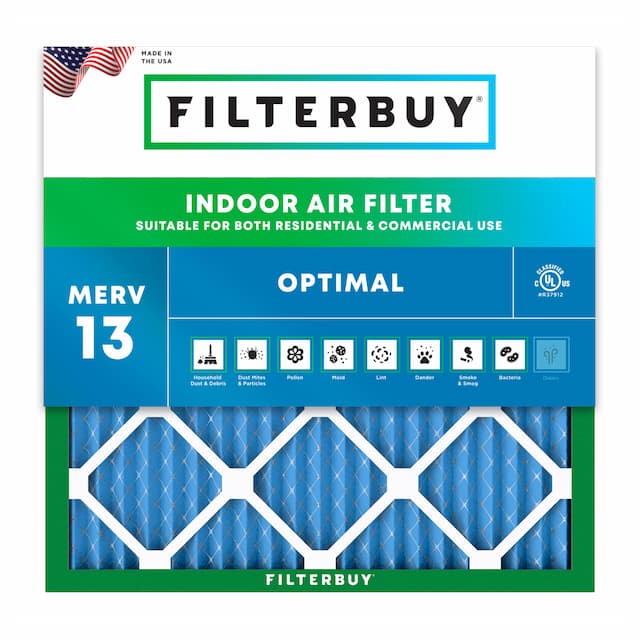
Improve your indoor air quality with MERV 13 air filters! This pleated filter utilizes an electrostatic charge to remove very fine particles from your air, as well as potential allergens like mold, pet dander, bacteria—even particles that carry viruses. In fact, the MERV 13 filter works up to 30 times more effectively and lasts 3 times longer than ordinary fiberglass filters. Also, it doesn't allow mold, fungus, or mildew to grow in your home or business.
Our MERV 13 filters trap 98% of airborne particles as small as 0.3 microns. Ideal for superior residential and commercial use and smoke lounges, this filter is designed to last 90 days.
We recommend replacing your filter regularly to ensure your air stays clean, energy costs are lowered, and your furnace works properly. MERV 13 filters are comparable to MPR 1500/1900 and FPR 10.
To learn more about MERV ratings click here.
Choose Your MERV 13 Filter Size
 6.88x15.88x1
- 8x14x1
- 8x16x1
- 8x20x1
- 8x24x1
- 8x30x1
- 9x30x1
- 9.75x23.75x1
- 10x10x1
- 10x14x1
- 10x15x1
- 10x16x1
- 10x18x1
- 10x20x1
- 10x24x1
- 10x25x1
- 10x28x1
- 10x30x1
- 11.25x11.25x1
- 11.25x19.25x1
- 11.25x23.25x1
- 11.5x21x1
- 11.88x16.88x1
- 12x12x1
- 12x15x1
- 12x16x1
- 12x18x1
- 12x20x1
- 12x22x1
- 12x24x1
- 12x25x1
- 12x26x1
- 12x26.5x1
- 12x27x1
- 12x30x1
- 12x30.5x1
- 12x34x1
- 12x36x1
- 12.5x21x1
- 12.75x21x1
- 13x18x1
- 13x20x1
- 13x21x1
- 13x21.5x1
- 13x24x1
- 13x25x1
- 13.25x13.25x1
- 14x14x1
- 14x18x1
- 14x20x1
- 14x22x1
- 14x24x1
- 14x25x1
- 14x27x1
- 14x28x1
- 14x30x1
- 14x36x1
- 14.5x19x1
- 15x15x1
- 15x20x1
- 15x25x1
- 15x30x1
- 15x30.5x1
- 15x30.75x1
- 15.25x15.25x1
- 15.5x29x1
- 16x16x1
- 16x18x1
- 16x20x1
- 16x21x1
- 16x21.5x1
- 16x22x1
- 16x22.25x1
- 16x24x1
- 16x25x1
- 16x30x1
- 16x32x1
- 16x36x1
- 16.25x21.25x1
- 16.38x21.38x1
- 16.38x21.5x1
- 16.5x21x1
- 16.5x22x1
- 17x17x1
- 17x19x1
- 17x20x1
- 17x21x1
- 17x22x1
- 17x25x1
- 17.25x17.25x1
- 17.25x19.25x1
- 17.25x23.25x1
- 17.25x26x1
- 17.25x29.25x1
- 17.25x35.25x1
- 17.5x22x1
- 17.5x23.5x1
- 17.5x27x1
- 18x18x1
- 18x20x1
- 18x22x1
- 18x24x1
- 18x25x1
- 18x30x1
- 18x36x1
- 18.25x22x1
- 19x19x1
- 19x21x1
- 19x21.5x1
- 19x22x1
- 19x23x1
- 19x27x1
- 19.25x21.25x1
- 19.25x23.25x1
- 19.5x21x1
- 19.5x22x1
- 19.75x21x1
- 19.75x22x1
- 19.88x21.5x1
- 20x20x1
- 20x21x1
- 20x21.5x1
- 20x22x1
- 20x22.25x1
- 20x23x1
- 20x24x1
- 20x25x1
- 20x27x1
- 20x30x1
- 20x32x1
- 20x34x1
- 20x36x1
- 21x21x1
- 21x22x1
- 21x23x1
- 21x23.25x1
- 21.25x21.25x1
- 21.5x23x1
- 21.5x23.25x1
- 21.5x24x1
- 21.5x26x1
- 22x22x1
- 22x24x1
- 22x26x1
- 22x28x1
- 22x36x1
- 22.25x25x1
- 23x25x1
- 23.25x29.25x1
- 23.5x23.5x1
- 23.5x25x1
- 23.5x30.75x1
- 24x24x1
- 24x25x1
- 24x28x1
- 24x30x1
- 24x36x1
- 25x25x1
- 25x28x1
- 25x29x1
- 25x32x1
- 27x27x1
- 28x30x1
- 29x29x1
- 30x30x1
- 30x32x1
- 30x36x1
- 10x12x1
- 10x22x1
- 10x32x1
- 10x33x1
- 10x36x1
- 12x14x1
- 14x16x1
- 15x19x1
- 15x28x1
- 16x27x1
- 16x28x1
- 17x27x1
- 18x21x1
- 18x28x1
- 19x20x1
- 29x30x1
- 6x10x1
- 6x12x1
- 8x8x1
- 11.5x11.5x1
- 12.25x24.25x1
- 12.5x24x1
- 13.25x17.75x1
- 13.25x22.75x1
- 17.5x21x1
- 19.75x21.5x1
- 21x23.5x1
Custom Filter
Don't see your size? Create one yourself using our custom filter tool!
Filterbuy MERV 13 Protects Your Home From








Why Choose a Filterbuy MERV 13 Air Filter?
MERV 13 filters blocks 98% of pollutants from the air.
MERV 13 filters provide maximum filtration.
MERV 13 filters elevate the performance of your HVAC system.
Need help choosing the right MERV rating?
MERV, which stands for Minimum Efficiency Reporting Value, measures how efficiently air filters remove particles from the air. MERV ratings range from 1-20; the higher the number, the greater percentage of pollutants the filter blocks. Selecting the right rating is important, as it will ensure both a) the right amount of bacteria is removed from your air, and b) your HVAC works properly. Read below to make sure you choose the best MERV rating for your home or business!
Merv comparison
Scroll to see more.
 MERV 8 |  MERV 11 |  MERV 13 |  Odor Eliminator | |
|---|---|---|---|---|
| Best for | Standard Residential/Commercial Healthy Families | Superior Residential/Commercial Allergy Sufferers | Optimal Residential/Commercial Hospital Grade | ODOR ELIMINATOR Residential/Commercial Household Odors |
| Comparable ratings | MPR 600 & FPR 5 | MPR 1000-1200 & FPR 7 | MPR 1500 - 1900 & FPR 10 | MPR 1000-1200 & FPR 7 |
| Filtration | Captures 90% of Airborne Particles | Captures 95% of Airborne Particles | Captures 98% of Airborne Particles | Captures 95% of Airborne Particles |
| Dust, lint & debris | ||||
| Mold, pollen | ||||
| Dander, dust mites | ||||
| Smoke & Smog | ||||
| Bacteria | ||||
| Odor, vocs |
TL;DR
A MERV 13 air filter is the highest-efficiency filter most residential HVAC systems can handle. Under ANSI/ASHRAE 52.2, it captures at least 90% of particles 3 to 10 microns, 85% of particles 1 to 3 microns, and 50% of particles 0.3 to 1 micron. The U.S. EPA recommends MERV 13 at minimum, or the highest rating your system allows. Filterbuy has manufactured pleated filters in the USA since 2013 and stocks more than 600 sizes.
Key Takeaways
MERV 13 clears a set minimum in three particle bands: at least 90% at 3 to 10 microns, 85% at 1 to 3, and 50% at 0.3 to 1, per ANSI/ASHRAE 52.2.
The EPA recommends MERV 13 as the residential target, noting that most systems run it without issue as long as the filter is changed on schedule.
MERV 13 does not remove odors, VOCs, gases, or radon. Gases pass straight through any pleated filter and need activated carbon instead.
"Most people don’t want a lecture on filtration. They want to know whether the filter in the hallway closet is the right one, and whether it can stay another month. That is the question this page answers."
— Michelle Wan, Brand Manager and Air Quality Writer, Filterbuy
What is a MERV 13 air filter?
A MERV 13 air filter is a pleated HVAC filter rated under ANSI/ASHRAE Standard 52.2 to capture at least 90% of particles 3 to 10 microns, 85% of particles 1 to 3 microns, and 50% of particles 0.3 to 1 micron. MERV stands for Minimum Efficiency Reporting Value, a 1 to 16 scale set by ASHRAE and published in the EPA MERV rating chart.
One thing the number hides, and something we watch closely on the Filterbuy line: MERV is a floor, not an average. Filters are tested across twelve particle-size ranges at six points in a dust-loading sequence, and the rating reflects the lowest efficiency the filter holds throughout. A filter that scrapes past the threshold and one that sails over it both print the same 13.
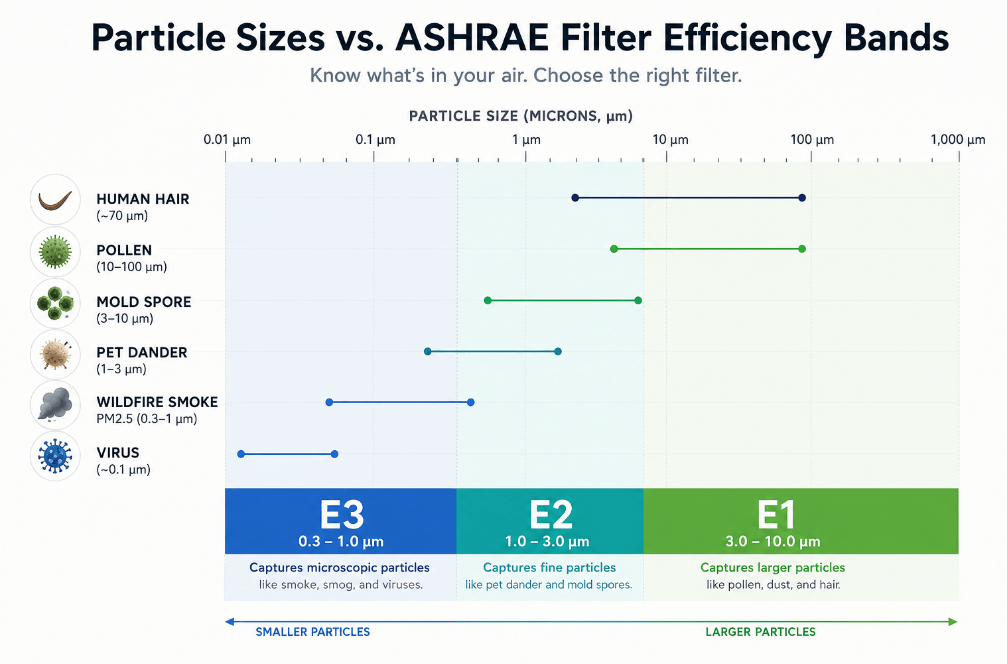
Filterbuy MERV 13 meets these ANSI/ASHRAE 52.2 minimums, confirmed against the U.S. EPA MERV rating chart.
What MERV Rating Should I Use In My Home?
Choose MERV 8 for a standard household, MERV 11 for pets or seasonal allergies, and MERV 13 for asthma, wildfire smoke, or the most filtration a home system can reasonably handle. EPA guidance is simple: use the highest-rated filter your slot allows.
Minimums per ANSI/ASHRAE 52.2. MERV is a national consensus standard; MPR and FPR are proprietary, per the U.S. EPA.
For a breakdown of all sixteen levels, see our MERV rating chart.
MERV Vs MPR Vs FPR: What Do The Other Ratings Mean?
MERV 13 corresponds to roughly MPR 1500 to 1900 and FPR 10. MERV is the ANSI/ASHRAE 52.2 standard that HVAC professionals and building codes use. MPR is 3M's proprietary scale, and FPR is Home Depot's. Only MERV rests on a national consensus standard, per the EPA.
Conversion table: MERV, MPR and FPR ratings compared.
MERV 13 Vs MERV 11: Which Should You Buy?
Buy MERV 13 if someone at home has asthma or serious allergies, or if wildfire smoke is a seasonal problem where you live. Choose MERV 11 for general allergy relief on an older system, or if you know you won't change a 1-inch filter every 90 days. MERV 11 captures at least 65% of particles 1 to 3 microns. MERV 13 captures at least 85%.
David Clark, the licensed HVAC technician who reviews our technical content, puts it plainly: "The best filter is the highest rating your system can move air through, changed on schedule. A MERV 11 you actually replace beats a MERV 13 you leave in for six months."
Not sure yours can handle it? Shop MERV 11 air filters instead.
Will A MERV 13 Filter Restrict Airflow In My System?
This is the question Filterbuy gets asked most, and the answer is usually no. The EPA states that most furnaces and HVAC systems can accommodate a MERV 13 filter without equipment problems, provided the filter is replaced frequently. Depth matters more than rating here: a 4-inch MERV 13 has far more pleated surface area than a 1-inch, so it moves the same volume of air with less resistance.
Choose MERV 13 if:
Someone at home has asthma, COPD, or bad allergies
Wildfire smoke or high PM2.5 is seasonal where you live
Step down to MERV 11 if:
Your ductwork is undersized or runs high static pressure
Your air handler has an older single-speed blower
If you're unsure, ask a technician what your system takes. Our team at Filterbuy HVAC Solutions can help.
Do MERV 13 Filters Work For Furnaces, Air Conditioners, And Heat Pumps?
Yes. One filter covers all three. A central system pulls return air through a single slot whether it's heating or cooling, so a MERV 13 furnace filter and a MERV 13 AC filter are the same product.
Ductless mini-splits are the exception. They use a separate washable filter: see mini split filters.
Why Buy American-Made MERV 13 Filters?
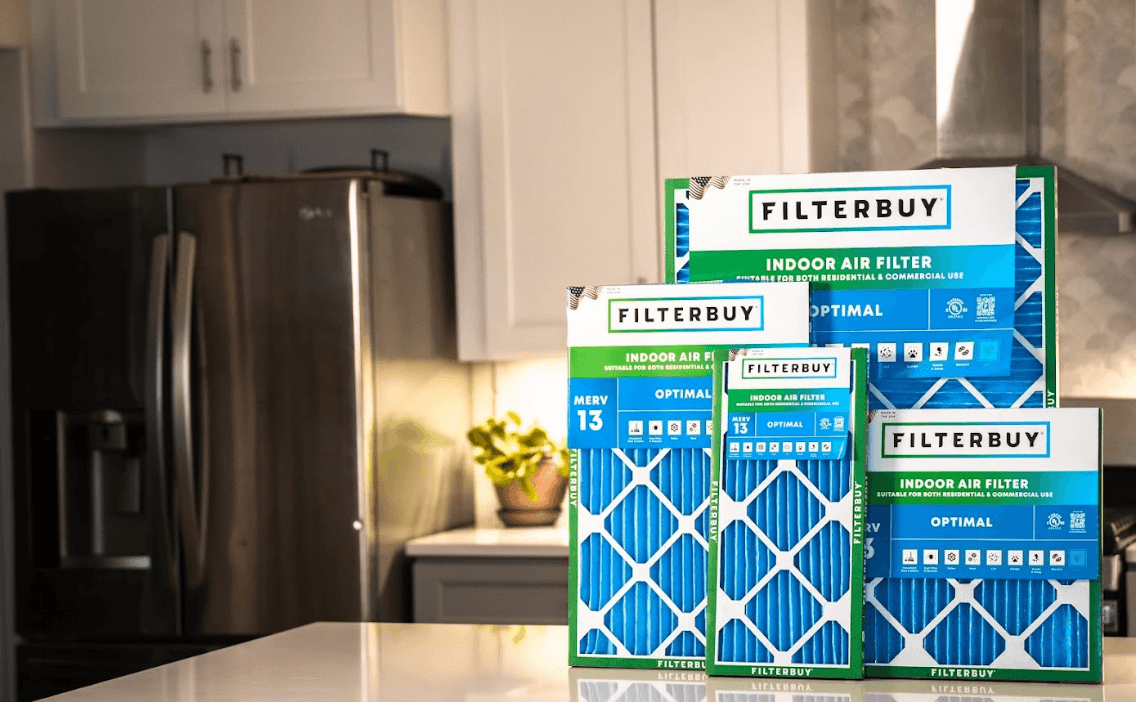
Filterbuy has made pleated air filters in the USA since 2013, from our headquarters in Talladega, Alabama, with plants in Florida, Pennsylvania, and Utah. We run our own production line, which is why we can cut more than 600 sizes, ship factory-direct, and tell you exactly what's inside the frame.
Read the Filterbuy story.
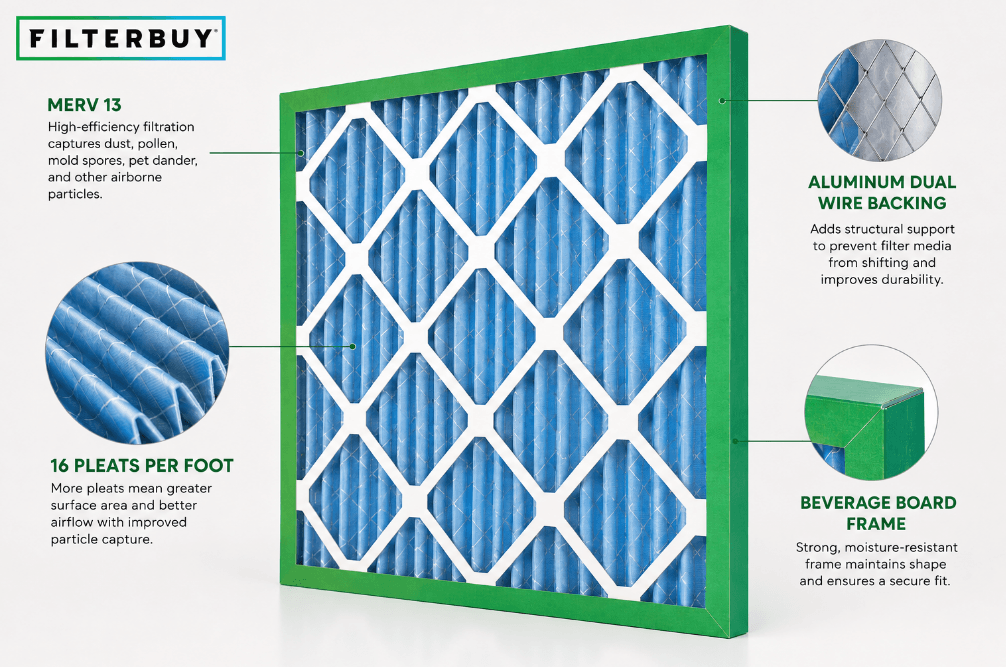
In every Filterbuy MERV 13:
Electrostatically charged synthetic media, 16 pleats per foot
Aluminum dual wire backing that holds pleat spacing under airflow
Beverage board frame that resists heat and humidity
100% made in the USA from recyclable materials
More than 4 million households have bought Filterbuy filters, backed by 85,000+ five-star reviews.
Should I Run My HVAC Fan All The Time?
A filter only cleans air while the system is moving it. The EPA notes that most homes run their systems less than 25% of the time during heating and cooling season, which means the filter sits idle for most of the day. Set the thermostat fan to ON and it keeps filtering between cycles.
This is the one thing Filterbuy recommends that costs nothing and isn't a product. On smoke or high-pollen days, run the fan for a few hours. There are two honest tradeoffs: more electricity, though far less on a variable-speed blower, and a filter that loads faster. If you bought MERV 13 for a reason, that trade is worth it.
Why Does Filter Rating Matter Indoors?
Three findings from the EPA, the CDC and the American Lung Association, not from filter makers.
Find Your MERV 13 Filter Size
Filterbuy stocks MERV 13 in more than 600 sizes and in 1-inch, 2-inch, and 4-inch depths. A 20x25x1 runs $33.99 as a single; multipacks bring it down to $11.08 each, or roughly $44 a year on a 90-day schedule. Shipping and exchanges are free.
The mistake we see most often isn't the MERV rating. It's the size. A filter that's slightly too small lets air slip past the frame, and air that bypasses a MERV 13 is unfiltered air. Check the size printed on your current filter, or measure the slot and round up. You can also build a custom air filter in a few clicks.
The other thing people forget is the schedule. Set up an air filter subscription and save 5%.
Frequently Asked Questions On MERV 13 Filters
How often should I replace a MERV 13 filter?
Every 90 days for a 1-inch filter, every 60 days with pets or allergies, and every 30 days if someone has respiratory concerns or you live in a smoke-prone area. A 4-inch filter lasts longer.
Do MERV 13 filters help with wildfire smoke?
Yes. Wildfire smoke is mostly fine particulate matter, and MERV 13 is the highest-efficiency filter most home systems can run against it. Run the fan continuously and change filters sooner.
Why stop at MERV 13? What about MERV 14 or HEPA?
Filterbuy could make them. We choose not to, because most home systems can't move enough air through them. MERV 14 and above are built for commercial blowers sized to handle that resistance. In a residential air handler, the restriction can drop airflow far enough to freeze the coil. A true HEPA filter removes 99.97% of particles at 0.3 microns, but it needs a dedicated housing, which is why it belongs in a portable air cleaner rather than a return slot.
Glossary
MERV (Minimum Efficiency Reporting Value): A 1–16 scale defined by ANSI/ASHRAE Standard 52.2 rating how well a filter removes particles from 0.3 to 10 microns.
E1, E2, E3: The three bands behind a MERV rating: E1 is 0.3–1.0 micron, E2 is 1.0–3.0, E3 is 3.0–10.
HEPA: High Efficiency Particulate Air filter, removing at least 99.97% of particles at 0.3 microns. It needs a dedicated housing, so it is not a drop-in HVAC filter.
Related: MERV rating chart · MERV 11 air filters