
Carrier Air Filters
- Available in MERV 8, 11, and 13
- Free shipping
- Guaranteed to fit
- Lowest prices
- Made in the U.S.A.
- Family owned and operated
CUSTOMER REVIEW

Absolutely the best and most efficient way to purchase furnace filters! No problem finding the filter I needed, filters delivered within a couple of days, fit perfectly and shipping is FREE! What's not to like?
Christine P.


Merv 8
Standard


Merv 11
Superior


Merv 13
Optimal

MERV 11 - filters pollen, dust mites, mold, auto emissions, and large particles like milled flour
as low as $ 21.99 when you buy 2 or more

Merv 8
Standard
Merv 11
Superior
Merv 13
Optimal
MERV 11 - filters pollen, dust mites, mold, auto emissions, and large particles like milled flour
as low as $ 19.49 when you buy 2 or more

Merv 13
Optimal
MERV 13 - filters pollen, dust mites, mold, all bacteria, droplet nuclei (sneeze), and tobacco smoke
as low as $ 40.99 when you buy 2 or more

Merv 8
Standard
Merv 11
Superior
Merv 13
Optimal
MERV 11 - filters pollen, dust mites, mold, auto emissions, and large particles like milled flour
as low as $ 29.49 when you buy 2 or more
Merv 8
Standard
Merv 11
Superior
Merv 13
Optimal
MERV 11 - filters pollen, dust mites, mold, auto emissions, and large particles like milled flour
as low as $ 21.49 when you buy 2 or more

Merv 8
Standard
Merv 11
Superior
Merv 13
Optimal
MERV 11 - filters pollen, dust mites, mold, auto emissions, and large particles like milled flour
as low as $ 53.49 when you buy 2 or more

Merv 8
Standard
Merv 11
Superior
Merv 13
Optimal
MERV 11 - filters pollen, dust mites, mold, auto emissions, and large particles like milled flour
as low as $ 67.99 when you buy 2 or more

Merv 8
Standard
Merv 11
Superior
Merv 13
Optimal
MERV 11 - filters pollen, dust mites, mold, auto emissions, and large particles like milled flour
as low as $ 29.49 when you buy 2 or more
Merv 8
Standard
Merv 11
Superior
Merv 13
Optimal
MERV 11 - filters pollen, dust mites, mold, auto emissions, and large particles like milled flour
as low as $ 24.49 when you buy 2 or more

Merv 8
Standard
Merv 11
Superior
Merv 13
Optimal
MERV 11 - filters pollen, dust mites, mold, auto emissions, and large particles like milled flour
as low as $ 53.49 when you buy 2 or more
Carrier Air Filters: Replacement Filters for Carrier Furnaces, AC Systems, and Media Cabinets
Carrier air filters are the replacement filters used in Carrier residential HVAC systems. They come in two forms: one-inch filters that drop into a return grille, and four- to five-inch media filters that sit in a cabinet beside the furnace. Nearly every Carrier system takes a standard nominal size, so a correctly sized compatible filter fits the same slot as the factory part. Filterbuy cuts, pleats, and frames every one of them to order in our own US plants.
TL;DR
Your Carrier filter size is printed on the filter you’re pulling out or on your cabinet sticker, not on your furnace. Carrier uses standard nominal sizes, so any correctly sized pleated filter fits, and we make every one of them. One exception we’ll always flag: Carrier Infinity and Performance Air Purifier cabinets take OEM cartridges, which we don’t make.
Key Takeaways
Your furnace model number doesn’t determine your filter size. The filter cabinet does, which is why two homes with identical Carrier furnaces can take different filters.
Carrier, Bryant, Payne, Day & Night, and BDP share filter cabinet designs. A filter that fits one fits the others. Only the part-number prefix changes.
Carrier consolidated its CC and BB part numbers into universal XX numbers. FILCCCAR0020 and FILXXCAR0020 are the same 20x25x5 filter.
Carrier advises checking a 1-inch filter every 30–60 days. Four-inch pleated media can run 6 months to a year.
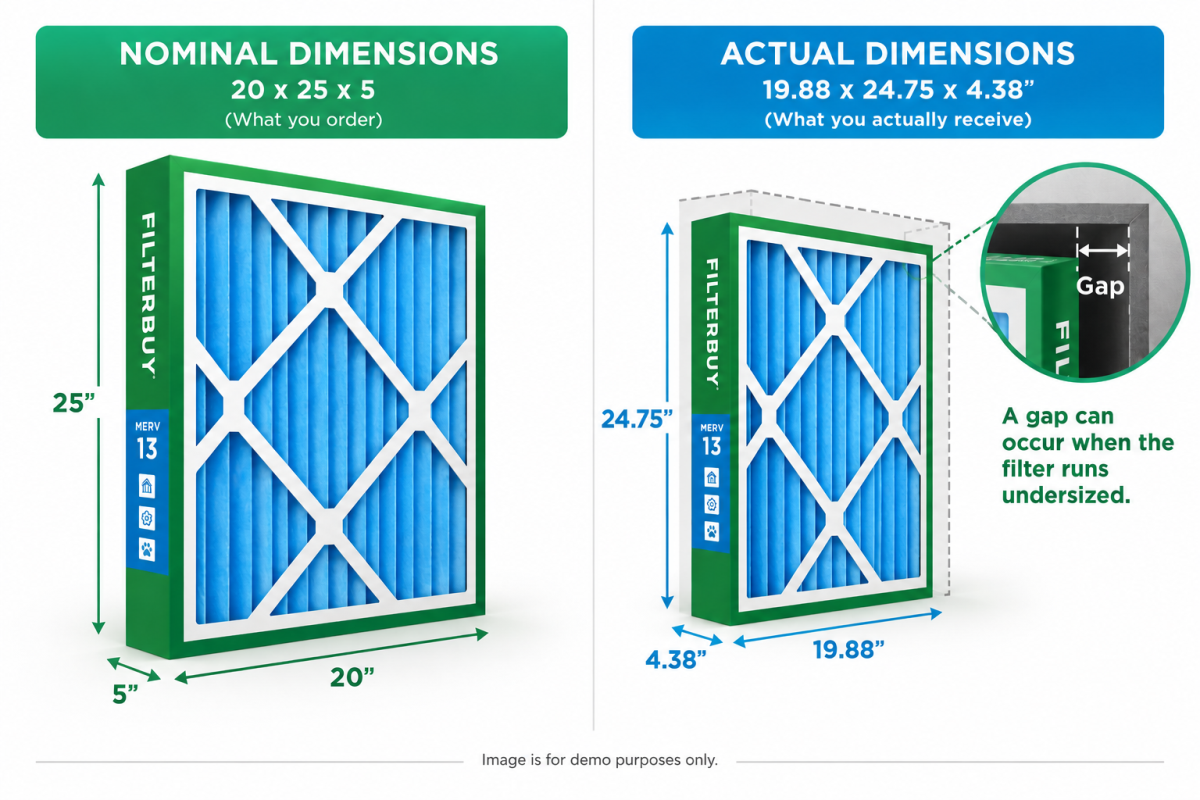
Nominal size is the ordering name; the actual cut is smaller by design. That clearance is what lets the filter seat in the slot, and every size here lists both numbers.
If your size isn’t listed, we cut custom sizes to the eighth of an inch.
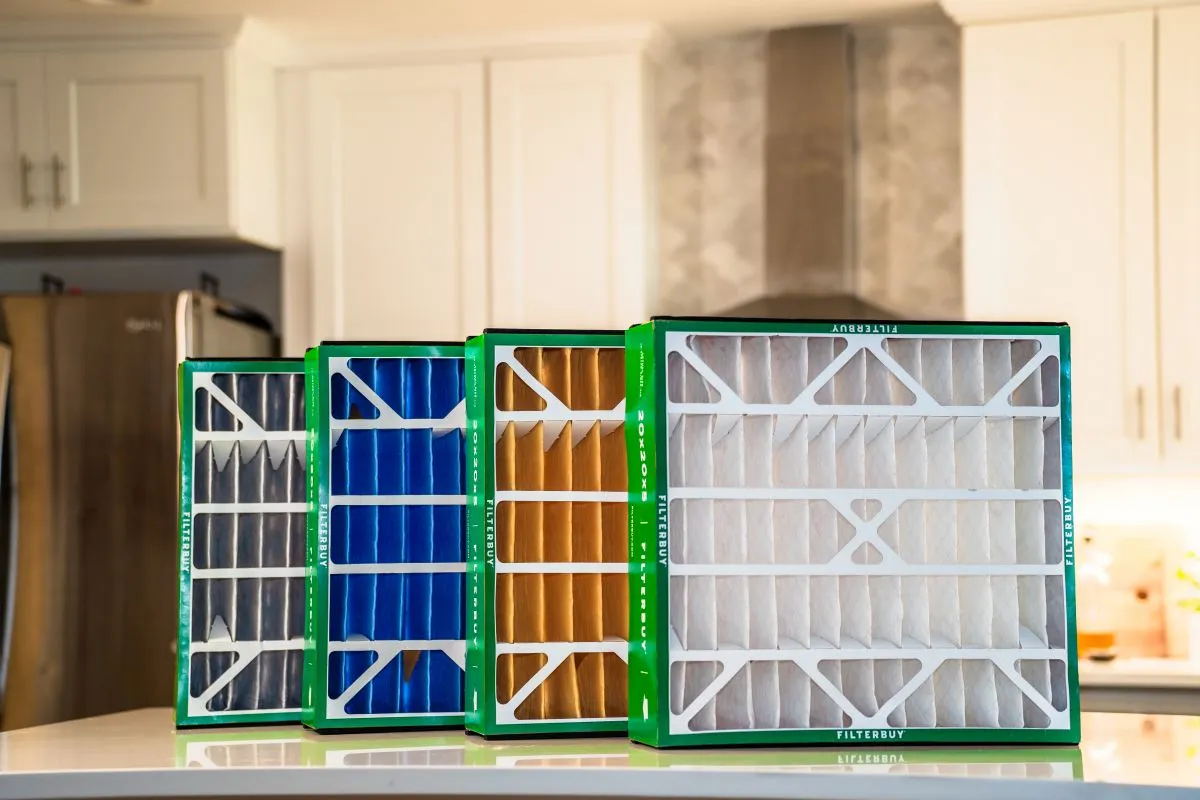
Shop Carrier Replacement Air Filters By Size
Every Filterbuy Carrier-compatible size, in MERV 8, 11, and 13. Because we cut these filters ourselves, each listing carries the actual trimmed dimensions alongside the nominal size, plus the Carrier part number it replaces.
How Do I Find My Carrier Filter Size?
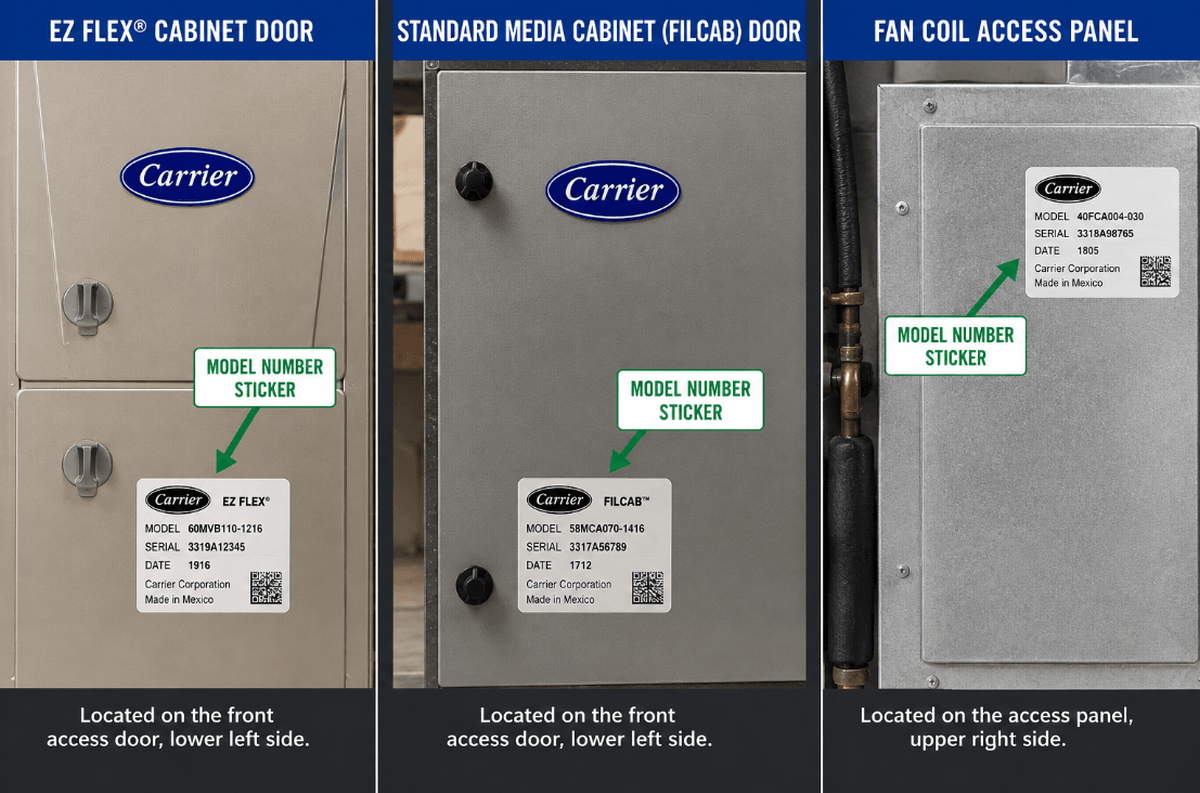
It’s printed on the filter you’re pulling out. Look along the cardboard edge for the nominal size, like 20x25x5, usually with the Carrier part number beside it. If the filter’s already gone, your cabinet door sticker tells you what fits. Either way it takes about ten seconds, and you don’t need any tools.
One thing trips people up: your Carrier furnace model number won’t tell you your filter size. The cabinet and the ductwork set the size, not the furnace, so two neighbors with identical furnaces can need different filters.
If both the filter and the sticker are missing, measure the slot opening and round each dimension up to the nearest whole inch. That gives you the nominal size, which is the number you shop by. Our guide to how to measure your air filter size walks through it with diagrams, and if your size isn’t on this page we cut custom sizes to the eighth of an inch.
Why Is My Carrier Filter An Odd Size?
Because Carrier fan coils use panel sizes built for their own cabinets. Sizes like 13x21.5x1 and 16.5x21.5x1 aren’t the standard sizes a hardware store keeps on the shelf, which is why they’re usually a special order locally. We make all of them, and if yours isn’t listed we’ll cut it to the eighth of an inch.
There’s something else worth knowing about the filter that came with your fan coil. It’s a washable panel in a metal frame, and the EPA notes that flat panel filters in that class are used mainly to protect the equipment from buildup rather than for indoor air quality. A pleated filter in the same size is a different piece of equipment doing a different job. Source: EPA, Guide to Air Cleaners in the Home.
Three Things That Go Wrong At Installation
A filter only works the way it was built to if it goes in correctly. Three things go wrong more often than anything else, and none of them is the filter.
1. The plastic stays on. Take the plastic wrap off before the filter goes in, but leave the cardboard frame alone, because that part is structural.
2. The arrow points the wrong way. Every Filterbuy filter has an airflow arrow printed on the frame edge. It points toward the furnace or air handler, the way the air travels.
3. The filter sits loose in the slot. A filter that rattles isn’t seated. ASHRAE suggests a piece of tape to hold a residential filter forward against the slot so it sits where it should.
Source: ASHRAE, Filtration and Disinfection FAQ.
What’s The Difference Between Nominal And Actual Size?
Nominal size is the ordering name, like 20x25x5. Actual size is the cut, which measures 19.88 x 24.75 x 4.38 inches. The actual cut is smaller on purpose, and that small clearance is what lets the filter slide into the slot and seat properly. Shop by nominal size, then check the actual dimensions against your opening.
We cut to that spec ourselves, so both numbers appear on every size here rather than just the rounded one. If your slot doesn’t match any nominal size on the page, that’s what custom sizing is for.
Which MERV Rating Should I Choose For My Carrier System?
Pick by what you want the filter to handle. MERV 8 is the standard choice for most homes. MERV 11 suits homes with allergies and asthma, and homes with pets and pollen coming in. MERV 13 is the one to choose for smoke. Check your HVAC manual to confirm which ratings your system is set up for, the same way you’d confirm the size.
MPR and FPR are third-party rating systems, shown for comparison. Filterbuy is not affiliated with or endorsed by Carrier.
More in our guide to choosing the right MERV filter for your system.
Does Filterbuy Make A Carrier Air Purifier Filter Replacement?
No. The Carrier Infinity Air Purifier (model DGAPA) takes a charged-media cartridge that works with the cabinet’s electrical system. Older Performance Air Purifier cabinets take their own cartridges. We make pleated filters, and none of them substitutes for either one. We’d rather point you to Carrier for the right part than sell you something that doesn’t belong in your cabinet.
Telling them apart takes five seconds. If a power wire runs to your cabinet, it’s an Infinity or Performance Air Purifier and you need the OEM cartridge. If it’s a plain metal box with no electrical connection, like an EZ Flex or a standard media cabinet, a Filterbuy pleated filter fits. Carrier lists its current lineup on its whole house air purifiers page.
Can I Use A Filterbuy Filter In A Carrier Electronic Air Cleaner?
No. Carrier electronic air cleaners use washable metal collector cells rather than disposable pleated media, so there’s no pleated equivalent to drop in. If your cabinet holds metal plates you slide out and rinse, that’s an electronic air cleaner.
Some homeowners convert one of those cabinets to pleated media once the cells wear out. That can work, as long as you measure the cabinet’s interior opening first and match it to an actual size on this page. If nothing matches, we can cut it.
Are Carrier And Bryant Air Filters The Same?
In the sizes that matter, yes. Carrier, Bryant, Payne, Day & Night, and BDP are all built by Carrier Global Corporation and share filter cabinet designs, so a filter that fits a Carrier EZ Flex cabinet fits the Bryant equivalent. The brand code in the part number changes; the dimensions and the media don’t.
Running a Bryant system? Everything here applies to you. See Bryant air filters for the Bryant part numbers, or browse replacement filters for every major HVAC brand. We make the same sizes for both.
How Often Should I Replace A Carrier Air Filter?
Carrier advises checking a one-inch filter every 30 to 60 days, and says four-inch pleated media may last six months to a year, per its guide to AC filters. The EPA notes that manufacturers typically recommend replacement every 60 to 90 days, and says to change filters sooner if they look heavily soiled when you pull them.
Shorten those windows if you’ve got pets, nearby construction, or a system running hard through smoke season. The simplest check: pull the filter and hold it up to a light. If light doesn’t come through, it’s done. If remembering is the hard part, set up Filterbuy auto-delivery.
Where Can I Buy Carrier Air Filters Near Me?
Home improvement stores stock standard sizes, and Carrier doesn’t use many of them. The fan coil panels and the five-inch media sizes are usually a special order locally, so a trip to the store tends to end in an order and a wait.
We cut, pleat, and frame every size on this page to order in our own US plants, with fast and free 2-day delivery to most US states.
Supporting Statistics
Two findings from federal sources on why filter changes matter.
1. A dirty filter costs 5% to 15% more energy.
Replacing a clogged filter with a clean one lowers an air conditioner’s energy use by 5% to 15%.
The swap takes two minutes and costs a few dollars.
Source: U.S. Department of Energy, Energy Saver 101: Home Cooling
2. Most of what you breathe, you breathe at home.
The EPA reports that people spend about 90% of their time indoors, mostly at home, so most exposure to airborne pollutants happens there.
The EPA also notes that furnace and HVAC filters only filter the air while the system is running.
Frequently Asked Questions
What Size Air Filter Does My Carrier Furnace Take?
Check the filter you’re replacing or the sticker on your filter cabinet, since the nominal size is printed on one of them. If both are gone, measure the slot opening and round up to the nearest whole inch. Your furnace model number won’t tell you, because the cabinet sets the size. We make every Carrier fan coil and media cabinet size.
Is Filxxcar0020 The Same Filter As Filcccar0020?
Yes. Carrier folded its brand-specific codes, CC for Carrier and BB for Bryant, into universal XX numbers. If your old filter reads FILCCCAR0020, the current equivalent is FILXXCAR0020, and both are 20x25x5.
Will A Compatible Filter Void My Carrier Warranty?
Carrier’s published homeowner warranty terms cover equipment and don’t name a required filter brand, though Carrier does advise genuine Carrier parts for repairs. Read your own warranty certificate, and if you’ve got a question about coverage, ask Carrier or your dealer directly.
What If My Carrier Filter Size Isn’t Listed?
We cut custom sizes to the eighth of an inch. Measure the slot opening, give us the three dimensions, and we’ll make it. This comes up most often with fan coil panels, which use sizes built for Carrier cabinets rather than standard shelf sizes.
About This Page
Written by Michelle Wan, Brand Manager and Air Quality Writer at Filterbuy. Michelle works directly with Filterbuy’s US manufacturing team and bases her writing on how filters are actually built, tested, and used in real homes.
Reviewed by David Clark, President of Filterbuy HVAC Solutions. David is an EPA-certified technician and a graduate of the South Florida Academy of Air Conditioning, with more than a decade in HVAC installation, maintenance, and service.
Glossary
Actual size. The cut dimensions of a filter, such as 19.88 x 24.75 x 4.38 inches. Slightly smaller than nominal by design.
Carrier Global Corporation. The manufacturer that builds Carrier, Bryant, Payne, Day & Night, and BDP equipment.
EZ Flex. Carrier’s expandable media filter cabinet. Current cabinets are marked EZXCAB; older ones MACA or MPKA.
Fan coil. An indoor air handler paired with a heat pump or AC rather than a furnace.
MERV. Minimum Efficiency Reporting Value, the industry scale for how much a filter captures. Higher numbers capture more.
MPR and FPR. Third-party filter rating systems used by other brands, shown here for comparison.
Nominal size. The rounded size printed on a filter frame, such as 20x25x5. The number you shop by.
Pleated filter. A disposable filter with folded media, which adds surface area compared with a flat panel filter.
Sources
U.S. EPA, Guide to Air Cleaners in the Home
Carrier, Whole House Air Purifiers
Carrier, Warranty Registration and Information
U.S. Department of Energy, Energy Saver 101: Home Cooling
ASHRAE, Filtration and Disinfection FAQ
Last updated: September 6, 2026
Filterbuy is not affiliated with or endorsed by Carrier. Carrier, Bryant, Payne, Day & Night, and BDP are trademarks of their respective owners, referenced here for compatibility only.
Explore More Air Quality Resources
Prefer to listen, watch, or browse visually? Explore the resources below to learn more about Carrier air filters and ways to support better indoor air quality.
See More
Short on reading time? Listen to the audio version for a convenient overview of Carrier air filters and how the right filtration can help improve the air quality inside your home.
Browse the presentation for a quick visual breakdown of Carrier air filters, including useful information to help you better understand filtration options and indoor air quality.
Get the key takeaways at a glance with this visual guide. The infographic highlights essential Carrier air filter information in an easy-to-scan format for quick reference.