
AMERICAN-MADE MERV 11 AIR FILTERSGUARANTEED TO FIT
Traps and blocks 95% of airborne particles. Recommended for standard or superior residential and commercial use.
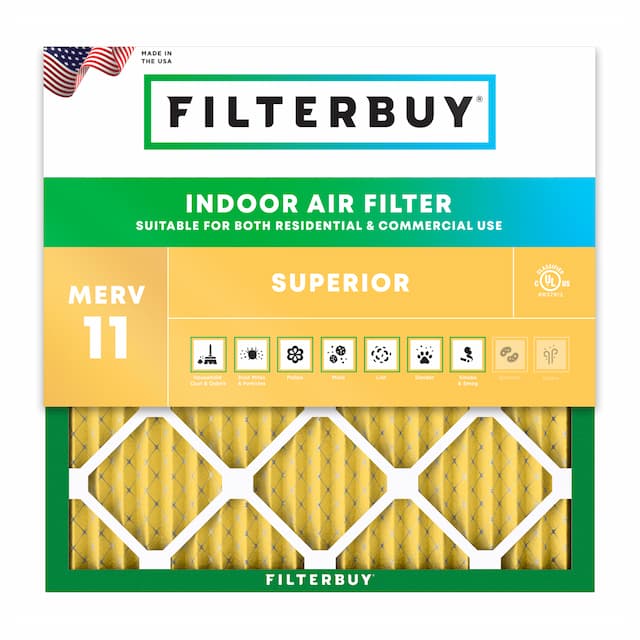
Improve your indoor air quality with MERV 11 air filters! The powerful electrostatic charge of this pleated filter captures nearly all pet dander, lint, dust, pollen, debris, mold spores, smoke, and smog from your air. In fact, the MERV 11 filter works up to 30 times more effectively and lasts 3 times longer than ordinary fiberglass filters. You don't have to worry about mold, fungus, or mildew growing in your home or business.
Our MERV 11 filters trap 95% of airborne particles as small as 1 microns. Ideal for standard or superior residential and commercial use, this filter is designed to last 90 days.
We recommend replacing your filter regularly to ensure your air stays clean, energy costs are lowered, and your furnace works properly. MERV 11 filters are comparable to MPR 1000/1200 and FPR 7.
To learn more about MERV ratings click here.
Choose Your MERV 11 Filter Size
 6.88x15.88x1
- 8x14x1
- 8x16x1
- 8x20x1
- 8x24x1
- 8x30x1
- 9x30x1
- 9.75x23.75x1
- 10x10x1
- 10x14x1
- 10x15x1
- 10x16x1
- 10x18x1
- 10x20x1
- 10x24x1
- 10x25x1
- 10x28x1
- 10x30x1
- 11.25x11.25x1
- 11.25x19.25x1
- 11.25x23.25x1
- 11.5x21x1
- 11.88x16.88x1
- 12x12x1
- 12x15x1
- 12x16x1
- 12x18x1
- 12x20x1
- 12x22x1
- 12x24x1
- 12x25x1
- 12x26x1
- 12x26.5x1
- 12x27x1
- 12x30x1
- 12x30.5x1
- 12x34x1
- 12x36x1
- 12.5x21x1
- 12.75x21x1
- 13x18x1
- 13x20x1
- 13x21x1
- 13x21.5x1
- 13x24x1
- 13x25x1
- 13.25x13.25x1
- 14x14x1
- 14x18x1
- 14x20x1
- 14x22x1
- 14x24x1
- 14x25x1
- 14x27x1
- 14x28x1
- 14x30x1
- 14x36x1
- 14.5x19x1
- 15x15x1
- 15x20x1
- 15x25x1
- 15x30x1
- 15x30.5x1
- 15x30.75x1
- 15.25x15.25x1
- 15.5x29x1
- 16x16x1
- 16x18x1
- 16x20x1
- 16x21x1
- 16x21.5x1
- 16x22x1
- 16x22.25x1
- 16x24x1
- 16x25x1
- 16x30x1
- 16x32x1
- 16x36x1
- 16.25x21.25x1
- 16.38x21.38x1
- 16.38x21.5x1
- 16.5x21x1
- 16.5x22x1
- 17x17x1
- 17x19x1
- 17x20x1
- 17x21x1
- 17x22x1
- 17x25x1
- 17.25x17.25x1
- 17.25x19.25x1
- 17.25x23.25x1
- 17.25x26x1
- 17.25x29.25x1
- 17.25x35.25x1
- 17.5x23.5x1
- 17.5x27x1
- 18x18x1
- 18x20x1
- 18x22x1
- 18x24x1
- 18x25x1
- 18x30x1
- 18x36x1
- 18.25x22x1
- 19x19x1
- 19x21x1
- 19x21.5x1
- 19x22x1
- 19x23x1
- 19x27x1
- 19.25x21.25x1
- 19.25x23.25x1
- 19.5x21x1
- 19.5x22x1
- 19.75x21x1
- 19.75x22x1
- 19.88x21.5x1
- 20x20x1
- 20x21x1
- 20x21.5x1
- 20x22x1
- 20x22.25x1
- 20x23x1
- 20x24x1
- 20x25x1
- 20x27x1
- 20x30x1
- 20x32x1
- 20x34x1
- 20x36x1
- 21x21x1
- 21x22x1
- 21x23x1
- 21x23.25x1
- 21.25x21.25x1
- 21.5x23x1
- 21.5x23.25x1
- 21.5x24x1
- 21.5x26x1
- 22x22x1
- 22x24x1
- 22x26x1
- 22x28x1
- 22x36x1
- 22.25x25x1
- 23x25x1
- 23.25x29.25x1
- 23.5x23.5x1
- 23.5x25x1
- 23.5x30.75x1
- 24x24x1
- 24x25x1
- 24x28x1
- 24x30x1
- 24x36x1
- 25x25x1
- 25x28x1
- 25x29x1
- 25x32x1
- 27x27x1
- 28x30x1
- 29x29x1
- 30x30x1
- 30x32x1
- 30x36x1
- 10x12x1
- 10x22x1
- 10x32x1
- 10x33x1
- 10x36x1
- 12x14x1
- 14x16x1
- 15x19x1
- 15x28x1
- 16x27x1
- 16x28x1
- 17x27x1
- 18x21x1
- 18x28x1
- 19x20x1
- 29x30x1
- 6x10x1
- 6x12x1
- 8x8x1
- 11.5x11.5x1
- 12.25x24.25x1
- 12.5x24x1
- 13.25x17.75x1
- 13.25x22.75x1
- 17.5x21x1
- 19.75x21.5x1
- 21x23.5x1
Custom Filter
Don't see your size? Create one yourself using our custom filter tool!
Filterbuy MERV 11 Protects Your Home From








Why Choose a Filterbuy MERV 11 Air Filter?
MERV 11 filters trap 95% of pollutants from the air.
MERV 11 filters provide premium filtration.
MERV 11 filters have up to 14 pleats per foot.
Need help choosing the right MERV rating?
MERV, which stands for Minimum Efficiency Reporting Value, measures how efficiently air filters remove particles from the air. MERV ratings range from 1-20; the higher the number, the greater percentage of pollutants the filter blocks. Selecting the right rating is important, as it will ensure both a) the right amount of bacteria is removed from your air, and b) your HVAC works properly. Read below to make sure you choose the best MERV rating for your home or business!
Merv comparison
Scroll to see more.
 MERV 8 |  MERV 11 |  MERV 13 |  Odor Eliminator | |
|---|---|---|---|---|
| Best for | Standard Residential/Commercial Healthy Families | Superior Residential/Commercial Allergy Sufferers | Optimal Residential/Commercial Hospital Grade | ODOR ELIMINATOR Residential/Commercial Household Odors |
| Comparable ratings | MPR 600 & FPR 5 | MPR 1000-1200 & FPR 7 | MPR 1500 - 1900 & FPR 10 | MPR 1000-1200 & FPR 7 |
| Filtration | Captures 90% of Airborne Particles | Captures 95% of Airborne Particles | Captures 98% of Airborne Particles | Captures 95% of Airborne Particles |
| Dust, lint & debris | ||||
| Mold, pollen | ||||
| Dander, dust mites | ||||
| Smoke & Smog | ||||
| Bacteria | ||||
| Odor, vocs |
TL;DR
A MERV 11 air filter is a pleated HVAC filter rated under ANSI/ASHRAE Standard 52.2 to capture at least 65% of particles between 1 and 3 microns and at least 85% of particles between 3 and 10 microns. That range covers pollen, pet dander, mold spores, dust mite debris, and most household dust. MERV 11 is the standard step up from MERV 8 for homes with pets or seasonal allergies. For wildfire smoke, MERV 13 is the better filter. Filterbuy, an American air filter manufacturer, builds both in more than 600 sizes.
Key Takeaways
MERV 11 is defined by a public standard, not a marketing scale. ANSI/ASHRAE 52.2 sets the minimums at 65% (1 to 3 microns) and 85% (3 to 10 microns), and every manufacturer is tested the same way.
20x25x1 and 16x25x1 are the two most common MERV 11 sizes in American homes, followed by 20x20x1 and 16x20x1. Filterbuy makes all four for you to order.
MERV 11 handles pet dander well and smoke only partially. Dander runs 2.5 to 10 microns. Smoke sits below 1 micron, where MERV 13 carries a 50% minimum and MERV 11 carries none.
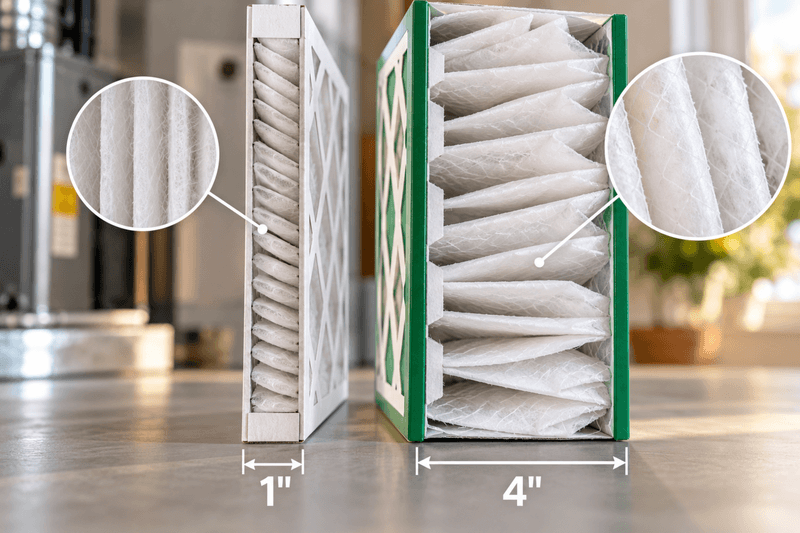
A 4-inch MERV 11 filter lasts 6 to 12 months, compared with 60 to 90 days for a 1-inch, because it packs several times the pleated media into the same footprint.
The EPA recommends MERV 13, or the highest rating your system can handle. MERV 11 is the sensible pick when your system, budget, or household points lower, and Filterbuy makes both.
What Is a MERV 11 Air Filter?
A MERV 11 air filter is a pleated HVAC and furnace filter rated under ANSI/ASHRAE Standard 52.2 to capture at least 65% of airborne particles between 1 and 3 microns and at least 85% of particles between 3 and 10 microns. MERV stands for Minimum Efficiency Reporting Value, the industry efficiency scale that runs from 1 to 16. MERV 11 sits in the upper middle of it.
The value of MERV is that it belongs to no one. As the EPA notes in its Guide to Air Cleaners in the Home, MERV is based on a national consensus standard, while FPR and MPR are proprietary ratings. Filterbuy lists MERV 11 as comparable to MPR 1200 to 1550 and FPR 6 to 9. For a plain-language primer, see all about MERV ratings.
One thing worth saying up front: Filterbuy creates MERV 8, MERV 11, and MERV 13 on the same lines, in the same plants. We do not earn more when you move up a rating, so nothing below is written to push you there. Where MERV 11 is the wrong filter, this page says so.
What Does a MERV 11 Filter Actually Capture?
A MERV 11 filter captures pollen, mold spores, pet dander, dust mite debris, lint, and most household dust. It captures smoke only partially. ASHRAE sets a floor for each of three particle size bands, and in the smallest band, MERV 11 has no floor at all.
Table 1 — MERV 11 vs. MERV 13 Minimum Capture Efficiency
Source: ANSI/ASHRAE Standard 52.2, as published by the U.S. EPA (epa.gov/indoor-air-quality-iaq/what-merv-rating).
What those bands mean in a real house:
Table 2 — What MERV 11 Captures, by Particle
For wildfire smoke and fine combustion particles, MERV 13 raises the minimum in this range to 50%.
That last row is the honest limit. If wildfire smoke is why you are shopping, MERV 13 air filters are the right answer, and Filterbuy builds them in the same sizes. If odors are the problem, filtration alone will not fix it; that calls for activated carbon filters.
Best MERV 11 Air Filter Sizes
The most common MERV 11 air filter sizes in American homes are 20x25x1 and 16x25x1, followed by 20x20x1, 16x20x1, 14x25x1, and the 4-inch 20x25x4. Filterbuy manufactures more than 600 sizes to order, so an unusual return does not mean settling for the nearest fit.
Table 3 — Most Common MERV 11 Filter Sizes
Filterbuy manufactures 600+ MERV 11 sizes to order, plus custom dimensions.
Filters are listed by nominal size, which is the rounded size printed on your old filter, and cut slightly under it so they seat without binding. Measure the filter, not the slot. For anything non-standard, build a custom filter size: we cut to order, which is how the catalog passed 600 sizes, and if what arrives does not fit we send the right one free.
MERV 11 vs. MERV 13 vs. MERV 8: Which Should You Buy?
Choose MERV 11 for pets or seasonal allergies, MERV 13 for asthma or wildfire smoke, and MERV 8 for an older or undersized system. Higher is not automatically better: denser media capture more but resist more airflow, and a system starved of air runs longer and wears out sooner.
Table 4 — MERV 8 vs. MERV 11 vs. MERV 13
Minimum particle size efficiency per ANSI/ASHRAE 52.2. MERV is a consensus standard; MPR and FPR are proprietary.
The EPA recommends selecting a filter rated at least MERV 13, or as high as your system will accommodate. MERV 11 is the right call when your equipment, budget, or needs point lower, not because it filters more. Compare the neighboring ratings: MERV 8 air filters and MERV 13 air filters.
Are MERV 11 Air Filters Good for Allergies?
MERV 11 filters are a good match for most seasonal allergies. Tree, grass, and ragweed pollen measure roughly 10 to 100 microns, and mold spores start around 3 microns. Both sit at or above the 3- to 10-micron band where MERV 11 is held to an 85% minimum, and particles larger than that band are easier to catch, not harder. MERV 13 captures more in the sub-micron range if your household needs it.
One habit matters more than the rating. The EPA points out that an HVAC filter only cleans air while the system is running, and a typical system cycles for a fraction of the day. Switching the thermostat fan from "auto" to "on" during peak pollen weeks pushes far more air through the filter. Filterbuy auto-delivery can be set so a fresh filter arrives before pollen season rather than halfway through it.
Are MERV 11 Air Filters Good for Pets?
MERV 11 filters are well matched to homes with pets. Dander flakes measure about 2.5 to 10 microns, which puts most of them inside MERV 11's rated range, and pet hair is far larger. For a multi-pet household, the useful adjustment is a shorter replacement interval or a deeper Filterbuy filter, not a higher MERV.
What no filter reaches is the dander already settled into carpet, upholstery, and bedding. Filtration works alongside vacuuming, not instead of it.
Will a MERV 11 Filter Restrict My HVAC Airflow?
In a properly sized residential system, a MERV 11 filter should not cause airflow problems. The EPA notes that most home furnaces and HVAC systems can accommodate filters in this range when they are replaced on schedule, which puts MERV 11 comfortably inside the safe zone for standard equipment. A clogged filter, not a higher rating, is what starves a system of air.
Depth matters more than rating here. A deeper filter packs more pleated media into the same opening, so it presents less resistance at the same MERV. That is why Filterbuy makes MERV 11 in 1-inch, 2-inch, and 4-inch depths.
Table 5 — MERV 11 by Filter Depth
Lifespan figures per Filterbuy product specifications. A 4-inch filter requires a 4-inch cabinet; actual thickness is about 3 5/8 inches.
Check with a licensed HVAC technician if your system predates roughly 2010, uses a single-speed blower, or runs on a single undersized return. After switching, watch for weak airflow, longer run times, or new blower noise.
In the field, the filter rarely gets blamed for the thing it actually caused. A frozen coil or a blower running long gets written up as a refrigerant or thermostat problem, when the real cause was a loaded filter nobody changed. Before paying for a diagnosis, pull the filter and hold it up to a light.
David Clark, Licensed HVAC Technician
What We Have Learned Building MERV 11 Filters Since 2013
Pleated filters outperform flat fiberglass panels because folding the media multiplies its surface area. A fiberglass panel typically rates MERV 4 or below and needs replacing within 30 days. A pleated 1-inch Filterbuy filter rates MERV 8 to 13 and runs 60 to 90 days. That much is standard industry knowledge. Three things we have learned on our own production floors are less obvious, and they change how we would shop.
More pleats are not the same as more filters. Our 2-inch MERV 11 carries about 10 pleats per foot. Our 4-inch carries about 8. Fewer pleats, and yet the 4-inch runs 6 to 12 months against the 1-inch's 90 days. Pleat density is a poor proxy for performance. What decides how long a filter keeps breathing freely is the total media area, and depth is what drives that. Pleat count is the number most often printed on packaging, and it is the one we would ignore.
The failure we see most is not filtration;it is bypass. A filter that flexes in its track lets air slip around the edge instead of through the media, and a correctly rated filter then performs like a much cheaper one. That is why we build on a beverage board frame with aluminum dual wire backing instead of plain cardboard. The failure is invisible from the outside: the filter still looks clean because the unfiltered air went around it.
Nominal sizes hide real traps. If you are replacing a 16x25x4 or 20x25x4 media filter, check the actual depth before you order. Several housings labeled 4-inch take a filter that measures closer to 5 inches, and the wrong one either will not seat or will leave a gap at the edge. We publish a compatibility note on every affected product page, and if the filter you order does not fit, we send the right size at no charge.
Pleated design. More pleats mean more surface area to capture dust and debris before airflow suffers.
Electrostatically charged media attract fine particles onto the fibers rather than waiting for them to collide.
Beverage board frame engineered to resist warping in heat and humidity, so air does not slip around the edges.
Aluminum dual wire backing keeps pleats evenly spaced, with no sagging at high airflow.
More on the company: about Filterbuy.
The question I get asked most is which MERV number is best. It is the wrong question. The best filter is the highest rating your system can move air through, in the deepest size your cabinet will take, changed on time. We make every rating on that scale, so I have no reason to sell you a number.
Michelle Wan, Brand Manager and Air Quality Writer, Filterbuy
4-Inch MERV 11 Air Filters
The catch with a 4-inch MERV 11 is not performance; it is whether your system will take one. It needs a media cabinet, not a 1-inch slot, and "4-inch” is a nominal figure: actual thickness runs about 3 5/8 inches. Check the depth of your existing filter before ordering. Browse 4-inch air filters or go straight to the 20x25x4 MERV 11 filter.
What a MERV 11 Filter Actually Costs Per Year
A Filterbuy 1-inch MERV 11 costs roughly $45 a year to run in a typical single-return home; a 4-inch costs roughly $37 to $50. The two are closer than most filter marketing suggests, and we would rather say so than imply the deeper filter always pays for itself.
Table 6 — Annual Cost by Depth, One Return
Based on Filterbuy list pricing for 20x25x1 and 20x25x4 MERV 11 at multi-pack tiers, captured August 6, 2026. One return assumed. Auto-delivery takes a further 5% off. Verify current pricing before publish.
Read the table honestly and two things fall out. In a home without pets, depth is close to cost-neutral. You are buying fewer interruptions and lower static pressure, not a lower bill. In a home with pets or allergies, where the 1-inch needs changing every 60 days, the 4-inch does become the cheaper filter, and by a clear margin. That is the case where we would tell someone to check their cabinet.
What a MERV 11 Filter Will Not Do
No filter fixes everything, and a filter sold as though it does is the fastest way to disappoint someone. Four things people regularly expect from a MERV 11 filter that it cannot deliver:
Table 7 — The Limits, and What Actually Works Instead
Sources: U.S. EPA, Guide to Air Cleaners in the Home; U.S. EPA, Indoor Air Quality.
The mold point matters most. The EPA states plainly that portable air cleaners and furnace filters do not address the cause of mold or musty odors, and that fixing a mold problem means removing the moisture feeding it. A MERV 11 filter captures spores already airborne. It does nothing about the spores still being produced. If odor is the issue rather than particles, activated carbon filters are the right product, and Filterbuy makes those in 1-inch as well.
Buying MERV 11 Air Filters in Bulk
Filterbuy sells MERV 11 filters by the case, and the per-filter price drops steeply with quantity. On the 20x25x1, it falls from $29.99 for a single filter to $9.41 each at twelve or more. Because we make them in-house, bulk orders ship factory-direct.
Volume discounts begin at two filters and step down through 4, 5, 6 to 11, and 12 or more
Auto-delivery takes another 5% off, and it can be edited, skipped, or canceled anytime
Mixed-size ordering suits rental portfolios, property managers, and facilities teams
Open a business account or set up auto-delivery.
Verify live pricing before publish. The figures above were captured August 6, 2026 from the 20x25x1 MERV 11 product page and will drift.
How Often Should You Replace a MERV 11 Filter?
Replace a 1-inch MERV 11 filter every 90 days in a typical home, every 60 days with pets or during allergy season, and every 30 days in a high-dust household or during a wildfire smoke event. A 4-inch MERV 11 filter runs 6 to 12 months, landing at the shorter end under those same heavier loads.
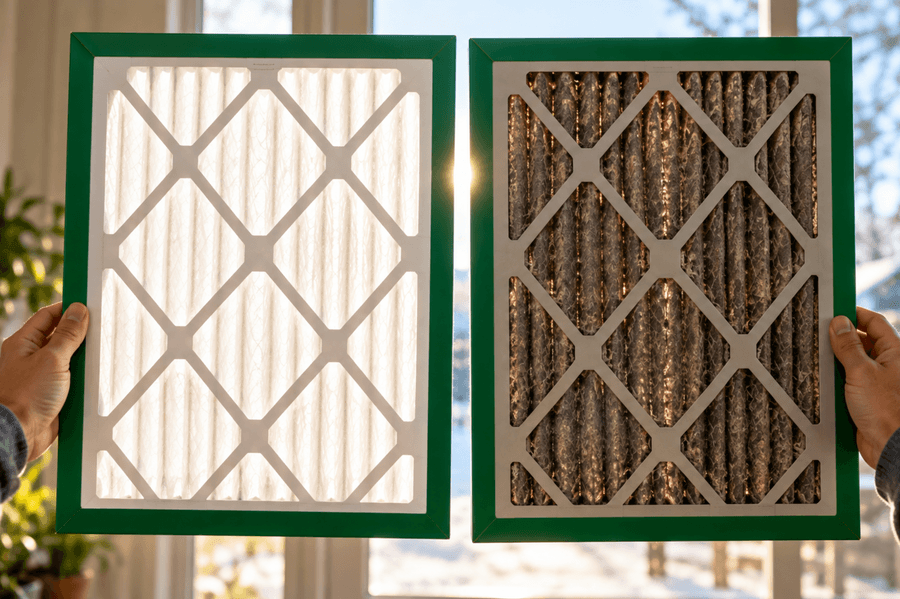
The quickest check is a visual one: pull the filter and compare it against a new one. A gray, matted media face means it is at or past due, and you do not need to wait for a calendar reminder to swap it. Filterbuy's own guidance sits in the 60 to 90 day range for 1-inch filters, which is where most manufacturer recommendations land.
Frequently Asked Questions
Is MERV 11 Good Enough for Allergies?
MERV 11 is good enough for most seasonal allergies. Pollen and mold spores are large particles, generally 3 microns and up, and MERV 11 captures at least 85% in that range. Asthma and wildfire smoke call for MERV 13 instead.
Will a MERV 11 Filter Damage My Furnace?
A MERV 11 filter will not damage a properly sized, modern furnace or air handler. The EPA notes that most systems handle even MERV 13 without equipment problems when the filter is changed on schedule. Systems predating roughly 2010 and those with undersized return ducting are worth checking with a licensed HVAC technician first.
What MPR and FPR Ratings Equal MERV 11?
Filterbuy lists MERV 11 as comparable to MPR 1200–1550 and FPR 6–9. MPR is 3M's proprietary scale, and FPR is Home Depot's; MERV is the only one of the three set by a public consensus standard and tested identically across manufacturers.
Can I Wash and Reuse a MERV 11 Filter?
No. Washing a pleated MERV 11 filter destroys the electrostatic charge that captures fine particles and drives moisture into the system. Filterbuy MERV 11 filters are disposable. Washable filters exist, but they generally carry far lower MERV ratings.
What Size MERV 11 Filter Do I Need?
Read the nominal size printed on your current filter. 20x25x1 and 16x25x1 are the most common. If nothing is printed, measure the old filter rather than the slot and round each dimension up. One trap we see constantly: a Honeywell 16x25x4 or 20x25x4 needs the Filterbuy 5-inch filter, not the 4-inch.
Supporting Statistics
Three figures explain why filter choice is worth thinking about at all. Each comes from a U.S. government agency or a national nonprofit, and each is linked below so you can check it. These are the same sources Filterbuy cites across its resource library.
Table 8 — Supporting Statistics at a Glance
Sources: U.S. EPA Report on the Environment; CDC/NCHS FastStats, Allergies; Asthma and Allergy Foundation of America, Pet Allergy. All verified August 6, 2026.
1. Indoor air, not outdoor air, is what you breathe most. The EPA Report on the Environment states that Americans spend approximately 90 percent of their time indoors, where concentrations of some pollutants are often 2 to 5 times higher than typical outdoor concentrations. The same page lists dust mites, mold, pet dander, and particulate matter among established asthma triggers.
2. Seasonal allergies are not a minority problem. CDC National Center for Health Statistics data put diagnosed seasonal allergy at 25.2% of U.S. adults and 20.6% of children in 2024, drawn from the National Health Interview Survey. Pollen and mold spores sit in the 3 micron and larger range, where a MERV 11 filter captures at least 85%.
3. Pet allergy is about dander, not fur. The Asthma and Allergy Foundation of America reports that about 6 in 10 U.S. households have a pet and that cat and dog allergies affect 10 to 20% of people worldwide, with the trigger being proteins in dander, saliva, and urine rather than hair. AAFA also notes pet dander can persist in a home for up to 6 months after the animal is gone, which is why filtration works alongside cleaning rather than instead of it.
Note on scope: the 10 to 20% pet allergy figure is worldwide, not U.S.-specific, and is presented that way above. AAFA sources it to Chan and Leung, Allergy Asthma Immunol Res, 2018, and the page carries a medical review by Mitchell Grayson, MD.
Glossary
MERV (Minimum Efficiency Reporting Value): The 1-to-16 air filter efficiency scale defined by ANSI/ASHRAE Standard 52.2.
ANSI/ASHRAE Standard 52.2: The American Society of Heating, Refrigerating and Air-Conditioning Engineers test method that assigns MERV ratings across three particle size bands.
E1, E2, E3: The three particle size bands ASHRAE measures, covering 0.3–1.0, 1.0–3.0, and 3.0–10 microns.
MPR (Microparticle Performance Rating): 3M's proprietary scale, used on Filtrete products.
FPR (Filter Performance Rating): Home Depot's proprietary scale.
Micron: One millionth of a meter. A human hair is roughly 70 microns wide.
Nominal size: The rounded ordering size, such as 20x25x1; actual dimensions run slightly smaller so the filter seats.
Written by Michelle Wan, Brand Manager and Air Quality Writer at Filterbuy, who covers AQI trends, wildfire smoke, and indoor air quality across the Filterbuy resource library. Technically reviewed by David Clark, Licensed HVAC Technician. Last updated August 6, 2026.
Efficiency figures on this page reference ANSI/ASHRAE Standard 52.2 as published by the U.S. EPA, and the EPA Guide to Air Cleaners in the Home. The EPA neither certifies nor recommends particular brands of air filters.