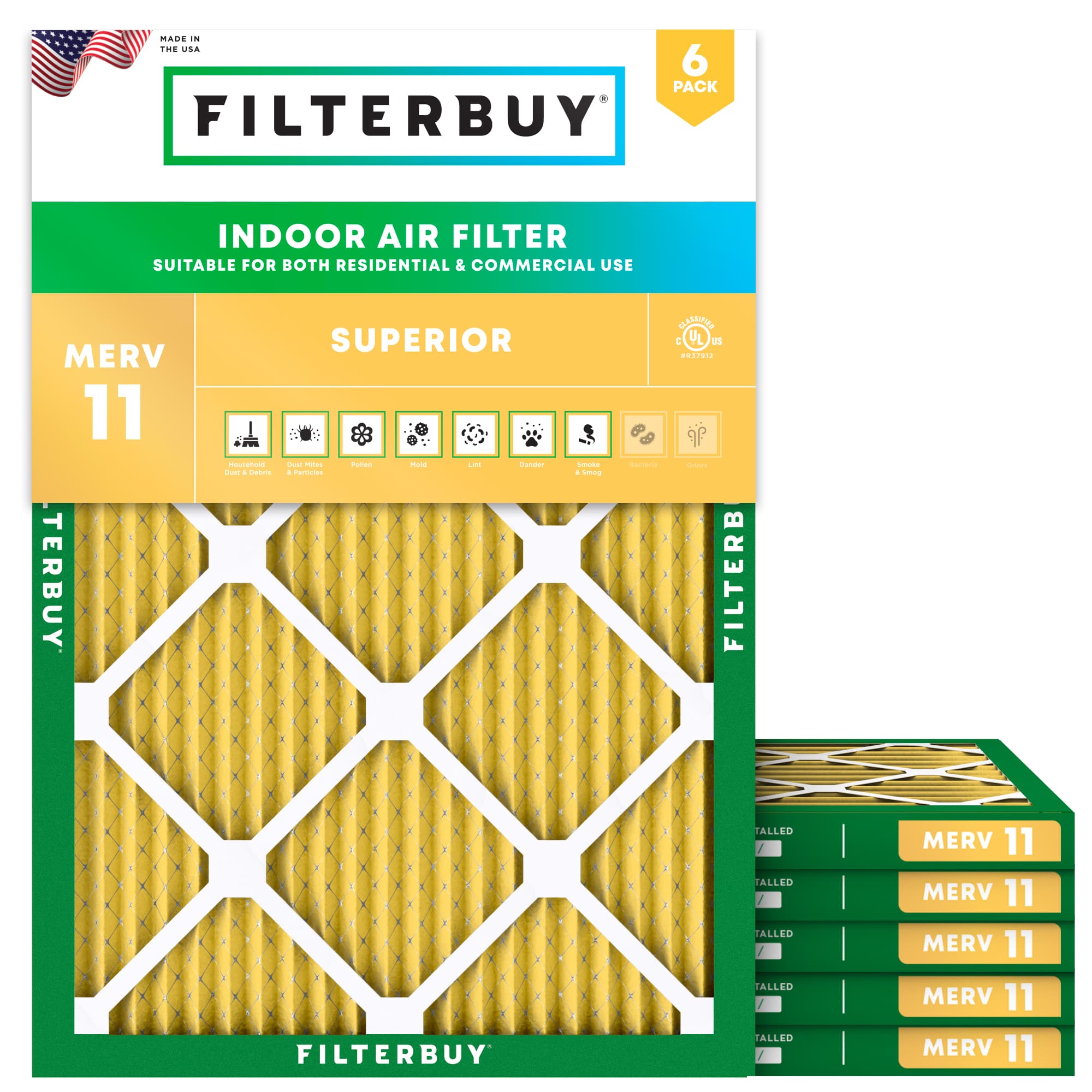
Actual Size: 21.5x23.5x1"
 Free Delivery
  Factory-Direct Low Prices, Made in the USA
 Hassle-Free Returns & Free Exchanges
RESIDENTIAL AND/OR COMMERCIAL USE
Change Every 3 Months
Actual Size: 21.5x23.5x1"
Free Delivery Factory-Direct Low Prices, Made in the USAHassle-Free Returns & Free ExchangesRESIDENTIAL AND/OR COMMERCIAL USE
Change Every 3 Months
Actual Size: 21.5x23.5x1"
Free Delivery Factory-Direct Low Prices, Made in the USAHassle-Free Returns & Free ExchangesRESIDENTIAL AND/OR COMMERCIAL USE
Change Every 3 Months
At Filterbuy, we don't cut corners—we craft high-quality air filters right here in the USA and ship them to your doorstep for free. No delays, no gimmicks—just clean air, made easy. With thousands of five-star reviews and filters built for real life & every HVAC system, it's no wonder why over 4 million families trust Filterbuy.

Proudly Made In The USA

Fast, Free Shipping on Every Order

Premium Materials That Go The Distance

85,000+ 5-Star Reviews From Happy Customers

Save Up to 70% Per Filter with Packs


Measure length × width × depth with a tape measure to find the actual size.

Round up each dimension to the nearest whole number to get the nominal size. Example: 21.5x23.5x1" in → 22x24x1 nominal.

Search by nominal size on our site for the best fit.


If the filter you buy doesn't fit, we'll send you a better size.
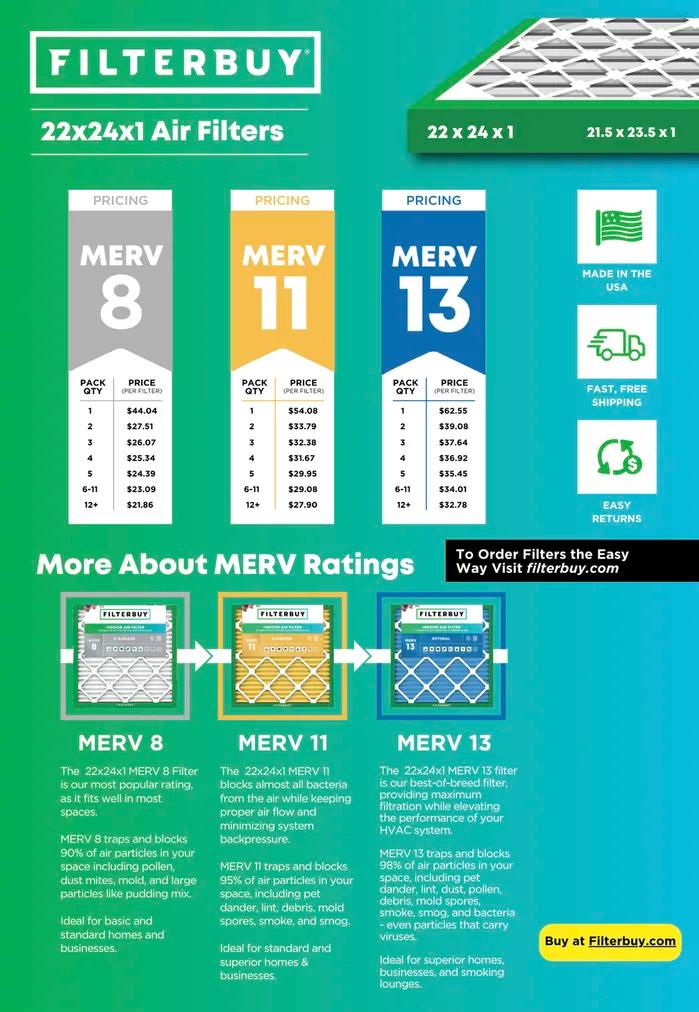
MERV stands for Minimum Efficiency Reporting Value—but don't let the technical name fool you. It's just a way to rate how well an air filter traps stuff like dust, pollen, pet dander, and smoke. The higher the MERV number, the more particles it catches—and the cleaner your air will be.

Comparable to:FPR: 4-7
MPR: 600-1000
 Dust & Debris
 Dust Mites & Particles
 Pollen
 Mold
Mold Lint
Lint Dander
Comparable to:FPR: 6-9
MPR: 1200-1550
Dust & DebrisDust Mites & ParticlesPollenMoldLintDander Smoke & Smog
Comparable to:FPR: 10
MPR: 1900-2800
Dust & DebrisDust Mites & ParticlesPollenMoldLintDanderSmoke & Smog Bacteria


We build every Filterbuy filter to deliver reliable 90-day performance—thanks to smart design and premium materials that do the heavy lifting. Here's what makes the difference:
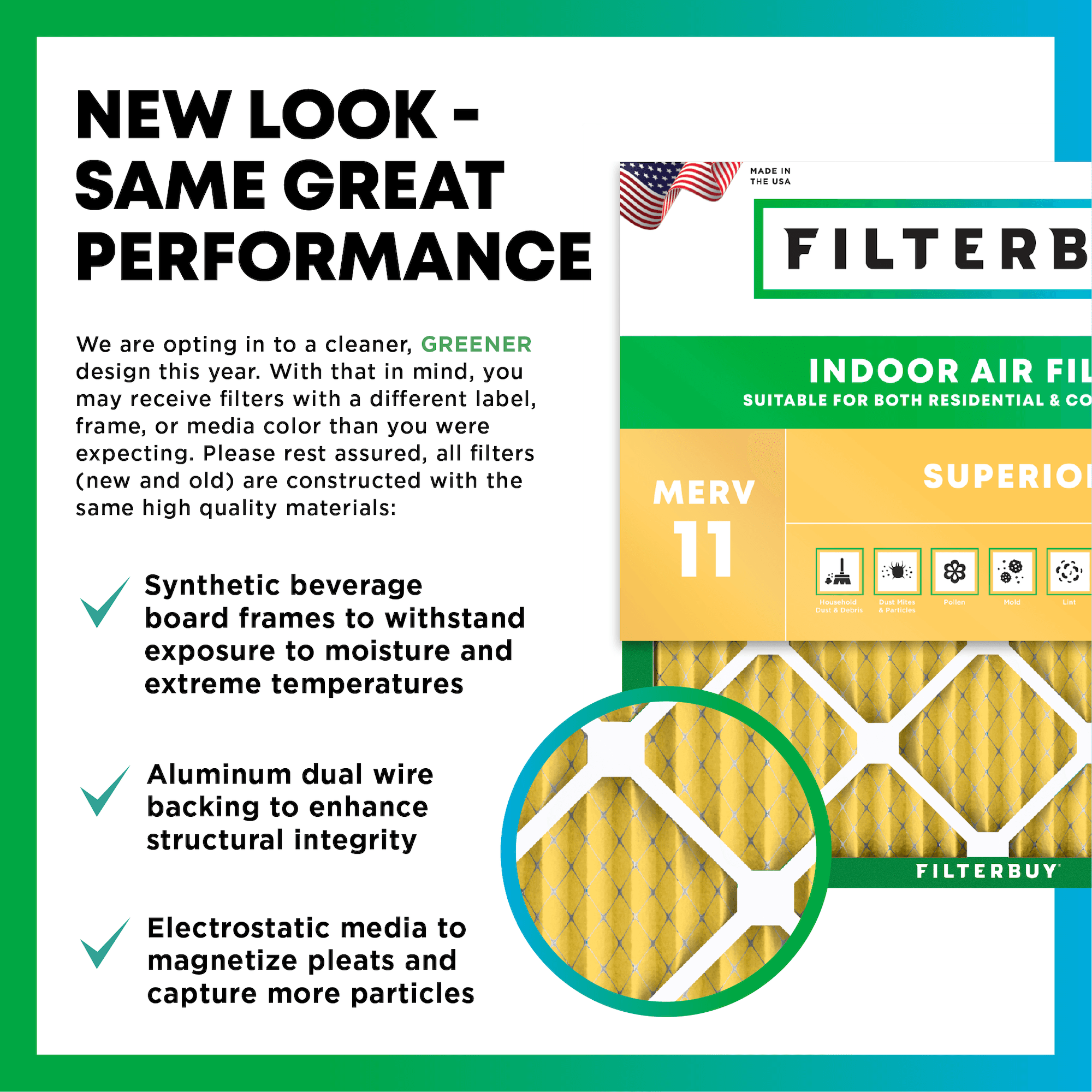
More pleats = more surface area to capture dust and debris, keeping your air cleaner longer.
Pleats are magnetized to attract and trap microscopic particles—like pet dander, pollen, and smoke.
Engineered to resist warping in extreme temperatures and high humidity.

A layer of metal reinforcement keeps pleats evenly spaced and structurally sound—no sagging, even at high airflow.
Assembled with care. Built to perform. Ships fast, free, and reliably from our U.S. facilities.

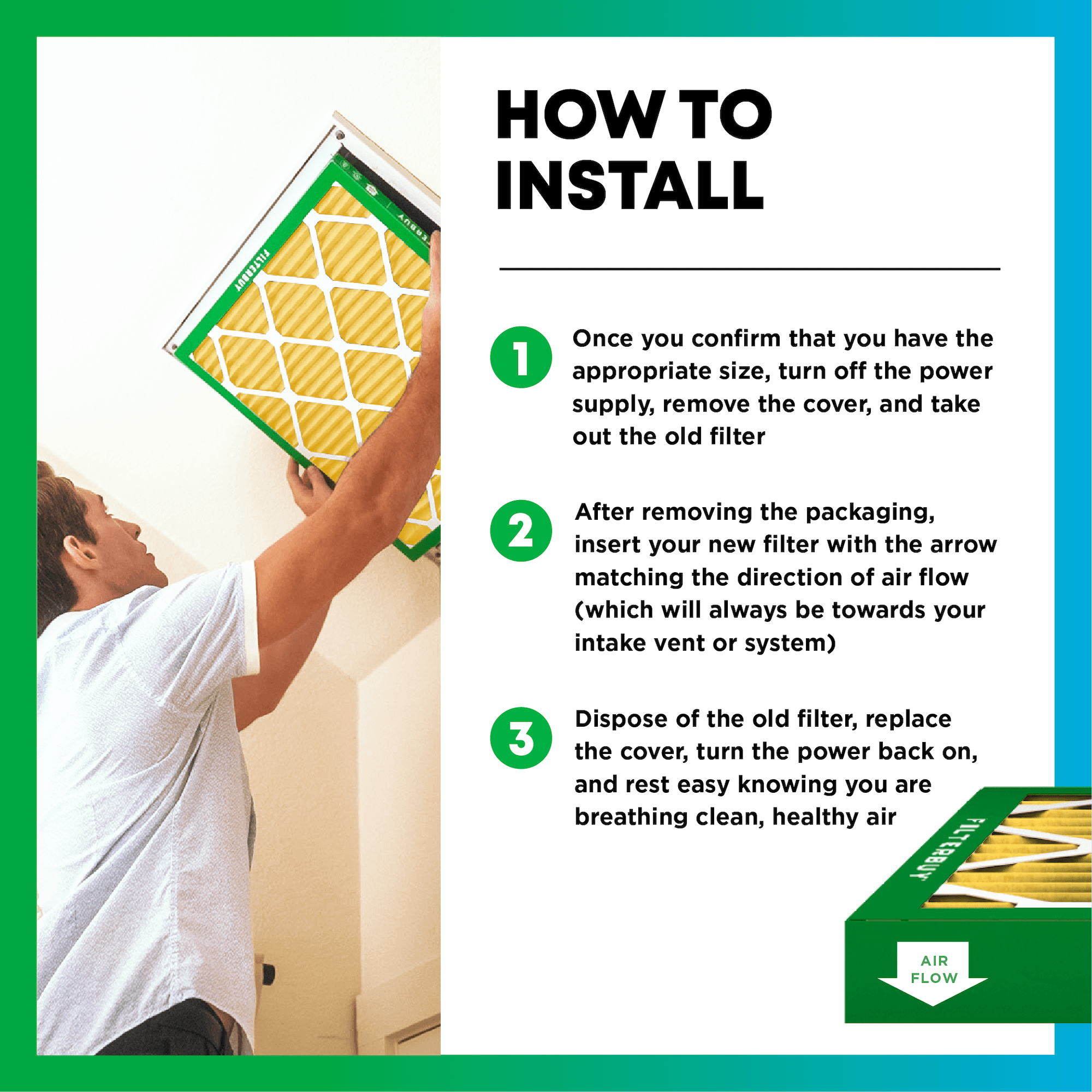
Turn Off Your HVAC SystemSafety first.

Remove The Old FilterLook for the airflow arrow and make note of the direction.

Slide In Your New FilterArrow should point toward the system (same direction as before).

Turn Your System Back OnAnd enjoy the fresh, clean air.

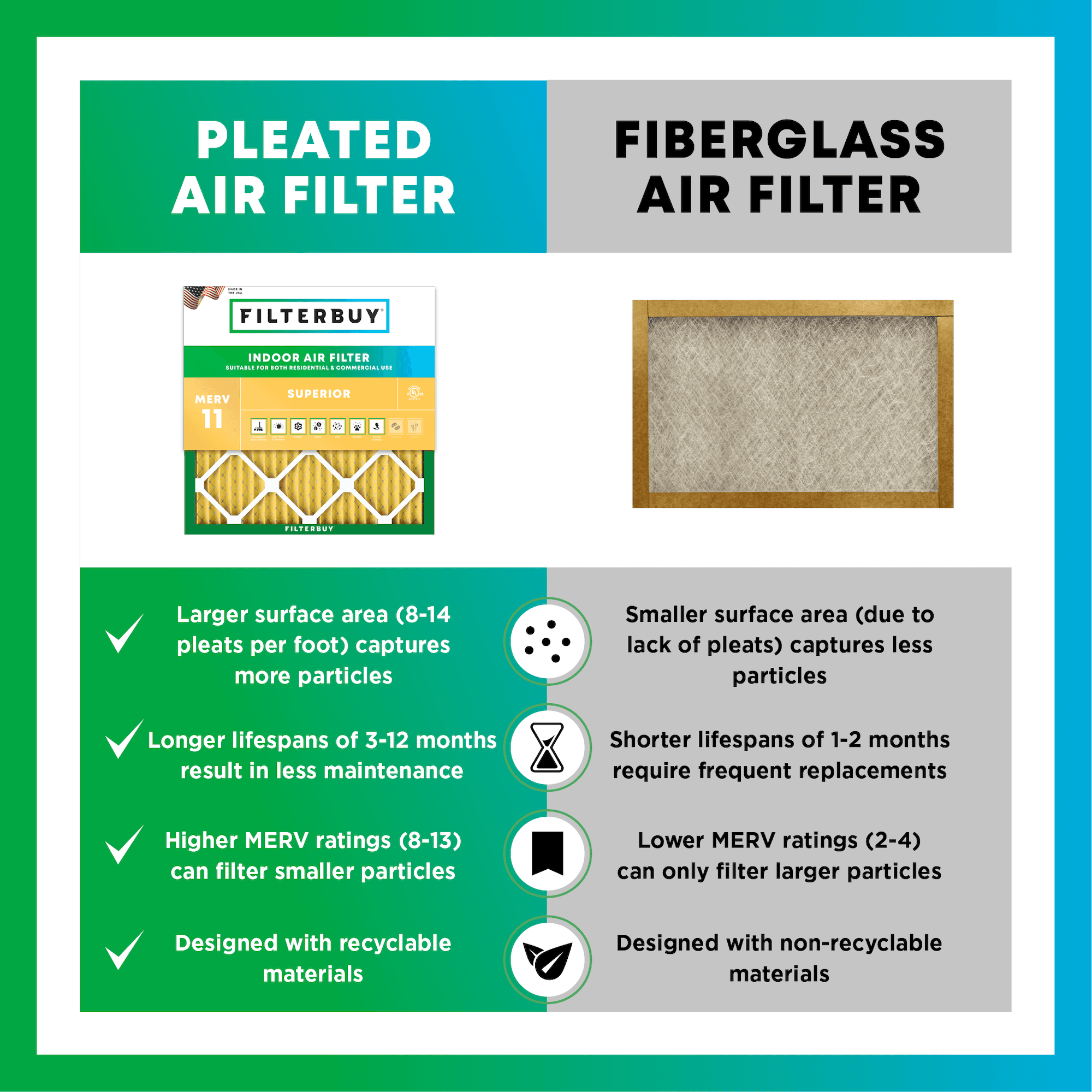
Not all air filters are created equal. Pleated filters don't just last longer—they actually clean your air better. Here's how they stack up:

Efficiency:
High (MERV 8–13) – Traps more particles
Lifespan:
90 days – Long-lasting performance
Air Quality:
Excellent – Cleaner, healthier air
Materials:
Recyclable and durable

Efficiency:
Low (MERV 4 or less) – Misses small stuff
Lifespan:
30 days or less – Replace often
Air Quality:
Minimal – Basic protection only
Materials:
Thin, flimsy, and not recyclable
Pleated filters are a no-brainer—more protection, less hassle, and better air for your home.
Changing your filter on time keeps your HVAC system running efficiently—and helps protect your lungs from dust, allergens, and airborne irritants. Here's how often to swap it out based on your needs:

For most homes without pets or special air quality concerns. Great for general upkeep and energy efficiency.

Shedding fur, dander, and allergy triggers can build up fast. Changing your filter every two months helps keep the air fresher and symptoms at bay.

For households affected by smoke, pollution, or respiratory conditions, monthly changes ensure maximum protection.

| Nominal Size | 22 x 24 x 1 inches |
| Actual Size | 21.5 x 23.5 x 1" inches |
| Filter Type | Pleated |
| Media | Electrostatically Charged |
| Frame | Beverage Board |
| MERV Ratings Available | 8, 11, 13 |
| Lifespan | Up to 90 Days |
| Origin | Made in USA |
Customers tell us the same thing all the time: they upgraded to a higher MERV rating expecting better air, and instead got a system that struggled, cycled harder, and ran up their energy bill.
After manufacturing millions of filters and studying how real HVAC systems respond under real household conditions, we can tell you with confidence — stronger isn't smarter. Matched is.
For a 22x24x1 slot, MERV 8 pleated is where balanced filtration actually lives. It captures the particles that drive the most common indoor air complaints — dust, pollen, pet dander, mold spores, and lint — without creating the static pressure that pushes undersized systems toward premature wear. That's not a compromise. That's precision.
What follows is what we know from the manufacturing floor, not the marketing sheet: why MERV 8 consistently outperforms both ends of the rating scale in most homes, what a pleated media construction delivers that fiberglass never can, and how to set a replacement schedule that protects both your air quality and your equipment investment.
The right filter for your system isn't always the one with the highest number on the box. For most 22x24x1 applications, it's this one.
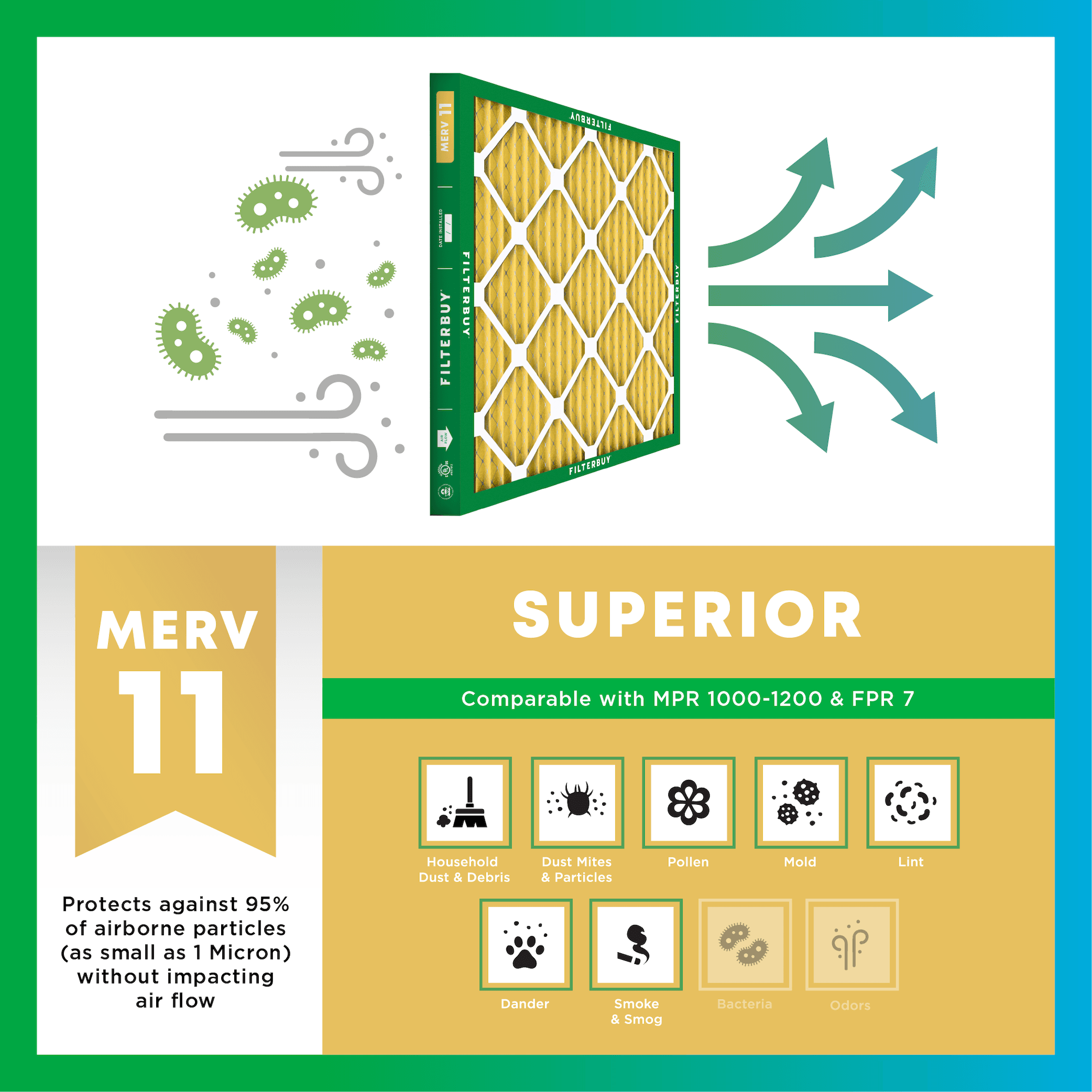
A 22x24x1 MERV 11 pleated air filter is a mid-efficiency residential air filter designed to capture 85–95% of airborne particles between 1 and 10 microns — including pet dander, mold spores, fine dust, bacteria carriers, and smog byproducts.
Key facts:
Nominal size: 22x24x1
Actual size: 21.50" x 23.50" x 0.75"
MERV 11 captures 65% of particles in the 1–3 micron range vs. 20% for MERV 8
Replace every 60–90 days under normal household conditions
Safe for most modern residential HVAC systems — pressure drop increase is only 15–20% over MERV 8
Equivalent to MPR 1000–1200 and FPR 7 ratings
Best for:
Homes with pets
Allergy and asthma sufferers
Households with above-average indoor air quality concerns
Not recommended for:
Older systems with undersized return ducts
Low-capacity blower motors not rated for mid-efficiency filtration
Bottom line: For most 22x24x1 residential applications, MERV 11 pleated delivers the most effective balance of particle capture and airflow performance available in this filter size.
The most important points from everything covered on this page.
Higher MERV isn't always smarter — matched is. MERV 11 hits the performance sweet spot for most 22x24x1 residential systems. It delivers meaningful filtration without straining airflow, overworking your blower, or driving up energy costs.
MERV 11 stops the particles that matter most. Key contaminants captured include:
Pet dander
Mold spores
Fine dust and bacteria carriers
Smog and combustion byproducts
MERV 8 captures 20% of 1–3 micron particles. MERV 11 captures 65%.
Fit matters as much as rating. Always verify actual dimensions before ordering:
Nominal size: 22x24x1
Actual size: 21.50" x 23.50" x 0.75"
Gaps around the frame allow unfiltered air to bypass the media entirely
A loaded filter is a preventable problem. Replace every 60–90 days. Set a reminder or subscribe to automatic delivery the moment you install your first filter.
Buying direct means buying with certainty. Every Filterbuy filter is:
American-made
ASHRAE Standard 52.2 tested
Built with electrostatically charged pleated media — never fiberglass
Choosing the right air filter for a 22x24x1 slot isn't complicated — but it does require understanding one thing most homeowners get wrong. A higher MERV rating isn't automatically the smarter choice. The filter that protects your home most effectively is the one engineered to match your system's actual airflow capacity while still capturing the particles that drive real indoor air quality problems.
After manufacturing millions of filters and studying how residential HVAC systems perform under real household conditions, we've found that MERV 11 pleated consistently delivers that balance for most 22x24x1 applications. It captures up to 95% of airborne particles between 1 and 10 microns — including pet dander, mold spores, fine dust, bacteria carriers, and smog byproducts — while keeping the pressure drop increase to only 15–20% over MERV 8. Most modern residential systems handle that difference without measurable performance loss.
"After manufacturing millions of filters and seeing how real HVAC systems perform across every type of home, the data is clear — forcing a high-MERV filter into a system not engineered for it doesn't clean your air better, it just makes your equipment work harder to push air through a wall it wasn't designed to overcome."
We're obsessed with making sure you have everything you need to make the right call — not just for your air quality, but for your HVAC system, your family, and your home. These seven resources cut through the noise so the Prudent Protector in you can move forward with confidence.
Source: Filterbuy — 22x24x1 MERV 11 Air Filter Product Page After manufacturing millions of filters, we know that the details matter — actual dimensions, media construction, pleat count, and frame integrity all determine whether a filter performs the way it should in your system. This page gives you everything you need to verify fit, confirm specs, and hear directly from customers who've installed this exact filter in homes like yours. https://filterbuy.com/air-filters/22x24x1/merv-11/
Source: Filterbuy — MERV 8 vs. MERV 11 Comparison Guide Here's something we've learned from working with millions of customers across every type of home and HVAC setup: the right filter rating isn't always the higher one — it's the one that matches your household's actual needs. This manufacturer-level comparison breaks down particle capture efficiency, airflow impact, and real-world suitability so you can make the call with confidence instead of guesswork. https://filterbuy.com/resources/air-filter-basics/merv-8-vs-merv-11/
Source: Filterbuy — MERV 8 vs. MERV 11 Pressure Drop Chart One of the most common mistakes we see is homeowners upgrading their filter rating without understanding how increased filtration density affects static pressure and blower performance. This resource walks you through the pressure drop data, explains what warning signs to watch for after switching, and shows how pleat design and filter size influence airflow resistance — the kind of insight that only comes from the manufacturing floor. https://filterbuy.com/resources/air-filter-basics/merv-8-vs-merv-11-air-filter-pressure-drop-chart/
Source: U.S. Environmental Protection Agency — Indoor Air Quality and Air Filtration Most homeowners don't realize that the particles causing the most damage to indoor air quality are the ones too small to see. The EPA's official guidance on MERV-rated filtration makes the invisible visible — explaining exactly which particle sizes matter most for respiratory health and why mid-efficiency filters like MERV 11 are recommended for households where air quality is a genuine concern. https://www.epa.gov/indoor-air-quality-iaq/what-are-air-cleaners-and-air-filters
5. Understand the Industry Standard Behind Every MERV Rating — Including How Filters Are Actually Tested
Source: ASHRAE — Filtration and Disinfection FAQ ASHRAE created the MERV rating system and sets the testing standards that every filter manufacturer — including us — is held to. This resource explains how filters are evaluated, what pressure drop really means in a residential system, and at what point higher MERV ratings start creating airflow challenges for equipment not designed to handle them. Essential reading for any Prudent Protector who wants to understand what's behind the numbers. https://www.ashrae.org/technical-resources/filtration-and-disinfection-faq
Source: Trane — MERV 8 vs. MERV 11 vs. MERV 13 Protecting your family's air means choosing a filter rated for your actual living conditions — not just the highest number on the shelf. Trane's plain-language comparison of the three most common residential MERV tiers gives you household-specific guidance for pet owners, allergy sufferers, and standard home environments, helping you confirm that MERV 11 is the right level of protection before you commit. https://www.trane.com/residential/en/resources/blog/merv-8-vs-merv-11-vs-merv-13/
Source: HVAC.com — MERV Ratings Explained: MERV 13 vs. MERV 11 vs. MERV 8 Don't take your indoor air for granted — understanding exactly what your filter catches and what it misses is the first step toward genuinely protecting the air your family breathes. This independent resource breaks down EPA-sourced particle capture rates by micron size across every major MERV tier, with practical guidance on matching your filter rating to real-life household factors including pets, allergies, and local environmental conditions. https://www.hvac.com/expert-advice/merv-13-vs-merv-11-vs-merv-8/
Statistics tell part of the story. What we've learned from manufacturing millions of filters tells the rest.
That includes the particles driving the most common indoor air complaints:
Pet dander
Mold spores
Fine dust
Smog and combustion byproducts
Customers who switch from MERV 8 to MERV 11 consistently tell us the same thing: less dust on surfaces, fewer allergy flare-ups, and air that feels cleaner between changes.
Reference: https://filterbuy.com/resources/air-filter-basics/merv-8-vs-merv-11/
That gap matters. Particles in that range include:
Fine dust
Bacteria carriers
Combustion byproducts
After manufacturing millions of filters, that's the micron range where filtration decisions start to have a measurable impact on how your household actually breathes.
Reference: https://filterbuy.com/resources/air-filter-basics/merv-8-vs-merv-11-air-filter-pressure-drop-chart/
Upgrading to a MERV 9–12 rated filter can significantly reduce the particle types most linked to allergy and respiratory symptoms. For most 22x24x1 applications, MERV 11 hits that target without the pressure drop risk that comes with MERV 13 in systems not designed for it.
Reference: https://www.epa.gov/indoor-air-quality-iaq/what-are-air-cleaners-and-air-filters
After more than a decade on the manufacturing floor and millions of filters produced, we've formed a clear opinion: the air filter industry has a bias toward higher MERV ratings that doesn't always serve homeowners well.
Higher number. Better filtration. Healthier air. The logic feels intuitive.
But in real homes with real systems, it isn't always that simple.
What Mismatched Filtration Actually Does to Your System:
Restricts airflow beyond what your blower was engineered to handle
Drives up energy costs through extended run cycles
Accelerates component wear by reducing heat exchange efficiency
Creates a false sense of protection while quietly stressing your equipment
What the 22x24x1 MERV 11 Pleated Filter Actually Delivers:
Captures pet dander, mold spores, fine dust, bacteria carriers, and smog byproducts
Hits a measurable efficiency rate without overloading residential airflow capacity
Protects your family's air and your HVAC investment at the same time
Our Honest Take After Millions of Filters: The Prudent Protector doesn't need the most aggressive filter available. They need the right one — chosen deliberately, sized correctly, and changed on schedule.
For the overwhelming majority of homes running a 22x24x1 slot, MERV 11 pleated is exactly that filter. That balance isn't a compromise. It's the point. And after millions of filters, we'd make the same call every time.
You've done the research. Here's exactly what to do next.
Step 1: Confirm Your Filter Size Before You Order Check your return vent or air handler cabinet before purchasing.
Nominal size: 22x24x1
Actual size: 21.50" x 23.50" x 0.75"
A poor fit allows unfiltered air to bypass the media entirely
Step 2: Order Directly from the Manufacturer Skip third-party listings. Every Filterbuy filter is:
American-made
ASHRAE Standard 52.2 tested
Built with electrostatically charged pleated media — never fiberglass
Shop the 22x24x1 MERV 11 here: https://filterbuy.com/air-filters/22x24x1/merv-11/
Step 3: Choose the Right Pack Size for Your Household
1-pack: First-time buyers confirming fit and performance
2–4 pack: Households replacing every 60–90 days
5+ pack: Homes with pets, allergies, or high-use systems needing more frequent changes
Step 4: Set a Replacement Reminder Right Now A loaded filter is one of the most overlooked indoor air quality problems. Two easy solutions:
Set a recurring phone reminder every 60–90 days
Subscribe to automatic delivery and never think about it again
Step 5: Monitor Your System After the First Installation Check in during the first two to three weeks. Healthy system signs include:
Strong, consistent airflow from supply vents
Rooms reaching set temperature without the system straining
If anything feels off — check the filter fit first. A snug, gap-free seal resolves most post-installation airflow concerns.
Step 6: Find the Right Filter for Every Return Vent in Your Home Most homes run more than one return — and not all take the same size. Explore your options:
All 22x24x1 filter options: https://filterbuy.com/air-filters/22x24x1/
MERV rating comparison guide: https://filterbuy.com/resources/air-filter-basics/merv-8-vs-merv-11/
Custom size finder: https://filterbuy.com/custom-air-filters/
The Bottom Line: Right filter. Correct fit. Changed on schedule. You now have everything you need to make that happen.
Q: What does MERV 11 mean and is it the right rating for my home? A: MERV stands for Minimum Efficiency Reporting Value — the ASHRAE-developed standard we build every filter around.
What MERV 11 captures:
Pet dander
Mold spores
Smog and combustion byproducts
85–95% of all particles between 1 and 10 microns
After manufacturing millions of filters across every MERV tier, MERV 11 is the rating that resolves the most common indoor air quality complaints we hear. It delivers a meaningful step up from MERV 8 without the airflow restriction risk that comes with pushing to MERV 13 in systems not engineered for it.
MERV 11 is the right choice for:
Homes with pets
Households with allergy or asthma sufferers
Any home where air quality is an above-average concern
Q: What is the actual size of a 22x24x1 air filter and why does it matter? A: The nominal size and actual size are not the same — and that difference is where installation problems begin.
Nominal size: 22x24x1 (used for cataloging purposes)
Actual size: 21.50" x 23.50" x 0.75" (true physical dimension)
Why it matters:
A poor fit allows unfiltered air to bypass the media around the frame
A MERV 11 filter with a poor fit performs worse than a MERV 8 with a perfect seal
Always measure your return vent or air handler cabinet against actual dimensions before ordering
Q: How often should I replace a 22x24x1 MERV 11 pleated air filter? A: Baseline replacement interval: every 60–90 days for most households.
Replace more frequently if your home has:
One or more pets: every 60 days
Allergy or asthma sufferers: every 45–60 days
High-use systems in extreme year-round climates: every 30–45 days
Active nearby construction or renovation: check monthly
What happens when you wait too long:
Restricted airflow forces your blower to compensate
Run cycles extend and energy costs climb
Choosing the right filter and leaving it in too long is one of the most common and most preventable HVAC mistakes we see.
Q: Will a MERV 11 filter restrict airflow or damage my HVAC system? A: For most modern residential systems — no.
The facts:
Pressure drop increase from MERV 8 to MERV 11: only 15–20%
That increase falls within the operational range of most standard residential blower motors
Most modern HVAC systems handle MERV 11 without measurable performance loss
The two variables that actually determine airflow performance:
Correct filter fit
Consistent replacement schedule
When airflow strain becomes a genuine concern:
MERV 13 and above
Older homes with undersized return ducts
Lower-capacity equipment not designed for higher filtration resistance
Q: What particles does a 22x24x1 MERV 11 pleated air filter capture compared to a MERV 8? A: Both ratings capture common household contaminants — dust, lint, pollen, and larger mold spores.
The meaningful difference lives in the 1–3 micron particle range: Particle capture rate by MERV rating:
MERV 8: captures approximately 20% of particles in the 1–3 micron range
MERV 11: captures approximately 65% of particles in the same range
What lives in the 1–3 micron range:
Fine dust
Bacteria carriers
Pet dander
Smog and combustion byproducts
That 45-point capture rate gap represents the particles circulating invisibly through your home's air — the ones driving the symptoms customers describe when they tell us their filter just isn't doing enough.
For homes where those particle types are a genuine concern, upgrading from MERV 8 to MERV 11 is not a marginal improvement. It is where the filtration decision actually matters.
You now know exactly why the 22x24x1 MERV 11 Pleated Air Filter hits the sweet spot between protection and performance — and what it takes to keep your home's air genuinely clean.
Order direct from the manufacturer today and put the right filter in the right place, where it can start doing exactly what your household needs.

