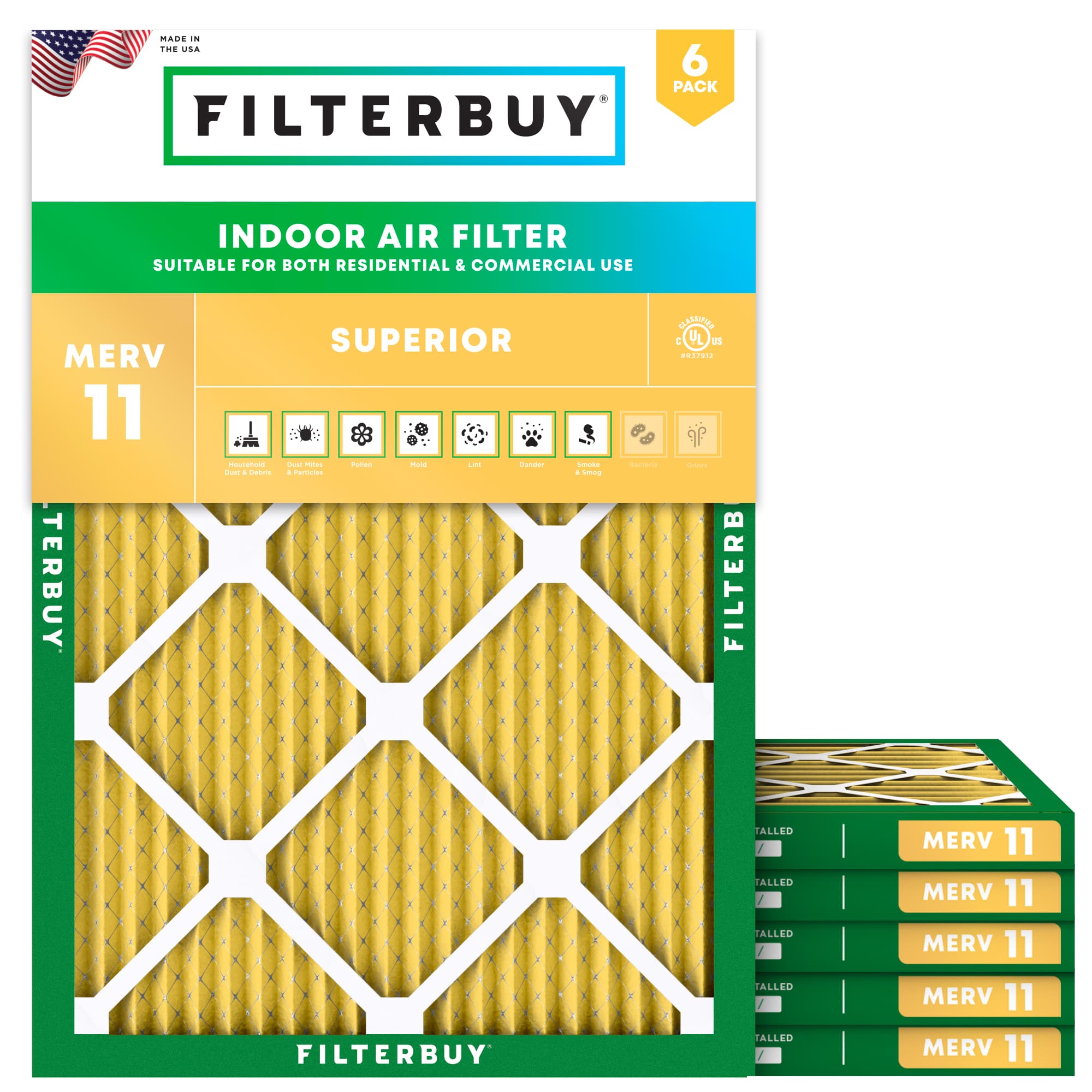
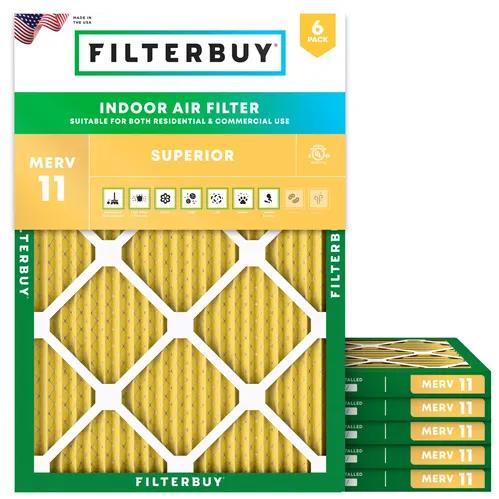
Actual Size: 17.50x23.50x0.75"
 Free Delivery
  Factory-Direct Low Prices, Made in the USA
 Hassle-Free Returns & Free Exchanges
RESIDENTIAL AND/OR COMMERCIAL USE
Change Every 3 Months
Actual Size: 17.50x23.50x0.75"
Free Delivery Factory-Direct Low Prices, Made in the USAHassle-Free Returns & Free ExchangesRESIDENTIAL AND/OR COMMERCIAL USE
Change Every 3 Months
Actual Size: 17.50x23.50x0.75"
Free Delivery Factory-Direct Low Prices, Made in the USAHassle-Free Returns & Free ExchangesRESIDENTIAL AND/OR COMMERCIAL USE
Change Every 3 Months
At Filterbuy, we don't cut corners—we craft high-quality air filters right here in the USA and ship them to your doorstep for free. No delays, no gimmicks—just clean air, made easy. With thousands of five-star reviews and filters built for real life & every HVAC system, it's no wonder why over 4 million families trust Filterbuy.

Proudly Made In The USA

Fast, Free Shipping on Every Order

Premium Materials That Go The Distance

85,000+ 5-Star Reviews From Happy Customers

Save Up to 70% Per Filter with Packs


Measure length × width × depth with a tape measure to find the actual size.

Round up each dimension to the nearest whole number to get the nominal size. Example: 17.50x23.50x0.75" in → 17.5x23.5x1 nominal.

Search by nominal size on our site for the best fit.


If the filter you buy doesn't fit, we'll send you a better size.
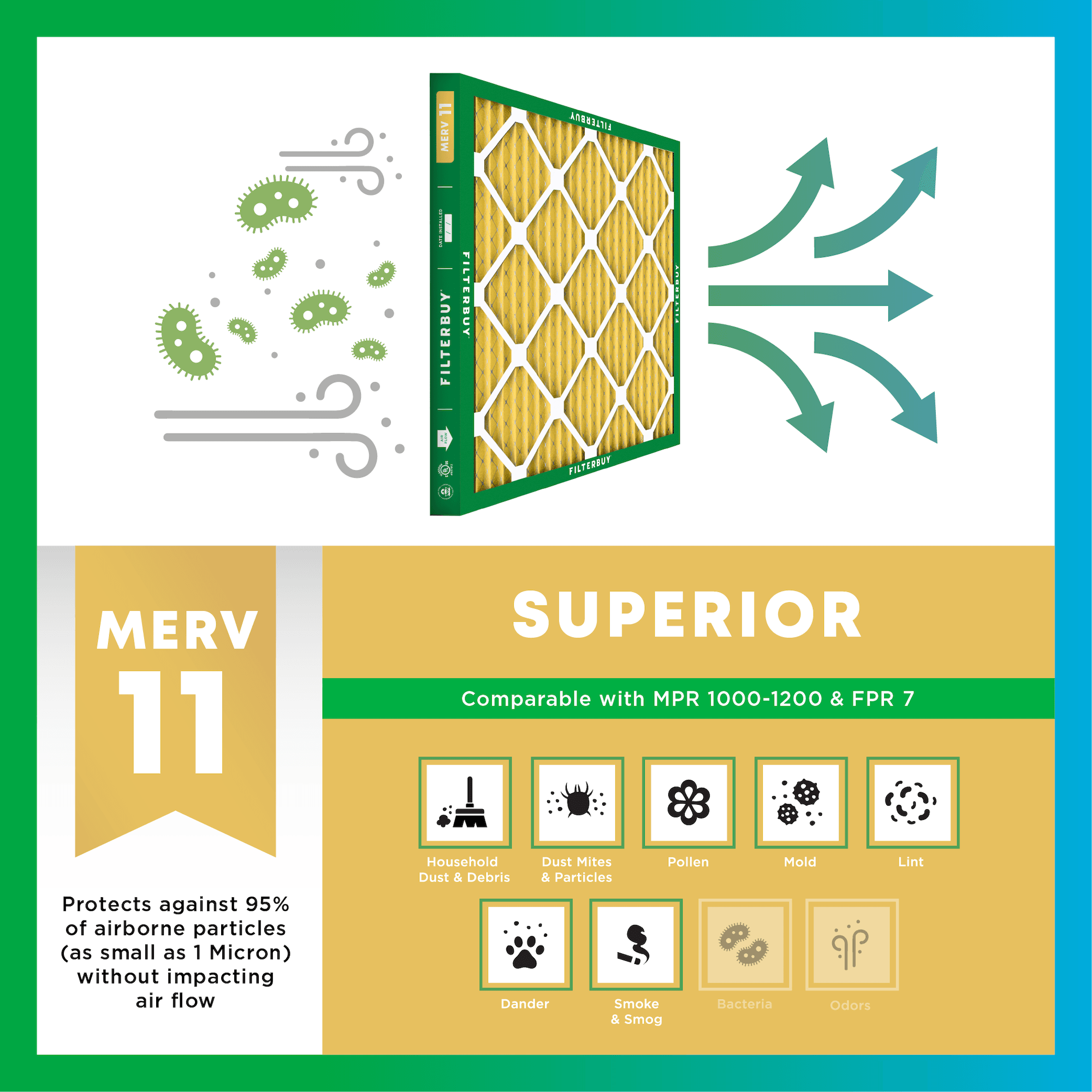
MERV stands for Minimum Efficiency Reporting Value—but don't let the technical name fool you. It's just a way to rate how well an air filter traps stuff like dust, pollen, pet dander, and smoke. The higher the MERV number, the more particles it catches—and the cleaner your air will be.

Comparable to:FPR: 4-7
MPR: 600-1000
 Dust & Debris
 Dust Mites & Particles
 Pollen
 Mold
Mold Lint
Lint Dander
Comparable to:FPR: 6-9
MPR: 1200-1550
Dust & DebrisDust Mites & ParticlesPollenMoldLintDander Smoke & Smog
Comparable to:FPR: 10
MPR: 1900-2800
Dust & DebrisDust Mites & ParticlesPollenMoldLintDanderSmoke & Smog Bacteria


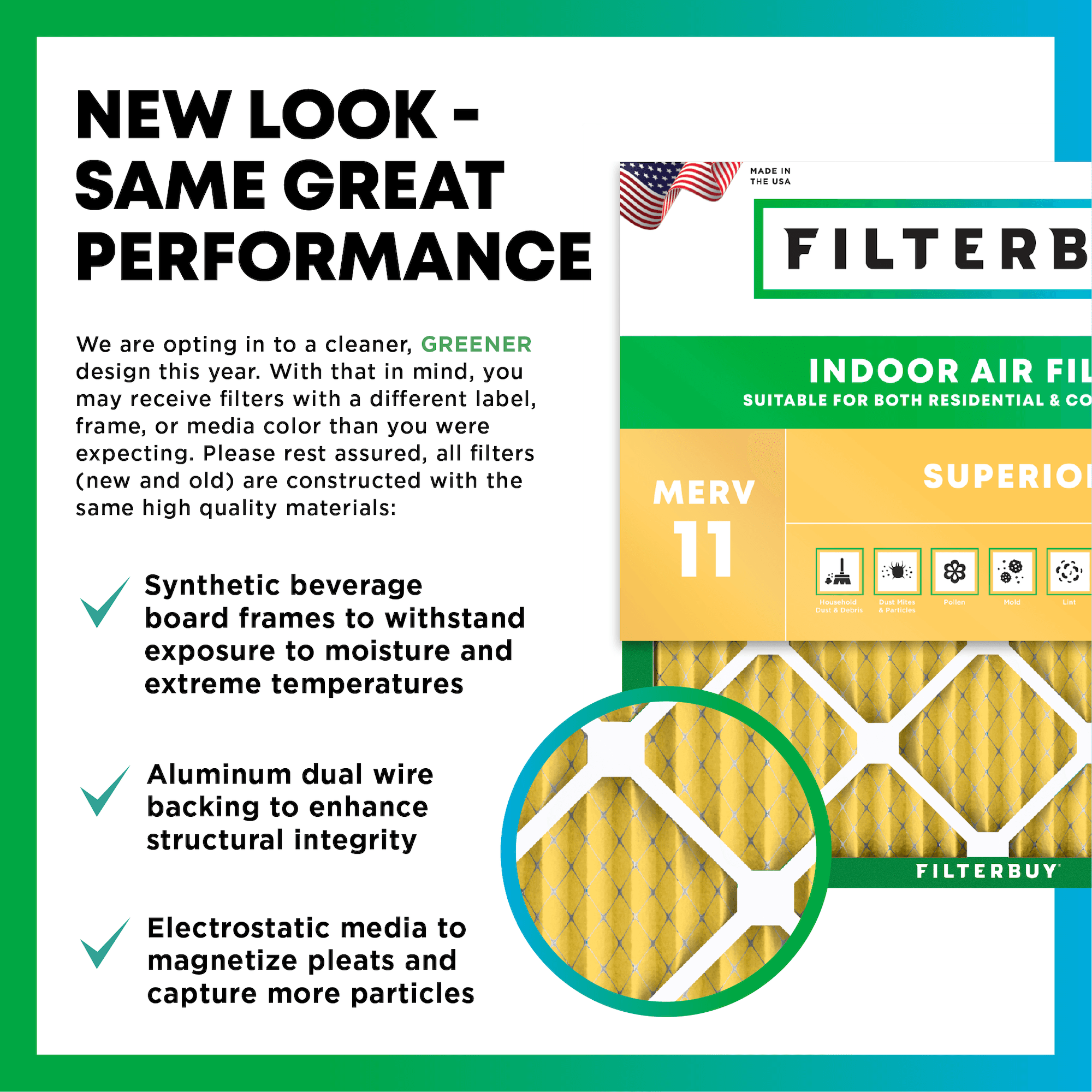
We build every Filterbuy filter to deliver reliable 90-day performance—thanks to smart design and premium materials that do the heavy lifting. Here's what makes the difference:
More pleats = more surface area to capture dust and debris, keeping your air cleaner longer.
Pleats are magnetized to attract and trap microscopic particles—like pet dander, pollen, and smoke.
Engineered to resist warping in extreme temperatures and high humidity.

A layer of metal reinforcement keeps pleats evenly spaced and structurally sound—no sagging, even at high airflow.
Assembled with care. Built to perform. Ships fast, free, and reliably from our U.S. facilities.

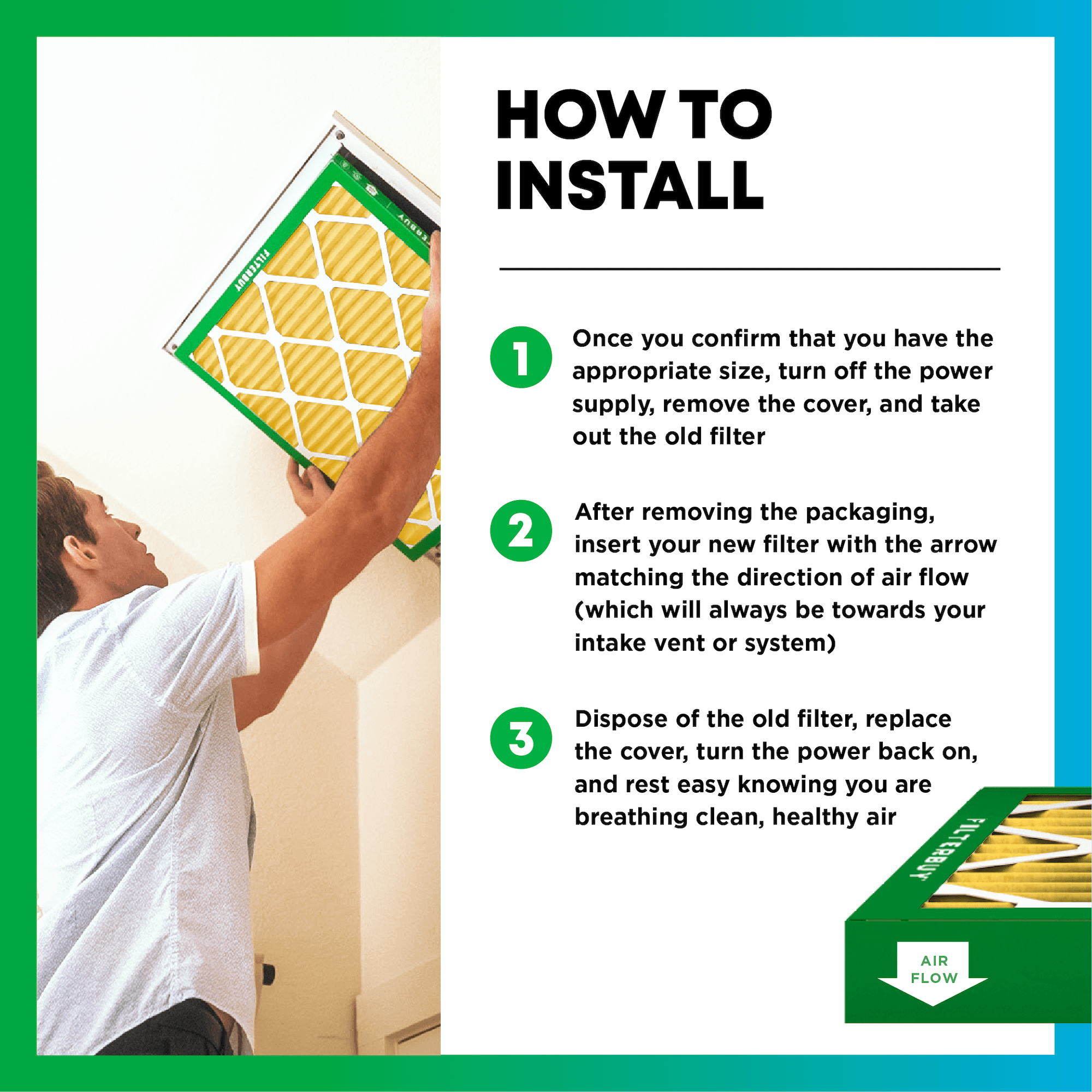
Turn Off Your HVAC SystemSafety first.

Remove The Old FilterLook for the airflow arrow and make note of the direction.

Slide In Your New FilterArrow should point toward the system (same direction as before).

Turn Your System Back OnAnd enjoy the fresh, clean air.

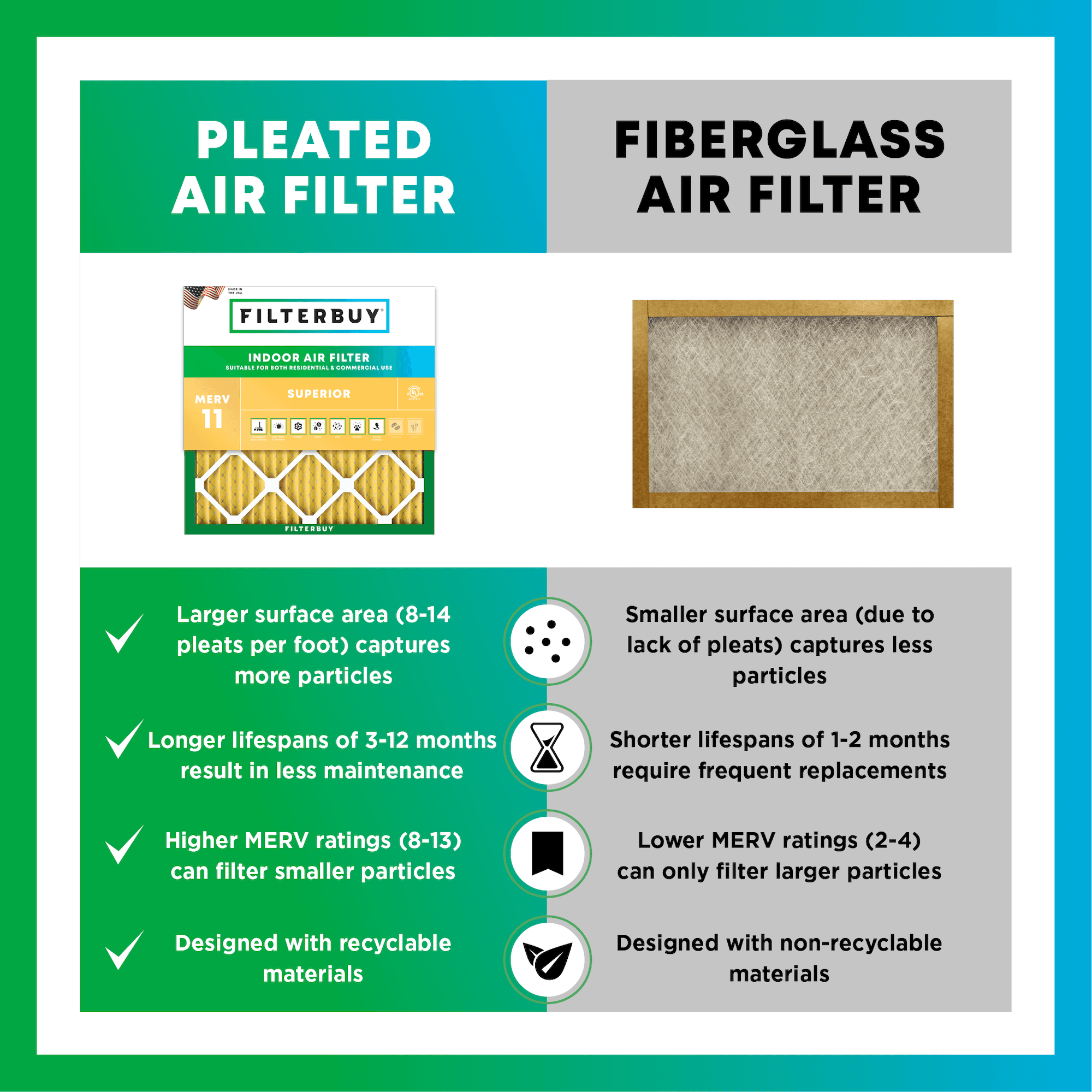
Not all air filters are created equal. Pleated filters don't just last longer—they actually clean your air better. Here's how they stack up:

Efficiency:
High (MERV 8–13) – Traps more particles
Lifespan:
90 days – Long-lasting performance
Air Quality:
Excellent – Cleaner, healthier air
Materials:
Recyclable and durable

Efficiency:
Low (MERV 4 or less) – Misses small stuff
Lifespan:
30 days or less – Replace often
Air Quality:
Minimal – Basic protection only
Materials:
Thin, flimsy, and not recyclable
Pleated filters are a no-brainer—more protection, less hassle, and better air for your home.
Changing your filter on time keeps your HVAC system running efficiently—and helps protect your lungs from dust, allergens, and airborne irritants. Here's how often to swap it out based on your needs:

For most homes without pets or special air quality concerns. Great for general upkeep and energy efficiency.

Shedding fur, dander, and allergy triggers can build up fast. Changing your filter every two months helps keep the air fresher and symptoms at bay.

For households affected by smoke, pollution, or respiratory conditions, monthly changes ensure maximum protection.

| Nominal Size | 17.5 x 23.5 x 1 inches |
| Actual Size | 17.50 x 23.50 x 0.75" inches |
| Filter Type | Pleated |
| Media | Electrostatically Charged |
| Frame | Beverage Board |
| MERV Ratings Available | 8, 11, 13 |
| Lifespan | Up to 90 Days |
| Origin | Made in USA |
If you’ve ever pulled out your old air filter and wondered why the numbers on the frame don’t quite match the vent size, you’re not imagining it. At Filterbuy, after manufacturing millions of filters across 600+ sizes (and plenty of custom ones), we’ve seen how small measurement mistakes can lead to big airflow issues. That’s why we’ve created this clear, step-by-step guide to help you measure your 17.5×23.5×1 air filter the right way—using the same methods our factory experts rely on. Follow along to get a perfect fit, protect your HVAC system, and keep your home’s air clean—without the hassle.
Quick Answers
How to Measure for a 17.5×23.5×1 Air Filter: Step-By-Step Guide
Remove the old filter and lay it flat on a level surface.
Measure edge to edge—length, width, and depth—to the nearest ⅛".
Compare actual vs. labeled size. The printed (nominal) size is rounded up; actual size is usually about ¼" smaller.
Use your measured size when ordering for the best fit.
Pro Insight (Filterbuy): Even a slight size mismatch can affect airflow and air quality. Measure once, buy right, and breathe easy.
Measure precisely. Even a ¼-inch off can impact airflow and filtration.
Check actual size. Don’t rely on the label—measure the filter’s true dimensions.
Ensure a snug fit. Tight, gap-free filters keep contaminants out and systems efficient.
Save energy and money. Proper sizing reduces strain, extends system life, and lowers costs.
Measure once. Buy right. Breathe easy. The perfect fit is the key to cleaner, healthier air.
The very first step of keeping the HVAC system is to find out the accurate sizes of the air filter, which will not only guarantee the unit's proper working but will also improve the quality of the air.
Length, width, and sometimes depth are the primary three factors that are measured in inches. The thickness of most residential air filters is between 1 and 4 inches, while length and width can be different, but most of the time they are between 10 and 25 inches.
If the dimensions are not printed on the side of the filter, then you have to measure it yourself.
This data helps you understand the different types of filters, such as fiberglass, pleated, and electrostatic filters, which have different sizes. For example, pleated filters are, on average, more bulky than fiberglass ones.
Hence, it is very important to know how these measurement units correspond to air filters of different types. The knowledge of air filter sizes is one of the ways to improve the HVAC system performance and indoor air quality.
Starting with measuring an air filter, you definitely need some tools to help you get accurate results. As your first step, gather these particular tools. They are not only the main instruments for your work, but they are also very important in the application of the correct measurement methods.
Your most essential piece of equipment is a tape measure that can accurately determine both the length and the width. The tool you use should be able to bend around the corners of the filter, and at the same time, it should be strong enough to keep it straight while measuring.
The accuracy of instruments is a main point when measuring. Therefore, you have to make sure that the condition of your tape measure is checked in detail. If there is any kind of damage, like a twisted tape or hard-to-read markings, it might give you wrong results. To be more sure, you can also have a backup instrument like a ruler or digital caliper.
Besides that, you need a flat surface where the air filter can be placed during the measuring process. This setting not only helps in eliminating any potential false readings that can come from an uneven surface, but also from a shaky one. If you have these tools, then you are all set to measure your air filter accurately.
After ensuring that you have all the necessary instruments, the next step is to figure out how to accurately measure the length of an air filter. This is, by and large, the longest side of the filter, and it is extremely important to get this measurement accurately if you are to get the correct size of the filter.
The first thing to do is to put your measuring tape at the very edge of the filter. Extend it to the other end, making sure it is straight and even. Measure the length of the filter from the most distant points and do not measure any parts of the housing or casing, as it could result in inaccurate measurements.
The methods of measuring may vary depending on the model of the filter. Some filters may be measured for length while still inside the cabinet. However, for the most accurate results, we suggest that you take the air filter out of its casing before measuring it.
It is very important to check your measurements again. Even small inaccuracies when measuring your length can make you buy the wrong size of the filter, resulting in a bad fit and lower air quality. Using a thorough method is a sure way of having an easy and correct air filter replacement.
Once you have rightly figured out the length of your air filter, next you should focus on the width and depth. These important measurements help ensure a perfect fit in your HVAC system, which is the best way to get fresh air into your house. With a tape measure, find out the width of the shorter side of your filter. You must measure from one end to the other and keep the tape straight and even to get an accurate measure.
As for depth, which is the thickness of your filter, the way of measuring is a bit different. Depth, which is less noticeable than length or width, is just as important when it comes to choosing a filter. Put your tape measure at the top edge of the filter and stretch it down to the bottom edge to get the depth.
Measuring for an air filter may seem like a straightforward task, but mistakes can sneak in unintentionally, and you end up with the wrong size. One of the most common mistakes is not checking whether the measuring tape is level and straight. As a result of this neglect, significant differences in measurements can be obtained, meaning that your filter will not fit.
It is advisable not to rely on a single measurement. Dimensions should be measured at least twice, which helps to determine the size. This approach is very helpful in the identification of errors that were made in the first measurements, thus ensuring correctness.
Errors frequently happen in the selection of tools for measurement. To illustrate, when a ruler is used instead of a tape measure, it can lead to inaccuracies, particularly when the dimensions are large. Therefore, always choose the most appropriate tool for taking accurate measurements.
Measuring your air filter shouldn’t feel like guesswork. As air-obsessed experts, we’ve pulled together the most helpful, trustworthy resources—straight from the field and the factory—to help you measure confidently, protect your HVAC system, and keep your home’s air as clean as it should be.
1. Measure Like a Pro: Filterbuy’s Factory-Backed Guide
After making millions of filters, we’ve learned exactly what causes sizing confusion (and how to fix it). This step-by-step guide shows you how to measure your filter the same way our engineers do—so you get a perfect fit, every time. 🔗 FilterBuy – How to Measure Your Air Filter
2. Learn from the Field: Avoid Costly Sizing Mistakes
Small errors can make a big difference. This expert-backed article explains the most common homeowner measuring mistakes and how to avoid airflow issues that drive up energy bills. 🔗 Home Air Solutions Resources – Avoid Costly Sizing Mistakes
3. Get It Right the First Time: Tools & Tips for Accurate Measuring
The right tools make all the difference. This guide walks you through precision measuring techniques with visuals and pro tips to make sure your filter fits snugly without gaps or strain. 🔗 Air Filter Sizes – How to Measure Air Filter Size
4. Protect What Matters: Why Size Accuracy Impacts Air Quality
Even a small measurement mismatch can restrict airflow and reduce your system’s efficiency. Learn why accurate sizing protects both your HVAC system and your family’s indoor air quality. 🔗 Design Filters – Measuring for the Right Air Filter Size
5. Find Your Fit Fast: Standard and Custom Filter Size Chart
Not sure where your 17.5×23.5×1 fits in? This resource lays out all the most common furnace and AC filter sizes—and explains when to go custom for a made-to-measure solution. 🔗 Comfort First Products – Furnace & Air Conditioner Filter Sizes Guide
6. Understand the Standards: What “Standard Size” Really Means
Ever wondered why your filter’s label doesn’t match your measuring tape? This guide breaks down how the HVAC industry defines “standard” filter sizes—and how to interpret those numbers correctly. 🔗 HVAC.com – Common Air Filter Sizes
7. Decode the Details: Nominal vs. Actual Size Explained
Here’s the truth: that “17.5×23.5×1” label is rounded. This expert explainer walks you through how nominal and actual sizes differ—and how to choose confidently when you reorder. 🔗 Filter Know How – Nominal vs. Actual Filter Size Explained
Pro Tip from Filterbuy: Measuring once the right way saves more than time—it protects your air, your comfort, and your system’s lifespan. Keep these trusted resources handy and measure like the experts do.
“After years of manufacturing millions of filters in hundreds of sizes, we’ve learned that precision matters more than people realize. Even a fraction of an inch can change how your system breathes, how efficiently it runs, and how clean your air really is. The key is simple—measure once, buy right, and let your air do the talking.”
At Filterbuy, after manufacturing millions of filters and testing across hundreds of HVAC systems, we’ve seen one simple truth: even a half-inch sizing mistake can affect your air quality and system performance. The data backs it up—here’s how.
1. You Breathe Indoor Air 90% of the Time
Fact: The U.S. Environmental Protection Agency (EPA) says people spend about 90% of their time indoors (EPA.gov).
Why it matters: If your filter doesn’t fit correctly, unfiltered air—and everything in it—can bypass your system.
Filterbuy insight: We’ve seen how a loose fit lets dust, allergens, and debris slip through. A snug filter means cleaner, healthier air.
2. Filtration Is a Proven Way to Improve Indoor Air Quality
Fact: The EPA and ASHRAE confirm that HVAC filtration is one of the most cost-effective and energy-efficient ways to improve air quality (ASHRAE.org).
Why it matters: Correct sizing ensures full use of the filter’s surface area, optimizing both airflow and contaminant capture.
Filterbuy insight: Every filter we make is precision-cut in our U.S. facilities to the fraction of an inch for maximum performance.
3. Poor Fit = Poor Airflow
Fact: ASHRAE notes that improperly fitted filters can cause pressure drops and reduce airflow (ASHRAE.org).
Why it matters: Too tight restricts airflow; too loose lets air bypass the filter. Both harm efficiency.
Filterbuy insight: We’ve tested both scenarios—and seen how correct sizing maintains steady airflow and system longevity.
What It All Means
You live and breathe mostly indoor air—your filter determines its quality.
Accurate measuring = effective filtration and better HVAC efficiency.
A well-fitted filter protects your home’s air and your system’s lifespan.
At Filterbuy, we measure like it matters—because it does.
At Filterbuy, we’ve seen it all—from filters off by a fraction of an inch to systems struggling under restricted airflow. The takeaway? Accurate measuring isn’t optional—it’s essential.
Why It Matters
We’ve manufactured millions of filters across 600+ sizes. The data is clear: precision measuring leads to cleaner air and longer-lasting systems.
Filter sizing isn’t standardized. A “17.5×23.5×1” filter can vary slightly between manufacturers.
Even a ¼-inch difference can cause air leaks, reduce efficiency, and allow dust to bypass the filter.
Our Real-World Insight
Precision = Protection: Correctly sized filters safeguard your HVAC system and your home’s air quality.
Efficiency Matters: Proper airflow saves energy, improves comfort, and extends equipment life.
Health Impact: A snug, well-measured fit ensures cleaner air for your family—every hour, every day.
Our Honest Opinion
In our experience, the smartest homeowners aren’t the ones who overspend—they’re the ones who measure once, buy right, and breathe easy. That’s the heart of our promise: clean air, without the hassle.
You’ve got the know-how—now take action. Follow these quick, clear steps to get the perfect fit and cleaner air.
1. Double-Check Your Measurements
Measure length, width, and depth to the nearest ⅛".
If numbers differ, use your actual measurements when ordering.
2. Pick the Right Filter Type
Choose your MERV rating:
MERV 8–11: Everyday dust and allergens.
MERV 13+: Pets, smoke, or allergy protection.
Not sure? Try the Filter Finder Tool for quick guidance.
3. Order with Confidence
Buy your 17.5×23.5×1 filter or request a custom fit.
Enjoy fast, free U.S. shipping direct from our factory.
Set up Auto-Delivery to never miss a change.
4. Install and Breathe Better
Check for a snug, gap-free fit.
Breathe easy—your air is cleaner and your system runs smoother.
5. Stay Ahead with Filterbuy
Bookmark this guide for future reference.
Visit our Resource Center for expert tips.
Join our email list for reminders and seasonal offers.
Pro Tip: Measure once. Buy right. Breathe better—that’s clean air without the hassle.
Remove the filter and lay it flat.
Measure length, width, and depth to the nearest ⅛".
Measure edge to edge, not over the frame lip.
The label shows the nominal size (rounded).
Actual size is about ¼" smaller (≈17⅜×23⅜×¾).
This difference allows filters to fit standard systems.
Yes—our testing shows even a ¼" gap reduces filtration.
Too tight restricts airflow; too loose lets dust bypass.
Aim for a snug, gap-free fit for best results.
Replace every 1–3 months based on use.
Check monthly if you have pets, allergies, or high dust.
A clean filter = better air and system efficiency.
Yes—Filterbuy makes custom-cut filters to exact specs.
Made in the USA for a precision fit and performance.
Measure once, order right, and breathe easy.
Pro Tip: Accurate measuring protects your air, saves energy, and extends your HVAC life. Precision always pays off.

