
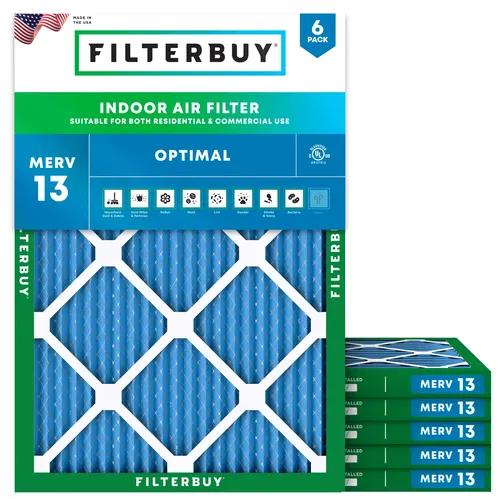
Actual Size: 17.50x23.50x0.75"
 Free Delivery
  Factory-Direct Low Prices, Made in the USA
 Hassle-Free Returns & Free Exchanges
RESIDENTIAL AND/OR COMMERCIAL USE
Change Every 3 Months
Actual Size: 17.50x23.50x0.75"
Free Delivery Factory-Direct Low Prices, Made in the USAHassle-Free Returns & Free ExchangesRESIDENTIAL AND/OR COMMERCIAL USE
Change Every 3 Months
Actual Size: 17.50x23.50x0.75"
Free Delivery Factory-Direct Low Prices, Made in the USAHassle-Free Returns & Free ExchangesRESIDENTIAL AND/OR COMMERCIAL USE
Change Every 3 Months
At Filterbuy, we don't cut corners—we craft high-quality air filters right here in the USA and ship them to your doorstep for free. No delays, no gimmicks—just clean air, made easy. With thousands of five-star reviews and filters built for real life & every HVAC system, it's no wonder why over 4 million families trust Filterbuy.

Proudly Made In The USA

Fast, Free Shipping on Every Order

Premium Materials That Go The Distance

85,000+ 5-Star Reviews From Happy Customers

Save Up to 70% Per Filter with Packs


Measure length × width × depth with a tape measure to find the actual size.

Round up each dimension to the nearest whole number to get the nominal size. Example: 17.50x23.50x0.75" in → 17.5x23.5x1 nominal.

Search by nominal size on our site for the best fit.


If the filter you buy doesn't fit, we'll send you a better size.
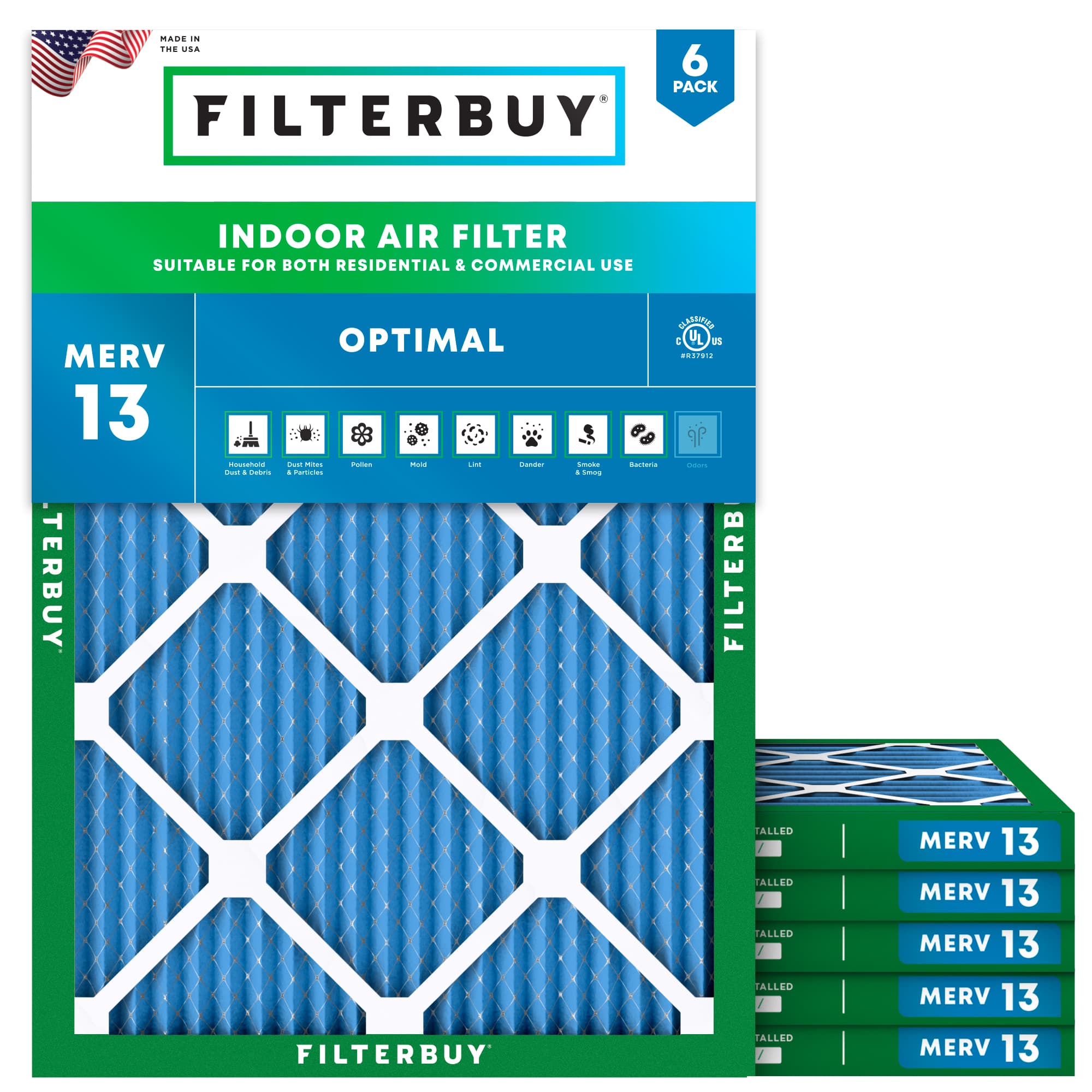
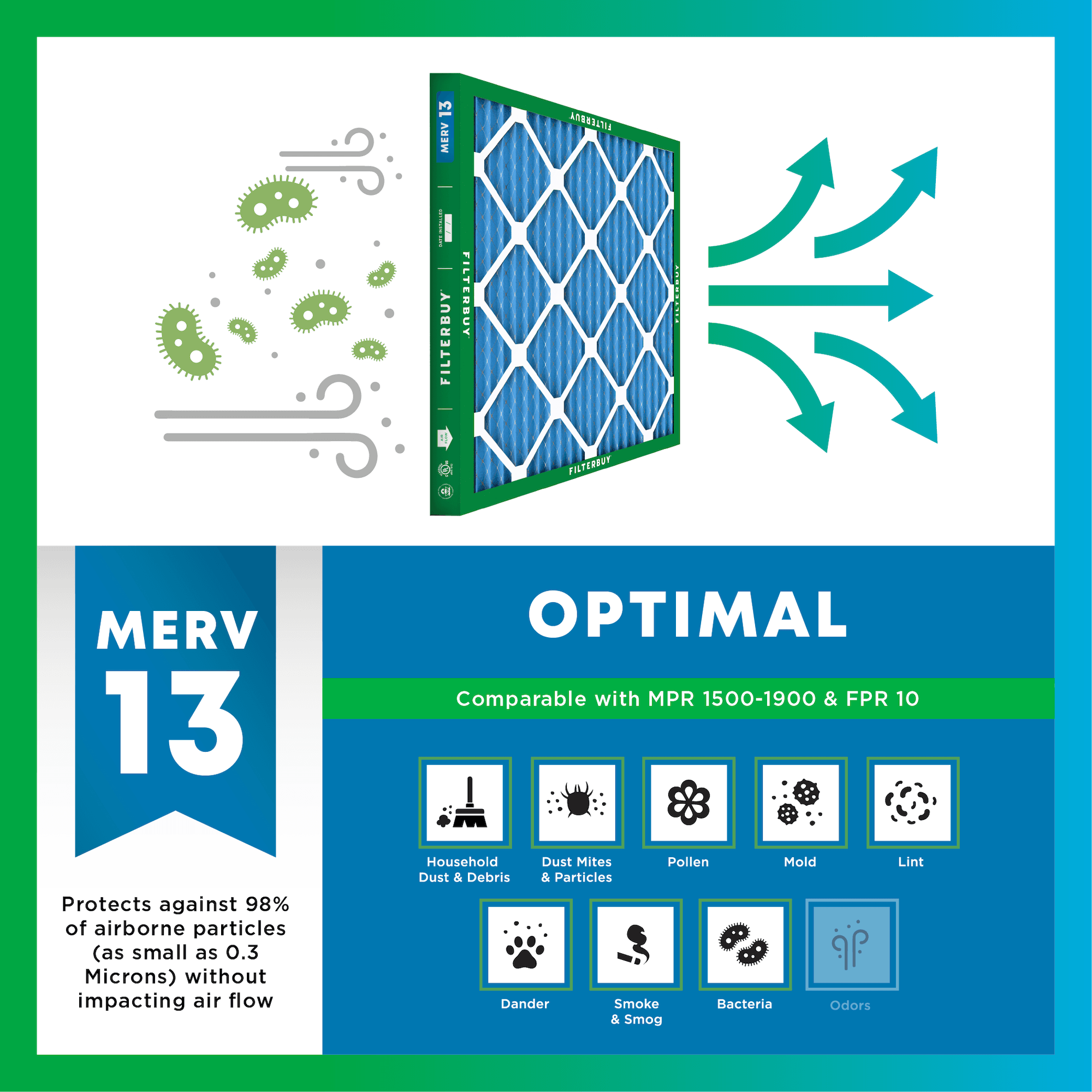
MERV stands for Minimum Efficiency Reporting Value—but don't let the technical name fool you. It's just a way to rate how well an air filter traps stuff like dust, pollen, pet dander, and smoke. The higher the MERV number, the more particles it catches—and the cleaner your air will be.

Comparable to:FPR: 4-7
MPR: 600-1000
 Dust & Debris
 Dust Mites & Particles
 Pollen
 Mold
Mold Lint
Lint Dander
Comparable to:FPR: 6-9
MPR: 1200-1550
Dust & DebrisDust Mites & ParticlesPollenMoldLintDander Smoke & Smog
Comparable to:FPR: 10
MPR: 1900-2800
Dust & DebrisDust Mites & ParticlesPollenMoldLintDanderSmoke & Smog Bacteria


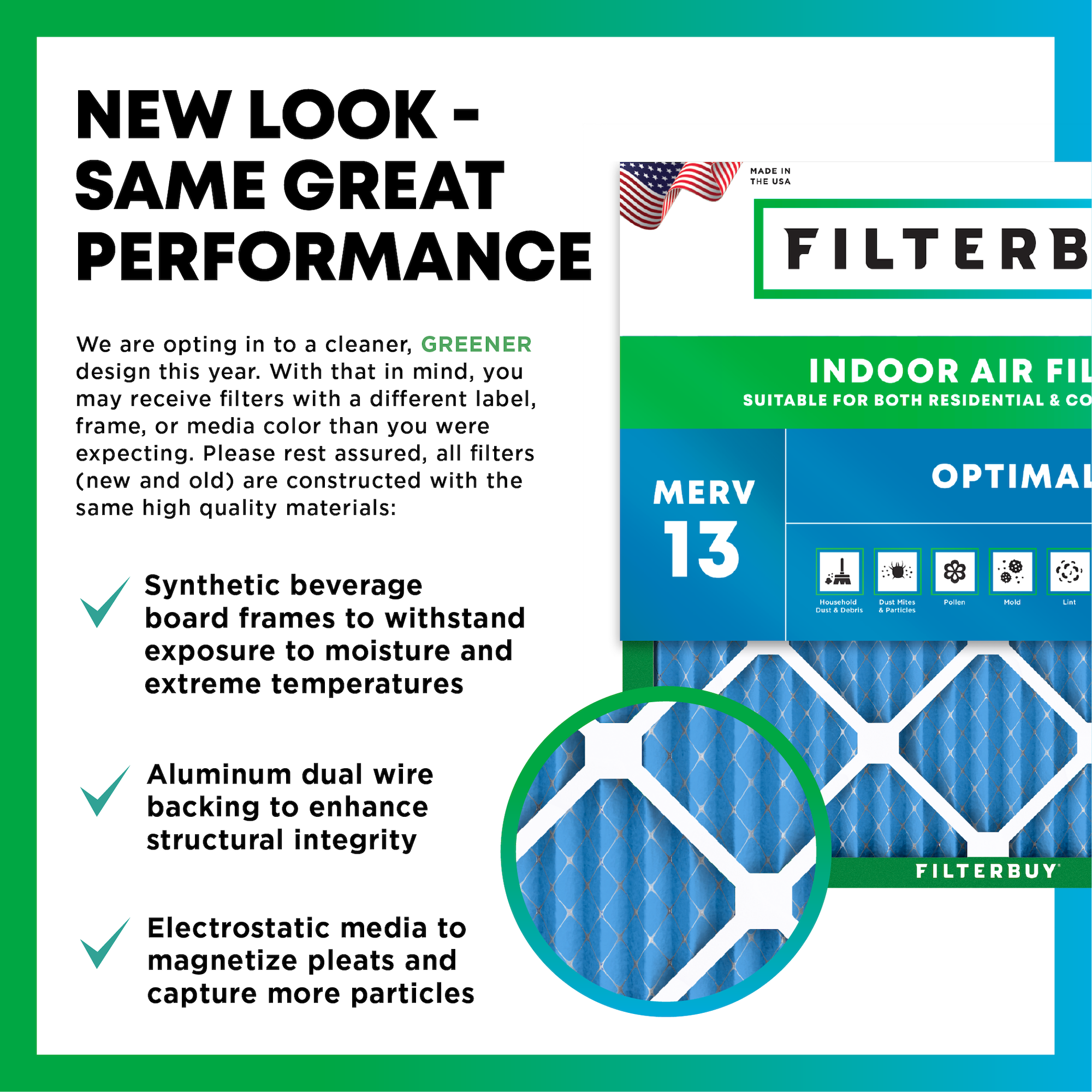
We build every Filterbuy filter to deliver reliable 90-day performance—thanks to smart design and premium materials that do the heavy lifting. Here's what makes the difference:
More pleats = more surface area to capture dust and debris, keeping your air cleaner longer.
Pleats are magnetized to attract and trap microscopic particles—like pet dander, pollen, and smoke.
Engineered to resist warping in extreme temperatures and high humidity.

A layer of metal reinforcement keeps pleats evenly spaced and structurally sound—no sagging, even at high airflow.
Assembled with care. Built to perform. Ships fast, free, and reliably from our U.S. facilities.

Turn Off Your HVAC SystemSafety first.

Remove The Old FilterLook for the airflow arrow and make note of the direction.

Slide In Your New FilterArrow should point toward the system (same direction as before).

Turn Your System Back OnAnd enjoy the fresh, clean air.

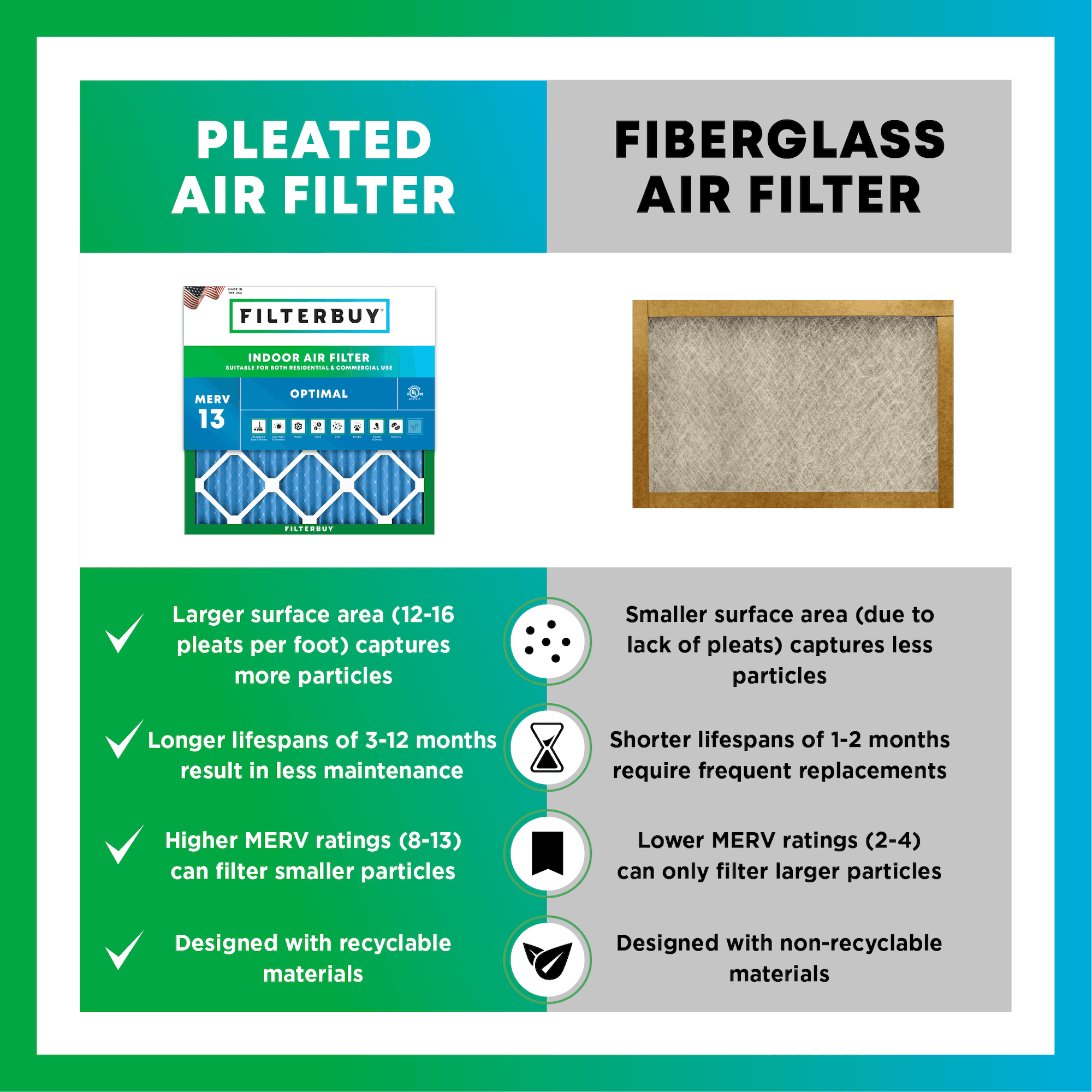
Not all air filters are created equal. Pleated filters don't just last longer—they actually clean your air better. Here's how they stack up:

Efficiency:
High (MERV 8–13) – Traps more particles
Lifespan:
90 days – Long-lasting performance
Air Quality:
Excellent – Cleaner, healthier air
Materials:
Recyclable and durable

Efficiency:
Low (MERV 4 or less) – Misses small stuff
Lifespan:
30 days or less – Replace often
Air Quality:
Minimal – Basic protection only
Materials:
Thin, flimsy, and not recyclable
Pleated filters are a no-brainer—more protection, less hassle, and better air for your home.
Changing your filter on time keeps your HVAC system running efficiently—and helps protect your lungs from dust, allergens, and airborne irritants. Here's how often to swap it out based on your needs:

For most homes without pets or special air quality concerns. Great for general upkeep and energy efficiency.

Shedding fur, dander, and allergy triggers can build up fast. Changing your filter every two months helps keep the air fresher and symptoms at bay.

For households affected by smoke, pollution, or respiratory conditions, monthly changes ensure maximum protection.

| Nominal Size | 17.5 x 23.5 x 1 inches |
| Actual Size | 17.50 x 23.50 x 0.75" inches |
| Filter Type | Pleated |
| Media | Electrostatically Charged |
| Frame | Beverage Board |
| MERV Ratings Available | 8, 11, 13 |
| Lifespan | Up to 90 Days |
| Origin | Made in USA |
If you’ve ever wondered whether a 17.5×23.5×1 filter will fit a 17×23 or 18×24 slot, you’re not the only one—we see this question all the time in our factory. After manufacturing millions of custom and standard filters right here in the U.S., we’ve learned that “close enough” sizing doesn’t always mean a proper fit. Slight differences between nominal and actual sizes can affect airflow, efficiency, and even the lifespan of your HVAC system. In this guide, we’ll share exactly how our experts measure, test, and recommend the right filter dimensions—so you can protect your system and your air quality with confidence.
Quick Answers
Can a 17.5×23.5×1 Filter Fit a Slot Listed as 17×23 or 18×24?
Short Answer: No — a 17.5×23.5×1 filter won’t fit properly in a 17×23 or 18×24 slot.
Why It Matters:
A 17×23 slot is too tight.
An 18×24 slot leaves gaps that let unfiltered air slip through.
Even a ½-inch difference can hurt airflow, efficiency, and air quality.
FilterBuy Insight: After manufacturing millions of filters, we’ve found that a custom 17.5×23.5×1 filter is the best solution for an airtight seal, cleaner air, and longer HVAC life.
Pro Tip: Always measure your slot’s actual size to the nearest ⅛ inch—then match it to the filter’s actual dimensions, not the printed label.
Fit matters.
Even a ½-inch difference can impact airflow, energy use, and air quality.
Measure, don’t guess.
Printed filter sizes are nominal—always measure your slot for actual size.
Tight seals = better performance.
A snug fit boosts efficiency and can lower energy costs by 5–15%.
Go custom when needed.
Perfect fit, cleaner air.
The right size means longer system life and healthier indoor air.
The size of an air filter is a very important factor for its performance and efficiency. The physical dimensions of the filter are the main influencers of the penetration of the particles to be trapped, thus increasing the quality of the air in the given rooms.
In order for the filters to be at their best, they have to meet certain size standards set by professionals from the industry. These standards work as a kind of guarantee that the filters will be in the correct places inside the air handling systems. Several issues may arise due to a poorly sized or misaligned filter, like bad air quality, higher energy consumption, and damage to the system may occur.
Understanding filter sizes requires one to know the length, width, and depth of a filter. These characteristics of the product, normally in inches, are very visible and easily accessible on the packaging. Most of the time, sellers indicate the size of the air filter in a system like 17.5x23.5x1. Therefore, the first two figures stand for length and width, and the last one is depth.
Acknowledging the exact filter fit importance is a direct result of understanding filter sizes. The fit, exact by definition, is not a luxury but a requirement for maximum filter performance and air quality maintenance. Too small a can lead to a situation where air is not properly filtered, while too large a can cause the slot not to be properly integrated.
We can highlight the importance of an exact fit by these four points:
Improved Performance of Filters: More pollutants can be captured by correctly fitted filters, thus their effectiveness is increased.
Better Indoor Air Quality: By a precise fit that prevents the circulation of unfiltered air, it helps to maintain better air quality indoors.
Longer Lifespan of the HVAC System: Filters that fit well take the load off the HVAC systems, thus their lifespan may be extended.
Cost Effectiveness: Precisely fitting filters are infrequently replaced, thus long-term savings are achieved.
One of the most important factors for an HVAC system working at its best is filter size compatibility. Filter sizes are the main characters in the story. For example, a 17.5x23.5x1 filter would be the length, the width, and the thickness, respectively. Therefore, wrong sizes might result in a poor quality of air, increased energy consumption, or even a situation where the HVAC system gets damaged.
When purchasing filters, you should first know the exact size of the product rather than the nominal size, which is rounded. For instance, a 17.5x23.5x1 filter may have a nominal size of 18x24.
The correct filters also depend on the installation advice. Don't forget to turn off your HVAC system before changing the filter. Check how the old filter is placed and do it the same way with the new one, i.,e. The air flow arrow should be pointing to the furnace or air handler. Secure the filter into the slot, but don't force it in. The most common mistakes are the most dangerous i.,e. Too-tight or too-loose filters can cause inefficiencies or harm your system.
Understanding the effect of size differences in filters is very important for the best performance of the HVAC system. Most of the time, these differences result from the misunderstanding of the filter dimensions and sizing standards. Such confusion can cause system inefficiencies and, in some cases, system damage.
Below are the most important things to consider:
Actual vs. Nominal Size. There is a difference between a filter's actual and nominal size. Nominal size indicates the approximate dimension, which is rounded up to the nearest inch. Whereas the actual size shows the exact measurement.
Standardized Sizing. The sizes of HVAC filters are based on industry standards that may vary from one manufacturer to another. It is always good to check the size of the replacement filter before buying it.
Size Discrepancies. Slight differences in size may affect a filter's efficiency and, at the same time, cause your HVAC system to be unreasonably stressed. Therefore, it is better to use a filter that is closest to the size of your system.
Measurement Technique. Take the measurements of your filter slope,t, and if there is a housing or casing that will increase the size of the filterconsider that on as well.
Knowing these factors helps you to be very confident when making decisions regarding filter size discrepancies.
In reality, principles most of the time need to be tweaked very closely before they can be put to work effectively. Filters illustrate this point well, as their sizes might differ due to production variances or measurement rounding. It is in such cases that customized solutions and precise measurement methods turn out to be very helpful.
Consider a filter of 17.5×23.5×1 dimensions, for instance. Its size may not match that of a 17×23 or 18×24 slot exactly. Nevertheless, with slight modifications, this filter may work efficiently. The exact measurement of the slot should be used to determine if the filter will fit or not. A bigger one may not fit, whereas a smaller one might allow unfiltered air to pass.
The problems such as these are solved by the custom filter solutions. These tailor-made filters are the ones that fit your slot exactly; hence, size discrepancy issues are eliminated. However, they are usually accompanied by a higher price and longer delivery time than the standard ones.
When it comes to indoor air, “close enough” doesn’t cut it. These trusted resources—from the EPA to real-world HVAC experts—can help you understand exactly why filter size, fit, and quality make all the difference.
1. EPA Guide to Air Cleaners in the Home – Learn How Clean Air Really Works
The U.S. Environmental Protection Agency (EPA) breaks down how filters impact your home’s air quality, energy use, and health. It’s a must-read if you want the science behind better breathing. 🔗 epa.gov/indoor-air-quality-iaq/guide-air-cleaners-home
2. Kleenex Air Quality Guide – Understand Filter Sizes the Easy Way
This simple guide explains the difference between nominal and actual filter sizes—why the numbers don’t always match, and how to measure your slot correctly. Clear, helpful, and quick. 🔗 kleenex.com/en-us/tips-advice/air-quality/all-about-air-filter-sizes
3. HVAC.com Expert Advice – See Which Filter Sizes Are Most Common
Industry pros share which sizes are most used, how to measure correctly, and what happens when your filter doesn’t quite fit. Great for homeowners who like to understand the “why” behind the fix. 🔗 hvac.com/expert-advice/common-air-filter-sizes-air-filters-size/
4. FilterBuy Measurement Guide – Measure Like an Air Pro
Straight from our U.S. manufacturing floor—this guide walks you through how to measure your filter slot the right way. No guesswork, no wasted filters—just a perfect fit every time. 🔗 filterbuy.com/resources/air-filter-basics/measure-air-filter/
5. Design Filters Guide – Avoid Common Airflow Mistakes
A helpful visual guide showing how incorrect sizing leads to air leaks, pressure drops, and uneven airflow. Knowing what to avoid makes every replacement a smarter one. 🔗 designfilters.com/how-to-correctly-measure-for-the-right-air-filter-size/
6. AC Tune-Up Pros – Learn from the Pros Who See It Every Day
Real-world technicians explain how to pick the right filter size and MERV rating based on actual system performance. It’s hands-on insight from the people who service HVAC systems daily. 🔗 actuneuppros.com/choosing-the-right-hvac-air-filter-sizing-calculations/
7. All Filters Blog – Get Step-by-Step Help for Measuring and Replacing Filters
This quick-read guide covers how to measure, choose, and replace your home’s air filters the right way—so your system runs smoother and your air stays cleaner. 🔗 allfilters.com/blog/how-to-change-home-air-filter-sizing-guide
Pro Tip from FilterBuy: If your system slot is labeled 17×23 or 18×24, a custom 17.5×23.5×1 filter will likely give you the best seal, efficiency, and clean-air results. Measure twice—filter once—and your HVAC system will thank you.
“After manufacturing millions of filters in the U.S. and helping homeowners with every kind of HVAC setup, we’ve learned one simple truth—the right fit isn’t just about measurements; it’s about performance. Even a half-inch gap can undo the clean-air benefits you’re paying for. When your filter fits perfectly, your system runs smarter, your air stays cleaner, and your family breathes easier.”
At FilterBuy, we’ve seen how even a small gap between a filter and its frame can impact energy use, airflow, and indoor air quality. The research—and our own testing—prove it.
1. Energy Efficiency Gains – U.S. Department of Energy
Properly fitted, clean filters can cut energy use by 5–15%.
Restricted airflow or loose filters force your system to work harder.
Our tests show that better airflow extends system life and reduces strain. 🔗 energy.gov/energysaver
2. Cleaner Air Performance – EPA AirNow
High-efficiency filters (MERV 13–16) can remove up to 95% of airborne particles.
A tight fit is crucial—even small gaps allow dust and allergens to bypass.
We’ve confirmed this in our U.S. manufacturing facility during filter fit testing. 🔗 airnow.gov
3. Sealing for Better Efficiency – ENERGY STAR
Proper sealing and fit can improve HVAC efficiency by up to 20%.
Many air leaks start right at the filter slot, not deep in the ducts.
A snug, well-made filter helps prevent bypass air and boosts system performance. 🔗 energystar.gov
4. Fit and Safety Standards – CDC/NIOSH
The CDC recommends ensuring filters are properly sized and sealed.
We’ve seen this principle in homes and commercial systems alike—fit equals performance. 🔗 cdc.gov/niosh
Bottom Line: A filter that doesn’t fit perfectly can’t perform perfectly. Choosing the correct 17.5×23.5×1 filter—measured to your exact slot—means:
Lower energy costs
Cleaner, healthier indoor air
After years of building and testing filters in our U.S. facilities, we’ve learned one simple truth:
Precision matters. Even a half-inch difference can make or break your HVAC performance.
Here’s what experience has taught us:
A “close enough” fit often means air leaks and reduced efficiency.
A perfect fit delivers cleaner air, smoother airflow, and lower energy costs.
Filters that seal tightly protect your system—and your family’s health.
In our experience:
Homeowners who measure correctly enjoy quieter systems and longer filter life.
Properly sized filters reduce strain and keep the air cleaner between replacements.
Our takeaway: Measure twice, filter once. The right 17.5×23.5×1 filter—custom-made to your slot—means your HVAC breathes easier, runs better, and keeps your home’s air truly clean.
Follow these simple steps to get the perfect filter fit:
1. Measure Your Slot
Use a tape measure to get the exact width, height, and depth.
Round to the nearest 1/8 inch for accuracy.
2. Check Your Current Filter
Printed sizes are nominal, not exact.
Match your measured slot to the actual filter size.
3. Choose the Right Fit
Between sizes (17×23 or 18×24)? → Order a custom 17.5×23.5×1 filter for a perfect seal.
Pick a MERV rating suited to your air quality needs.
4. Order with Confidence
All filters are U.S.-made, custom-built, and ship free & fast.
Set up auto-delivery to replace filters on time—without reminders.
5. Breathe Easier
Pro Tip: Save this page or sign up for FilterBuy reminders—so your filters always fit and arrive right when you need them.
No. It’s too large for 17×23 and too small for 18×24.
Even a ½-inch difference can cause air leaks or reduced airflow.
Based on our factory tests, a custom-sized filter ensures a perfect seal.
Printed sizes are nominal (rounded for labeling).
Actual sizes are slightly smaller for easier installation.
We recommend measuring the slot to the nearest 1/8 inch for true accuracy.
Loose fit: Unfiltered air bypasses the filter.
Tight fit: Airflow is restricted, straining your system.
From experience, both reduce efficiency and indoor air quality.
Measure the slot’s width, height, and depth with a tape measure.
Compare to the actual size listed online, not the nominal label.
Our team uses these measurements to build filters that fit exactly right.
Yes—custom filters seal better, last longer, and improve airflow.
We’ve seen them cut energy costs and extend HVAC system life.
The right fit always leads to cleaner, healthier air at home.

