
How to Measure Your Air Filter: Complete Step-by-Step Guide
September 19, 2026
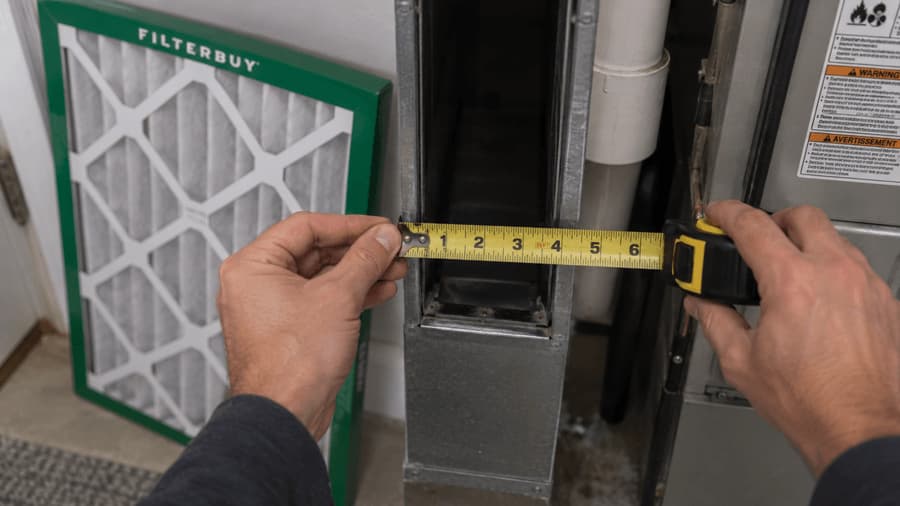
Getting the right filter size is simpler than it looks. This guide walks you through reading the label on your existing filter, taking manual measurements when the label is missing, and understanding why the number you order is slightly different from what you measure.
Why Filter Sizing Matters More Than You Think
Even a half-inch gap around your filter can reduce filtration effectiveness by 20–30%. That gap lets unfiltered air bypass your MERV-rated filter entirely — circulating dust, allergens, and contaminants through your home without you knowing.
Unfiltered particles circulate freely through every room
System works harder to compensate for air bypass or restriction
Contaminants reach sensitive components, causing premature failure
Your MERV rating is worthless if air flows around the filter
Step 1: Check Your Existing Filter Label
Start here — it's the fastest method. Look along the cardboard frame of your current filter. Most filters display two measurements side by side.
Printed in large type on the frame. This is the rounded ordering size — the number you use when buying a replacement.
Printed in smaller type. The filter's true physical dimensions — always slightly smaller than the nominal size.
Step 2: Measure Manually if the Label Is Gone
If your label is faded, torn, or missing, grab a tape measure and follow these steps.
The shorter horizontal edge, measured from frame edge to frame edge.
The longer horizontal edge, measured from frame edge to frame edge.
The thickness of the filter. This is the dimension most people forget.
Round to the nearest whole inch — 19.5" becomes 20". That's your nominal size to order.
Always measure all three dimensions — not just length and width. A wrong depth is the most common ordering mistake we see.
Understanding Nominal vs. Actual Sizing
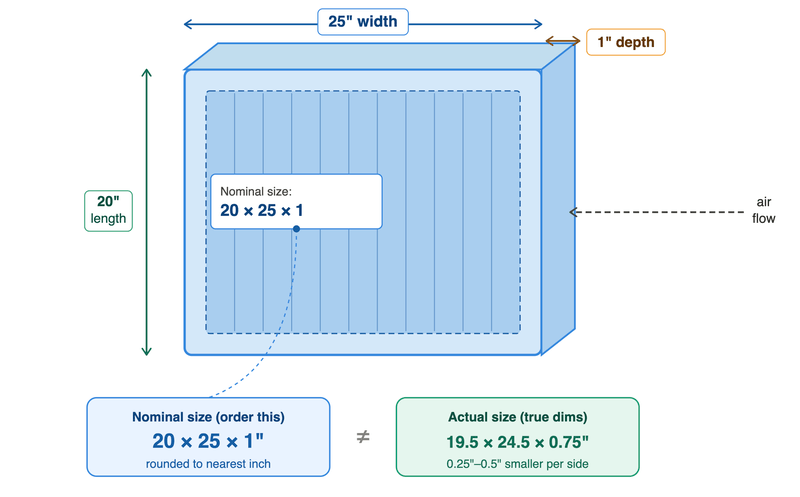
This is the single concept that trips up most homeowners. Filters are deliberately made slightly smaller than their labeled size — that small clearance is what lets them slide into the housing without binding.
Nominal and actual size typically differ by 0.25" to 0.5" per side. A filter labeled 20×25×1 actually measures around 19.5×24.5×0.75. This is standard across the industry — not a defect.
Standard Filter Depths at a Glance
Depth is the dimension that determines compatibility with your HVAC unit. Always verify which depths your system supports before ordering a thicker filter.
| Nominal depth | Actual depth | Best for |
|---|---|---|
| 1"Most common | 0.75" | Standard residential HVAC systems |
| 2" | 1.75" | Upgraded residential, longer change intervals |
| 4" | 3.75" | High-capacity systems, commercial use |
| 5" | 4.75" | Whole-home filtration systems |
Safety and Installation Checklist
Before you pull out the old filter, run through these four steps.
Always power down at the thermostat first. Removing a filter while the system runs pulls unfiltered air and debris into the unit.
Every filter frame has printed arrows. Photograph or memorize the direction before pulling it out — your replacement must go in the same way.
Run your hand around the edges after inserting the new filter. Any air movement means a gap — and a gap means the filter isn't working.
Look for warping, cracks, or buildup on the housing walls. Damage here can affect fit regardless of filter quality.
When Your Size Doesn’t Exist
Older homes, custom builds, and certain HVAC models often use non-standard dimensions. If your measurements don't match any common size, don't try to modify a standard filter to fit — the resulting gaps undo any filtration benefit. Custom filter manufacturers can produce filters to exact dimensions. When ordering, use your actual measured dimensions (before rounding) so the manufacturer can size the nominal correctly for your housing.
TL;DR
Your air filter’s size is the nominal size printed on its cardboard frame, three numbers like 20x25x1, in inches. That is the number to order. If the print has worn off, or the system is sitting empty, measure the slot instead and round each dimension to the nearest inch. Land on a true fraction like 22.25 and you have a custom slot, which Filterbuy cuts to the exact figure.
Key Takeaways
Filter sizes read short side by long side by depth, so a 16x25x1 is 16 inches by 25 by 1 inch thick.
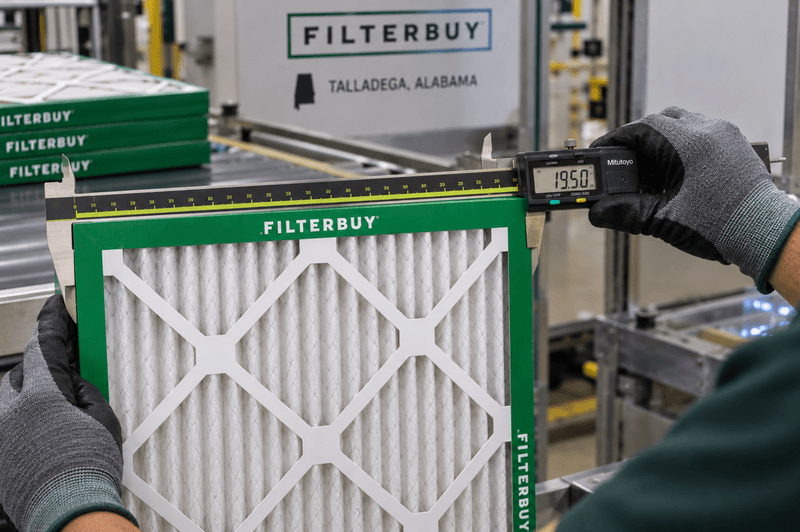
Filterbuy cuts every size half an inch under nominal, which is why a 20x25x1 measures 19.50 x 24.50 x 0.75.
The most common size in American homes is 20x20x1, followed by 16x25x1, 16x20x1 and 20x25x1.
If there is no filter to measure, measure the slot opening itself, because the return grille frame around it is always larger.
Your HVAC brand does not set your filter size. Carrier, Trane, Goodman and Rheem all take standard nominal sizes.
Depth is the dimension Filterbuy’s manufacturing team sees ordered wrong most often, and a 1-inch slot will not take a 4-inch filter.
How Do You Measure an Air Filter?
Measuring an air filter takes a tape measure and about five minutes. Turn the system off, pull the old filter out, measure the slot it came from in three dimensions, then round each number to the nearest inch.
Turn the system off at the thermostat. Pulling a filter while the blower is running draws debris straight into the unit.
Take the old filter out. Set it aside and measure the slot rather than the filter, because one that has sat there a season is usually bowed, and a bowed filter reads short.
Measure the short side, then the long side. Run the tape edge to edge across the opening.
Measure the depth. How far the slot runs front to back. Most people skip this one, and it is the dimension that decides whether a filter fits at all.
Round each number to the nearest whole inch. A slot at 19.9 or 20.1 takes a 20-nominal filter. If you land on a true fraction, stop here and read the fractional-slot section below before you order.
Which Number Is Which on an Air Filter?
Write the three numbers as short side, long side, depth, and you will never order a filter turned sideways. A 16x25x1 is 16 inches across its short side, 25 inches across its long side, and 1 inch thick.
The confusing part is that the industry calls the first number the length and the second the width, which is backwards from the way most people describe a rectangle. That one convention causes more trouble than anything else in filter sizing, so ignore the labels and keep the order.
The question I get most is which MERV to buy. The one to ask first is whether the filter you are holding actually fills the slot. A rating describes the media, not the gap around it.
Michelle Wan, Brand Manager and Air Quality Writer, Filterbuy
Why Is the Actual Size Smaller Than the Size on the Label?
Every filter carries two sizes. The nominal size is the rounded number on the frame, and the actual size is what the filter really measures, cut smaller on purpose so it slides into the slot without binding.
The EPA notes that home filters run between 1 and 5 inches thick, and depth is also the dimension our manufacturing team sees ordered wrong most often. Here is what we cut to.
Nominal size is what you order. Actual size is what the Filterbuy filter measures.
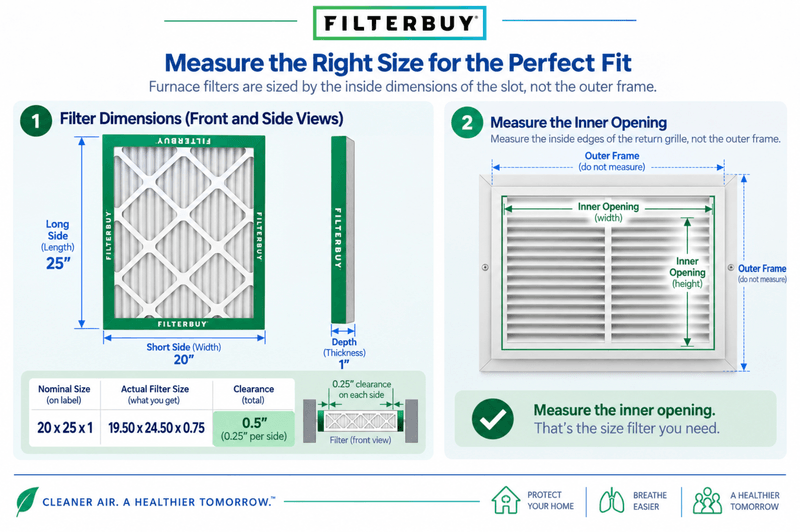
Flat dimensions run half an inch under nominal on every size Filterbuy cuts, and no industry standard sets that clearance, so read the frame on any filter from another maker. We publish both numbers because we cut to both. A company that prints only the nominal size has told you what to order and left you guessing about the fit.
How Close Does the Fit Have to Be?
Close enough is a quarter of an inch of clearance per side, and the cut spec is what lets you check it. A Filterbuy 20-nominal filter measures 19.50, so a slot opening at 20.00 leaves a quarter inch of clearance per side, which is exactly what the design expects. At 20.40 you have most of an inch sitting on one side, and that is the kind of gap the bypass figures further down describe. Measure to the tenth of an inch.
How Do I Know What Size Air Filter I Need Without a Filter?
Measure the empty slot. You do not need the old filter to work this out, and in a new build there may never have been one.
Start by finding the slot. It sits on the return side of the furnace or air handler, or behind a return grille in a wall or ceiling. More on where your air filter is located.
Then measure the opening the filter drops into, because a grille’s outer frame is always larger than the filter behind it. Take the depth as well, round each number to the nearest inch, and repeat the whole thing at every return your home has.
Homeowners bring me the old filter and ask what to buy. I ask for a photo of the empty slot instead. Half the time the filter they had been using was never right for the opening it sat in.
David Clark, Licensed HVAC Technician, Filterbuy HVAC Solutions
What Are the Most Common AC Filter Sizes?
The most common air filter size in American homes is 20x20x1, followed by 16x25x1, 16x20x1 and 20x25x1. Furnace, AC and HVAC filter sizes all describe the same measurement, because a forced-air home runs heating and cooling through one blower and one filter.
All dimensions in inches, from Filterbuy production specifications.
Filterbuy labels its size chart by where each size turns up instead of by popularity, since we are the ones cutting them. 16x25x1 lands in furnace slots, while 20x22x1 and 20x24x1 belong to air handlers. The full air filter size chart lists every dimension we cut. Shop the four above directly: 20x20x1, 16x25x1, 16x20x1 and 20x25x1.
Can I Find My AC Filter Size by Model Number?
Your HVAC brand does not determine your filter size. Your slot does. Carrier, Trane, Lennox, Goodman, Rheem and York air handlers all take standard nominal sizes, and two homes with the same model number can need different filters, so measuring a Carrier filter is the same job as measuring any other.
The exception is a whole-house media cabinet. Those run 4 or 5 inches deep, are built to brand-specific dimensions and are often fractional, so read the size off the cabinet label and do not round it.
How Do You Measure a Ceiling Return Filter?
A ceiling return measures like any other, except that you are doing it on a ladder. Turn the system off, release the grille latches, let the cover hinge down, and measure the inner opening. The airflow arrow points up into the duct rather than back at the room, so photograph the old filter before you pull it.
What if My Slot Measures Between Sizes?
Rounding works on the assumption that you land near a whole number. On a true fraction like 17.5 or 22.25 it costs you either way: round down and air bypasses the filter, round up and the filter will not seat.
What you have there is a custom slot, and it turns up more often than the category admits, because builders frame the compartment to the ductwork and ductwork does not care what a catalog stocks. Record the exact figure and order a custom air filter cut to those numbers. The Filterbuy custom range covers any dimension from 3/8 inch to 30 inches, which was a deliberate decision: we built it around what installers frame, not around what sells.
How Do I Know the Filter I Ordered Actually Fits?
Slide it in, then run a hand around all four edges while the system is running. Air moving at the edge means air is travelling around the filter instead of through it. Almost nobody does this check, and it is the only one that confirms the measurement was right.
Three other signs give a bad fit away. A filter that bows once seated is too big. One you can rock side to side is too small. And if you had to force it in at all, stop, because a bent filter has already lost its seal along the fold.
The EPA puts the requirement plainly in its Guide to Air Cleaners in the Home: a filter has to fit snugly, with no air leaking around it and no bending to make it fit. The Supporting Statistics below put numbers to what happens when it does not.
Supporting Statistics
Three findings from federal and independent US sources on why fit matters as much as rating.
1. A filter sitting loose in its slot lets roughly 10% of the air past it. A filter with a large gap around it lets 25% past.
Lawrence Berkeley National Laboratory modelled residential coil fouling across three bypass cases: none, 10% for a filter in a loose slot, and 25% for one with a large gap around it or fixed on a single edge. The no-bypass case is uncommon because it takes deliberate sealing, and the paper notes that a high-MERV filter’s added efficiency can be largely compromised by bypass. These are engineering estimates used in a simulation rather than field measurements. Source: Siegel, Walker and Sherman, Dirty Air Conditioners, ACEEE Summer Study, 2002.
2. 82.7 million American homes cool with a central system, and 36 million of those sit in houses built before 1980.
The 2020 Residential Energy Consumption Survey, drawn from 18,496 households, counts 82.69 million homes cooled mainly by central air conditioning or a heat pump, and every one of them has a filter slot to measure. Of those, 35.96 million, or 43%, sit in houses built before 1980, where the compartment was framed to the ductwork instead of to a catalog size. Source: U.S. Energy Information Administration, 2020 RECS Table HC7.3.
3. Improper installation can cut a heating and cooling system’s efficiency by up to 30%.
ENERGY STAR, the joint EPA and Department of Energy program, puts installation quality at up to 30% of system efficiency. The figure covers equipment installation rather than filter fit, and we offer it as the closest federal measure of the principle this page rests on. Source: ENERGY STAR (U.S. EPA and U.S. DOE), Heat & Cool Efficiently.
Frequently Asked Questions
Four questions that come up after the measuring is done.
How Many Air Filters Does My House Need?
More than one, usually, and often in more than one size. A two-story house frequently runs separate systems upstairs and down, each with its own slot, and a single system can pull through several return grilles that each hold a filter. Count your return vents before you order, and measure every one of them.
Can I Cut a Filter Down to Fit?
No. Trimming destroys the seal along the cut edge, and unfiltered air takes the path of least resistance straight through the gap you just made. If your slot is not a standard size, order a custom filter cut to your measurement instead.
What Micron Size Does an Air Filter Capture?
MERV ratings report minimum capture across three particle bands. The EPA publishes the full table. MERV 8 is rated at least 20 percent at 1 to 3 microns, MERV 11 adds 20 percent at 0.3 to 1 micron, and MERV 13 reaches 50 percent in that same band. For scale, a human hair is about 75 microns across. More on air filter MERV ratings.
Do Sponge and Foam Filters Use the Same Sizes?
Yes. Washable sponge filters, also called foam filters, come in the same standard nominal sizes as pleated ones, so you measure for them exactly the same way.
Glossary
Nominal size. The rounded dimensions printed on a filter frame, such as 20x25x1, and the size you order by.
Actual size. What the filter really measures, always under nominal. A Filterbuy 20x25x1 comes off the line at 19.50 x 24.50 x 0.75.
MERV. Minimum Efficiency Reporting Value, the scale defined in ANSI/ASHRAE 52.2. It rates what a filter captures and says nothing about how it fits.
Micron. One millionth of a meter, the unit used for airborne particle size.
Filter slot. The framed opening a filter seats into, on the return side of the system.
Return grille. The vent that pulls room air back in, with an outer frame larger than the filter behind it.
Media cabinet. A housing in the ductwork built for a 4 or 5 inch filter.
Sponge filter. A washable foam filter, sold in standard nominal sizes and measured like a pleated one.
Custom air filter. A filter built to exact dimensions, fractions included, for a slot no standard size fits.
Sources and Authorship
Sources: EPA, MERV ratings · EPA, Guide to Air Cleaners in the Home · ENERGY STAR · American Lung Association · ANSI/ASHRAE 52.2 · Filterbuy production specs.
Michelle Wan is Brand Manager and Air Quality Writer at Filterbuy, turning MERV ratings, filtration and HVAC efficiency into plain-English advice (B.A., UC Santa Cruz). Working with Filterbuy’s manufacturing teams, she writes from how filters are built and used, not spec sheets. Reviewed by David Clark, Licensed HVAC Technician, Filterbuy HVAC Solutions.
Filterbuy is a second-generation, family-owned American manufacturer. It began in the 1950s as Talladega Machinery and Supply, sold its first filter in 2013, and makes 100% of its products in the USA.