
How to Replace an AC Air Filter: Steps, Arrow Direction, and Size
May 5, 2026
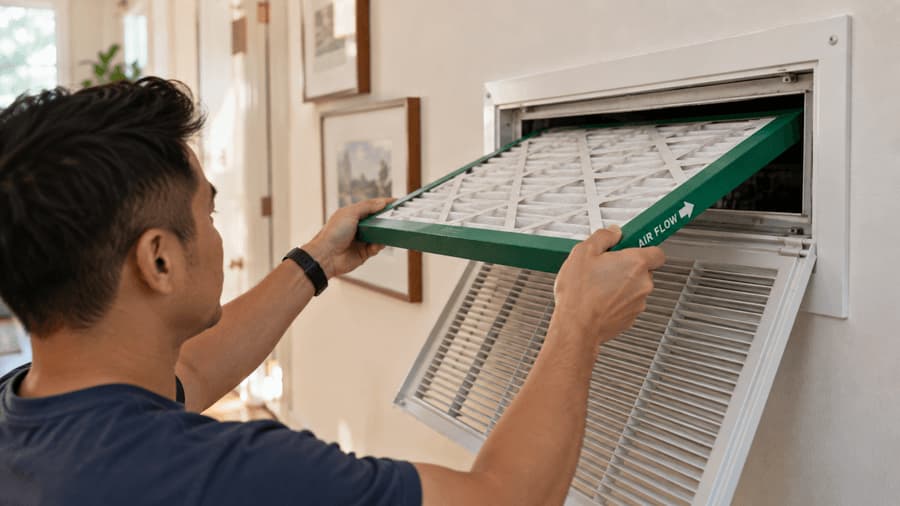
Replacing an AC air filter takes about five minutes and no tools. Turn the system off, slide the old filter out, and slide the new one in with its airflow arrow facing the same way.
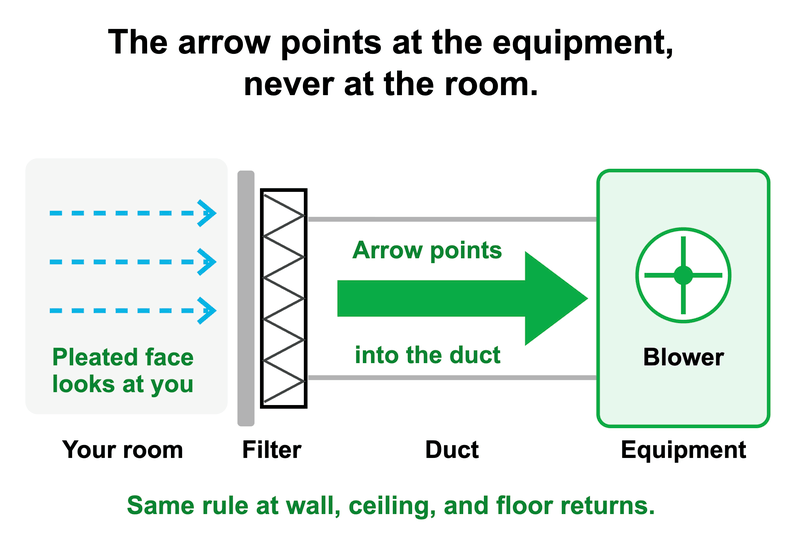
The arrow points at the equipment, never at the room. Check that the filter sits flush, since even a small gap lets air slip around it.
600+ sizes plus custom, cut in Filterbuy's U.S. plants.
Have a Ductless Mini Split Instead?
Mini split heads use reusable mesh screens you rinse, not replace. Answer a few quick questions and we'll match you to the right fit for your system.
TL;DR
Replacing an AC air filter takes about five minutes and no tools. Turn the system off, note which way the airflow arrow points, slide the old filter out, and slide the new one in facing the same direction with no gaps at the edges. Two things decide whether the swap works: the size and the arrow. Most guides tell you to point that arrow toward the blower, but Filterbuy stopped saying it, because at a ceiling return there is no blower in sight. The rule that works everywhere is below.
Key Takeaways
The airflow arrow points at the equipment, never at the room. At a wall or ceiling return it points into the wall or ceiling, and the pleated face looks back at you.
A quarter-inch gap makes a filter close to useless. Air takes the easiest path available, so it slips around the media rather than through it.
Nominal size is a label, not a measurement. A filter sold as 20x25x1 measures 19½" × 24½" × ¾", because Filterbuy cuts half an inch under nominal so the filter seats without binding.
ENERGY STAR recommends inspecting monthly and replacing at least every three months. Pets, allergies, and smoke season all shorten that window.
The U.S. Department of Energy reports that a clean filter can lower an air conditioner's energy use by 5% to 15%.
Where Is My AC Air Filter?
Your AC air filter sits on the return side of the system. That means one of three places: behind a large return grille on a wall or ceiling, in a slot on the air handler or furnace cabinet, or behind several return grilles at once. The grille is the most common spot. Returns are the vents that pull air in rather than blow it out.
A return grille pulls air in. A supply vent blows air out and never holds a filter.
The U.S. Department of Energy places central AC filters along the return duct, most often in walls, ceilings, or the air conditioner itself. Every return path takes exactly one filter, and when the air handler sits somewhere awkward to reach, DOE recommends putting a filter in each return grille instead.
That rule explains the call Filterbuy's customer care team fields more than any other: someone has changed one filter faithfully for years, and a second in a hallway ceiling has never come out. Count your return vents before you stop looking. For the full picture, see where air filters are located and how many filters a house has.
People assume finding the filter is the easy part and choosing it is the hard part. It is the other way round. Once you know whether your equipment is reachable, you know where the installer put the filter, and everything after that is just reading three numbers off a frame.
Michelle Wan, Brand Manager and Air Quality Writer, Filterbuy
How to Replace an AC Air Filter in 6 Steps
Once you have found the filter, the swap is quick. Turn the system off at the thermostat, note the airflow arrow on the old filter, slide it out into a trash bag, then slide the new one in facing the same way and confirm the edges sit flush before closing up. The whole job runs about five minutes and needs no tools.
Turn off the system. Set the thermostat to Off so the blower cannot start while your hands are in the slot. If you are reaching into an air handler cabinet rather than a wall grille, trip the breaker as well. Equipment in an attic or crawlspace needs a flashlight and careful footing on the joists, and if you cannot get to it safely, this is a fair job to hand to a technician.
Note the airflow arrow. Photograph the printed arrow on the edge of the old filter before you pull anything out. Reversing it is the most common installation mistake, and photographing the old one makes it impossible.
Slide the old filter out. Pull it straight out and take your time, so the trapped dust stays on the filter instead of shaking loose into the room. Wipe the slot clean while it is empty.
Bag it immediately. Slide the old filter straight into a trash bag so the dust stays where it belongs.
Slide the new filter in. Point the arrow the same direction the old one faced, then press the filter flat against the back of the slot.
Check the seal, then restart. Run a finger along all four edges. If it sits flush and stays quiet when the system comes back on, you are finished.
Which Way Does the Air Filter Arrow Point?
The airflow arrow points in the direction the air travels, out of your rooms and into the equipment. Air moves from the room, through the return grille, through the media, and on to the blower, and the arrow traces that path. In a furnace room you can see the blower and aim at it. At a wall or ceiling return you cannot, which is where most advice leaves people stuck. The DOE's Building America Solution Center gives the answer that works in both cases: the arrow should point into the duct. The pleated face looks back at you.
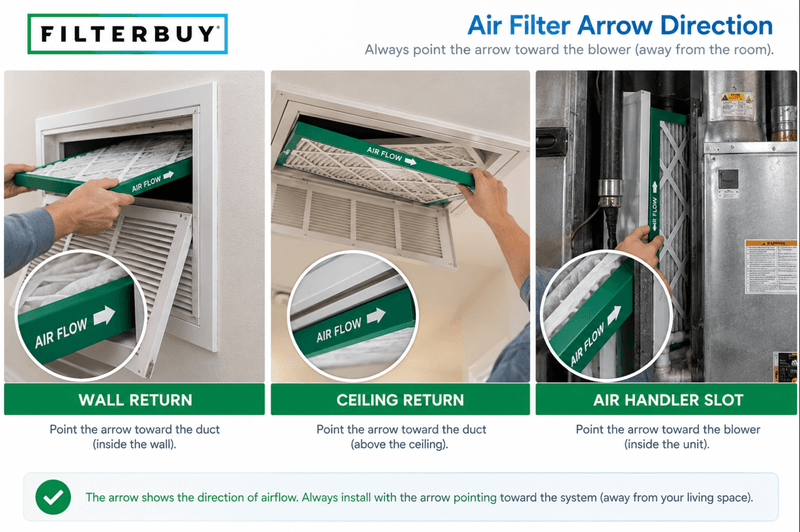
Whatever your setup, one rule covers it: the arrow points at the equipment, never at the room.
One rule covers every row: the arrow points at the equipment, never at the room.
The 10-second airflow direction test
If the old filter is already gone, you do not have to guess. Set the thermostat to run the fan and hold a sheet of tissue paper flat against the grille. If it sticks, air is being pulled in and the arrow points that way. If it blows off, you are at a supply vent. Mark the direction on the duct and you will never need the test again.
How to tell if a filter is installed backwards
A backwards filter still traps dust, but it gives up capacity and makes the system work harder. Four things give it away:
Whistling at the return when the blower runs
Media bowing outward toward the fan instead of holding its shape
Longer run times to reach the temperature you set
Dust settling on the clean side of the media
The consequences grow as the MERV rating climbs. A MERV 8 filter installed backwards restricts airflow, while a MERV 13, built from denser media, restricts it considerably more.
If your filter has no printed arrow, check all four edges again before giving up, then fall back on the tissue test. A wire mesh backing, where one exists, goes on the downstream side. Every Filterbuy pleated filter carries a printed airflow arrow on the frame edge.
Why AC Filter Gaps Ruin an Otherwise Perfect Replacement
A filter only works if the air is forced through it rather than around it. A quarter-inch gap along one edge lets air bypass the media almost entirely, because air takes the easiest path available. A correctly sized filter sits flush and stays silent; a loose one rattles every time the blower cycles.
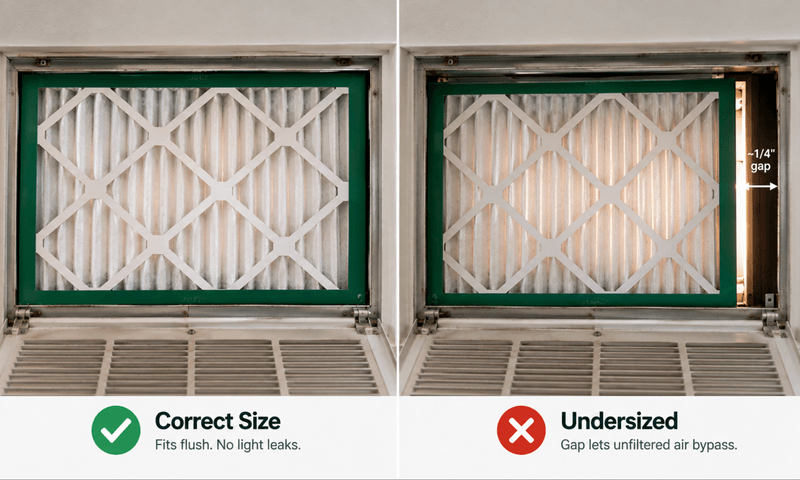
So run a finger along all four edges once the new filter is in. If it rattles or sits visibly small in the opening, the size is wrong and the fix is ordering the one that fits.
A correctly sized filter in an oversized return grille is a different problem, and it is the fit complaint Filterbuy hears about most. Here DOE guidance is specific: seal the perimeter with masking tape to close the bypass path. Masking tape peels off cleanly at the next change, which is exactly why the same guidance warns against caulking a slot shut.
A filter that does not fill its rack is doing less than the homeowner thinks. Air will always take the gap over the media. When I pull a panel and find a clean filter sitting next to a dirty coil, that gap is almost always why.
David Clark, Licensed HVAC Technician, Filterbuy HVAC Solutions
Forcing a filter that runs too large fails the opposite way. Bending one warps the frame, pulls the media off the slot walls, and opens channels along the very edges you were trying to seal.
What Size AC Filter Do I Need? Nominal vs. Actual
Nominal size is the rounded number printed on the frame, like 20x20x1. Actual size is what the filter measures in your hands. The two are never the same. Filterbuy cuts half an inch under the nominal length and width, and a filter sold as one inch thick measures ¾ of an inch. Order by nominal, verify by actual.
Filterbuy cuts every standard filter half an inch under the nominal length and width. Other manufacturers use different clearances, so read the actual dimensions on any frame before switching brands.
That half-inch is Filterbuy's own cut spec, not an industry rule. Other manufacturers undercut by different amounts and a few run larger than nominal, so read the actual dimensions on any frame before switching brands. We publish other manufacturers' numbers beside our own, including the rows where we come off worst, because you cannot check a fit nobody told you about.
When you measure, measure the slot rather than the old filter, since a warped frame sends you to the wrong size. Take the opening as length by width by depth, round to the nearest inch, and order the nominal size within half an inch of it. If nothing standard comes close, the slot needs a custom cut filter.
There is also a shortcut most guides miss, and it runs in reverse: the size you are holding tells you where your filter lives. Because Filterbuy cuts these sizes, we can see where each one turns up. The 20x22x1, 20x24x1 and 20x25x1 are air handler sizes, 16x25x1 is the most common furnace slot, and 20x20x1 is the most common size in American homes. A true fraction like 17.5 or 22.25 is not a label error either; it means the compartment was framed to the ductwork on site, which puts the filter at the equipment rather than behind a grille.
For the longer walkthrough, see how to measure your air filter and the air filter sizes chart.
How Often Should You Change an AC Filter?
ENERGY STAR recommends checking your filter every month and changing it at least every three months. Household conditions move that number in both directions, so treat it as a starting point. Appearance settles the question: hold the filter up to a light, and if none passes through the pleats, replace it whatever the calendar says.
ENERGY STAR recommends inspecting monthly and replacing at least every three months. The rows above adjust that baseline for household conditions; the filter's appearance is always the final word.
The heat pump row is worth pausing on. A heat pump moves heat in both directions, so it runs through the shoulder seasons as well as the peaks, and its filter sees far more hours of airflow each year than the same filter in a furnace-and-AC home. Anyone who switched from gas heat and kept their old schedule is changing it too late.
Calibrate Your Own Interval in Two Changes
Two changes will tell you what your house actually needs, and then you can stop checking. Write the install date on the cardboard frame in marker. At 30 days, pull the filter and hold it next to a new one against white paper. Still clean? Put it back and check again at 60. Visibly loaded? You are on a 30-day cycle. Repeat once to confirm, then set a recurring reminder and stop thinking about it. Start over whenever something changes: a new pet, a renovation, a move, a smoke season.
Checking every 30 days forever is advice almost nobody follows. Do it properly twice instead.
Four Conditions That Override the Calendar
Whatever interval you land on, replace the filter immediately if any of these is true. All four come from Department of Energy guidance:
It is clogged with debris and no light passes through the pleats.
The pleats have collapsed or the media is bowing.
The system bangs or thumps when it starts.
The filter is damp or moldy.
That last one deserves a moment. A wet filter means water is reaching the return side of your system, and putting it back circulates whatever has grown on it. Replace it, then find out why it got wet, because that is a condensate problem no filter can fix.
Skipping changes carries a real cost. The U.S. Department of Energy reports that obstructed airflow lets dirt bypass the filter and settle on the evaporator coil, impairing its ability to absorb heat. A neglected filter then shows up as weak airflow, longer run times, and higher bills.
Supporting Statistics
A filter with a large gap around it, or fixed on only one edge, is estimated to allow 25% air bypass; one sitting loose in its slot, about 10%. Lawrence Berkeley National Laboratory researchers used those figures to model coil fouling and found that the added efficiency of a MERV 12 filter can be largely compromised by filter bypass. A better filter does little if a quarter of the air goes around it. Siegel, Walker & Sherman, LBNL, ACEEE Summer Study proceedings.
A single filter can consume half of a home system's airflow budget. Most residential systems run efficiently at no more than 0.4 to 0.5 inches w.c. of total static pressure, and a 0.25-inch w.c. filter uses half of that by itself on a PSC motor. Fit and orientation matter more the higher the MERV rating climbs. Pacific Northwest National Laboratory, U.S. Department of Energy.
Air conditioning was about 19% of all electricity used in U.S. homes in 2020, roughly 254 billion kilowatt-hours. Against a number that size, the 5% to 15% DOE attributes to swapping a clogged filter for a clean one is not a rounding error. U.S. Energy Information Administration, 2020 RECS.
Frequently Asked Questions
Can I Run My AC Without a Filter?
Not for long. Dust goes straight onto the blower and evaporator coil. A few hours while you wait on a replacement is survivable; a season is not.
Is an AC Filter the Same as a Furnace Filter?
In a central HVAC system, yes. The furnace and air conditioner share one air handler and one filter slot, so the name changes with the season rather than the hardware. See air filters vs. furnace filters.
Do I Need to Change the Filter in a Mini Split Too?
Yes, though differently. Ductless mini split heads use reusable mesh screens, rinsed rather than replaced.
Can I Clean and Reuse a Disposable Filter?
No. Washing or vacuuming pleated media damages the fibers and leaves the trapped particles behind. Filterbuy pleated filters are disposable by design; the reusable screens in a mini split head are the exception.
Glossary
AC air filter. The pleated filter on the return side of a central HVAC system. It is the same part as the furnace filter: one blower, one slot, one filter serving both seasons.
Nominal size. The rounded size printed on the frame, such as 20x25x1. This is what you order by.
Actual size. A filter's true measured dimensions. A Filterbuy 20x25x1 measures 19½" × 24½" × ¾". A true fraction on the label means the slot was framed on site.
Filter bypass. Air slipping around a filter's edges instead of passing through the media. It defeats filtration at any MERV rating.
MERV. Minimum Efficiency Reporting Value, the ASHRAE 52.2 scale rating what a filter captures. The EPA's Guide to Air Cleaners in the Home recommends MERV 13, or as high as your system allows. Filterbuy makes MERV 8, 11, and 13.
Order the Right Filter
Filterbuy cuts everything it sells, in 600+ sizes plus custom, at plants in Alabama, Pennsylvania, Texas, and Utah. That is the vantage point this page is written from: a company that cuts to the slot rather than one that only describes it. It is why we publish actual dimensions beside nominal ones, and why the arrow guidance above is written for a ceiling return instead of a furnace room.
Shop air filters by size · Set up auto-delivery and save 5%
About the author
Michelle Wan is Brand Manager and Air Quality Writer at Filterbuy, where she turns MERV ratings, filtration, and HVAC efficiency into plain-English advice and fronts much of the brand's educational video content. She works directly with Filterbuy's manufacturing teams, so she writes from how filters are built and used rather than from spec sheets. B.A., University of California, Santa Cruz. More from Michelle Wan.
Reviewed by David Clark, Licensed HVAC Technician, Filterbuy HVAC Solutions.