
20x20x1 Air Filters
Actual Size: 19.5x19.5x0.75

3 month filters
2. Select Quantity
Buying multiple sizes?


Made in the USA
Ships in 24 hours
20x20x1 Air Filters Air Filter Description
Available In MERV Rating: 8, 13, 11, Odor Eliminator
Made in the USA
Ships in 24 hours
Merv comparison
Scroll to see more.
 MERV 8 |  MERV 11 |  MERV 13 |  Odor Eliminator | |
|---|---|---|---|---|
| Best for | Standard Residential/Commercial Healthy Families | Superior Residential/Commercial Allergy Sufferers | Optimal Residential/Commercial Hospital Grade | ODOR ELIMINATOR Residential/Commercial Household Odors |
| Comparable ratings | MPR 600 & FPR 5 | MPR 1000-1200 & FPR 7 | MPR 1500 - 1900 & FPR 10 | MPR 1000-1200 & FPR 7 |
| Filtration | Captures 90% of Airborne Particles | Captures 95% of Airborne Particles | Captures 98% of Airborne Particles | Captures 95% of Airborne Particles |
| Dust, lint & debris | ||||
| Mold, pollen | ||||
| Dander, dust mites | ||||
| Smoke & Smog | ||||
| Bacteria | ||||
| Odor, vocs |
Is it time to change your filter?
Generally, we recommend you replace your air filters every 90 days. Find out below if you should change your filters more often.

If someone in your home has asthma or allergies...
Change your filter every
6 weeks
to ensure indoor air quality is at its best.
If you have pets...
Change your filter every
2 months
to avoid shedding and odor buildup.

If you have young children...
Change your filter every
2-3 months
as having clean air is even more important with children in your home.
If someone in your home has asthma or allergies...
Change your filter every
6 weeks
to ensure indoor air quality is at its best.
If you have pets...
Change your filter every
2 months
to avoid shedding and odor buildup.
If you have young children...
Change your filter every
2-3 months
as having clean air is even more important with children in your home.
Author: Michelle Wan | Reviewer: David Clark, Licensed HVAC Technician | Updated: September 4, 2026
TL;DR
A 20x20x1 air filter actually measures 19½” × 19½” × ¾”. That’s the size Filterbuy cuts to, and it fits most residential furnaces, air handlers, and return-air grilles. MERV 8 is the standard choice for most homes. Step up to MERV 11 for allergies, asthma, pets, or pollen, MERV 13 for smoke, or the carbon Odor Eliminator for household odors. Change it about every 90 days. We build every filter to order in our own US plants, starting at $6.24 each.
Key Takeaways
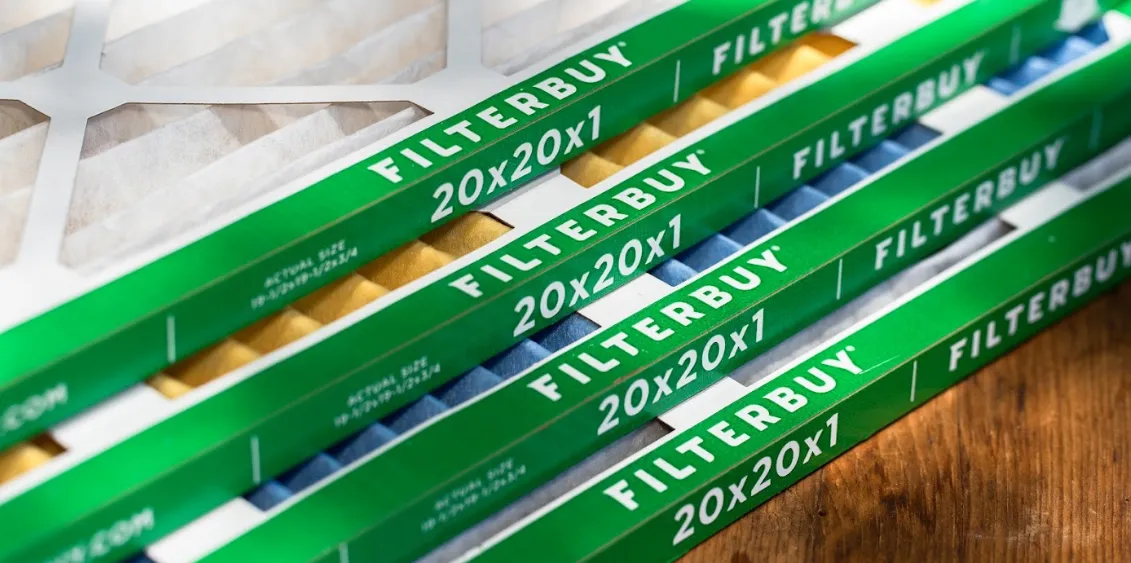
A 20x20x1 filter’s actual size is 19.5 × 19.5 × 0.75 inches. “20x20x1” is the nominal name you order by. The half-inch undercut is deliberate clearance, and it’s what lets the filter seat properly in the slot.
MERV 8 is the standard choice for most homes. It captures 90% of airborne particles and handles the everyday load of dust, lint, mold, and pollen.
Step up when you’ve got something specific to filter. MERV 11 captures 95% of Airborne Particles and is built for allergy sufferers, pets, and pollen. MERV 13 captures 98% and is the tier to pick for smoke. The Odor Eliminator includes activated carbon to eliminate household odors.
Change it about every 90 days. Sooner with pets, allergies, or smoke in the air. The table below breaks it down by household.
Buying in bulk cuts the per-filter cost by up to 74%. A single 20x20x1 is $23.99. The same filter in a 12-pack works out to $6.24.
20x20x1 Air Filter Specifications
What Size Is a 20x20x1 Air Filter?
A 20x20x1 air filter measures 19½ × 19½ × ¾ inches. “20x20x1” is the nominal size, the name you order by, and every 1-inch filter on the market is labeled that way.
So if you pulled your old filter, measured it, and got 19½ inches, nothing is wrong. That’s exactly what it should be. The undercut is deliberate clearance, and it’s what lets the filter slide in and seat cleanly.
Force a filter that’s too big into a slot and it bows, which sends air around the pleats instead of through them.
To find your size, check the frame of your old filter first. The size is usually printed right on it. No old filter to check? Measure the slot itself: length, width, and depth.
Worth doing while you’re at it: walk the house and check every return-air grille. Some systems pull through more than one, and they aren’t always the same size.
If the size you need isn’t listed, we cut custom air filters to the eighth of an inch. You can also browse the full air filter sizes chart.
"Not sure what size air filter you need? Start by checking your current filter, since the size is usually printed right on the frame. If there’s no size listed, simply measure the length, width, and depth with a tape measure. If you need a size that isn’t listed, Filterbuy can make a custom filter to your exact specifications.”
— Customer Service Team
Which 20x20x1 Filter Should You Choose?
Filterbuy makes the 20x20x1 in four filtration levels. MERV stands for Minimum Efficiency Reporting Value, the industry scale for how much a filter catches. The higher the number, the finer the particles it holds onto.
MERV comparison chart: MERV 8, MERV 11, MERV 13, and Odor Eliminator
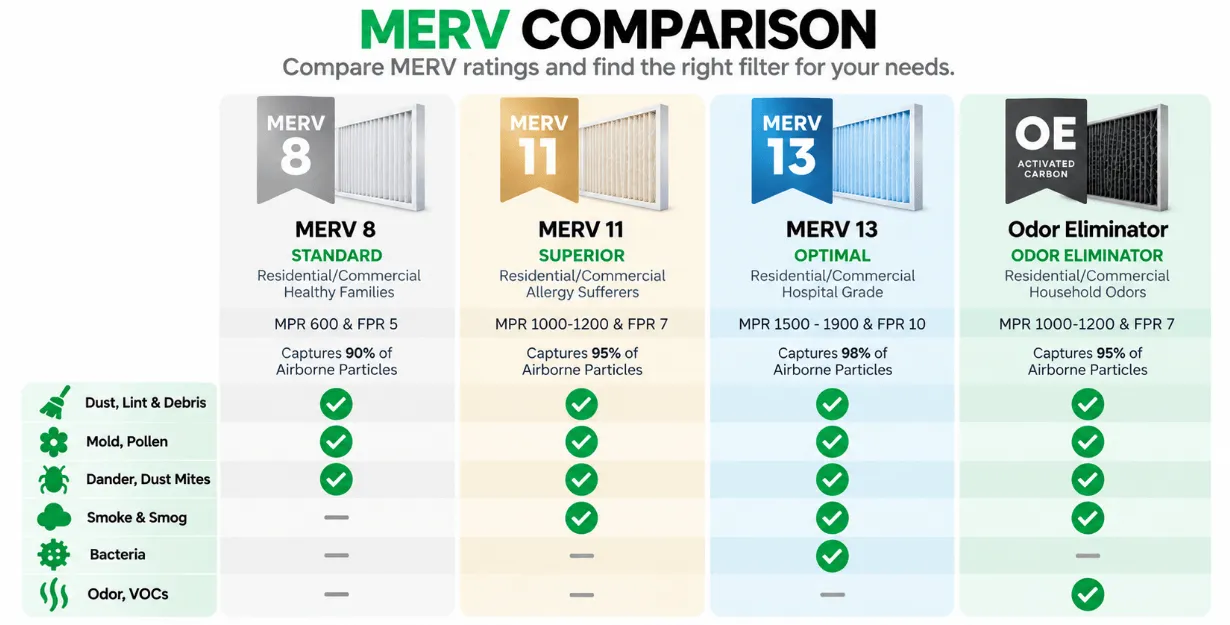
MPR and FPR are third-party rating systems, shown for comparison only. Filterbuy is not affiliated with or endorsed by 3M or The Home Depot.
One quick check before you order: your HVAC manual lists which filter ratings the system is set up for. It’s the same kind of fit check as confirming the size.
Most Homes: MERV 8
If nobody in the house is dealing with allergies and there’s no particular problem you’re solving, MERV 8 is the one. It captures 90% of Airborne Particles, and it takes care of the everyday load of dust, lint, mold, and pollen. Shop the 20x20x1 MERV 8.
Allergies, Asthma, Pets, And Pollen: MERV 11
MERV 11 captures 95% of Airborne Particles. It’s the tier built for allergy sufferers, and it’s also the one to pick if you’ve got pets, because it’s dander that gets through, not hair, and dander is fine enough to stay airborne for hours. The American College of Allergy, Asthma & Immunology suggests a disposable filter in the MERV 11 to 13 range for whole-house filtration.
During pollen season, change it every 45 days. Shop the 20x20x1 MERV 11.
Smoke: MERV 13
MERV 13 captures 98% of Airborne Particles, the finest of the four levels. Wildfire smoke is mostly PM2.5, meaning particles under 2.5 microns across, small enough to stay suspended in the air for hours. EPA’s wildfire guidance identifies MERV 13 as the rating to look for in a home HVAC filter.
When there’s smoke in the air, run your system’s fan continuously and check the filter every 30 days. Shop the 20x20x1 MERV 13, read our guide to the best MERV filter for wildfire smoke, or check live air quality in your area.
Odors: The Odor Eliminator
When the problem is smell, the Odor Eliminator is the one to order. It handles cooking smells, pet smells, and smoke that hangs around after the fact. The build layers activated carbon, a porous form of charcoal that traps odor molecules, into the same pleated media.
For a deeper comparison, see our guide to HEPA versus MERV filters.
How Often Should You Replace a 20x20x1 Filter?
Change your 20x20x1 about every 90 days under normal conditions. Pets, allergies, and smoke all shorten that.
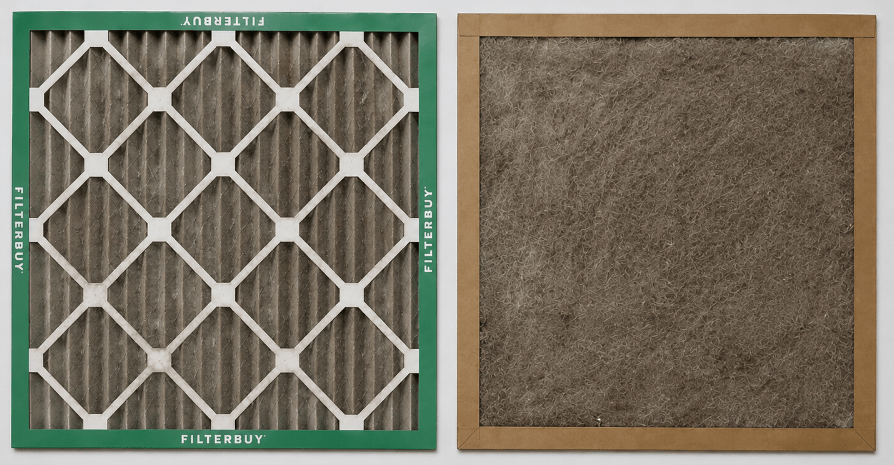
There’s a faster check than the calendar. Pull the filter and hold it up to a light. If light doesn’t come through the pleats, it’s ready to change.
Treat the schedule as a starting point. Hold the filter up to a light once a month; if you cannot see light through the media, change it.
Of everything your system needs, the filter is the simplest to keep up with, and a loaded one makes the blower work harder for less air. See our guide to how often to change your HVAC filter by household type.
How Much Do 20x20x1 Air Filters Cost?
One at a time is the priciest way to buy filters. A single filter carries a full share of packaging and shipping, while a multipack spreads both across twelve.
Cost per month assumes the 90-day schedule. On a 45-day schedule, double it. Prices current as of August 2026; auto-delivery takes a further 5% off.
A word on the cheap ones. A $3 fiberglass panel is built to keep lint off your blower motor, and it doesn’t do much past that. The ACAAI’s guidance on air filters advises against relying on inexpensive fiberglass furnace filters for the air you breathe.
Why Buy Factory-Direct From Filterbuy?
Filterbuy is a manufacturer, not a reseller. A big-box filter has sat on a shelf for months. Every filter we sell is cut, pleated, and framed to order in our own US plants, then shipped straight to your door.
We’ve been doing this since 2013, and we stock 600+ standard sizes.
Two million-plus households have bought from us, with a 4.9 out of 5 across 85,000+ Google reviews.
Every order ships with fast and free 2-day delivery to most US states.
Filters That Show Up On Time
The hardest part of changing a 20x20x1 is remembering to. A Filterbuy air filter subscription handles it: pick your filtration level and your interval, and a fresh set turns up at 5% off. Skip or cancel any time, no fee.
The Research Behind This Page
Filter changes and cooling costs. The U.S. Department of Energy calls routine filter replacement the most important maintenance task for keeping an air conditioner efficient, and puts the savings from swapping a dirty, clogged filter for a clean one at 5 to 15 percent.
Source: DOE, Energy Saver 101: Home Cooling.
Where we spend our time. Americans spend roughly 90% of their time indoors, and EPA reports that some pollutants run two to five times higher inside than out.
Source: EPA, Report on the Environment: Indoor Air Quality.
Pet allergens without pets. NIEHS reports that nationwide surveys have turned up dog and cat allergens in nearly every home tested, including homes that have never had a pet.
Source: NIEHS, Pet Allergens.
Frequently Asked Questions
What does the “1” in 20x20x1 mean?
Depth. A 20x20x1 is one inch thick, or ¾ of an inch once it’s cut. The first two numbers are length and width.
Which way does the arrow on the filter face?
Toward the furnace or air handler, pointing in the same direction the air travels. The arrow’s printed on the side of the frame. If you can’t see it once the filter’s in, you’ve probably got it backwards.
Are 20x20x1 air conditioner filters the same as furnace filters?
Yes. In a forced-air system, the furnace and the air conditioner share one blower, one set of ducts, and one filter slot, so one filter covers both.
Will a MERV 13 fit my system?
The 20x20x1 is the same size in every filtration level, so it drops into the same slot. For the rating itself, check your HVAC manual. It lists which filter ratings the system is set up for.
Where can I buy 20x20x1 air filters near me?
We ship factory-direct from our US plants, with fast and free 2-day delivery to most US states. Enter your ZIP above to check yours.
Do you run sales on 20x20x1 air filters?
Our quantity pricing is standing, so the 12-pack rate isn’t a limited-time offer waiting on a sale.
Glossary
Nominal vs. actual size. Nominal is the name you order by (20x20x1). Actual is what we cut to (19.5 × 19.5 × 0.75 inches). The difference is the clearance that makes it fit.
MERV. Minimum Efficiency Reporting Value, the 1-to-16 industry scale for how much of the airborne particle load a filter captures.
MPR and FPR. Third-party filter rating systems used by other manufacturers and retailers, shown on our comparison chart so you can cross-reference. Filterbuy is not affiliated with or endorsed by 3M or The Home Depot.
PM2.5. Airborne particles smaller than 2.5 microns, the bulk of what wildfire smoke is made of.
Author & Review
Written by Michelle Wan. Brand Manager & Copywriter, Filterbuy
Reviewed for technical accuracy by David Clark, Licensed HVAC Technician
Last updated: September 4, 2026