
Air Filter Sizes - Which Air Filter Size Do I Need?
July 18, 2026

TL;DR
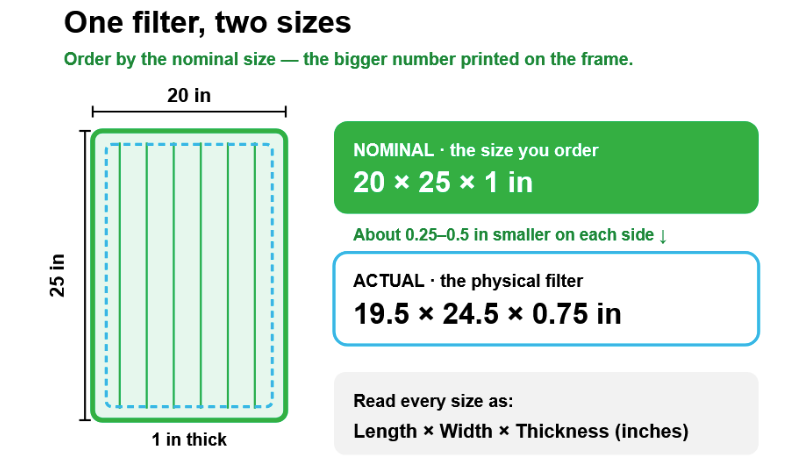
Order your filter by its nominal size — the rounded number printed in large text on the frame, written as Length × Width × Thickness (for example, 20 × 25 × 1 inches). That nominal size is slightly larger than the filter's actual size, which runs about 0.25 to 0.5 inches smaller on each side so it slides into the slot without binding.
If your old filter's label is faded, measure the slot's length, width, and thickness, then round up to the nearest inch. Not sure which filtration level fits your home? Take the quick match quiz below.
Know your size? Answer a few quick questions and we'll match you to the right filtration level (MERV) for your home.
Prefer to shop now? Browse every air filter size at Filterbuy.
How to Measure Your Air Filter: Step-by-Step Expert Guide
Choosing the correct air filter size is essential for maintaining optimal air quality and ensuring your HVAC system operates efficiently. Knowing how to measure your air filter properly will help you find the perfect fit and avoid potential issues caused by an incorrect size.
Use the Existing Filter
The easiest method is checking your current filter. Look for size markings printed along the edge—they're usually there in black ink.
If the label is faded or missing, check your HVAC manual or look up the model number online. Many systems use standard sizes based on the unit specifications.
Measure It Manually
When in doubt, grab a tape measure and follow these steps:
Measure length (the longest side of the opening)
Measure width (the shorter side)
Measure thickness (how deep the slot is)
Round up to the nearest whole or half inch for the nominal size
Format as Length × Width × Thickness
Remember to measure the actual opening, not an old filter that might be warped or compressed.
Measure once, order with confidence from Filterbuy—we make it easy to find your exact size.
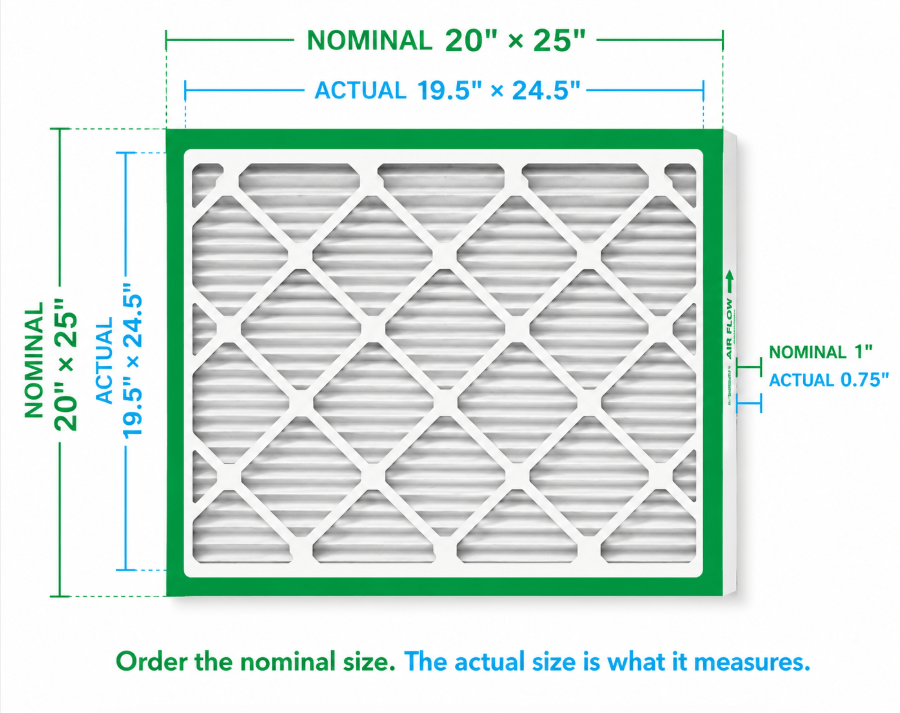
Air filter sizes are written as Length × Width × Thickness in inches. A 20x25x1, for example. Order the nominal size, the rounded number on the frame. It is not what the filter measures. Our 20x25x1 comes off the line at 19.50 x 24.50 x 0.75, and we cut it that way on purpose: the clearance is what lets it slide in without binding.
The most common air filter size in American homes is 20x20x1, then 16x25x1, 16x20x1 and 20x25x1. If the label has faded, measure the slot and round up to the nearest inch. We manufacture every filter we sell, so the dimensions here are numbers we cut to, not numbers we looked up.

Key Takeaways
Air filter sizes read Length × Width × Thickness. Order the nominal size on the frame.
We cut ours 0.5 inches under on length and width; a 1-inch filter is 0.75 inches thick.
20x20x1 is the most common US size, then 16x25x1, 16x20x1 and 20x25x1.
Furnace, AC and HVAC filter sizes are the same measurement in a forced-air home.
Land on a true fraction and you have a custom slot. Rounding costs the seal.
Why Your Air Filter Measures Smaller Than the Size on the Label
Every air filter has two sizes, and the gap between them is the most common reason homeowners order the wrong one. The nominal size is the rounded number on the frame. That is what you order. The actual size is what it measures. Here is what we cut ours to:
Length and width: 0.5 inches under the nominal size
Thickness: 0.75 in on a 1-inch filter, 1.75 in on a 2-inch, 3.63 in on a 4-inch
So our 16x25x1 measures 15.50 x 24.50 x 0.75. That half-inch is a decision, not an accident. Cut it tighter and the filter binds going in. Cut it looser and air bypasses the media entirely.
One caution from our floor: that convention is ours. It is not a published standard, and it is not universal. See the brand comparison below. If you run a thick media filter from another maker, read the actual size on its frame.
"I don’t want anyone to feel like they need an HVAC license just to pick the right filter. My job is to give you the straight answer, explain why it matters, and let you get back to your day."
— Michelle Wan, Brand Manager and Air Quality Writer, Filterbuy
Air Filter Sizes Chart: Standard Nominal and Actual Dimensions
Every actual dimension below is a spec from our production line, not an industry estimate. All stocked in MERV 8, MERV 11 and MERV 13.
1-Inch Air Filter Sizes
Nominal size is what you order. Actual size is what the Filterbuy filter measures. Filterbuy stocks 600+ sizes; if yours is not here, we cut it custom.
2-Inch, 4-Inch and 5-Inch Air Filter Sizes
Thicker filters hold more particles before airflow drops. Your slot depth decides what you can use. A 1-inch slot cannot take a 4-inch filter.
The part that surprises people: our 1-inch carries 14 pleats per foot, our 4-inch carries 8. Fewer pleats, not more. Each one is simply far deeper. Pleat count is not the number to shop on. Depth is.
Filterbuy cuts 2-inch filters to 1.75 in actual and 4-inch to 3.63 in. Slot depth decides what your system accepts. A 1-inch slot cannot take a 4-inch filter.
Furnace Filter Sizes vs. AC Filter Sizes: Are They the Same?
Furnace filters and AC filters are the same filter. In a forced-air home the furnace and air conditioner share one blower, one duct system and one filter slot. So "furnace filter size," "AC filter size" and "HVAC filter size" all describe the same measurement.
The most common furnace filter sizes are 16x25x1, 20x25x1, 16x20x1 and 20x20x1. Furnace slots run larger than return-grille slots, which is why 16x25x1 turns up there most. Filterbuy cuts all four, in MERV 8, 11 and 13.
Where to look: usually the return side of the furnace, a narrow gap with a removable cover. Some homes use a return grille instead; a few have both, and both need changing. Our guide to finding your HVAC air filter location covers every spot.
How Do I Measure My Air Filter?
Measure the slot, not the old filter. A warped one sends you to the wrong size.
Remove the existing filter.
Measure the length, width, and depth of the slot opening in inches.
Round to the nearest whole inch, unless you land on a true fraction (see below).
Write it as Length × Width × Thickness. For example, 16 × 25 × 1.
Those rounded numbers are your nominal size, and that is what you order from Filterbuy. If your slot lands on an odd fraction, don’t round. See below.
Full instructions, including what to do about warped filters and fractional slots: how to measure your air filter.
What if My Slot Measures Between Sizes?
Round-up advice assumes your slot sits close to a whole number. Most do. Here is the rule for when yours doesn’t.
Within about a quarter-inch of a whole number: that number is your nominal size. A slot at 19.9 or 20.1 inches takes a 20-nominal filter. Ours measures 19.5, leaving the gap the design expects.
On a true fraction like 17.5, 22.25 or 23.75, rounding costs the seal either way. Round down and the gap is wide enough to bypass. Round up and the filter is wider than the opening and will not seat. That is a custom slot.
Custom slots are commoner than the category admits. Builders frame the compartment to the ductwork, and ductwork does not care what a catalog stocks. Older homes, renovations, apartments and mobile homes most of all. It is the reason Filterbuy cuts to order at all.
Does Filter Type Change the Size You Need?
Filter type and size are independent choices, with one exception. Pleated, fiberglass and washable filters all use the same standard nominal sizes, so switching type does not change the size you order. Media filters are the exception.
Pleated filters fold the media to increase surface area, capturing pollen, pet dander, mold spores and fine dust. Every standard nominal size.
Fiberglass filters are flat and cheap, built to protect equipment rather than clean air. Same nominal sizes.
Media filters sit in a whole-house cabinet at the air handler, usually 4 to 5 inches thick. Their sizes are cabinet-specific and often fractional, so read the cabinet label and do not round. Filterbuy makes these to the cabinet.
What if My Air Filter Isn’t a Standard Size?
We cut one to your numbers. Record the slot’s exact dimensions including fractions and order a custom air filter. We build these from the ground up, not pre-made filters trimmed to fit. This is also where our 0.5-inch rule stops: custom fractional sizes we cut to exactly what you specify. Our 20x22.25x1 measures 20.00 x 22.25 x 0.75.
Why the Wrong Size Costs More Than a Bad Fit
A filter that doesn’t seal doesn’t filter. Undersized, air routes around the edges. The system runs, the filter looks clean, and dust reaches the blower and coil. Oversized is worse: forcing it breaks the seal and can buckle media into the blower. The EPA states the rule plainly. A filter must fit snugly, without leaking air around it or being bent to fit. That is the whole reason we publish actual dimensions next to nominal ones instead of only the rounded number on the box.
Do All 20x25x1 Filters Measure the Same? No.
Nominal sizes are shared across the industry. Actual sizes are not. Every filter below is sold as 20x25 nominal and no two measure alike. That is why one that fit last time can bind or leak if you switch brands. We are cut furthest under nominal of the three, and we are publishing that anyway: you cannot check a fit nobody told you about.
Dimensions from each manufacturer's published retail listings, July 2026. Every filter above is sold as a 20x25 nominal size. None measure the same.
Frequently Asked Questions
How Do I Find My Filter Size by HVAC Model Number?
Your HVAC brand does not determine your filter size. Your slot does. Carrier, Trane, Lennox, Goodman, Rheem and York all take standard nominal sizes, and two homes with the same model can need different filters depending on the ductwork. Measure the slot, then match it to the Filterbuy chart above.
What MERV Rating Should I Choose?
MERV measures how much a filter captures, not how it fits. Size and MERV are separate decisions, and every MERV rating is sold in every standard size. The EPA recommends a filter rated at least MERV 13, or as high as your system fan and filter slot will accommodate.
FAQ link (inside the MERV answer): all about air filter MERV ratings, charts and scales
Supporting Statistics
Three findings from federal and public-health sources on why size and fit matter.
1. Americans spend about 90% of their time indoors, mostly at home.
The U.S. EPA reports that because most people spend roughly 90% of their time indoors, most exposure to airborne pollutants happens at home. Your filter is the only thing cleaning that air when the system runs. That is why one that lets air slip past its edges is worse than it looks. Source: EPA, Guide to Air Cleaners in the Home.
2. Nearly half the energy used in a US home goes to heating and cooling.
ENERGY STAR, the joint EPA and Department of Energy program, reports that heating and cooling account for nearly half of a home’s energy use, and that a dirty filter slows airflow and makes the system work harder. A wrong-sized filter does the same thing for the same reason. Source: ENERGY STAR, Heat & Cool Efficiently.
3. The default residential filter is a one-inch, low-efficiency filter costing about $12.
The American Lung Association reports that HVAC systems usually take a rectangular one-inch-thick filter in the return ducts, that the default is low-efficiency at around MERV 8, costs roughly $12, and should be changed about every two months. We make filters, so take our word on depth with a grain of salt. That is a health authority confirming the two claims this page rests on: 1-inch is standard, and the return duct is where to look. Source: American Lung Association, Air Cleaning.
Michelle Wan is Brand Manager and Air Quality Writer at Filterbuy, where she turns MERV ratings, filtration and HVAC efficiency into plain-English advice and fronts much of the brand’s educational video content (B.A., University of California, Santa Cruz). Working directly with Filterbuy’s manufacturing teams, she writes from how filters are built and used, not from spec sheets. Reviewed by David Clark, Licensed HVAC Technician, Filterbuy HVAC Solutions.
Filterbuy is a second-generation, family-owned American manufacturer. It began in the 1950s as Talladega Machinery and Supply, became Filterbuy in 2012, and sold its first filter in 2013. Filterbuy makes 100% of its products in the USA, in Alabama, Pennsylvania, Texas and Utah, in 600+ sizes plus custom, shipped factory-direct.
Sources: ANSI/ASHRAE Standard 52.2 (MERV definitions and particle-size groups) · National Air Filtration Association (NAFA) · U.S. Environmental Protection Agency (indoor air quality) · Filterbuy manufacturing and order data