
All About Air Filter MERV Ratings, Charts & Scales
May 5, 2026
The short answer
MERV stands for Minimum Efficiency Reporting Value. It runs from 1 to 16, and a higher number means the filter captures a higher share of smaller particles. Most homes land somewhere between MERV 8 and MERV 13.
- MERV 8 catches larger particles — dust, lint, pollen, pet dander.
- MERV 11 adds finer particles down to 1.0 micron.
- MERV 13 adds particles down to 0.3 micron.
- Higher ratings restrict airflow more, so check what your system is rated to handle.
MERV rating chart, 1 to 16
MERV is measured across three particle size ranges. Each rating has a minimum efficiency it has to hit in each range to qualify.
E1 = 0.3–1.0 micron · E2 = 1.0–3.0 microns · E3 = 3.0–10.0 microns
| MERV | E1 0.3–1.0 µm |
E2 1.0–3.0 µm |
E3 3.0–10.0 µm |
Typically used for |
|---|---|---|---|---|
| 1–4 | — | — | Under 20% | Basic equipment protection |
| 5 | — | — | 20%+ | Light residential |
| 6 | — | — | 35%+ | Light residential |
| 7 | — | — | 50%+ | General residential |
| 8 | — | 20%+ | 70%+ | Standard residential |
| 9 | — | 35%+ | 85%+ | Residential, light commercial |
| 10 | — | 50%+ | 85%+ | Residential, light commercial |
| 11 | 20%+ | 65%+ | 85%+ | Homes with pets, higher dust load |
| 12 | 35%+ | 80%+ | 90%+ | Higher-efficiency residential |
| 13 | 50%+ | 85%+ | 90%+ | Finest residential filtration |
| 14 | 75%+ | 90%+ | 90%+ | Commercial, industrial |
| 15 | 85%+ | 90%+ | 95%+ | Commercial, industrial |
| 16 | 95%+ | 95%+ | 95%+ | Specialized facilities |
How small is a micron?
A micron is one millionth of a metre. The numbers in the chart above only mean something once you know what sits at each size.
Bar lengths are illustrative and not drawn to scale.
How MERV is measured
The scale comes from ASHRAE, the American Society of Heating, Refrigerating and Air-Conditioning Engineers, which published the MERV test method in 1987 to give filter performance a common yardstick.
The test works by loading a filter with a measured aerosol and counting particles upstream and downstream at twelve size increments. Those counts get grouped into the three ranges in the chart above. A filter is tested repeatedly as dust builds up on it, and its MERV reflects the lowest efficiency it recorded across that run — which is why the M stands for minimum.
That detail matters when you compare filters. A MERV rating is a floor, not a peak.
Filterbuy MERV ratings compared
We make pleated electrostatic filters in three MERV ratings, plus a carbon option for odors.
MERV 8
| Captures | 90% of airborne particles 3.0–10.0 microns |
| Particle types | Dust, lint, debris, pollen, pet dander, dust mite debris, mold spores |
| Comparable to | MPR 600, FPR 5 |
| Typical use | Standard residential and commercial filtration |
| Trade-off | Lowest airflow resistance of our pleated range, and the most affordable. Does not capture smoke- or smog-sized particles, bacteria, or odors. |
✔ Handles everyday household dust and pollen
✘ Does not capture smoke, smog, bacteria or odors
MERV 11
| Captures | 95% of airborne particles 1.0–10.0 microns |
| Particle types | Everything MERV 8 captures, plus finer particles down to 1.0 micron, including smoke and smog |
| Comparable to | MPR 1000–1200, FPR 7 |
| Typical use | Homes with pets, higher dust loads, or nearby construction |
| Trade-off | Denser media than MERV 8, so more airflow resistance. Not designed for bacteria or odors. |
✔ Captures finer particles than MERV 8, down to 1.0 micron
✘ Not designed to capture bacteria or odors
MERV 13
| Captures | 98% of airborne particles 0.3–10.0 microns |
| Particle types | Everything MERV 11 captures, plus the finest particles in the residential range, down to 0.3 micron |
| Comparable to | MPR 1500–1900, FPR 10 |
| Typical use | The finest filtration we offer for residential systems |
| Trade-off | Highest airflow resistance of our pleated range. Check your system's rated pressure drop first. Not specialized for odors or VOCs. |
✔ Captures the smallest particle size range we rate for, down to 0.3 micron
✘ Not specialized for odors or VOCs
Odor Eliminator
| Captures | 90% of airborne particles 3.0–10.0 microns, plus an activated carbon layer that adsorbs odors and volatile organic compounds (VOCs) |
| Particle types | Dust and dander, plus gases and odors from cooking, pets and smoke |
| Comparable to | MERV 8 on particle capture, with carbon added |
| Typical use | Households where smell is the main concern |
| Trade-off | Particle capture matches MERV 8, not MERV 11 or 13. |
✔ Adds odor and gas adsorption to MERV 8 particle capture
✘ Captures fewer fine particles than MERV 11 or 13
MPR and FPR are proprietary rating scales owned by other manufacturers. Filterbuy is not affiliated with or endorsed by them.
Which MERV rating should you use?
| Your situation | Start with | Why |
|---|---|---|
| General dust control, no pets | MERV 8 | Covers the common household particles with the least airflow restriction |
| Pets, or a dusty area | MERV 11 | Adds capture down to 1.0 micron for dander and finer dust |
| You want the finest filtration available for a home | MERV 13 | Captures down to 0.3 micron, if your system can handle it |
| Cooking, pet or smoke smells | Odor Eliminator | Activated carbon targets odors, which MERV alone does not measure |
| Older system, or you're unsure of its limits | MERV 8 | Check your manufacturer's rated pressure drop before going higher |
Not sure which one fits your home?
Answer six questions and we'll point you to a size and rating.
Find your filter matchAirflow and system compatibility
This is the real trade-off with MERV, and it's the one thing worth getting right before you buy.
Denser media captures more, but it also resists airflow more. That resistance is measured as pressure drop. If a filter's pressure drop is higher than your blower was designed for, the system works harder to move the same volume of air. Over time that can mean higher energy use, more wear on the blower motor, and in some setups a frozen evaporator coil.
What to check before upgrading:
- Your HVAC manufacturer's documentation for a maximum rated pressure drop or a recommended MERV range.
- Filter depth. A 4-inch or 5-inch filter has far more surface area than a 1-inch, so it can hit a higher MERV at a lower pressure drop.
- Your replacement cadence. Higher MERV filters load up faster, and a loaded filter restricts more than a fresh one.
If your system documentation specifies a MERV limit, follow it. If you can't find it or you're not sure how to read it, ask a licensed HVAC technician rather than guessing.
Why pleated media matters
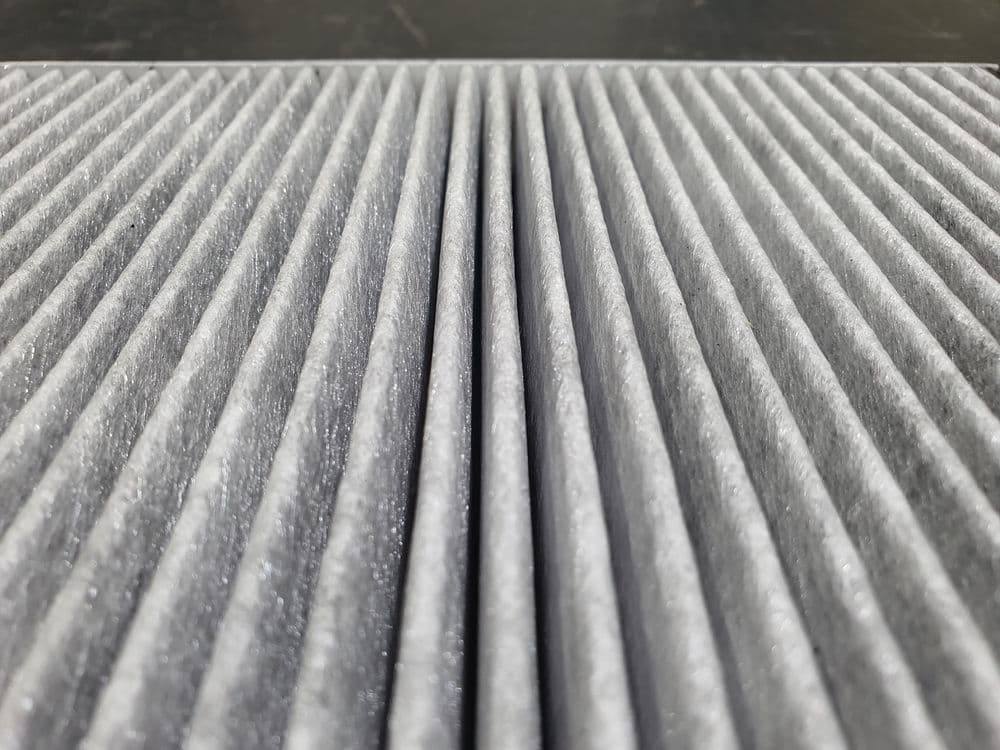
A flat fiberglass filter presents a single plane of media to the airstream. A pleated filter folds that media into a zigzag, which packs far more surface area into the same frame.
More surface area does two things. It lets the filter reach a higher MERV without proportionally more resistance, because the air is spread across more media. And it gives particles more room to accumulate, so the filter takes longer to load up.
That's why our filters across all four options use pleated electrostatic media rather than flat fiberglass. Read the full comparison.
Frequently asked questions
What MERV rating is best for a home?
Most homes are well served between MERV 8 and MERV 13. MERV 8 handles general dust and pollen. MERV 11 adds finer particles for homes with pets. MERV 13 captures the smallest particles in the residential range. The right choice depends on what your system is rated to handle as much as on what you want to capture.
Is MERV 13 too high for a residential system?
Not necessarily, but it depends on the system. MERV 13 has the highest pressure drop of our residential range. Some systems handle it without issue, particularly with a 4-inch or 5-inch filter. Others were designed around lower-resistance media. Check your manufacturer's documentation for a rated maximum before upgrading.
Will a higher MERV filter restrict airflow?
Every filter restricts airflow to some degree, and denser media restricts more. The question is whether that restriction stays within what your blower was designed for. A thicker filter at the same MERV restricts less than a 1-inch, because the pleats spread the air across more surface area.
What's the difference between MERV 8 and MERV 11?
MERV 8 is rated on particles from 3.0 to 10.0 microns. MERV 11 is rated across that range plus the 1.0 to 3.0 micron range, and carries a minimum rating in the 0.3 to 1.0 micron range as well. In practical terms, MERV 11 captures a meaningfully larger share of fine dust, dander and smoke-sized particles, at the cost of more airflow resistance.
Does MERV go above 16?
The ASHRAE scale tops out at MERV 16. Ratings of MERV 17 and above are sometimes used informally to describe HEPA-class media, but they sit outside the standard and aren't part of the MERV test method.
What MERV rating captures dust?
Household dust spans a wide size range, so the answer depends on which end of it you mean. Larger visible dust is captured well from MERV 8 up. Finer dust below 3 microns is where MERV 11 and 13 pull ahead.
How do MERV, MPR and FPR compare?
MERV is the industry standard published by ASHRAE. MPR and FPR are proprietary scales created by individual manufacturers and retailers, so they aren't directly interchangeable with MERV or with each other. The comparisons in the tables above are approximate equivalents, not exact conversions.
How often should I change my filter?
It depends on the filter depth, the rating, and how much the system runs. Higher MERV filters and homes with pets or high dust loads need changing more often. Our replacement guide covers this in detail.
Do pleated filters restrict airflow more than fiberglass?
A pleated filter captures more than a flat fiberglass one, and at a given MERV it does so with less resistance than flat media of the same efficiency would, because the pleats add surface area. Compared against a very low-efficiency fiberglass filter, though, a pleated filter will have a higher pressure drop, because it's doing considerably more.
What's the downside of the highest MERV ratings?
Restricted airflow and shorter service intervals. A system pushing air through dense media works harder, which raises energy use and adds wear to the blower. And because high-MERV media loads up faster, the filter needs changing sooner. Above MERV 13 you're generally into commercial and specialised territory rather than residential.
Keep reading
- Which MERV rating should I use?
- Fiberglass vs pleated air filters
- How does your air filter work?
- How often should you change your HVAC filter?
- MERV 17 filters explained
Key Takeaways:
MERV ratings quantify how effectively air filters trap particles, with a scale from 1 to 16.
Higher MERV ratings capture smaller particles.
MERV ratings can trap particles between 0.3 to 10 microns.
MERV air filters boost indoor air quality, and capture allergens, dust, mold spores, and bacteria.
Choosing an appropriate MERV rating requires balancing air quality needs with HVAC system compatibility.
Higher MERV filters extend HVAC system lifespan by minimizing dust accumulation on components.
What is a MERV Rating?
First, what is a MERV rating and what does it stand for? A MERV rating, or Minimum Efficiency Reporting Value, calculates the effectiveness of an air filter in capturing particles. Understanding MERV ratings is essential for determining how air filters can filter out harmful particles and enhance the air quality in your home.
How was MERV developed?
The Minimum Efficiency Reporting Value (MERV) system was developed by the American Society of Heating, Refrigerating, and Air-Conditioning Engineers (ASHRAE) in 1987, and aimed to standardize air filter performance measurements. This standardization enables consumers and professionals to make well-informed decisions.
How MERV Ratings Work
Every air filter has a rating that measures how efficiently it captures particles of specific sizes that pass through it as your furnace operates. MERV ratings range from 1 (least efficient) to 16 (extremely efficient).
Particles are measured in microns and range from carpet and textile fibers (greater than 10 microns) to microscopic bacteria (less than 0.3 microns).
Different MERV filter types address varying levels of air quality needs. Here's a breakdown of what MERV ratings assess:
Particle Size Range: Effectiveness against particles such as dust, pollen, mold spores, and bacteria.
Efficiency Levels: Filters capture a percentage of particles within specific size ranges.
Application Suitability: Higher MERV ratings are ideal for environments requiring superior air quality, like hospitals, while lower ratings suffice for residential use.
Evaluating filter performance involves considering the specific air quality requirements of your environment. It’s important to note that higher MERV ratings generally mean better filtration but may also impact airflow and energy efficiency. Understanding these criteria helps in choosing the appropriate MERV filter type to ensure optimal air quality in your space.
What Do MERV Ratings Mean?
MERV stands for Minimum Efficiency Reporting Value, a standard that rates how well an air filter captures particles of varying sizes. The higher the MERV rating, the finer the filtration.
At Filterbuy, we focus on pleated, electrostatic filters in MERV 8, 11, 13, and a specialized Odor Eliminator option. Here’s how to choose the right one for your needs:
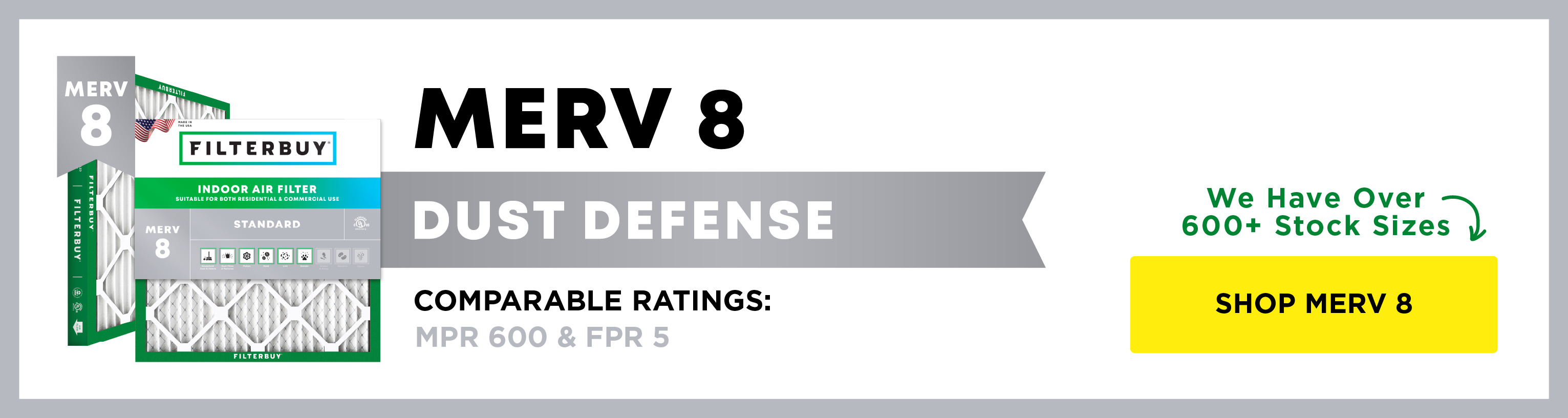
MERV 8: Basic Everyday Protection
Best for: Standard residential and commercial use
Captures: 90% of airborne particles (3.0–10.0 microns)
Targets: Dust, lint, debris, mold, pollen, pet dander, and dust mites
Comparable to: MPR 600, FPR 5
Ideal for: Healthy households looking for general air cleanliness at an affordable price
✔ Great for general dust and allergen control
✘ Doesn’t filter smoke, smog, bacteria, or odors
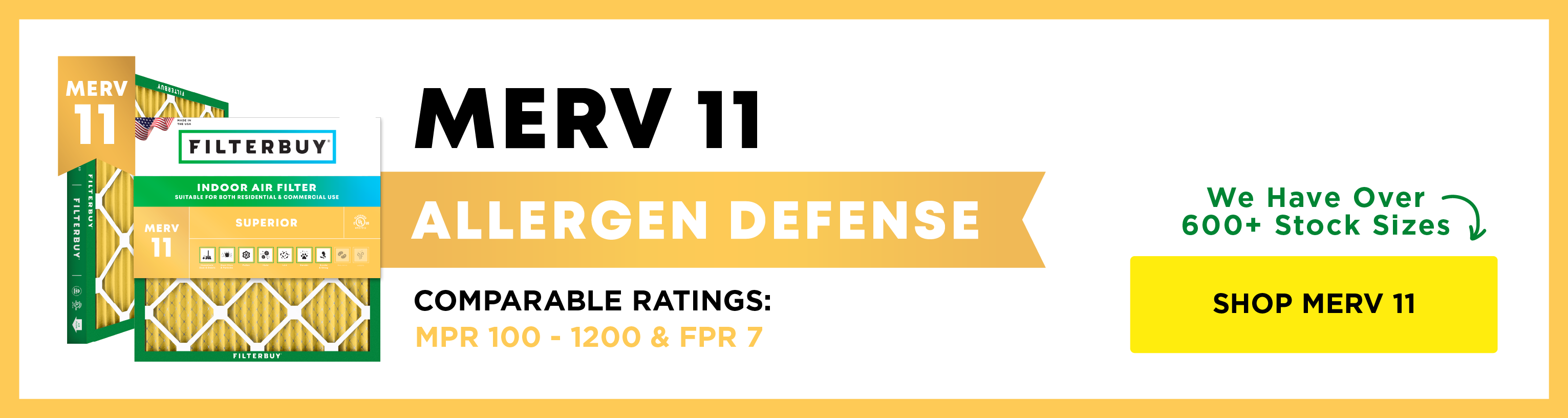
MERV 11: Allergy Defense
Best for: Homes with pets or mild allergy concerns
Captures: 95% of airborne particles (1.0–10.0 microns)
Targets: Everything MERV 8 does, plus better capture of finer particles like smoke and smog
Comparable to: MPR 100–1200, FPR 7
Ideal for: Families with pets, mild respiratory issues, or seasonal allergies
✔ Better protection from airborne allergens
✔ Helps reduce smoke and smog particles
✘ Not designed to filter bacteria or odors
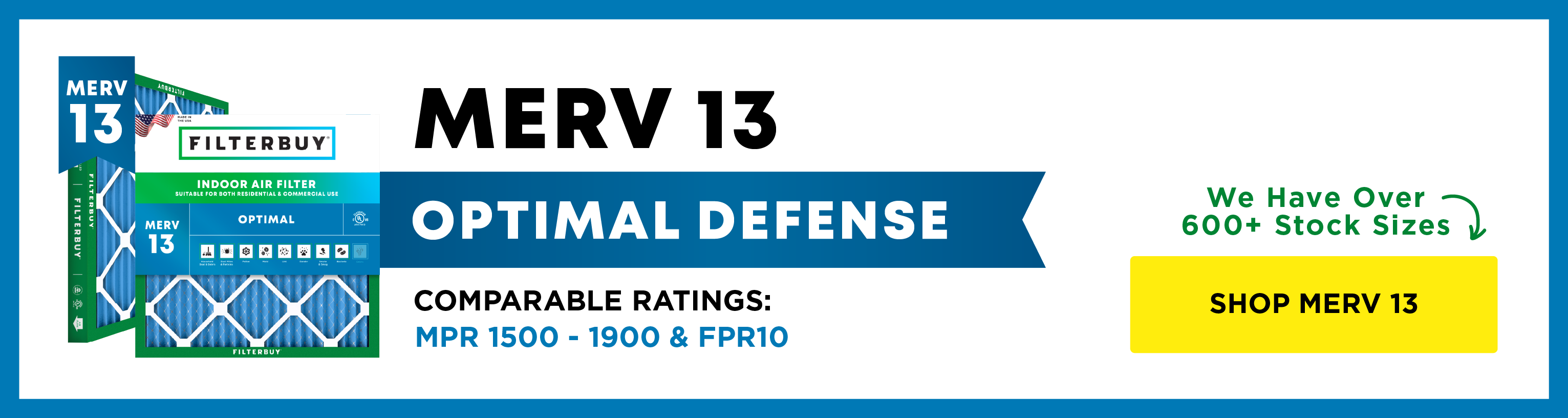
MERV 13: Maximum Home Protection
Best for: Homes with asthma, severe allergies, or immune-sensitive individuals
Captures: 98% of airborne particles (0.3–10.0 microns)
Targets: Fine allergens, bacteria, and even some viruses
Comparable to: MPR 1500–1900, FPR 10
Ideal for: Households requiring the cleanest air possible
✔ Hospital-grade filtration for cleaner air
✔ Captures bacteria and virus-sized particles
✘ Not specialized for odors or VOCs
Odor Eliminator: Targeted VOC & Smell Control
Best for: Homes with pets, cooking odors, smoke, or chemical smells
Captures: 90% of airborne particles + odors and volatile organic compounds (VOCs)Targets: Dust, dander, odors, and gases
Comparable to: MERV 8 in particle capture, with added odor filtration
Ideal for: Customers who want basic filtration with added odor defense
✔ Helps remove smells from pets, smoke, or cooking
✔ Captures common household particles
✘ Not as effective as MERV 11 or 13 for fine allergens or bacteria
Quick Comparison: Which Filter Should You Choose?
Still unsure?
If you’re a healthy household just looking to reduce dust, MERV 8 is a great start. If you suffer from allergies or have pets, go for MERV 11. For maximum protection, especially if you have asthma or respiratory issues, MERV 13 is your best bet. And if odors are your main concern, the Odor Eliminator is specifically designed for that.
Why Invest in Pleated Air Filters By Filterbuy
Filterbuy MERV filters are made of pleated high-quality electrostatic media. What does this mean and why is it important for air filters?
Pleated air filters can capture dust, allergens, and other airborne particles better than standard fiberglass filters. This is because the pleated structure increases the surface area of the filter media, allowing for higher efficiency. This design traps more contaminants without greatly restricting airflow.
Using a pleated filter typically results in better performance compared to a standard flat, fiberglass filter.
The pleats offer additional space for particles to gather, helping maintain cleaner air in homes or offices.
The expanded surface area also means the filter can endure longer before replacement, making it a cost-effective choice for sustaining high indoor air quality.

Frequently Asked Questions
Do Pleated Air Filters Restrict Airflow?
Pleated filters have a more intricate design than standard flat versions. While designed to capture more airborne particles, pleated can slow down airflow depending on your system. This is why it’s important to understand your system’s requirements and choose the right filter accordingly. Check your HVAC system manufacturer’s guide.
How Often Should Merv 8 Filters Be Changed?
Determining how frequently you should replace MERV 8 filters depends on several factors. Usage patterns, air quality, and environmental conditions all impact the ideal replacement schedule.
If you reside in an area abundant with dust or pollen, changing the filters more often than the usual 1 to 3 months might be necessary. Additionally, if you have pets or allergies, you may also need to change your filters more frequently.
Regularly inspecting the filter's state and adjusting your replacement routine accordingly is crucial to determine the right schedule for your home and needs.
What MERV Rating Stops Dust?
Understanding MERV ratings is essential for maintaining dust-free indoor air. Filters with ratings between 8 and 13 effectively capture a wide range of particles. For instance, a MERV 11 filter can trap up to 95% of dust, significantly enhancing air quality and reducing HVAC inefficiency.
What MERV Rating Is Best for Home Use?
Ratings between 8 and 13 typically work well, effectively capturing dust, pollen, and allergens without overburdening your system. If you have pets or family members with allergies, higher ratings might be beneficial. However, ensure your HVAC system can handle the increased filtration. Consider factors like your system's capacity and household requirements to guide your decision.
Is MERV 13 Too High for Residential?
Upgrading your home's air filter to a MERV 13 might seem appealing, but it comes with potential complications. High-efficiency types can significantly improve indoor air quality by trapping smaller particles. However, they can also strain HVAC systems not designed to handle such resistance. It's vital to recognize that while higher ratings provide superior protection, not all HVAC systems can accommodate them. Always verify your system's specifications to ensure compatibility and maintain efficiency.
What Is Considered a High MERV Rating?
Considering air quality, a rating above 13 is essential for capturing minuscule particles like dust, pollen, and bacteria. Such filters are often employed where air purity holds significant importance, such as hospitals and commercial buildings.
Should I Buy MERV 8 or 11?
Differences between 8 and 11 are mainly in efficiency and particle-capturing capability. Those with a 8 rating achieve about 70-85% efficiency for particles sized between 3.0 to 10.0 microns. In contrast, rated-11 filters boast higher efficiency, capturing up to 85-95% of particles in that range and even smaller ones down to 1.0 micron. Consequently, these excel at removing dust, pollen, and other pollutants, ensuring cleaner air. However, this increased efficiency can impose a greater demand on your HVAC system due to higher resistance.
Is MERV 14 Too High?
They excel at capturing allergens and pollutants, making them ideal for places like hospitals. However, they can increase energy costs and might not be compatible with your current HVAC system. This incompatibility could lead to frequent changes and unexpected expenses. Filters rated 14 are often utilized in settings demanding strict air quality control. Grasping these ratings allows you to select the right variety for your needs, ensuring optimal performance and clean air.
Will MERV 11 Restrict Airflow?
They excel at trapping allergens like pet dander and pollen, significantly improving indoor air quality. However, denser filter media might reduce airflow, potentially straining the HVAC system. Balancing filtration needs with airflow requirements is crucial to avoid unnecessary strain on the system. Higher ratings mean better filtration but can also affect airflow. MERV 11 filters efficiently capture particles like pet dander, pollen, and dust mites. Improving indoor air quality, their higher efficiency can restrict airflow more than lower-rated types.
How Often Should MERV 8 Filters Be Changed?
Usage patterns, air quality, and environmental conditions all impact the ideal replacement schedule. If you reside in an area abundant with dust or pollen, changing them more often than the usual 1 to 3 months might be necessary. Areas with high pollen or pollution levels will clog them more quickly.
Which Is Better MERV 11 or 16?
When choosing between 11 and 16 filters, consider factors like air quality requirements, cost, and upkeep. Rated-11 filters enhance indoor air without being expensive, striking a good balance between efficiency and longevity. Conversely, MERV 16 filters offer superior purification, trapping smaller particles such as bacteria and allergens, though they are costlier and require more frequent changes. Selection depends on specific needs. The 11 offers extended life and basic air quality improvement, while the 16 provides superior purification but necessitates more frequent replacements.
Do Pleated Air Filters Restrict Airflow?
Pleated air filters enhance indoor air quality by capturing dust, allergens, and other airborne particles. The pleated structure increases the surface area of the media, allowing for higher efficiency. This design traps more contaminants without greatly restricting airflow. Using a pleated ones typically results in better performance compared to a standard flat type. The pleats offer additional space for particles to gather, helping maintain cleaner air in homes or offices. The expanded surface area also means it can endure longer before replacement, making it a cost-effective choice for sustaining high indoor air quality.
What MERV Rating Stops Dust?
Filters with ratings between 8 and 13 effectively capture a wide range of particles. For instance, an 11 filter can trap up to 95% of dust, significantly enhancing air quality and reducing HVAC inefficiency. They are rated on a scale from 1 to 20; the higher the number, the more particles captured. For residential use, ratings between 8 and 13 are ideal, balancing efficiency and airflow. For those with ratings like a 16 are typically used in hospitals and cleanrooms. Understanding this system ensures your home's air quality meets your standards.
What Is One Disadvantage of the Highest MERV Rated Filters?
Opting for the highest rated filters can place additional strain on HVAC systems, potentially increasing energy use and wear. Restricted airflow forces the HVAC system to work harder to move air through it. This extra effort results in higher energy consumption, leading to increased utility costs. Furthermore, the additional strain accelerates wear and tear on components, possibly reducing equipment lifespan. While high rated filters improve air quality, they might unintentionally cause HVAC systems to operate less efficiently, illustrating the trade-off between air purity and system performance.
Air Filter MERV Ratings Chart and Scale
SHOP AIR FILTERS