
18x24x1 Air Filters
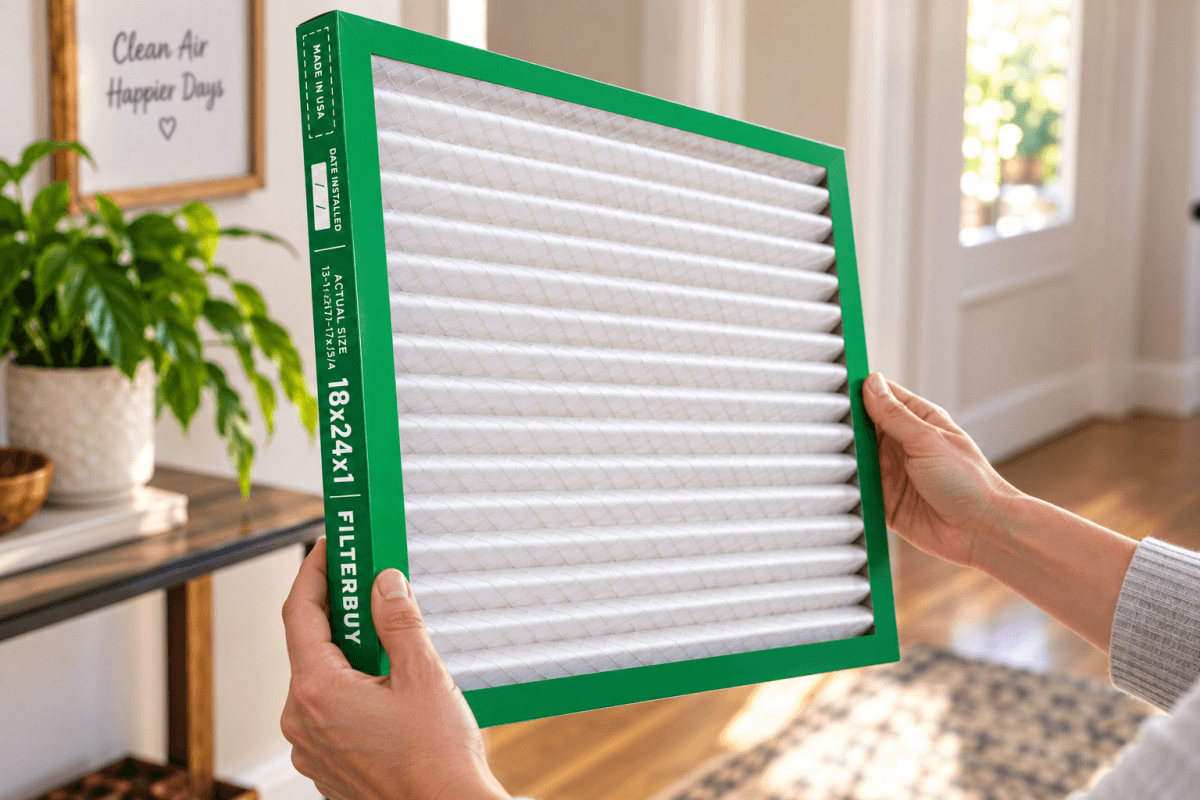
Actual Size: 17.38x23.38x0.75

3 month filters
2. Select Quantity
Buying multiple sizes?


Made in the USA
Ships in 24 hours
18x24x1 Air Filters Air Filter Description
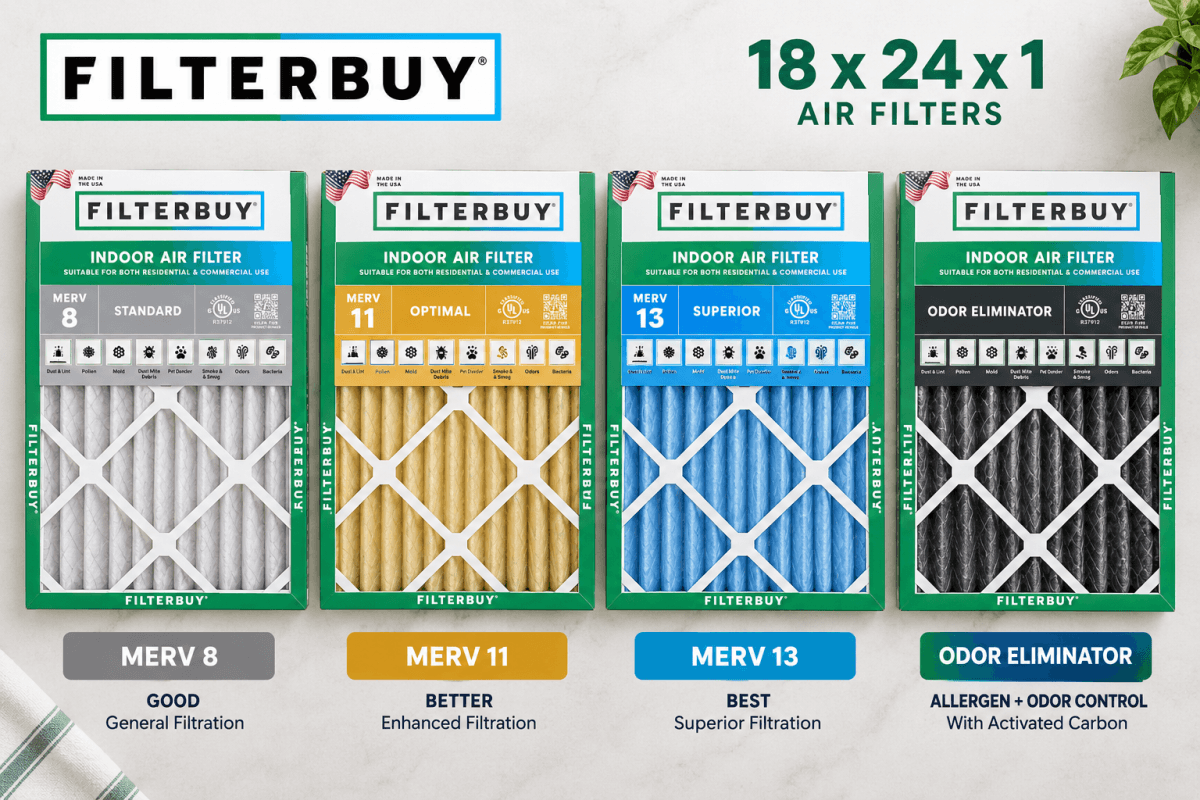
Available In MERV Rating: 8, 11, 13, Odor Eliminator
Made in the USA
Ships in 24 hours
Merv comparison
Scroll to see more.
 MERV 8 |  MERV 11 |  MERV 13 |  Odor Eliminator | |
|---|---|---|---|---|
| Best for | Standard Residential/Commercial Healthy Families | Superior Residential/Commercial Allergy Sufferers | Optimal Residential/Commercial Hospital Grade | ODOR ELIMINATOR Residential/Commercial Household Odors |
| Comparable ratings | MPR 600 & FPR 5 | MPR 1000-1200 & FPR 7 | MPR 1500 - 1900 & FPR 10 | MPR 1000-1200 & FPR 7 |
| Filtration | Captures 90% of Airborne Particles | Captures 95% of Airborne Particles | Captures 98% of Airborne Particles | Captures 95% of Airborne Particles |
| Dust, lint & debris | ||||
| Mold, pollen | ||||
| Dander, dust mites | ||||
| Smoke & Smog | ||||
| Bacteria | ||||
| Odor, vocs |
Is it time to change your filter?
Generally, we recommend you replace your air filters every 90 days. Find out below if you should change your filters more often.

If someone in your home has asthma or allergies...
Change your filter every
6 weeks
to ensure indoor air quality is at its best.
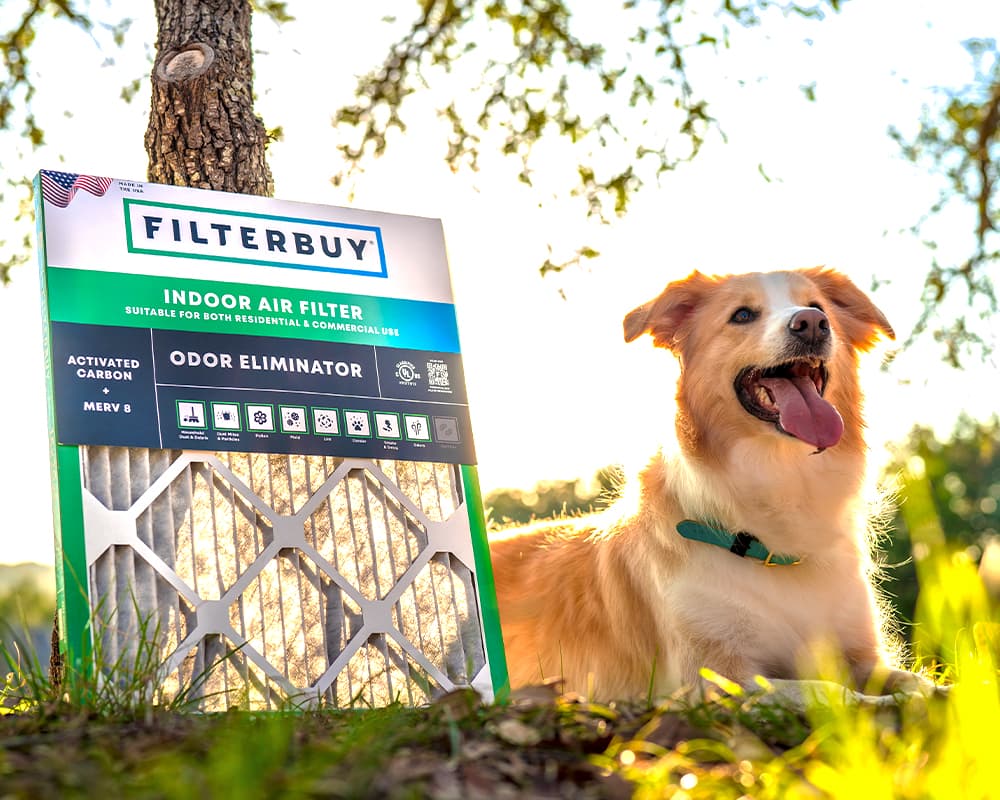
If you have pets...
Change your filter every
2 months
to avoid shedding and odor buildup.

If you have young children...
Change your filter every
2-3 months
as having clean air is even more important with children in your home.
If someone in your home has asthma or allergies...
Change your filter every
6 weeks
to ensure indoor air quality is at its best.
If you have pets...
Change your filter every
2 months
to avoid shedding and odor buildup.
If you have young children...
Change your filter every
2-3 months
as having clean air is even more important with children in your home.
By Michelle Wan · Technically reviewed by David Clark, Licensed HVAC Technician, Filterbuy HVAC Solutions · Updated September 15, 2026
TL;DR
An 18x24x1 air filter is a one-inch pleated filter for an 18-by-24-inch return grille or filter slot. Filterbuy cuts, pleats and frames it to order in our own US plants, in four options: MERV 8, MERV 11, MERV 13 and an activated-carbon Odor Eliminator. Fast and free 2-day delivery to most US states. Most homes replace this filter every 90 days.
Key Takeaways
“18x24x1” is the ordering name, not a measurement. Filterbuy cuts the filter smaller on purpose, and that clearance is what lets it slide into the slot.
MERV 8 is the standard choice for most homes. MERV 11 is for allergy sufferers, pets and pollen. MERV 13 is for smoke. The Odor Eliminator is for odors.
Check your HVAC manual for the filter ratings your system takes, the same quick check as confirming the size.
If your size isn’t listed, Filterbuy cuts custom sizes to the eighth of an inch.
What Size Is An 18x24x1 Air Filter?
Finding your size is easy. Pull the old filter out and read the numbers printed along the frame. That’s what you order. No filter in the slot? Measure the opening instead, then round to the nearest inch.
A Filterbuy 18x24x1 measures 17.38 x 23.38 x 0.75 inches, and we cut it that way deliberately. The nominal size is the ordering name. The actual cut runs smaller, and that bit of clearance is what lets the filter slide into the track without binding. So if you measure your old filter and don’t get 18 by 24, nothing’s wrong.
One thing to check if you’re switching brands: nominal sizes are shared across the industry, but actual cuts aren’t.
Source: manufacturer product listings, retrieved September 2026.
Dimensions from each manufacturer’s published listings, September 2026. Filterbuy isn’t affiliated with or endorsed by Filtrete or Filter King.
Order by the nominal size and it’ll fit. If your slot lands on a true fraction, like 17.75 or 23.25, don’t round it. That’s a custom slot, and we cut custom sizes to the eighth of an inch.
“I don’t want anyone to feel like they need an HVAC license just to pick the right filter. My job is to give you the straight answer, explain why it matters, and let you get back to your day.”
Michelle Wan, Brand Manager and Air Quality Writer, Filterbuy
→ Need help pinning it down? See the air filter sizes chart, how to measure your air filter, or where your HVAC air filter is located.
Which 18x24x1 Filter Should You Choose?
Start with what’s in your air. MERV 8 is the standard choice for most homes. MERV 11 is built for allergy sufferers, and it’s the one to pick if you’ve got pets or a bad pollen season. MERV 13 is for smoke. The Odor Eliminator is for odors.
Efficiency floors per EPA, "Residential Air Cleaners: A Technical Summary," 3rd Edition, and ANSI/ASHRAE Standard 52.2.
MERV stands for Minimum Efficiency Reporting Value, the industry scale for how much airborne particulate a filter captures. MPR and FPR are separate rating systems from other companies, listed here so you can match what’s on your old filter.
Before you order, check your HVAC manual for the filter ratings your system takes. It’s the same quick check as confirming the size, and it applies to every rating on this page. Our MERV ratings guide walks through the full scale.
What Does An 18x24x1 Charcoal Filter Do?
A charcoal filter, properly called activated carbon, goes after odors. The Filterbuy 18x24x1 Odor Eliminator layers pleated media with carbon, which adsorbs odor molecules the way a pleat can’t.
Pick it when the thing bothering you is a smell: cooking, pets, smoke, a newly furnished room. If it’s dust or pollen you’re chasing, go with MERV 11 or MERV 13 instead. Carbon won’t do anything about carbon monoxide or radon, so keep a detector for those.
How Often Should You Replace An 18x24x1 Air Filter?
Every 90 days in a typical home. That’s the interval Filterbuy builds this filter to hold. Homes with pets, allergy sufferers, or a smoky stretch of weather will want to swap it sooner.
Where Should You Buy 18x24x1 Air Filters?
Three options, and they mostly differ on price per filter.
Big-box stores carry the 18x24x1, so searching “18x24x1 air filters nearby” usually turns something up. You’ll pay single-unit retail, you’ll make the trip, and the higher ratings can be hit or miss on the shelf. Marketplaces improve on the price but bring slower shipping and the brand-to-brand sizing differences covered above.
Buying factory-direct from Filterbuy takes out the middleman markup. We’re a manufacturer, not a reseller: your filter is cut, pleated and framed to order in our own US plants, then sent out with fast and free 2-day delivery to most US states. Per-filter pricing drops as pack size goes up.
Worth knowing before you shop on price alone: a $4 fiberglass panel isn’t a cheaper pleated filter. It’s a flat screen that catches far less, and you’ll be replacing it more often. And if the real problem is that a filter sat in the slot for six months because nobody remembered, the Filterbuy air filter subscription ships on whatever interval you set, at a discount.
→ Shop 18x24x1 MERV 13 filters · Shop 18x24x1 MERV 11 filters · Shop 18x24x1 MERV 8 filters
Supporting statistics
Context on why so many people ask about home filtration. These are outside findings about air and health in the US. None of them describes what a filter does.
1. 61.5 million Americans live in counties that fail on short-term particle pollution.
Those counties fail on short spikes from wildfire smoke and dust. Year-round averages are graded separately.
Source: ALA, “State of the Air” 2026
2. 27.8 million Americans have asthma, 8.4% of the country.
The 2023 figure is 23 million adults and 4.8 million children.
Source: CDC, Most Recent Asthma Data
3. Two-thirds of US homes cool centrally.
88% of households use air conditioning, and two-thirds of those run central AC or a heat pump, each pulling air through a single filter slot.
Source: US EIA, 2020 RECS
Frequently Asked Questions
Which Way Does The Arrow Face?
Toward the furnace or air handler, away from the return grille. Filterbuy prints an airflow arrow on the frame so you don’t have to guess.
Is 18x24x1 A Large Furnace Filter?
It’s at the larger end of the standard 1-inch sizes. Filterbuy cuts 600+ sizes plus custom dimensions, so bigger returns are covered too.
Are Cheap 18x24x1 Filters Worth It?
For a home air filter replacement you’d like to leave in for 90 days, no. A budget fiberglass panel costs less and catches less. Factory-direct multipacks close most of the price gap.
Do You Run Sales On 18x24x1 Filters?
Pricing is factory-direct year round and drops by pack size, so a multipack usually beats a promotion on a single filter.
What If I Can’t Find My Size?
Measure the slot and order a custom filter. We cut to the eighth of an inch, so odd slots in older homes and renovations aren’t a problem.
Sources
American Lung Association, “State of the Air” 2026
Centers for Disease Control and Prevention, Most Recent Asthma Data (2023 National Health Interview Survey)
US Energy Information Administration, Residential Energy Consumption Survey, 2020
About the author
Michelle Wan is Brand Manager and Air Quality Writer at Filterbuy, where she turns filter ratings and HVAC upkeep into plain-English advice (B.A., University of California, Santa Cruz). She works directly with Filterbuy’s manufacturing teams and writes from how filters are built and used. Technically reviewed by David Clark, Licensed HVAC Technician, Filterbuy HVAC Solutions.
Filterbuy is a second-generation, family-owned American manufacturer. It began in the 1950s as Talladega Machinery and Supply, became Filterbuy in 2012 and sold its first filter in 2013. We make 100% of our products in the USA, in 600+ sizes plus custom, shipped factory-direct.
Glossary
Nominal size: The rounded name printed on the frame, like 18x24x1. It’s what you order.
Actual size: What the filter measures once it’s cut. On standard sizes it runs under nominal so it fits the slot.
Activated carbon: Porous carbon that adsorbs odors and gases. Layered with pleated media in the Filterbuy Odor Eliminator.