
20x30x1 Air Filters
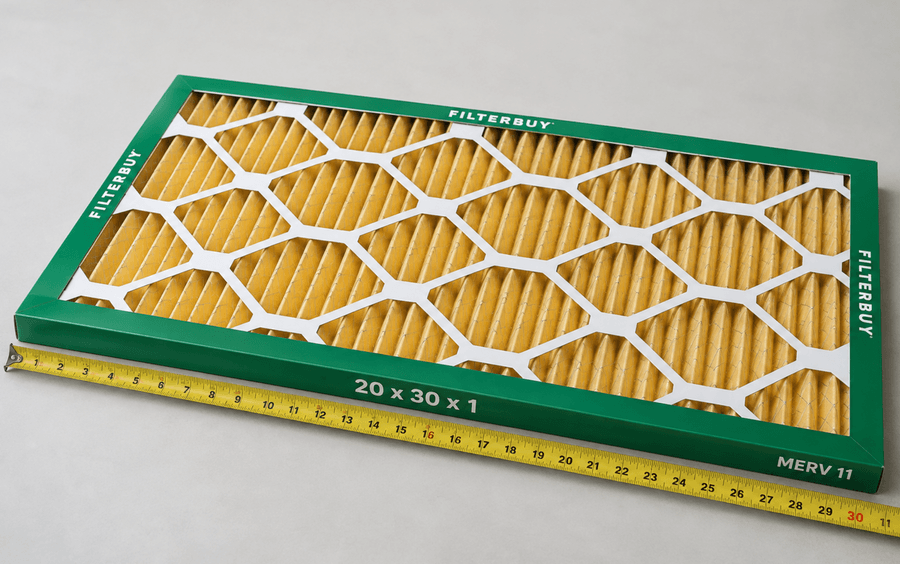
Actual Size: 19.63x29.63x0.75

3 month filters
2. Select Quantity
Buying multiple sizes?


Made in the USA
Ships in 24 hours
20x30x1 Air Filters Air Filter Description
Available In MERV Rating: 8, 13, 11, Odor Eliminator
Made in the USA
Ships in 24 hours
Merv comparison
Scroll to see more.
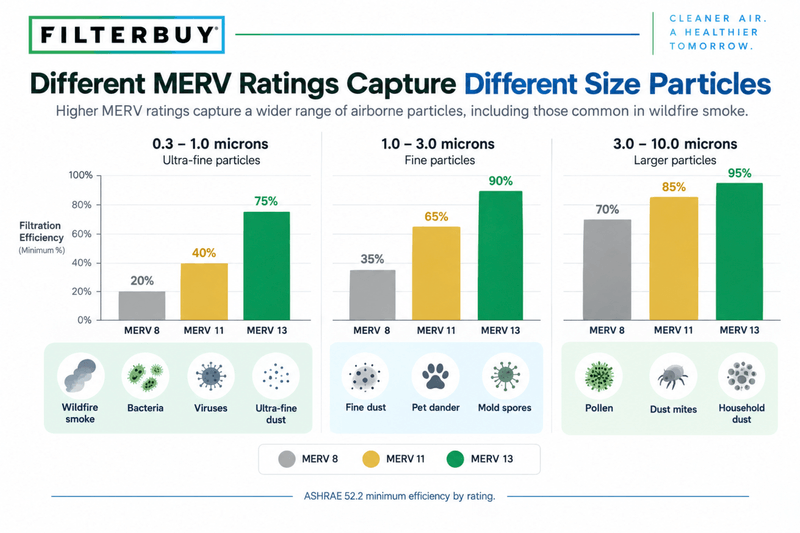
 MERV 8 |  MERV 11 |  MERV 13 |  Odor Eliminator | |
|---|---|---|---|---|
| Best for | Standard Residential/Commercial Healthy Families | Superior Residential/Commercial Allergy Sufferers | Optimal Residential/Commercial Hospital Grade | ODOR ELIMINATOR Residential/Commercial Household Odors |
| Comparable ratings | MPR 600 & FPR 5 | MPR 1000-1200 & FPR 7 | MPR 1500 - 1900 & FPR 10 | MPR 1000-1200 & FPR 7 |
| Filtration | Captures 90% of Airborne Particles | Captures 95% of Airborne Particles | Captures 98% of Airborne Particles | Captures 95% of Airborne Particles |
| Dust, lint & debris | ||||
| Mold, pollen | ||||
| Dander, dust mites | ||||
| Smoke & Smog | ||||
| Bacteria | ||||
| Odor, vocs |
Is it time to change your filter?
Generally, we recommend you replace your air filters every 90 days. Find out below if you should change your filters more often.

If someone in your home has asthma or allergies...
Change your filter every
6 weeks
to ensure indoor air quality is at its best.
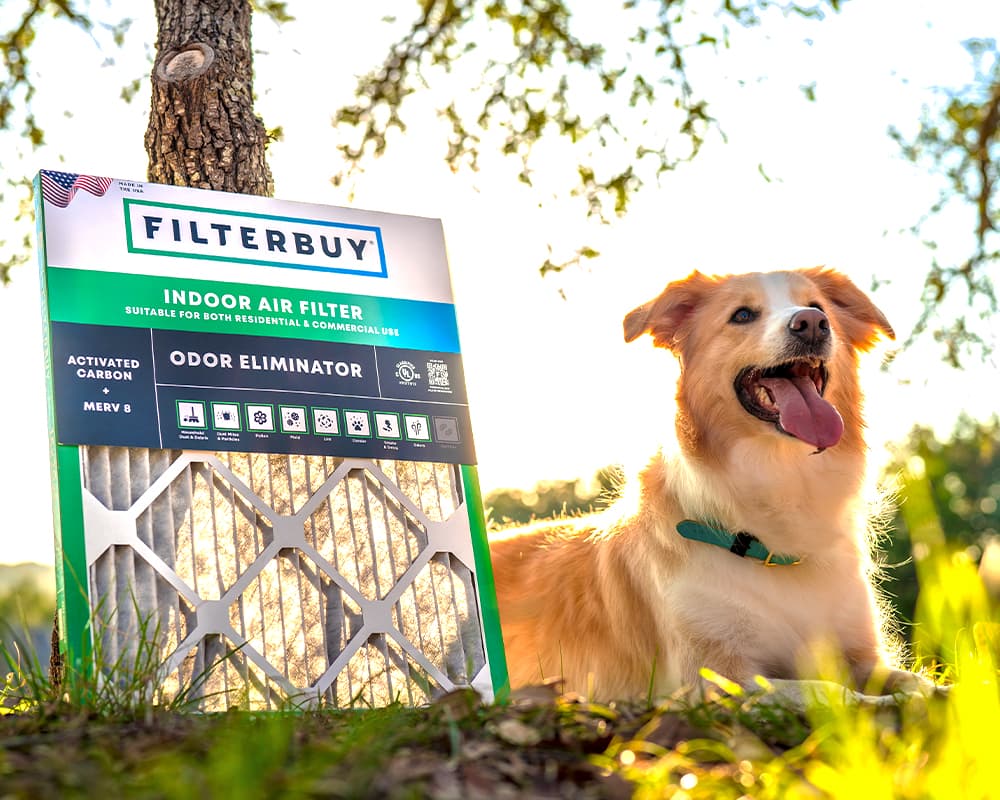
If you have pets...
Change your filter every
2 months
to avoid shedding and odor buildup.

If you have young children...
Change your filter every
2-3 months
as having clean air is even more important with children in your home.
If someone in your home has asthma or allergies...
Change your filter every
6 weeks
to ensure indoor air quality is at its best.
If you have pets...
Change your filter every
2 months
to avoid shedding and odor buildup.
If you have young children...
Change your filter every
2-3 months
as having clean air is even more important with children in your home.
TL;DR
A 20x30x1 air filter is a one-inch pleated HVAC filter that measures 19½" × 29½" × ¾", and it usually sits in a large return-air grille instead of down at the furnace. Filterbuy cuts, pleats, and frames it to order in our own US plants in MERV 8, MERV 11, MERV 13, and Odor Eliminator, with fast and free 2-day delivery to most US states.
Key Takeaways
20x30x1 is the nominal size, which is the name you order by. The filter itself is cut slightly smaller, and that clearance is what lets it slide in.
All four Filterbuy options fit the same slot, so you're only choosing how much you want caught.
Check your HVAC manual for filter compatibility before you settle on a rating. It's the same quick check as confirming your size.
A 12-pack works out to about $7.49 a filter [VERIFY PRICING], which covers roughly three years of changes in a home with one return.
What Is a 20x30x1 Air Filter?
A 20x30x1 air filter is a one-inch pleated HVAC filter with a nominal size of 20 by 30 by 1 inches and an actual size of 19½" × 29½" × ¾". It sits in the return air path and catches particles before they reach your blower and coil. At 30 inches long, it usually lives behind a wall or ceiling return grille instead of down at the furnace.
The nominal number is the ordering name. The actual cut runs smaller by design, and that clearance is what makes it fit. We're a manufacturer, so these are the numbers we cut to: Filterbuy filters are cut, pleated, and framed to order in our own US plants.
Which MERV Rating Should You Choose for a 20x30x1 Filter?
MERV is the industry scale for how much an air filter captures, and Filterbuy builds this size in four options. MERV 8 is the standard choice for most homes. MERV 11 is built for allergies and asthma, and it's the one to reach for if you've got pets or heavy pollen. MERV 13 is the one for smoke. And if the problem is odors, the carbon Odor Eliminator is made for that.
Check your HVAC manual for filter compatibility before you settle on a rating.
Before you settle on a rating, check your HVAC manual for filter compatibility. It takes a minute, and it's the same kind of fit check as confirming your size.
Will a 20x30x1 Filter Fit My Furnace or Air Conditioner?
Yes, if that's the size your system takes. One filter covers both heating and cooling, because a central system shares a single air handler and return duct, so there's no separate furnace version and AC version. A filter listed as 30x20x1 is the same thing with the numbers reversed.
Finding your size is usually the easy part. Pull the old filter and read the nominal size printed on the frame. That's what you order. If there's no old filter to read, measure the slot instead and round each dimension up to the nearest inch.
Read the nominal size off your old filter first. Measure the slot only if there isn't one to read.
Don't see your size? We cut custom sizes to the eighth of an inch, so send us your measurements and we'll build it.
One Size That's Easy to Confuse
Filterbuy also builds a 19.5x29.5x1, and it's a different filter. That one measures 19.63" × 29.63" × 0.75". So if your slot came out at 19½ by 29½, the 20x30x1 on this page is the one cut to those numbers. Order by what you measured.
Where Can You Buy 20x30x1 Air Filters?
You'll find 20x30x1 at Home Depot, Lowe's, Walmart, and Amazon, usually in one or two ratings and small packs. Filterbuy sells all four ratings direct, in packs from one to twelve or more, with fast and free 2-day delivery to most US states. If you need a filter this afternoon, the store down the road wins on speed. For every change after that, Auto Delivery costs less and drops the errand.
What Does a 20x30x1 Air Filter Cost Per Year?
Buying in quantity is what moves the number. Here's how it works out at four changes a year.
MERV 8 pricing at four changes a year. Verify against the live product page before publish.
That's MERV 8 pricing, and the other ratings follow the same quantity structure. Pleated filters keep indefinitely if you store them flat and dry, so buying ahead costs you nothing but a bit of shelf space.
20x30x1 Replacement Filters by Brand
Our 20x30x1 fits the same slot as Honeywell, Filtrete, HDX, Rheem, Trane, Lennox, and Carrier filters of that size. The tricky part is that three rating systems are in play. MERV is the industry scale. MPR belongs to 3M, and FPR belongs to The Home Depot.
MPR belongs to 3M and FPR to The Home Depot. Filterbuy isn't affiliated with or endorsed by either.
Match the number and you've matched the tier. Filterbuy isn't affiliated with or endorsed by Honeywell, 3M, Filtrete, The Home Depot, HDX, Rheem, Trane, Lennox, or Carrier.
How Often Should You Change a 20x30x1 Air Filter?
Change it about every 90 days in a standard household, every 60 with a pet, and every 45 with several pets or heavy pollen. The Odor Eliminator runs about 60 days.
Here's a test that beats any calendar. Hold the filter up to a light. If light doesn't pass through the pleats, it's due. Check it monthly and you'll know where you stand.
If remembering is the hard part, Auto Delivery ships every 30, 60, or 90 days at 5% off [VERIFY OFFER]. Aiming for 45 days? Pick 30, and breathe easy.
How Do You Install a 20x30x1 Without Bending It?
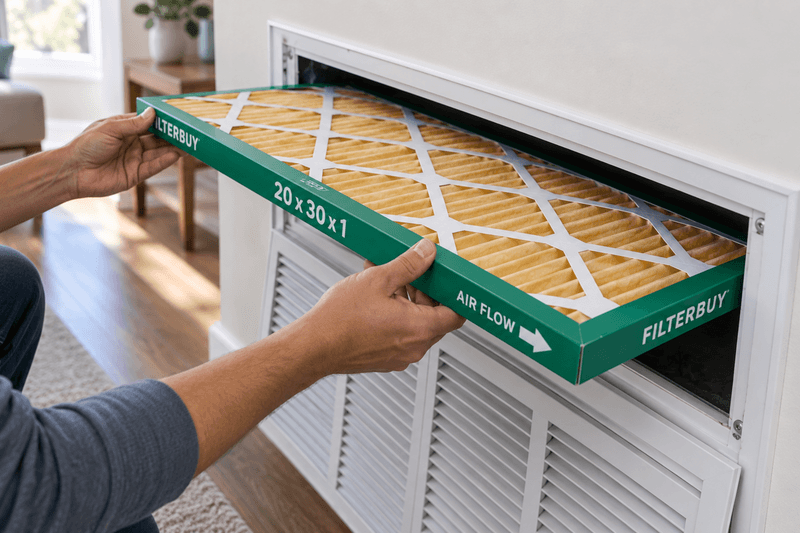
Start with the arrows. The frame has airflow arrows printed on it, and they point toward your furnace or air handler, the way air travels away from the room. Check which way the old one pointed before you pull it out.
Then deal with the length. At 30 inches, this filter flexes if you carry it by one end, so hold it under the middle. Working overhead at a ceiling grille, slide the far edge into the track first and let the near edge follow. It should go in without force.
Then run the system and listen at the grille. A whistle usually means air is slipping around the frame instead of passing through the pleats. Older housings warp over the years, and a strip of weatherstripping around the opening closes that gap.
Can You Wash or Reuse a 20x30x1 Air Filter?
No. Filterbuy's pleated filters are disposable, and washing one ruins it. Water strips the electrostatic charge we put on the media during manufacturing, collapses the pleats, and leaves damp material sitting in your duct.
Washable 20x30x1 filters do exist, metal-framed with a rinseable mesh. The ACAAI points out that a permanent filter is very hard to get properly clean. Our washable versus disposable breakdown has the full comparison.
20x30x1 Air Filter FAQs
Does One 20x30x1 Filter My Whole House?
Often, yes. A 30-inch return is usually a single central return for the whole system, so a lot of 20x30x1 homes run one filter where a smaller-size home might run three or four.
Can I Put a 20x30x1 in a 20x30x2 Slot?
No. A 2-inch slot needs a 2-inch filter. A 1-inch filter will rattle and tip in there, and air will slip around the frame.
What if My Size Isn't Listed?
We cut custom sizes to the eighth of an inch. Send us your measurements and we'll build it.
Glossary
MERV. The industry scale for how much an air filter captures. Higher numbers capture more.
MPR and FPR. Third-party rating systems. MPR belongs to 3M and FPR to The Home Depot, and neither is ours.
Nominal size. The rounded size printed on the frame, and the name you order by. The actual size is the true measurement, 19½" × 29½" × ¾" here.
About the Author
Michelle Wan is Filterbuy's Brand Manager and Air Quality Writer. She works with our US manufacturing team, so she writes from how filters get built and used. Reviewed by David Clark, Licensed HVAC Technician.