
14x30x1 Air Filters
Actual Size: 13.88x29.88x0.75

3 month filters
2. Select Quantity
Buying multiple sizes?


Made in the USA
Ships in 24 hours
14x30x1 Air Filters Air Filter Description
Available In MERV Rating: 8, 11, 13, Odor Eliminator
Made in the USA
Ships in 24 hours
Merv comparison
Scroll to see more.
 MERV 8 |  MERV 11 |  MERV 13 |  Odor Eliminator | |
|---|---|---|---|---|
| Best for | Standard Residential/Commercial Healthy Families | Superior Residential/Commercial Allergy Sufferers | Optimal Residential/Commercial Hospital Grade | ODOR ELIMINATOR Residential/Commercial Household Odors |
| Comparable ratings | MPR 600 & FPR 5 | MPR 1000-1200 & FPR 7 | MPR 1500 - 1900 & FPR 10 | MPR 1000-1200 & FPR 7 |
| Filtration | Captures 90% of Airborne Particles | Captures 95% of Airborne Particles | Captures 98% of Airborne Particles | Captures 95% of Airborne Particles |
| Dust, lint & debris | ||||
| Mold, pollen | ||||
| Dander, dust mites | ||||
| Smoke & Smog | ||||
| Bacteria | ||||
| Odor, vocs |
Is it time to change your filter?
Generally, we recommend you replace your air filters every 90 days. Find out below if you should change your filters more often.

If someone in your home has asthma or allergies...
Change your filter every
6 weeks
to ensure indoor air quality is at its best.
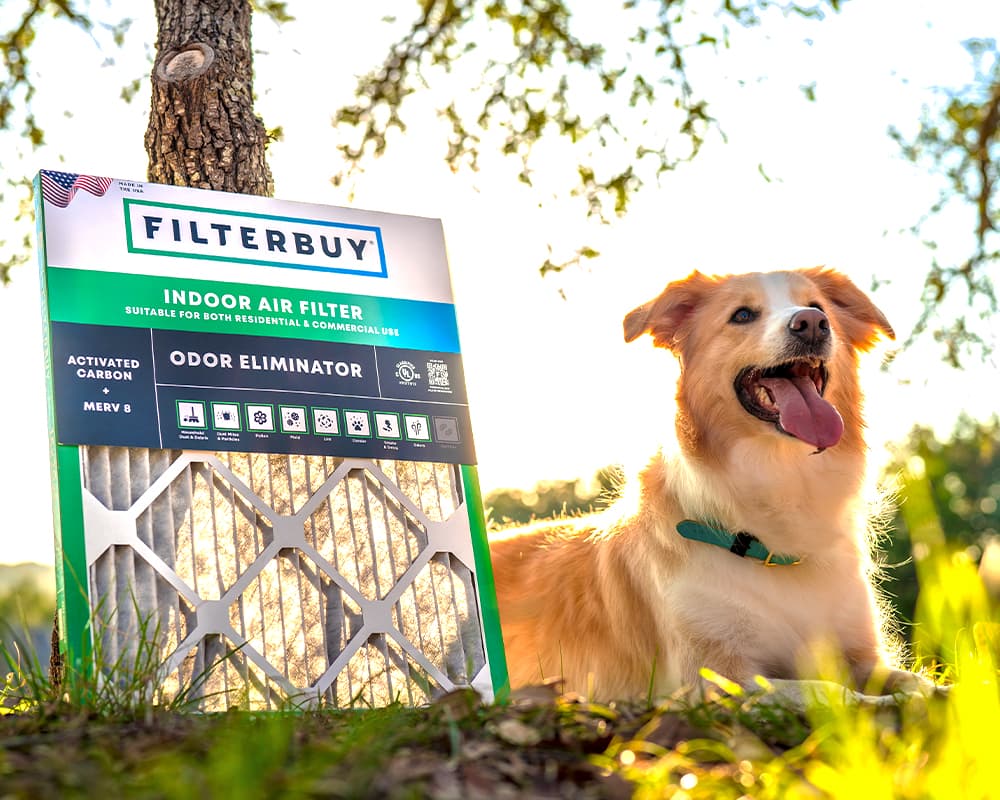
If you have pets...
Change your filter every
2 months
to avoid shedding and odor buildup.

If you have young children...
Change your filter every
2-3 months
as having clean air is even more important with children in your home.
If someone in your home has asthma or allergies...
Change your filter every
6 weeks
to ensure indoor air quality is at its best.
If you have pets...
Change your filter every
2 months
to avoid shedding and odor buildup.
If you have young children...
Change your filter every
2-3 months
as having clean air is even more important with children in your home.
TL;DR
A 14x30x1 air filter is a one-inch pleated HVAC filter, and 14x30x1 is the nominal size you order by. The actual cut is a little smaller, and that clearance is what lets it slide into the slot. Filterbuy cuts, pleats and frames this size to order in our own US plants, in MERV 8, 11, 13 and Odor Eliminator, from $8.33 a filter.
Key Takeaways
14x30x1 is the nominal size. A Filterbuy 14x30x1 measures 13.88 x 29.88 x 0.75 inches.
Read the size off your old filter first. If the slot is empty, measure the opening and round up.
Change it about every 90 days, sooner with pets, allergies or heavy dust.
A 6-pack covers roughly 18 months on one return vent and brings the price down to $8.33 a filter
What Is a 14x30x1 Air Filter?
A 14x30x1 air filter is a one-inch-deep pleated HVAC filter, sold under the nominal size 14" x 30" x 1". It sits in the return-air grille or the filter slot at your air handler, catching dust and debris before they reach the fan. Furnace filter, AC filter, HVAC filter: in a central system they all name the same part.
That 30-inch edge runs longer than most residential air filter sizes, so home air filters this size tend to turn up in older homes, in custom ductwork, and in systems built around one large return. You won’t often find 14x30x1 on a shelf. Filterbuy cuts, pleats and frames it to order in our own US plants, alongside more than 600 other sizes.
What Are the Actual Dimensions of a 14x30x1 Air Filter?
A Filterbuy 14x30x1 air filter measures 13.88 x 29.88 x 0.75 inches. 14x30x1 is the nominal size, the rounded name you order by, and the real cut is smaller on purpose. That clearance is what lets the filter slide in instead of binding, which is why nothing labeled 14x30x1 measures a flat 14 by 30.
Finding your size is usually the easy part. Pull the old filter and read the size printed along the frame, because that is the nominal size and it is what you order. If the slot is empty, measure the opening and round each dimension up to the nearest inch. Our guide to how to measure your air filter walks through both.
Here is how the major brands actually measure this size:
Source: each manufacturer’s published specifications, compiled September 2026. Filterbuy isn’t affiliated with or endorsed by these brands.
Clearance isn’t standard across the industry, and it isn’t even the same across our own catalog. Filterbuy cuts the 14x30x1 to 13.88 inches, an eighth under nominal, while the 16x25x1 comes off the line at 15.50, a half inch under. We publish both numbers because a single rule of thumb is what sends people home with the wrong filter.
If you’re switching brands, the width in this size varies by up to 0.38 inches between manufacturers, and Filterbuy sits at the wide end. A slot that took a looser filter should still take ours, but it’s worth a look before you order six. If yours doesn’t seat, our exchange policy sends a different size free. And if your slot measures something we don’t list, we cut custom air filters to the eighth of an inch.
Which MERV Rating Should You Choose for a 14x30x1 Filter?
MERV 8 is the standard choice for most homes. MERV 11 is for allergies and asthma, and for houses with pets or pollen coming in. MERV 13 is the one for smoke. The Filterbuy Odor Eliminator sits alongside that scale, adding an activated carbon layer for odors.
MPR and FPR are third-party rating systems from 3M and The Home Depot, so comparisons are approximate. Whichever tier you choose, check your HVAC manual for filter compatibility.
Whichever tier you pick, check your HVAC manual for filter compatibility, the same way you’d confirm a size. Our MERV guide goes further into the scale.
I don’t want anyone to feel like they need an HVAC license just to pick the right filter. My job is to give you the straight answer, explain why it matters, and let you get back to your day.
Michelle Wan, Brand Manager and Air Quality Writer, Filterbuy
How Often Should You Replace a 14x30x1 Air Filter?
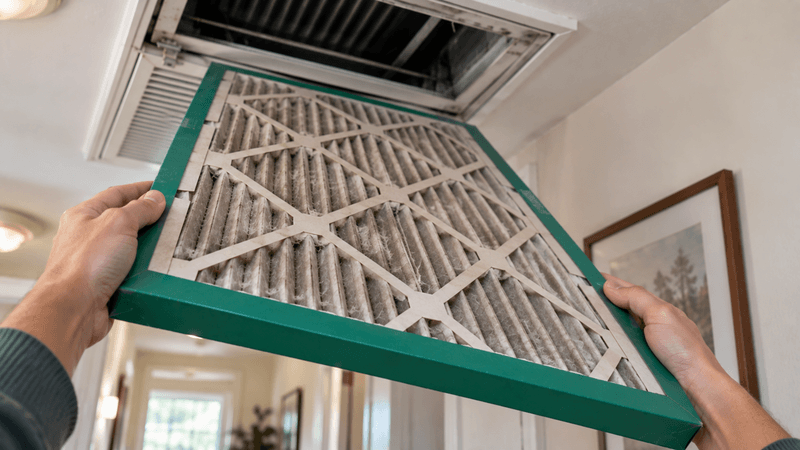
Replace a 14x30x1 filter about every 90 days in most homes. One inch of depth holds less than two or four inches, so pets, allergies and heavy dust all shorten the interval. Treat the calendar as a starting point: hold the filter up to a light, and if light doesn’t come through the pleats, change it whatever the date says.
Check the filter monthly and change it whenever it looks dirty, whatever the interval says.
Those intervals match the 60-to-90-day norm the EPA cites, and ENERGY STAR suggests a look every month through the heaviest heating and cooling season. In wildfire smoke the EPA advises replacing sooner than the manufacturer suggests. Our guide to how often to change your air filter breaks it down by depth.
Should You Buy a 6-Pack or a 12-Pack of 14x30x1 Filters?
A 14x30x1 air filter 6-pack suits a home with one return vent, covering roughly 18 months on a 90-day schedule. Move up to a 12-pack if you’re feeding two or three returns. Filterbuy prices these in tiers, so the cost per filter drops as the pack grows, from $29.99 for one to $8.33 each at six.
Coverage assumes one return vent on a 90-day schedule. Filterbuy list prices; confirm before publishing.
If you’re hovering between four and five, buy six. Five Filterbuy 14x30x1 filters come to $48.95 and six come to $49.98, so that sixth filter costs you about a dollar. Past six, the price per filter stops falling: a 12-pack is exactly twice the 6-pack. Buy twelve if you’d rather order half as often, or you’re covering a second return vent. Auto-delivery takes another 5% off and times each shipment to your interval.
Where Can You Buy 14x30x1 Air Filters Near You?
You probably won’t find 14x30x1 on a shelf, because big-box stores stock about a dozen high-volume sizes and this isn’t one of them. Filterbuy cuts, pleats and frames this size to order in our own US plants and ships it direct, with fast and free 2-day delivery to most US states.
If the reason you’re looking today is that you forgot last time, auto-delivery sends the next one on your own schedule and takes 5% off. Set it once and breathe easy.
Should You Buy 14x30x1 Filters on Amazon or From Filterbuy.com?
Filterbuy sells the same 14x30x1 air filters on Amazon.com and here, off the same line: same electrostatic pleated media, same beverage-board frame, same 13.88" x 29.88" x 0.75" cut. Buy on Amazon if you’d rather use Prime. Buy here for the quantity tiers above and to mix sizes in one order.
14x30x1 Air Filter FAQ
Is a 14x30x1 Filter the Same as a 30x14x1 Filter?
Yes. The two names list the same face dimensions in a different order, and manufacturers label it both ways, so order whichever matches your system.
Can 14x30x1 Air Filters Be Washed and Reused?
No. These are pleated disposable filters. Washing collapses the media and strips the electrostatic charge, so a washed filter doesn’t work as well as a new one.
How Do You Install a 14x30x1 Air Filter?
Turn the system off, slide the old filter out, and note which way the airflow arrow on its frame points. The new one goes in the same direction. That arrow is the step people get wrong, and our guide to changing a furnace filter has the full walkthrough.
What if 14x30x1 Isn’t the Right Size?
Measure the slot and order what it measures, rounded up, and don’t force a near fit. Filterbuy makes 600+ air filter sizes including every standard 1-inch filter, and cuts custom sizes to the eighth of an inch, so an odd measurement isn’t a dead end.
Supporting Statistics
1. A snug fit matters as much as the rating you choose.
The EPA advises making sure the filter fits snugly so air can’t leak around it, and that you shouldn’t have to bend it to fit.
Why it matters: air that slips past the frame never passes through the media, so a loose filter undoes the tier you paid for.
Source: U.S. EPA, Guide to Air Cleaners in the Home, 2nd ed., February 2026.
2. Only one of the three ratings on a filter box comes from a consensus standard.
MERV comes from ANSI/ASHRAE Standard 52.2. MPR and FPR are proprietary scales from 3M and The Home Depot.
Why it matters: the MPR and FPR equivalents in the table above are approximate, so compare filters across brands on MERV.
Source: U.S. EPA, Guide to Air Cleaners in the Home.
3. Manufacturers typically recommend replacement every 60 to 90 days.
The EPA adds that if filters look heavily soiled when you replace them, change them more often.
ENERGY STAR recommends checking the filter monthly and changing it whenever it looks dirty.
Why it matters: the schedule above is a starting point, and what your own filter looks like at 30 days beats any chart.
Sources: U.S. EPA; ENERGY STAR.
Glossary
Nominal size. The rounded whole-inch dimensions printed on the frame and used to order.
Actual size. A filter’s measured dimensions, always a little under nominal. A Filterbuy 14x30x1 measures 13.88 x 29.88 x 0.75 inches.
MERV. Minimum Efficiency Reporting Value, from ANSI/ASHRAE Standard 52.2. It rates particle capture from 1 to 16.
MPR and FPR. Proprietary rating scales from 3M and The Home Depot. Neither is MERV, so equivalents are approximate.
Filter bypass. Air slipping around a filter’s edges instead of through the media, which undoes filtration at any MERV rating.
About the author and reviewer
Michelle Wan, Author
is Brand Manager and Air Quality Writer at Filterbuy. She works with Filterbuy’s US manufacturing team and writes from how filters are built and used in real homes. B.A., UC Santa Cruz. Learn more on her author page.
David Clark, Reviewer, Licensed HVAC Technician
Licensed HVAC Technician with Filterbuy HVAC Solutions, who reviews Filterbuy’s maintenance and system-compatibility guidance.