
24x30x1 Air Filters
Actual Size: 23.88x29.88x0.75

3 month filters
2. Select Quantity
Buying multiple sizes?


Made in the USA
Ships in 24 hours
24x30x1 Air Filters Air Filter Description
Available In MERV Rating: 8, 13, 11, Odor Eliminator
Made in the USA
Ships in 24 hours
Merv comparison
Scroll to see more.
 MERV 8 |  MERV 11 |  MERV 13 |  Odor Eliminator | |
|---|---|---|---|---|
| Best for | Standard Residential/Commercial Healthy Families | Superior Residential/Commercial Allergy Sufferers | Optimal Residential/Commercial Hospital Grade | ODOR ELIMINATOR Residential/Commercial Household Odors |
| Comparable ratings | MPR 600 & FPR 5 | MPR 1000-1200 & FPR 7 | MPR 1500 - 1900 & FPR 10 | MPR 1000-1200 & FPR 7 |
| Filtration | Captures 90% of Airborne Particles | Captures 95% of Airborne Particles | Captures 98% of Airborne Particles | Captures 95% of Airborne Particles |
| Dust, lint & debris | ||||
| Mold, pollen | ||||
| Dander, dust mites | ||||
| Smoke & Smog | ||||
| Bacteria | ||||
| Odor, vocs |
Is it time to change your filter?
Generally, we recommend you replace your air filters every 90 days. Find out below if you should change your filters more often.

If someone in your home has asthma or allergies...
Change your filter every
6 weeks
to ensure indoor air quality is at its best.
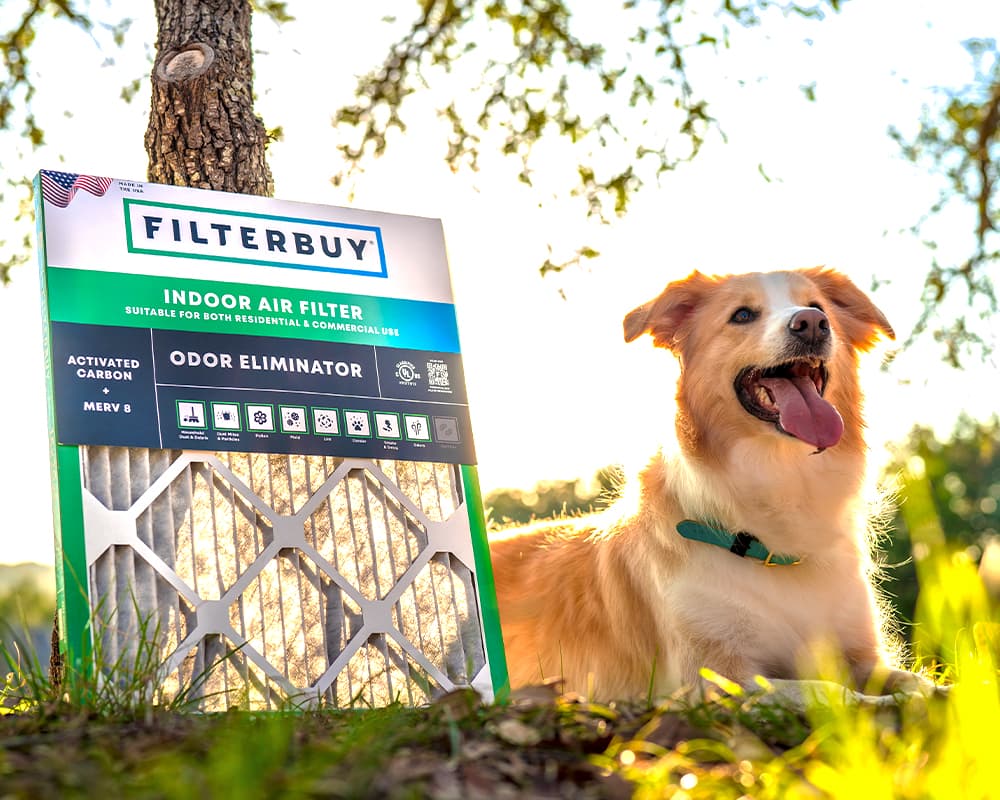
If you have pets...
Change your filter every
2 months
to avoid shedding and odor buildup.

If you have young children...
Change your filter every
2-3 months
as having clean air is even more important with children in your home.
If someone in your home has asthma or allergies...
Change your filter every
6 weeks
to ensure indoor air quality is at its best.
If you have pets...
Change your filter every
2 months
to avoid shedding and odor buildup.
If you have young children...
Change your filter every
2-3 months
as having clean air is even more important with children in your home.
TL;DR
A 24x30x1 air filter is a one-inch pleated HVAC filter, and the actual cut measures 23.88" x 29.88" x 0.75". Your furnace, air conditioner and heat pump all pull through the same air handler, so one filter covers all three. Filterbuy makes this size in MERV 8, MERV 11, MERV 13 and Odor Eliminator, cut, pleated and framed to order in our own US plants.
Key Takeaways
24x30x1 is the name you order by. The actual cut measures 23.88" x 29.88" x 0.75".
One filter covers heating and cooling, because both run through the same air handler.
MERV 8 is the standard choice for most homes. MERV 11, MERV 13 and Odor Eliminator each have a job of their own.
Check your HVAC manual for the rating your system is set up for, the same way you would check the size.
Plan on a new filter every 60 to 90 days. A year of them runs about $42 to $107.
24x30x1 Specifications
What Size Is A 24x30x1 Air Filter?
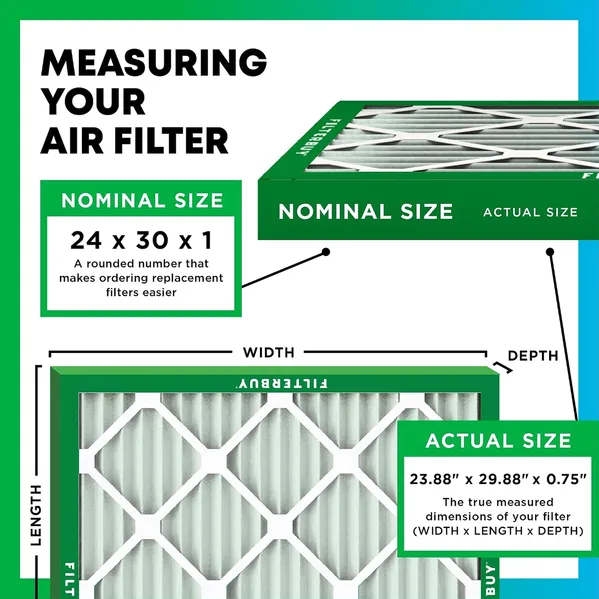
A 24x30x1 air filter is cut to 23.88" x 29.88" x 0.75". The 24x30x1 on the box is the nominal size, which is just the name you order by. The cut comes in a little smaller on purpose, and that clearance is what lets the filter slide into the slot and still seal against it.
Finding your size takes about a minute.
HOW TO CONFIRM YOUR SIZE
Switch the system off at the thermostat and slide the old filter out.
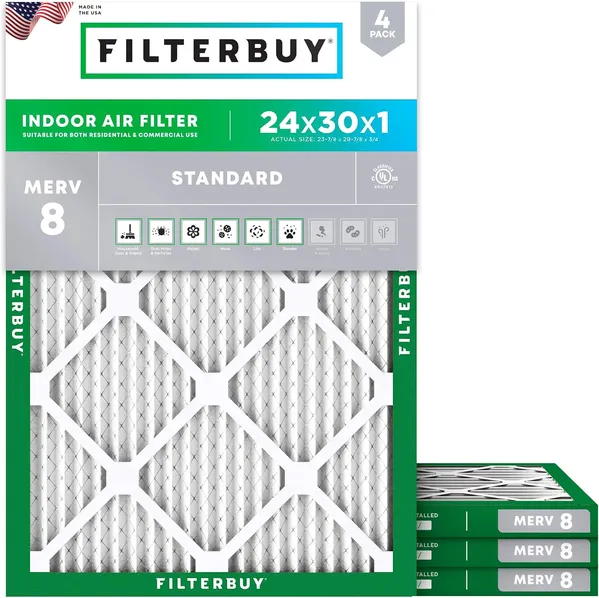
Read the size printed along the frame. That’s the nominal size, and it’s what you order.
If there isn’t a filter in there, or the frame has worn blank, measure the slot itself to the nearest eighth of an inch.
AFTER THE STEPS
If your measurement doesn’t match a size we list, we cut custom filters to the eighth of an inch, so an odd slot isn’t a dead end.
One thing worth double-checking is depth. A 24x30x2 is cut to 23.50" x 29.50", so on a tape measure its width and height look close to a 24x30x1. If your slot is one inch deep, the 24x30x1 is the one you want.
Sizes People Mistake For 24x30x1
All figures are Filterbuy cut sizes. Measure your slot before you order.
Will A 24x30x1 Filter Work In Both My Furnace And My Air Conditioner?
Yes, it’s the same filter for both. In a central system your furnace and air conditioner share one air handler and one blower, and the filter sits on the return side, so whichever one is running pulls air through it.
That’s why you’ll see this size called a furnace filter, an AC filter, an HVAC filter and a heat pump filter. They’re four names for one part, and Filterbuy lists the size under each of them because that’s how people search.
What does change with the season is how quickly it fills up. Heating and cooling both run the blower hard, so check yours monthly through midsummer and midwinter.
Which Rating Should You Choose For A 24x30x1?
MERV 8 is the standard choice for most homes. MERV 11 is built for allergy sufferers, and for households with pets or heavy pollen. MERV 13 is the one to reach for where smoke is part of life. Odor Eliminator uses carbon media and is made for odors, from cooking to pets.
Before you settle on a rating, check your HVAC manual for what your system is set up for. It’s a quick fit check, the same as confirming the size.
The MERV Ladder
MPR and FPR are third-party rating systems owned by their respective companies and appear for comparison only. Odor Eliminator uses carbon media for odors and is not rated on this scale.
Read more: MERV ratings explained
Where Can You Buy 24x30x1 Air Filters Near You?
You can order 24x30x1 air filters from Filterbuy with fast, free 2-day delivery to most US states. Some nearby hardware stores carry this size too, though the selection tends to be thin, because 24x30x1 isn’t as common as 20x25x1 or 16x25x1.
That gap is why we keep uncommon sizes in production. If you want MERV 11 or MERV 13 in a 24x30x1, the local shelf often won’t have it, and buying one filter at a time is the most expensive way to do it.
How Often Should You Replace A 24x30x1 Filter?
Plan on a new 24x30x1 filter every 60 to 90 days in a typical home, and sooner if you’ve got pets, allergy sufferers or young children. The EPA notes that manufacturers generally recommend the same 60 to 90 days. The table below shows where most households land.
Not sure whether yours is done? Hold it up to a light. If the light won’t come through the pleats, it’s time.
Replacement Schedule
Check the filter monthly in peak heating and cooling season. Hold it up to a light, and if the light won't come through the pleats, swap it.
The easiest way to stop thinking about it’s to put it on a schedule. We’ll ship your size on whatever interval you pick, and you can change it or skip a delivery whenever you want. Nobody should need an HVAC license to remember a filter change.
What Does A Year Of 24x30x1 Filters Cost?
A year of 24x30x1 filters runs about $42 to $107, which works out to roughly three to nine dollars a month. The table does the arithmetic at our six-or-more price, across the two replacement intervals most households land on.
MERV 11 costs about five dollars a year more than MERV 8, so stepping up isn’t the expense people expect. Odor Eliminator is the priciest of the four, because carbon media costs more to make.
What a Year of Filters Costs
Based on the price at six or more filters. Buying twelve at a time brings every figure down further.
Why Buy Your 24x30x1 Filters From Filterbuy?
We are a manufacturer, not a reseller. Your filters are cut, pleated and framed to order in our own US plants, then shipped straight to you, which is why an uncommon size like 24x30x1 gets tooled for here instead of skipped.
Because we build them, we can tell you what’s in one. The frame is beverage board, a dense paperboard that holds its shape in a humid return where ordinary cardboard sags. Behind the pleats sits a wire backing that keeps the media from bowing once air is moving through it.
We cut this size an eighth of an inch under nominal. Some brands cut as much as half an inch under, which is a looser fit in the same slot. Whichever brand you end up buying, read the actual dimensions printed on the frame before you order.
We make more than 600 sizes. If yours isn’t one of them, we’ll cut it.
"The number on the box and the number on your tape measure won't match, and that's the part that worries people. A 24x30x1 is cut to 23.88 by 29.88 for a reason. It has to slide into the slot and still seal once it's in there. If your old filter says 24x30x1, you're ordering the right thing."
— Michelle Wan
Supporting Figures
Both figures were checked against the source documents in August 2026.
Frequently Asked Questions
What’s The Actual Size Of A 24x30x1 Air Filter?
A Filterbuy 24x30x1 is cut to 23.88" x 29.88" x 0.75". The 24x30x1 on the label is the nominal size, rounded to the nearest inch, and it’s the name you order by. Cut sizes vary between brands, so read the frame before you switch.
Which Way Does The Arrow Face?
The arrow on the frame points the way the air travels, toward the furnace or air handler and away from the room. Put in backwards, a filter still works, but not at its best, and it can bow. Not sure which way the air moves? Hold a sheet of paper against the grille while the system runs and watch which way it pulls.
Which Rating Should I Get?
MERV 8 for most homes, MERV 11 for allergy sufferers and homes with pets, MERV 13 where smoke is a factor, and Odor Eliminator for odors. Whichever you choose, check your HVAC manual for the rating your system is set up for, the same way you would check the size.
What If My Size Isn’t Listed?
We’ll cut it. Measure the slot to the nearest eighth of an inch and order a custom size. A filter that’s close but not right is worse than the correct one, because gaps at the edges let air slip around the media instead of through it.
How Do I Know When To Change It?
Hold it up to a light. If light won’t pass through the pleats, replace it. Most homes land on 60 to 90 days, but a house with pets or a heavy heating season will get there sooner.
Glossary
Nominal size: the rounded dimensions printed on a filter, and the name you order by.
Actual cut: what the filter really measures. A Filterbuy 24x30x1 is cut to 23.88" x 29.88" x 0.75".
MERV: Minimum Efficiency Reporting Value, the industry scale used to compare how much a filter captures.
MPR and FPR: rating scales owned by other companies, shown alongside MERV so you can cross-reference a filter you have bought before.
Air handler: the cabinet holding the blower that moves air through your ducts. Your furnace and air conditioner share one.
Beverage board: the dense, moisture-resistant paperboard we use for filter frames. It’s the same material drink packaging is made from.
Carbon media: the layer in an Odor Eliminator filter that goes after odors instead of particles.
Written by Michelle Wan , Brand Manager and Air Quality Writer at Filterbuy.
Reviewed for technical accuracy by David Clark, Licensed HVAC Technician. Updated August 25, 2026.
Filterbuy has manufactured air filters in the USA since 2013, in more than 600 sizes. Breathe easy.