
20x20x4 Air Filters
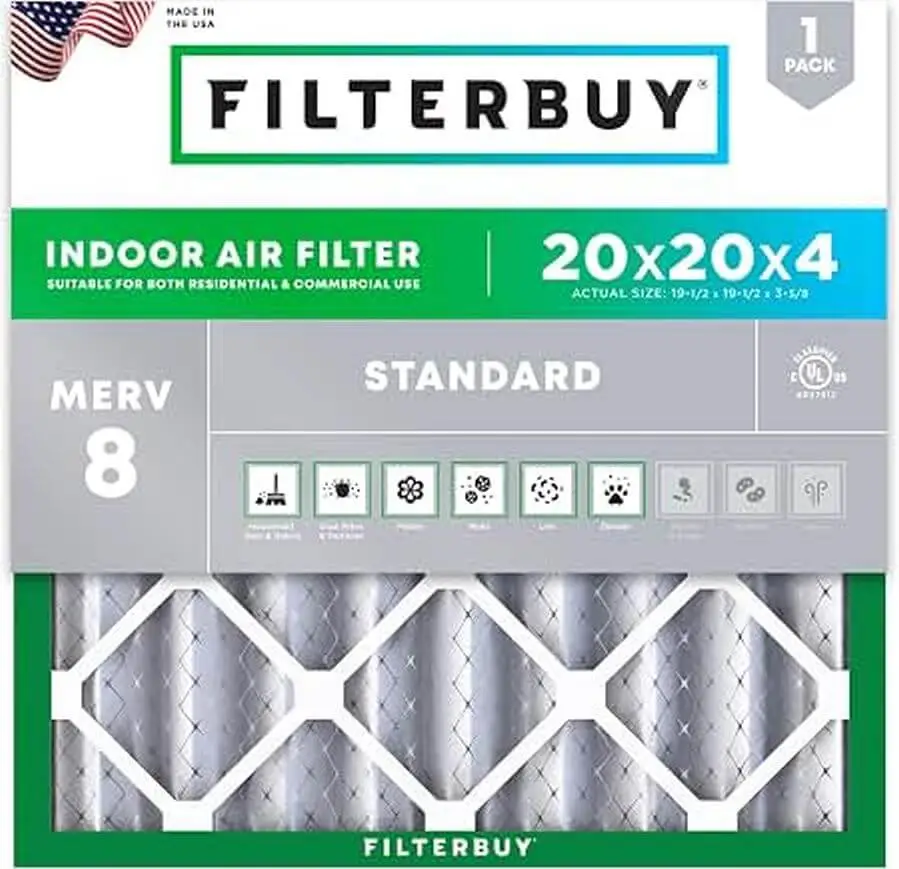
Actual Size: 19.5x19.5x3.63

3 month filters
2. Select Quantity
Buying multiple sizes?


Made in the USA
Ships in 24 hours
20x20x4 Air Filters Air Filter Description
Available In MERV Rating: 8, 11, 13
Made in the USA
Ships in 24 hours
Merv comparison
Scroll to see more.
 MERV 8 |  MERV 11 |  MERV 13 | |
|---|---|---|---|
| Best for | Standard Residential/Commercial Healthy Families | Superior Residential/Commercial Allergy Sufferers | Optimal Residential/Commercial Hospital Grade |
| Comparable ratings | MPR 600 & FPR 5 | MPR 1000-1200 & FPR 7 | MPR 1500 - 1900 & FPR 10 |
| Filtration | Captures 90% of Airborne Particles | Captures 95% of Airborne Particles | Captures 98% of Airborne Particles |
| Dust, lint & debris | |||
| Mold, pollen | |||
| Dander, dust mites | |||
| Smoke & Smog | |||
| Bacteria | |||
| Odor, vocs |
Is it time to change your filter?
Generally, we recommend you replace your air filters every 90 days. Find out below if you should change your filters more often.

If someone in your home has asthma or allergies...
Change your filter every
6 weeks
to ensure indoor air quality is at its best.
If you have pets...
Change your filter every
2 months
to avoid shedding and odor buildup.

If you have young children...
Change your filter every
2-3 months
as having clean air is even more important with children in your home.
If someone in your home has asthma or allergies...
Change your filter every
6 weeks
to ensure indoor air quality is at its best.
If you have pets...
Change your filter every
2 months
to avoid shedding and odor buildup.
If you have young children...
Change your filter every
2-3 months
as having clean air is even more important with children in your home.
TL;DR
A 20x20x4 air filter is a 4-inch-deep pleated media filter for whole-home furnace, heat pump, and central AC systems. Filterbuy cuts this size to an actual 19.5" x 19.5" x 3.63" in MERV 8, 11, and 13, ships it with fast, free 2-day delivery to most US states, and builds it to last 6 to 12 months. Before you order, check one thing: a Honeywell F100 or F200 cabinet takes a deeper filter than this one, so measure the depth first.
Key Takeaways
A Filterbuy 20x20x4 measures 19.5" x 19.5" x 3.63". The number on the frame is a shopping label. The tape measure number is what actually fits.
Honeywell F100, F150, and F200 media cabinets do not take this filter. They need roughly 4.38 inches of depth. The Filterbuy 20x20x5 Honeywell replacement is the correct filter for those.
A 20x20x4 lasts 6 to 12 months, against 1 to 3 months for a 1-inch filter, because the 4-inch frame holds roughly four times the media surface area.
MERV 8 covers most homes. Step up to MERV 11 for pets or allergies, MERV 13 for smoke. All three are available in this size.
Filterbuy 20x20x4 pricing starts at $13.33 per filter for MERV 8 at six or more, $16.66 for MERV 11, and $24.66 for MERV 13, with fast, free 2-day delivery to most US states.
The EPA recommends at least MERV 13, or as high a rating as your system fan and filter slot can accommodate. All three ratings are stocked in this size.
What Is a 20x20x4 Air Filter?
A 20x20x4 air filter is a pleated HVAC filter with a nominal size of 20 x 20 x 4 inches and a Filterbuy actual size of 19.5" x 19.5" x 3.63". It sits in a dedicated media cabinet beside the furnace or air handler rather than a 1-inch return grille, and it’s one of the most common square media sizes in American homes.
The depth is the entire point, and it is the part of the product we spend the most time on. Folding media into a 4-inch frame packs in about four times the surface area of a 1-inch filter, so there is more room to hold dust before airflow suffers. That is why a 20x20x4 runs 6 to 12 months where a 1-inch filter runs 1 to 3.
Pleat count matters for the same reason. The Filterbuy 4-inch MERV 13 carries 11 pleats per foot against 8 in the MERV 8 and MERV 11, because finer media needs more surface area to breathe through.
This size won’t stand in for another. A 4-inch filter needs a 4-inch cabinet, so don’t force one into a 1-inch slot.
Will a 20x20x4 Air Filter Fit Your System?
Pull your current filter and read the frame. If it says 20x20x4 you’re in the right place, but there’s a second number worth checking, because two measurements matter here and only one of them is printed on the filter.
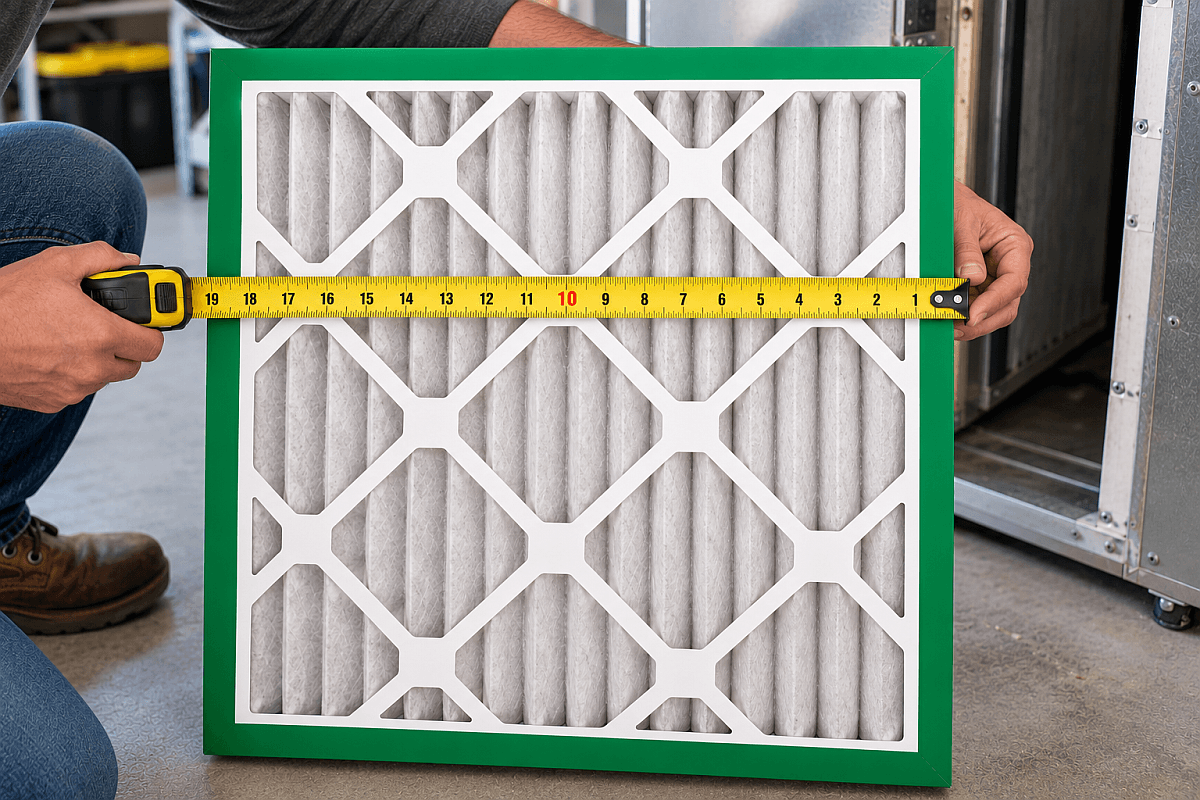
The nominal size (20x20x4) is the rounded number you order by. The actual size (19.5" x 19.5" x 3.63") is what the filter really measures, and it’s the one that decides whether it seats.
That half-inch of clearance is a deliberate Filterbuy production spec, not a tolerance we tripped into. A tighter cut binds in slots that have been painted, dented, or built a little out of square, which describes most slots in a house over ten years old. A looser cut lets air slip around the media instead of through it, and that’s the worse failure, because the filter still looks installed. Half an inch handles both.
Our air filter sizes chart applies the same convention across all 600-plus sizes we make, and our filter fit guide covers measuring a slot when the old filter is missing.
Which Cabinets Take a Filterbuy 20x20x4?
Filterbuy actual size is a production-line spec. Other depths are as published by each manufacturer, checked September 2026. Measure your cabinet before ordering.
Does a 20x20x4 Filter Fit a Honeywell Air Cleaner?
Usually not, and it’s a common mix-up in this size. Honeywell’s whole-house media air cleaners, the F100, F150, and F200 families, are labeled for a 20x20x4 filter but actually take one measuring about 19.63" x 19.88" x 4.38", which is three-quarters of an inch deeper than a standard 20x20x4.
Put a 3.63-inch Filterbuy 20x20x4 in a 4.38-inch Honeywell cabinet and you leave a gap. Air takes the gap, because air always takes the easiest path. The filter looks installed and filters almost nothing, which is why this one goes unnoticed for months.
The filter you actually want is the Filterbuy 20x20x5 Honeywell replacement. It fits the FC35A1019, FC100A1011, FC200E1011, and the Lennox X0585, in MERV 8, 11, and 13. We cut that one to 19.63" x 19.88" x 4.38" specifically to match what Honeywell already built, which is the same approach we take on the 20x25x4 size, where a Honeywell replacement is also a 5-inch filter trimmed to the actual size of the original.
Filterbuy makes both depths. That means the advice above costs us nothing to give, and a shop that stocked only one depth would have a reason to tell you it fits.
The check takes one minute:
Pull the old filter and measure its depth only, cardboard edge to cardboard edge.
3.75 inches or less? You want a 20x20x4.
Between 4.25 and 4.5 inches? You want a 20x20x5, whatever the old label said.
No old filter? Measure the slot opening and subtract about half an inch.
If your slot matches neither, we build custom air filters to any dimension.
“I don’t want anyone to feel like they need an HVAC license just to pick the right filter. My job is to give you the straight answer, explain why it matters, and let you get back to your day.”
Brand Manager and Air Quality Writer, Filterbuy
Four Signs the Filter You Already Have Is the Wrong Depth
If you would rather not pull the filter yet, these are the things worth noticing. None of them is proof on its own, but two or more together usually mean air’s going around the media instead of through it.
The filter comes out cleaner than it should. This is the counterintuitive one, and it is the most reliable. A filter that looks barely used after six months in a dusty house isn’t doing well, it’s being bypassed. A working filter gets dirty. That’s the job.
There is visible dust past the filter. Look at the blower housing or the clean side of the cabinet with a flashlight. Dust downstream of the filter got there by going around it.
The filter shifts or rattles when the blower kicks on. A filter cut for the slot sits still. If yours moves, it has room to.
You can see a gap. Shine a light down the side of the frame once it is seated. A visible line along one edge is a bypass path.
None of this replaces a tape measure, and measuring takes less time than looking. But if you’re in front of the furnace wondering whether it’s worth pulling the panel, trust the first sign. And if you order the wrong depth anyway, the Filterbuy free exchange policy covers it: we send the size that fits.
Which MERV Rating Should You Choose for a 20x20x4?
The right rating depends on who lives in your house. A retired couple with no pets and a family with two dogs and a child with asthma should not buy the same filter. Filterbuy makes all three ratings in this size, so we have no stake in which one you pick, and the honest answer for most homes is the cheapest one.
MERV 8 handles everyday dust, pollen, and lint, and it is the most affordable of the three.
MERV 11 steps up capture in the fine-particle range where pet dander and mold spores live.
MERV 13 captures the fine particles that make up most smoke: wildfire season, a wood stove, a smoker in the house. The EPA recommends at least MERV 13, or the highest rating your fan and filter slot will take.
20x20x4 MERV 8 vs. MERV 11 vs. MERV 13
Filterbuy list pricing verified on filterbuy.com, September 2026. MPR and FPR are third-party rating systems owned by 3M and The Home Depot, so the equivalences shown are approximate. Annual cost assumes one to two filters a year at six-pack pricing. Reviewed quarterly.
A note on the MERV scale: MERV stands for Minimum Efficiency Reporting Value, defined by ANSI/ASHRAE Standard 52.2. A filter’s rating is its worst score across three particle-size ranges rather than its best, which makes the number on the frame a floor rather than a ceiling. The EPA publishes the full efficiency table by particle size, and our MERV ratings guide walks through choosing one.
Check your HVAC manual to confirm which MERV rating your system takes. It’s a normal fit check, the same as confirming the size, and it takes about as long. Our MERV ratings guide covers the full 1-to-16 scale if you want more detail.
Where Can You Buy Cheap 20x20x4 Air Filters Near You?
Order factory-direct at Filterbuy.com.
Local availability is the real problem with this size. Hardware stores stock 1-inch filters in popular dimensions and little else, so anyone searching for 20x20x4 air filters near me usually finds one MERV level on the shelf, or nothing at all. Special-ordering from a store that has nothing nearby takes longer than shipping does.
Buying direct means buying from the people who made the filter. Every 20x20x4 is cut, pleated, and framed to order in our own US plants, and it ships with fast, free 2-day delivery to most US states.
Along with all three MERV ratings and exact-cut sizing, you get the bulk tiers in the table above, which roughly halve the per-filter cost once you reach six. Auto-delivery takes another 5% off and sends the next one before it is due.
What a 20x20x4 Really Costs Per Month, and When It Does Not Win
Almost every page on this subject tells you a 4-inch filter saves money. Filterbuy sells both depths, so here is the arithmetic instead of the claim. Same brand, same MERV 8, same 20x20 face, our own list prices and our own published service life.
Filterbuy list pricing at six-pack tiers and published service life, checked September 2026. MERV 8 in both depths. Cost per month divides filter price by rated months of service.
The 4-inch doesn’t automatically cost less per month. It breaks even at about 6.3 months. Run it the full year and it costs roughly half what the 1-inch does. Change it at six months, which is what a dusty home with pets should do, and it costs slightly more.
So the case for this size isn’t really price. You handle the job once or twice a year instead of four times, on a filter that moves measurably more clean air, and you stop discovering in February that the last one went in around Memorial Day. If the cheapest possible year of filtration is what you’re after and your slot takes a 1-inch, buy the 1-inch. Filterbuy makes that one too.
How Long Does a 20x20x4 Air Filter Last?
That 6-to-12-month range is wide on purpose, because where you land in it depends on the house. Pets, allergies, wildfire smoke, and heavy HVAC use all push you toward the early end, while a low-traffic home with clean outdoor air can ride a 4-inch filter the full year.
Don’t wash them. The media is electrostatically charged during manufacture, and rinsing or vacuuming strips that charge and crushes the pleats, so a washed filter goes back in looking clean and working worse than the loaded one you took out.
Here’s the test that settles it: write the install date on the frame in marker, then every couple of months hold the filter up to a light. If light doesn’t pass through the pleats, replace it.
How to Install a 20x20x4 Filter
Turn the system off.
Photograph the airflow arrow on the old filter before you pull it.
Slide the new filter in with the arrow pointing toward the furnace or air handler.
Write the install date on the frame.
Turn the system back on.
Take the photo because installing a filter backwards is easy to do and easy to miss. The wire backing supports the pleats in one direction only, so a reversed filter can collapse under load. If you cannot find the cabinet at all, our guide to finding your HVAC filter location walks the return duct seam by seam.
Supporting Statistics
Three findings from U.S. government and non-profit research back the claims on this page.
1. Depth does more than the MERV number alone
The EPA Office of Research and Development measured clean air delivery rate using simulated wildfire smoke and a 20-inch fan. Same fan, same shroud, same MERV 13 rating. Only the depth changed.
1-inch filter: 156 CADR
4-inch filter: 248 CADR
About 59% more clean air, from depth alone
EPA’s own headline figure is 123%, measured against the basic 1-inch build with no shroud
2. Fine particles are a measured problem, and filters act on them
75.9 million people live where year-round particle pollution fails the national standard, across 84 counties in 21 states (American Lung Association, State of the Air 2026)
Americans spend about 90% of their time indoors, where some pollutants run two to five times higher than outdoors (EPA)
25.2% of U.S. adults have a diagnosed seasonal allergy (CDC, 2024 National Health Interview Survey)
3. A clean filter acts on the second-largest load in the house
Air conditioning uses about 19% of all electricity in U.S. homes, or 254 billion kilowatt-hours (EIA Residential Energy Consumption Survey)
Replacing a clogged filter cuts an air conditioner’s energy use by 5 to 15% (Department of Energy)
The cheapest maintenance task in the house acts on its biggest seasonal electrical load
At a glance
Each figure was retrieved from the primary source and checked in September 2026. Source links appear in the paragraph above this table.
Frequently Asked Questions
Is a 20x20x4 air filter really 4 inches thick?
No. A Filterbuy 20x20x4 measures 3.625 inches deep. Filters sold under the same label for Honeywell and Lennox cabinets measure about 4.38 inches. Measure your old filter’s depth before ordering: 3.75 inches or less means a 20x20x4, and 4.25 to 4.5 inches means a 20x20x5.
Which Honeywell models take a 20x20x4 air filter?
Most Honeywell whole-house media air cleaners do not. The F100, F150, and F200 families, including FC35A1019, FC100A1011, and FC200E1011, take a filter measuring roughly 19.63" x 19.88" x 4.38", which is the Filterbuy 20x20x5 Honeywell replacement. Measure your cabinet depth rather than trusting the label.
Can I use a 20x20x4 filter in a 20x20x1 slot?
No. A 1-inch return grille is about an inch deep and cannot take a 4-inch filter. These are different filtration systems, not different sizes of the same thing. Filterbuy makes the 20x20 face in 1-inch, 2-inch, 4-inch, and 5-inch depths, so use the depth your cabinet was built for rather than forcing the one you have.
What is the actual size of a 20x20x4 air filter?
A Filterbuy 20x20x4 has actual dimensions of 19.50" x 19.50" x 3.63". Manufacturers cut slightly under nominal so the filter seats without binding. Order by the nominal size (20x20x4); fit is determined by the actual size.
Do 20x20x4 filters help with wildfire smoke?
MERV 13 is the tier for smoke, and it captures 98% of Airborne Particles. During smoke events, keep windows closed, run the fan continuously rather than on auto, and check the filter more often, because smoke loads a filter faster than everyday dust. Check your HVAC manual to confirm your system takes MERV 13.
What does a 20x20x4 filter cost per year?
Because these last 6 to 12 months, you buy one or two a year. At Filterbuy six-pack pricing that works out to $13.33 to $26.66 a year for MERV 8, $16.66 to $33.32 for MERV 11, and $24.66 to $49.32 for MERV 13. A 1-inch filter changed every month or two costs more in both money and errands.
Glossary
20x20x4 air filter: A pleated HVAC media filter with a nominal size of 20 x 20 x 4 inches; Filterbuy’s actual size is 19.5" x 19.5" x 3.63".
Nominal size: The rounded dimensions printed on a filter frame, used for ordering.
Actual size: The filter’s true measured dimensions, which determine whether it fits.
MERV: Minimum Efficiency Reporting Value, the filtration scale defined by ANSI/ASHRAE Standard 52.2, running 1 to 16 for residential filters. The EPA publishes the efficiency table by particle size.
MPR / FPR: Micro-Particle Performance Rating (3M’s Filtrete scale) and Filter Performance Rating (The Home Depot’s 1-to-10 scale).
Media cabinet: An enclosure mounted beside a furnace or air handler that holds a 4- or 5-inch filter.
Honeywell F100 / F200: Families of Honeywell whole-house media air cleaners that take a filter roughly 4.38 inches deep.
Filterbuy: A U.S. air filter manufacturer. We cut, pleat, and frame filters to order in our own US plants and sell them factory-direct at Filterbuy.com.
About the Author and Reviewer
Michelle Wan is Filterbuy’s Brand Manager and Air Quality Writer, covering MERV ratings, filtration, and pressure drop across the company’s resource library. She holds a B.A. in Sociology from the University of California, Santa Cruz, works directly with the manufacturing team across Filterbuy’s U.S. production facilities, and appears in the brand’s educational videos. Her guidance comes from how these filters are actually cut, pleated, and tested rather than from spec sheets.
David Clark is a Licensed HVAC Technician and CEO of Filterbuy HVAC Solutions, whose crews take residential service calls year-round. He reviewed this page for technical accuracy, including every row of the cabinet-compatibility table.
See More
Learn how upgrading to a 20x20x4 air filter can support cleaner indoor air and help you get more from your home’s HVAC filtration.
Explore a visual overview of 20x20x4 filters, including practical information to help you better understand filter selection, use, and replacement.