
Four Inch Air Filters
4” pleated air filters manufactured by FilterBuy are a guaranteed fit for your AC or Furnace. Don't see your size listed below? Simply create it via our custom filter tool.

4" Filters
- 6.88x15.88x4
- 8x14x4
- 8x16x4
- 8x20x4
- 8x24x4
- 8x30x4
- 9.75x23.75x4
- 10x10x4
- 10x14x4
- 10x15x4
- 10x16x4
- 10x18x4
- 10x20x4
- 10x24x4
- 10x25x4
- 10x30x4
- 11.25x11.25x4
- 11.25x19.25x4
- 11.25x23.25x4
- 11.5x21x4
- 12x12x4
- 12x15x4
- 12x16x4
- 12x18x4
- 12x20x4
- 12x22x4
- 12x24x4
- 12x25x4
- 12x26x4
- 12x26.5x4
- 12x27x4
- 12x30x4
- 12x30.5x4
- 12x36x4
- 12.5x21x4
- 12.75x21x4
- 13x18x4
- 13x20x4
- 13x21x4
- 13x21.5x4
- 13x24x4
- 13.25x13.25x4
- 14x14x4
- 14x18x4
- 14x20x4
- 14x22x4
- 14x24x4
- 14x25x4
- 14x27x4
- 14x28x4
- 14x30x4
- 14x36x4
- 14.5x19x4
- 15x15x4
- 15x20x4
- 15x25x4
- 15x30x4
- 15x30.5x4
- 15x30.75x4
- 15.25x15.25x4
- 15.5x19.5x4
- 15.5x24.5x4
- 16x16x4
- 16x18x4
- 16x20x4
- 16x21x4
- 16x21.5x4
- 16x22x4
- 16x22.25x4
- 16x24x4
- 16x25x4
- 16x30x4
- 16x32x4
- 16x36x4
- 16.25x21x4
- 16.25x21.25x4
- 16.38x21.38x4
- 16.5x21x4
- 16.5x22x4
- 17x17x4
- 17x19x4
- 17x20x4
- 17x21x4
- 17x22x4
- 17x25x4
- 17.25x17.25x4
- 17.25x19.25x4
- 17.25x23.25x4
- 17.25x26x4
- 17.25x29.25x4
- 17.25x35.25x4
- 17.5x23.5x4
- 17.5x27x4
- 18x18x4
- 18x20x4
- 18x22x4
- 18x24x4
- 18x25x4
- 18x30x4
- 18x36x4
- 18.25x22x4
- 19x19x4
- 19x21x4
- 19x21.5x4
- 19x22x4
- 19x23x4
- 19x27x4
- 19.25x21.25x4
- 19.25x23.25x4
- 19.5x19.5x4
- 19.5x21x4
- 19.5x22x4
- 19.5x24.5x4
- 19.75x21x4
- 19.75x22x4
- 19.88x21.5x4
- 20x20x4
- 20x21x4
- 20x21.5x4
- 20x22x4
- 20x22.25x4
- 20x23x4
- 20x24x4
- 20x25x4
- 20x27x4
- 20x30x4
- 20x32x4
- 20x34x4
- 20x36x4
- 21x21x4
- 21x22x4
- 21x23x4
- 21x23.25x4
- 21.25x21.25x4
- 21.5x23x4
- 21.5x23.25x4
- 21.5x24x4
- 21.5x26x4
- 22x22x4
- 22x24x4
- 22x26x4
- 22x28x4
- 22x36x4
- 22.25 x 25 x 4"
- 23x25x4
- 23.25x29.25x4
- 23.5x23.5x4
- 23.5x25x4
- 23.5x30.75x4
- 24x24x4
- 24x25x4
- 24x28x4
- 24x30x4
- 24x36x4
- 25x25x4
- 25x28x4
- 25x29x4
- 25x32x4
- 27x27x4
- 28x30x4
- 29x29x4
- 30x30x4
- 30x36x4
Custom Filter
Don't see your size? Create one yourself using our custom filter tool!
4 Inch HVAC & Furnace Air Filter Replacements: Are They Worth It?
Right now, a thin pleated panel is the only thing standing between your blower and everything drifting through your home’s air. Pull it after a few months, and you’ll see what it caught: a gray mat of dust, pollen, pet hair, and the dander you can’t see. That panel is probably an inch thick. The question we field most from homeowners shopping for something sturdier is whether the thicker 4 inch air filter is worth the extra few dollars. We make both in our own American plants, and we’ll be honest with you. For the right system, a 4-inch filter earns its keep. It just isn’t for every home.
TL;DR Quick Answers
Four Inch HVAC And Furnace Air Filter Replacements
A 4-inch HVAC or furnace filter is a deep-pleat replacement that sits about four inches into your system and holds several times more media than a standard 1-inch panel. That depth lets it trap more dust, pollen, and dander, lasts several months between changes, and strains your blower less. It only fits systems built with a 4-inch media cabinet or slot, so a 1-inch slot needs a cabinet first.
Lasts longer. Several months between changes, versus every 1 to 3 months for a 1-inch panel, depending on your system, MERV rating, pets, and air quality.
Filters more. Extra pleated media adds surface area, so it catches more of what you can't see.
Easier on your system. Lower airflow resistance at the same MERV rating, gentler on your blower.
Fits only 4-inch slots. Check for a media cabinet beside your air handler first.
Comes in common sizes. 16x25x4 and 20x25x4, in MERV 8, 11, and 13.
Top Takeaways
A 4-inch filter holds several times more pleated media than a 1-inch panel, so it captures more across a longer life.
A 4-inch filter typically goes several months between changes, depending on your system, MERV rating, pets, and air quality, while a 1-inch filter needs swapping every 1 to 3 months.
More media means less airflow resistance at the same MERV rating, which is easier on your blower.
A 4-inch filter needs a matching media cabinet or slot. A 1-inch slot won’t take one.
Common sizes include 16x25x4 and 20x25x4, and matching nominal to actual dimensions is what gets you the right fit.
What A 4-Inch Air Filter Is
A 4-inch filter sits about four inches deep in your system instead of the usual inch. That extra depth lets us fold in far more media, the pleated material that does the actual catching. More folds mean more surface area, and more surface area means more room for particles to land before air ever reaches your blower. If you want the engineering behind how that media traps a particle, the Wikipedia write-up on the air filter explains it well.
Most of what your filter grabs never shows up to the naked eye. Pollen, mold spores, fine dust, and dander move through your rooms unseen, and a deeper bed of media simply gives all of it more places to get stuck.
4-Inch Filters Vs. 1-Inch Filters
The 1-inch panel is what ships with most homes. It’s cheap, and it slides right into the standard slot, but it loads up fast and needs swapping often. A 4-inch filter carries several times more media, so it keeps working far longer and pushes back against airflow less at the same MERV rating. That last part matters more than people expect. When a filter chokes airflow, your blower works harder, runs hotter, and wears out sooner.
| Factor | 1-Inch Filter | 4-Inch Filter |
|---|---|---|
| Typical change interval | About every 1 to 3 months | Several months (varies by system and use) |
| Media surface area | Lower | Several times greater |
| Airflow resistance at the same MERV | Higher | Lower |
| Housing required | Standard 1-inch slot | 4-inch media cabinet or slot |
| Common MERV options | 8 to 13 | 8 to 13 |
Are 4-Inch Furnace Filters Worth The Money?
This is where a 4-inch furnace filter pays you back. One often lasts several times as long as a 1-inch panel, so plenty of households buy fewer filters across a year even though each one costs more at checkout. You also crack open that cabinet far less often, which is a real relief when your filter hides in a cramped attic or a crawlspace you’d rather not visit. The catch is fit. A 4-inch furnace filter only works if your system has a 4-inch media cabinet or a slot built for that depth. You can’t wedge one into a 1-inch slot.
Common 4-Inch Sizes And How To Choose
Four-inch filters follow the same sizing logic as the thin ones. The common dimensions include 16x25x4, 20x25x4, and 14x25x4, plus smaller cabinet sizes for tighter systems. If your system uses an odd size, we build those too. For a sense of how a listing maps to the real filter, look at our 8x14x4 deep-pleat filters.
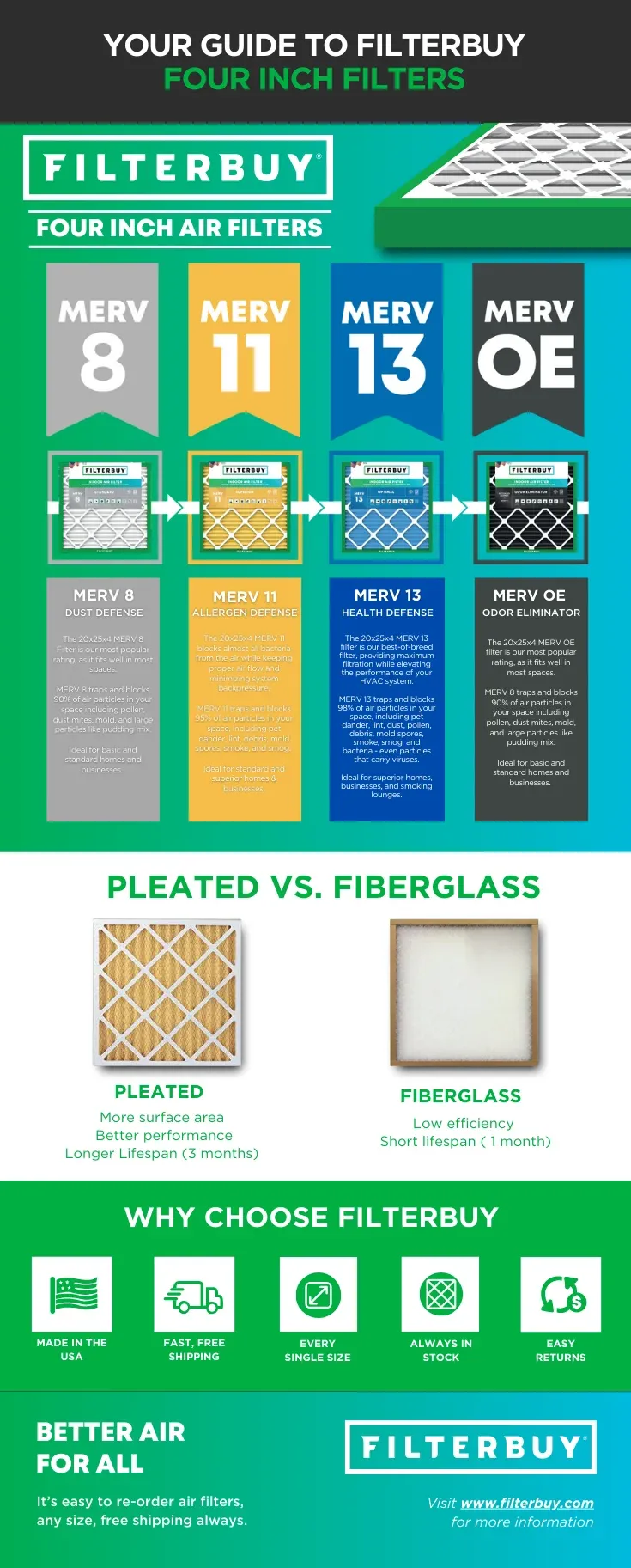
One detail trips people up. The number printed on the frame is the nominal size, rounded for shelf labeling, while the filter itself measures a hair smaller. Read the dimensions stamped on your current filter and match that nominal number. For most homes, a MERV 8 handles everyday dust, a MERV 11 catches more pet dander, and a MERV 13 reaches the fine particles tied to smoke and allergens. The American Lung Association steers homeowners toward MERV 13 wherever the system can take it.
Does Your System Fit A 4-Inch Filter?
Checking takes about a minute. Look beside your air handler or furnace for a thicker housing, often called a media cabinet, with a slot roughly four inches wide. Then slide out your current filter and read the depth printed on the frame. A 1 means you have the standard slot. A 4 or a 5 means you’re already set up for deep-pleat filters. If you’re stuck with a 1-inch-only system, you still have two solid moves. Keep a quality 1-inch filter and change it on schedule, or ask an HVAC pro about adding a media cabinet so you can move up later.

“After manufacturing filters for over a decade and serving more than two million households, I’ll tell you what I tell my own family. A 4-inch filter isn’t magic, and it isn’t right for every system. What it does well is buy you time and steadier airflow. In our own lab, we’ve watched a deeper bed of media hold more dust before it ever starts fighting the fan, which is easier on your blower and on your calendar. If your system has the cabinet for it, this is one of the simplest upgrades you can make for cleaner air at home.”
— Filterbuy Indoor Air Quality Team
7 Essential Resources
Don’t take our word for it. These seven independent sources back up everything above, and every link below is one we’d hand a customer who wanted to check our work.
Start With The EPA’s Consumer Guide. EPA Guide to Air Cleaners in the Home walks through how furnace and HVAC filters cut indoor pollutants and where filtration fits next to ventilation.
ENERGY STAR On Efficiency. ENERGY STAR Heating and Cooling Guide shows why a clean filter protects efficiency and when to check or change it.
The CDC Explains MERV. CDC Ventilation and Filtration FAQs spells out how filters are tested under ASHRAE Standard 52.2 and what each MERV number means.
Maintenance Basics From The Department Of Energy. Department of Energy Air Conditioner Maintenance Guide covers how a clogged filter drags down airflow and efficiency.
The American Lung Association’s Health Angle. American Lung Association Air Cleaning Guidance recommends upgrading furnace filters to a higher MERV for cleaner indoor air.
California’s Regulator On Safe Choices. California Air Resources Board Air Cleaner Guidance helps you choose higher-efficiency filtration and avoid ozone-producing gadgets.
The Filter Industry’s Own MERV Primer. NAFA Understanding MERV Publications, from the National Air Filtration Association, breaks down the MERV scale built with ASHRAE 52.2.
3 Supporting Statistics
Most homes never move past the thinnest option. A peer-reviewed review of residential air filtration reports that roughly 95% of forced-air homes run 1-inch panel filters, while deeper 2-to-5-inch filters carry more capacity.
Allergens hit a lot of households. The Asthma and Allergy Foundation of America reports that more than 100 million people in the United States deal with allergies each year, which puts a real premium on catching airborne pollen and dander.
Clean air is rarer than most of us assume. World Health Organization air pollution data shows that 99% of the world’s population breathes air that exceeds its guideline limits for fine particulate matter, a sharp reminder of what can slip indoors.
Final Thoughts And Opinion
If your system has the cabinet for it, a 4-inch filter is one of the easiest wins in home maintenance, and we’ll say that plainly. You change it far less often, your blower breathes easier, and you get strong filtration without the airflow penalty that thick media can bring at high MERV ratings. That’s why the best four inch air filters are the ones matched to your system and your household, not simply the highest number on the box. The honest caveat hasn’t changed. If all you have is a 1-inch slot, don’t force a 4-inch filter to fit. Buy the right 1-inch filter, or call a pro about adding a cabinet.
Next Steps
Measure the depth of your current filter slot, then read the size printed on the filter you pull out.
Confirm whether your system has a 4-inch media cabinet or a standard 1-inch slot.
Match your nominal size and choose the MERV rating that fits your household.
Set a reminder so the new filter actually gets changed on schedule.
Frequently Asked Questions
Q: Are 4 Inch Furnace Filters Worth It?
A: For most homes with a compatible media cabinet, yes. A 4-inch furnace filter lasts longer, captures more over that longer life, and fights airflow less at a given MERV rating than a 1-inch panel. The payoff depends on having the right housing.
Q: How Often Should I Change A 4 Inch Filter?
A: It varies. Most go several months between changes, depending on your system, MERV rating, pets, and local air. Check it every couple of months and swap it sooner if it looks loaded.
Q: Can I Put A 4 Inch Filter In A 1 Inch Slot?
A: No. A 4-inch filter needs a 4-inch slot or media cabinet. If your system has only a 1-inch slot, run a quality 1-inch filter or have a pro add a cabinet built for deeper filters.
Q: What MERV Rating Is Best For A 4 Inch Air Filter?
A: For most homes, MERV 8 handles everyday dust, MERV 11 catches more pet dander, and MERV 13 reaches the finer particles tied to smoke and allergens. Pick the highest rating at which your system runs comfortably.
Q: Do 4 Inch Filters Restrict Airflow?
A: Less than you’d think. Because a 4-inch filter spreads more pleated media across a deeper frame, it usually resists airflow less than a 1-inch filter at the same MERV rating, which eases the load on your blower.
Find Your 4-Inch Filter
Ready to make the switch? Browse our Four Inch Air Filters in standard and custom sizes, set up auto-delivery so a fresh one shows up right on time, and get back to breathing easy without giving your filter another thought.