
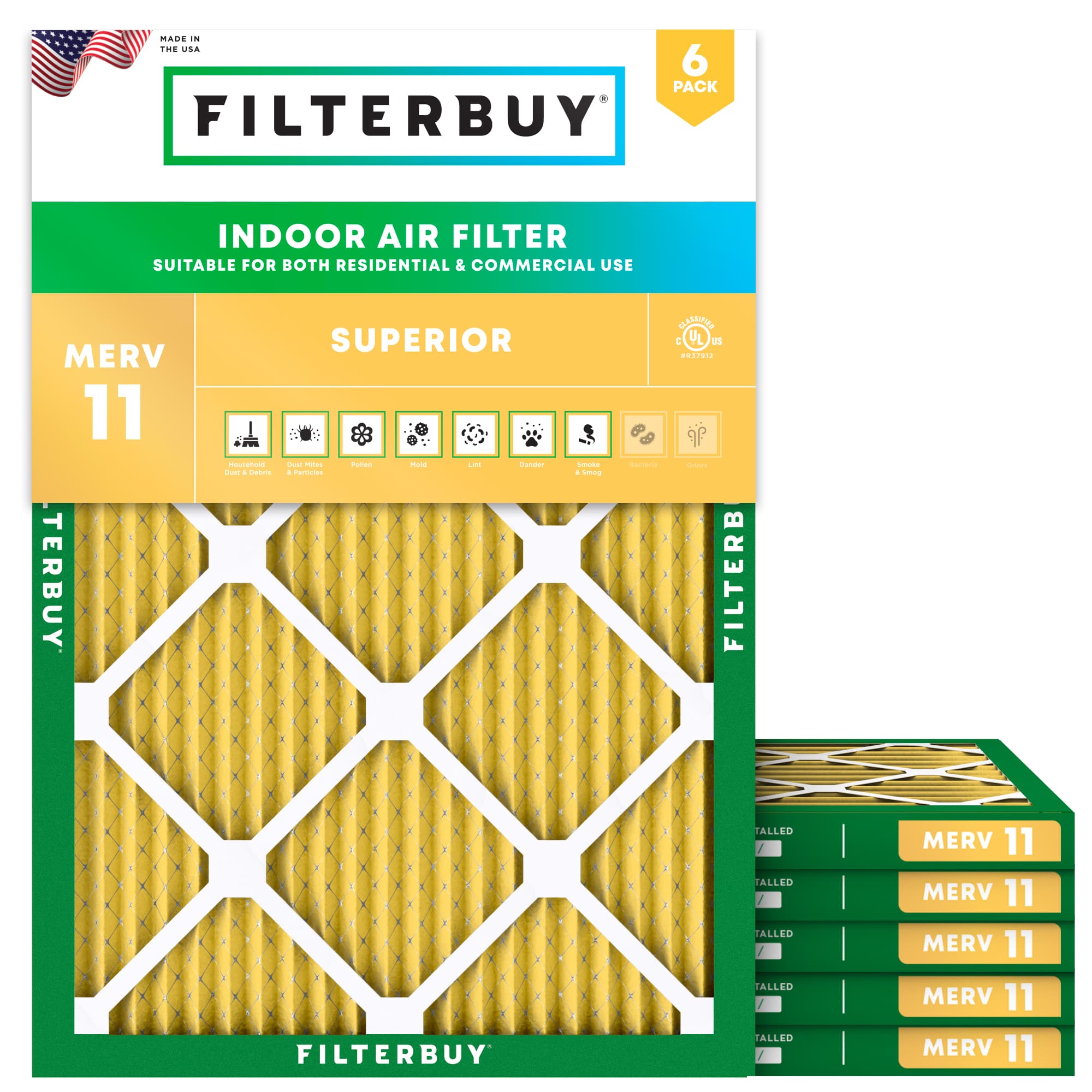
20x21x1 MERV 11 Pleated Air Filter
Actual Size: 19.5x20.5x0.75
 Free Delivery
  Factory-Direct Low Prices, Made in the USA
 Hassle-Free Returns & Free Exchanges
RESIDENTIAL AND/OR COMMERCIAL USE
Change Every 3 Months
20x21x1 MERV 11 Pleated Air Filter
Actual Size: 19.5x20.5x0.75
Free Delivery Factory-Direct Low Prices, Made in the USAHassle-Free Returns & Free ExchangesRESIDENTIAL AND/OR COMMERCIAL USE
Change Every 3 Months
20x21x1 MERV 11 Pleated Air Filter
Actual Size: 19.5x20.5x0.75
Free Delivery Factory-Direct Low Prices, Made in the USAHassle-Free Returns & Free ExchangesRESIDENTIAL AND/OR COMMERCIAL USE
Change Every 3 Months
About
- This is a list 20x21x1 MERV 11 air filter replacement for your furnace, air conditioner, heat pump, or HVAC system
- Actual air filter size: 19.5x20.5x0.75
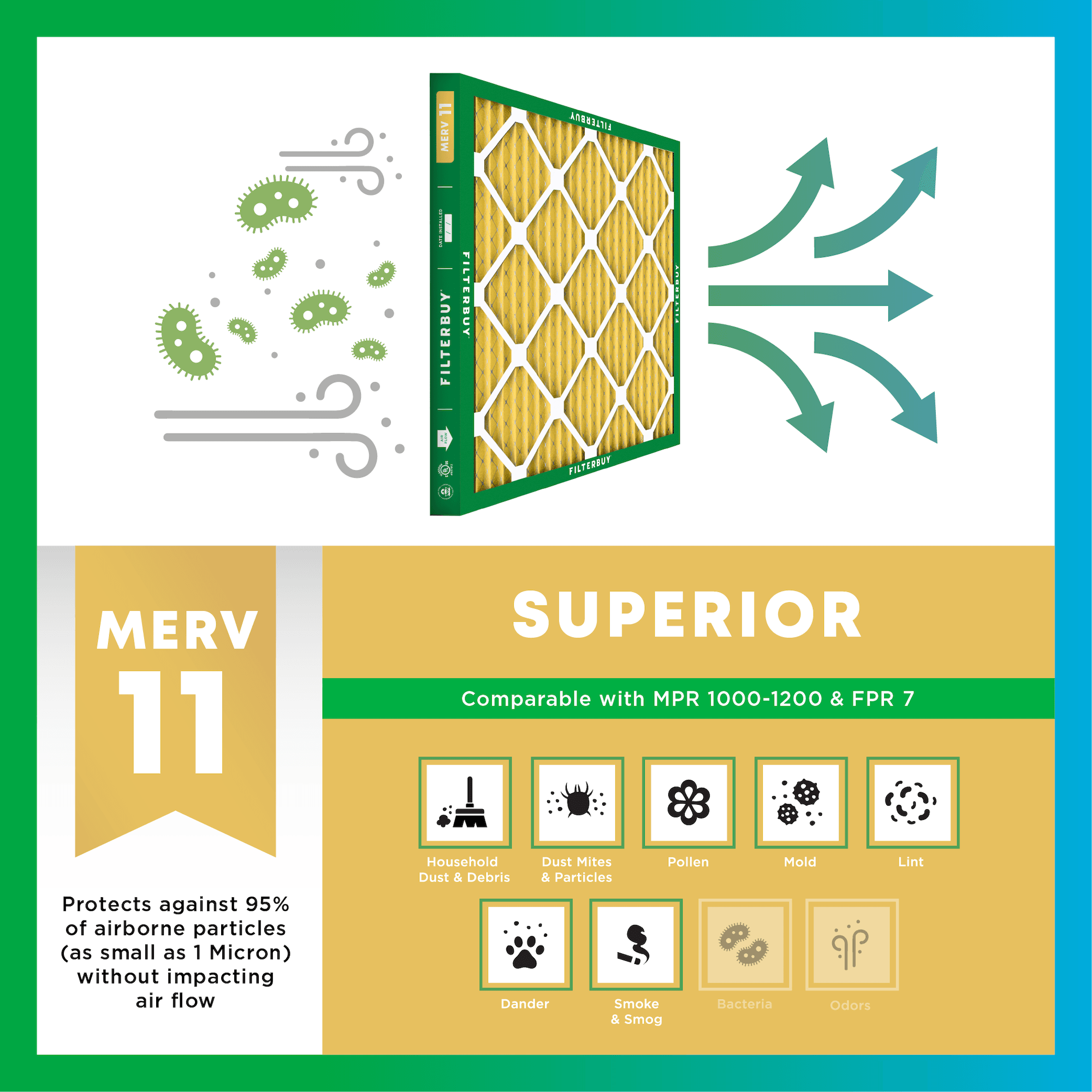
- MERV 11 synthetic media (comparable with MPR 1000/1200 and FPR 7) offers superior protection from dust, pollen, pet dander, mold, smog and more by trapping 95% of airborne particles without impacting air flow
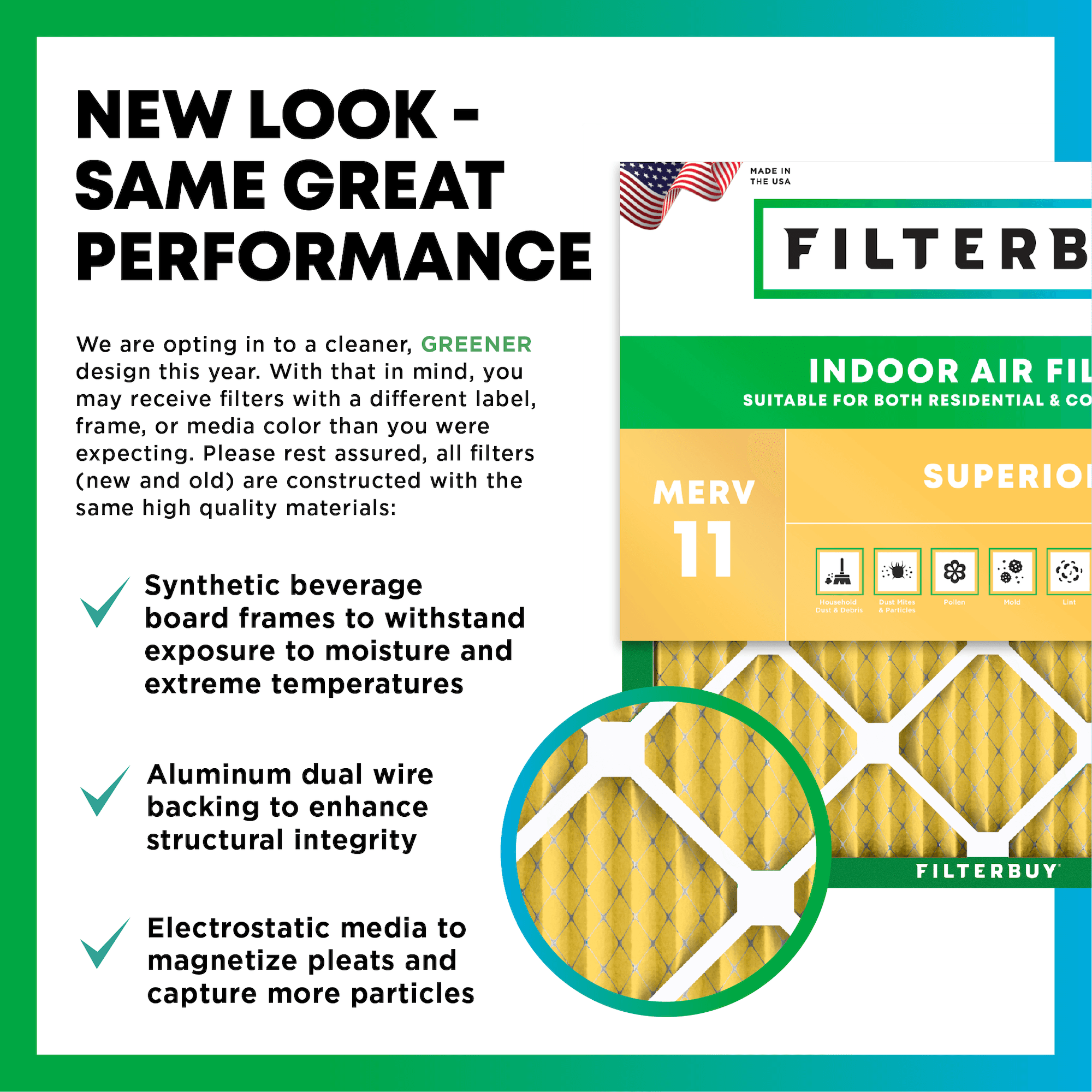
- High-quality construction means electrostatically charged pleated filter media, reinforced wire backing for structural integrity, and a durable frame to resist heat and humidity
- Built to last 3 months. 300% longer than fiberglass models
- 100% manufactured in the United States and designed with recyclable materials
- Learn more about 20x21x1 Air Filters
Top-Rated Filters. American Made. Delivered Free.
At Filterbuy, we don't cut corners—we craft high-quality air filters right here in the USA and ship them to your doorstep for free. No delays, no gimmicks—just clean air, made easy. With thousands of five-star reviews and filters built for real life & every HVAC system, it's no wonder why over 4 million families trust Filterbuy.

Proudly Made In The USA

Fast, Free Shipping on Every Order

Premium Materials That Go The Distance

85,000+ 5-Star Reviews From Happy Customers

Save Up to 70% Per Filter with Packs
Things to Know About Filter Sizes

Nominal Size
- The rounded size printed on your filter or HVAC unit (e.g., 20x21x1).
- Usually whole numbers to make identifying and ordering easier.
- A label for compatibility—not the exact measurement.

Actual Size
- The true, trimmed dimensions of the filter (e.g., 19.5x20.5x0.75 inches).
- Filters are manufactured slightly smaller so they slide into the filter slot without forcing.
- If you don't know your nominal size, measure your filter to get the actual size, then round up to find the nominal size to search on our site.

Why the difference?
- Nominal sizes simplify shopping and standardize categories.
- Actual sizes ensure the filter fits properly inside your HVAC's filter rack.
How To Find Your Nominal Size When You Don't Know It


Measure length × width × depth with a tape measure to find the actual size.

Round up each dimension to the nearest whole number to get the nominal size. Example: 19.5x20.5x0.75 in → 20x21x1 nominal.

Search by nominal size on our site for the best fit.

Why Getting the Right Size Matters
- Too small? Air can bypass the filter, reducing air quality and efficiency.
- Too big? It won't fit—risking bent frames and airflow issues.
- Just right? You get maximum performance, better filtration, and cleaner air.

Free Exchange Policy
If the filter you buy doesn't fit, we'll send you a better size.

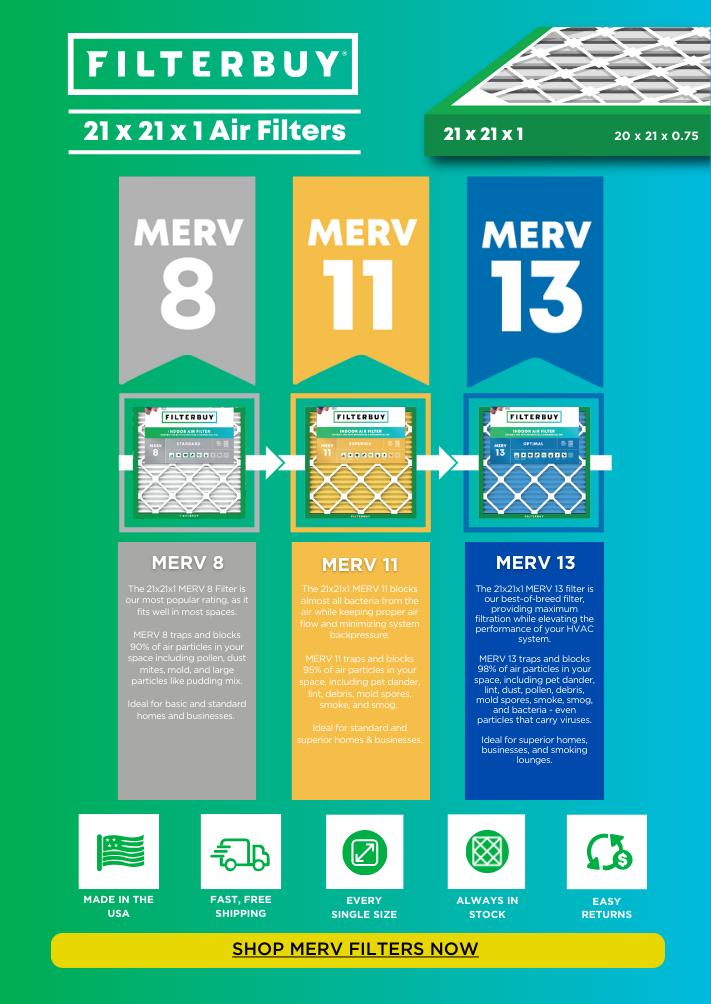
What's a MERV Rating?
MERV stands for Minimum Efficiency Reporting Value—but don't let the technical name fool you. It's just a way to rate how well an air filter traps stuff like dust, pollen, pet dander, and smoke. The higher the MERV number, the more particles it catches—and the cleaner your air will be.

Merv 8
Comparable to:FPR: 4-7
MPR: 600-1000
 Dust & Debris
 Dust Mites & Particles
 Pollen
 Mold
Mold Lint
Lint Dander
Merv 11
Comparable to:FPR: 6-9
MPR: 1200-1550
Dust & DebrisDust Mites & ParticlesPollenMoldLintDander Smoke & Smog
Merv 13
Comparable to:FPR: 10
MPR: 1900-2800
Dust & DebrisDust Mites & ParticlesPollenMoldLintDanderSmoke & Smog Bacteria
MERV 8
Comparable to:FPR: 4-7MPR: 600-1000


MERV 11
Comparable to:FPR: 6-9MPR: 1200-1550

MERV 13
Comparable to:FPR: 10MPR: 1900-2800
What Makes Our Filters Last 90 Days? Quality, From the Inside Out
We build every Filterbuy filter to deliver reliable 90-day performance—thanks to smart design and premium materials that do the heavy lifting. Here's what makes the difference:
Pleated Design
More pleats = more surface area to capture dust and debris, keeping your air cleaner longer.
Electrostatically Charged Media
Pleats are magnetized to attract and trap microscopic particles—like pet dander, pollen, and smoke.
Synthetic Beverage Board Frame
Engineered to resist warping in extreme temperatures and high humidity.

Aluminum Dual Wire Backing
A layer of metal reinforcement keeps pleats evenly spaced and structurally sound—no sagging, even at high airflow.
Made in the USA
Assembled with care. Built to perform. Ships fast, free, and reliably from our U.S. facilities.
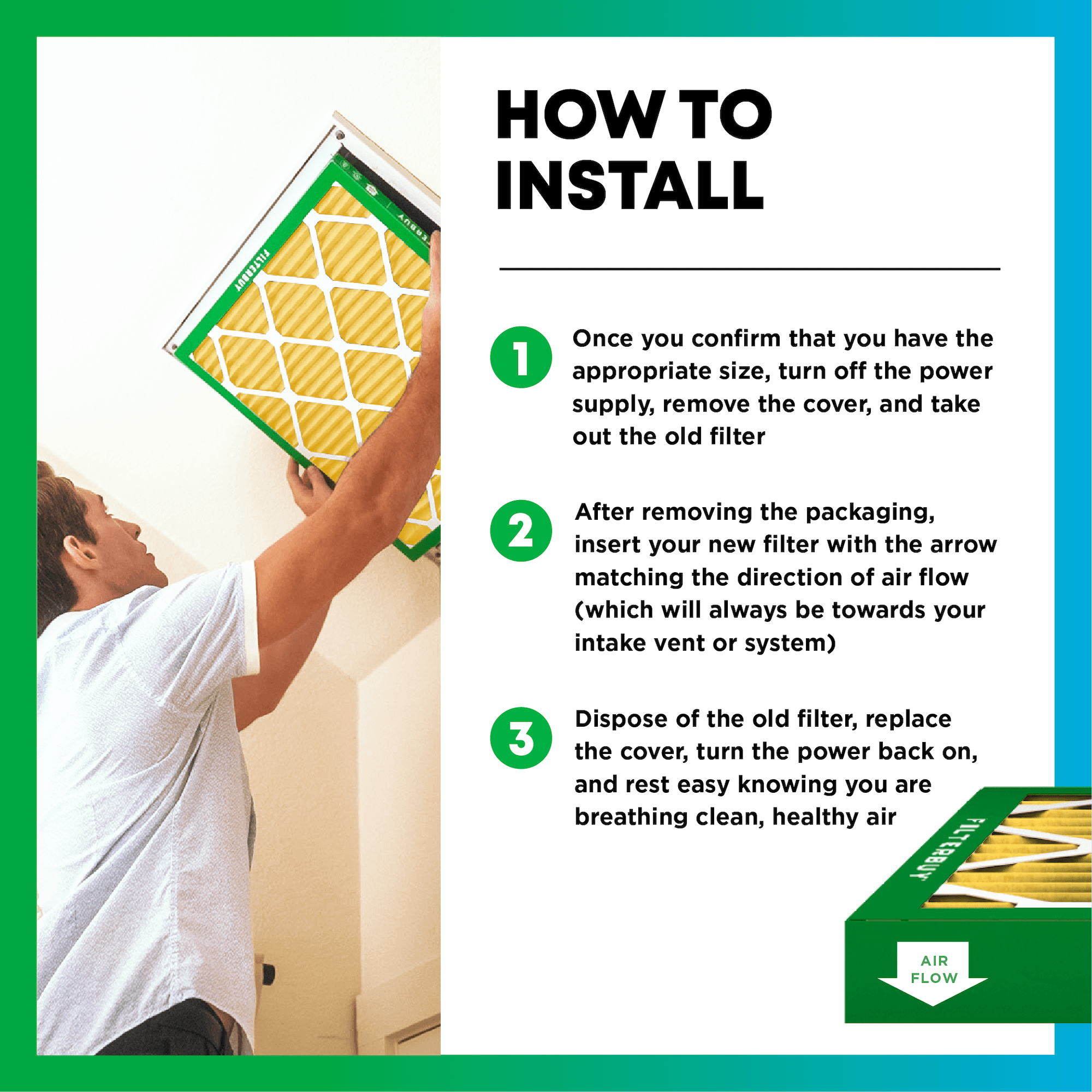
How to Install Your Filter in 4 Simple Steps

Turn Off Your HVAC SystemSafety first.

Remove The Old FilterLook for the airflow arrow and make note of the direction.

Slide In Your New FilterArrow should point toward the system (same direction as before).

Turn Your System Back OnAnd enjoy the fresh, clean air.

Never forget to replace your air filter again.
- Save 5% on every order
- Choose Your Delivery Schedule
- Edit, Skip, or Cancel Anytime.
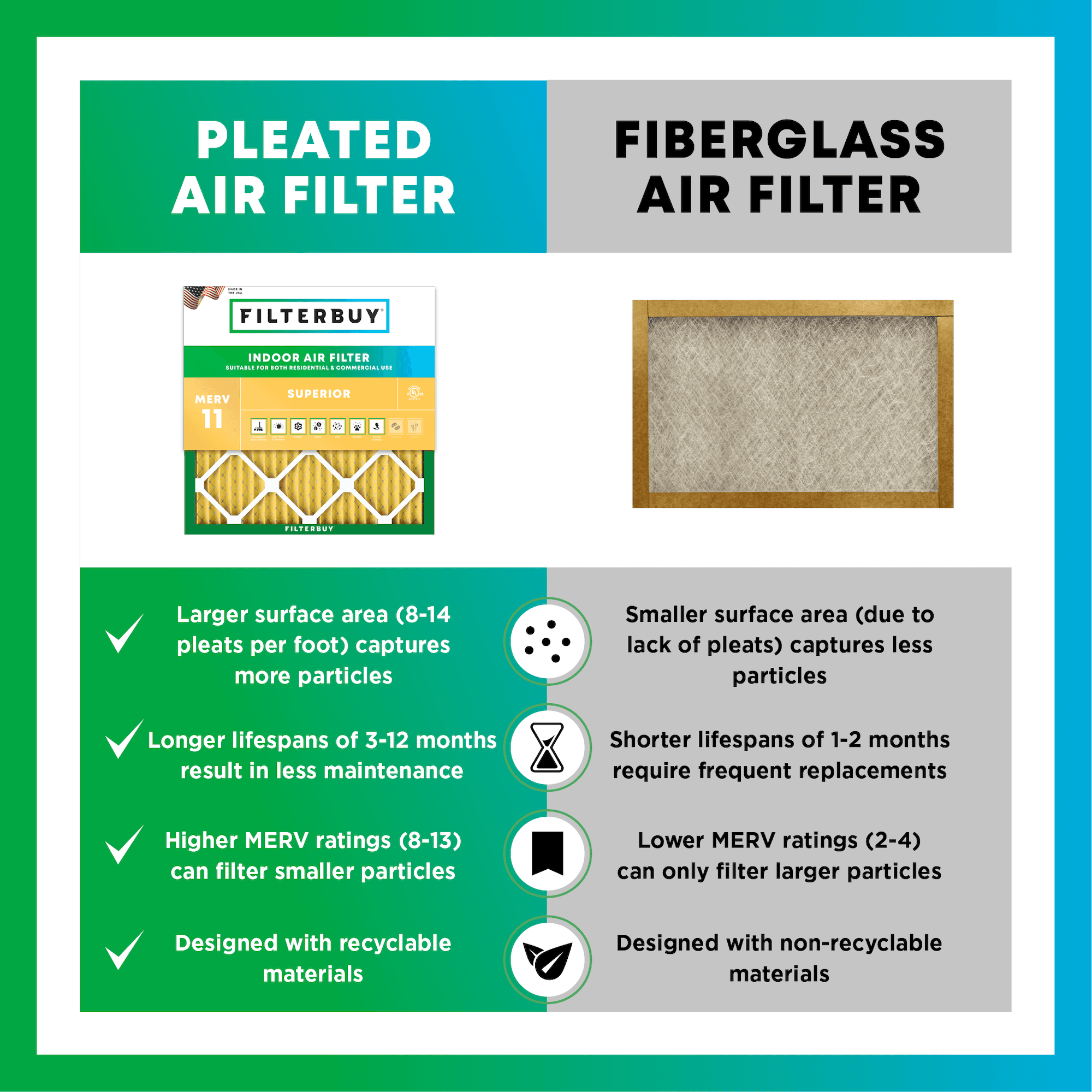
Pleated Filters vs. Fiberglass—What's the Difference?
Not all air filters are created equal. Pleated filters don't just last longer—they actually clean your air better. Here's how they stack up:

Pleated Filters
Efficiency:
High (MERV 8–13) – Traps more particles
Lifespan:
90 days – Long-lasting performance
Air Quality:
Excellent – Cleaner, healthier air
Materials:
Recyclable and durable

Fiberglass Filters
Efficiency:
Low (MERV 4 or less) – Misses small stuff
Lifespan:
30 days or less – Replace often
Air Quality:
Minimal – Basic protection only
Materials:
Thin, flimsy, and not recyclable
Pleated filters are a no-brainer—more protection, less hassle, and better air for your home.
How Often Should You Change Your Filter?
Changing your filter on time keeps your HVAC system running efficiently—and helps protect your lungs from dust, allergens, and airborne irritants. Here's how often to swap it out based on your needs:

Every 90 Days
Standard ScheduleFor most homes without pets or special air quality concerns. Great for general upkeep and energy efficiency.

Every 60 Days
If You Have Pets or AllergiesShedding fur, dander, and allergy triggers can build up fast. Changing your filter every two months helps keep the air fresher and symptoms at bay.

Every 30 Days
If You Have Respiratory Concerns or Live in Smog/Wildfire ZonesFor households affected by smoke, pollution, or respiratory conditions, monthly changes ensure maximum protection.

Want to stay on track? Set a reminder—or skip the stress with auto-delivery so fresh filters show up right when you need them.
Don't Just Take Our Word For It...
Got More Questions? We've Got Answers.
Product Specifications
| Nominal Size | 20 x 21 x 1 inches |
| Actual Size | 19.5 x 20.5 x 0.75 inches |
| Filter Type | Pleated |
| Media | Electrostatically Charged |
| Frame | Beverage Board |
| MERV Ratings Available | 8, 11, 13 |
| Lifespan | Up to 90 Days |
| Origin | Made in USA |
Signs Your 20x21x1 MERV 11 Air Filter Might Be Hurting, Not Helping, Your HVAC
If your home feels dustier than usual, your allergies are kicking up, or your HVAC seems to be working overtime, your 20x21x1 MERV 11 air filter may be signaling a problem we’ve seen countless times in the FilterBuy manufacturing and testing process. Homeowners choose MERV 11 for its stronger defense against allergens—but when this filter becomes overloaded or improperly matched to the system, it can quietly restrict airflow and undermine the very protection it’s meant to provide.
At Filterbuy, we’ve spent years refining how MERV 11 filters perform in real homes—not just controlled labs—and we consistently see the same early warning signs appear before efficiency drops and indoor air quality deteriorates. In this guide, we’ll walk you through the specific symptoms we observe most often, why they show up, and the simple steps we recommend to prevent small issues from becoming costly repairs.
This isn’t generic HVAC advice—it’s a firsthand look at what our experts see every day on the production line, in performance testing, and in feedback from millions of filters delivered nationwide.
TL;DR Quick Answers
MERV 11 20×21×1 Air Filter
Captures fine particles like pollen, pet dander, and smaller allergens.
Performs best with healthy, unrestricted airflow.
Replace every 60–90 days (monthly with pets/allergies).
Watch for airflow issues: whistling vents, long run times, uneven temps.
Proper sizing ensures cleaner air without stressing your HVAC.
A MERV 11 20×21×1 filter is a strong choice for homes that need higher-level filtration, but it’s important to monitor airflow and stay consistent with replacements. In our experience, a well-matched MERV 11 filter delivers cleaner, healthier air—while a clogged or incorrectly fitted filter can quietly reduce performance. Keep an eye on early signs, and you’ll get the full benefit without added strain on your system.
Top Takeaways
Airflow is critical. MERV 11 only works well when your system can support it.
Watch early signs. Uneven temps, long run times, and whistling vents signal airflow issues.
Clogged filters backfire. Reduced airflow = higher strain, higher bills, and lower filtration.
Replace consistently. Every 60–90 days, or monthly with pets/allergies.
Match matters. Use a properly sized, well-built filter your HVAC can handle.
Reduced Airflow From Supply Vents
Place your hand near a supply vent while the system runs. If the air feels weaker than usual, your 20x21x1 MERV 11 filter may be clogged or too restrictive for your unit. A dirty MERV 11 filter forces the blower motor to work harder, which reduces the volume of conditioned air reaching your rooms. Some older or lower-capacity HVAC systems struggle with MERV 11 ratings even when the filter is new, so it is worth confirming your system can handle that filtration level.
Short Cycling or Frequent On-Off Patterns
Short cycling happens when your HVAC turns on, runs briefly and shuts off before completing a full heating or cooling cycle. A clogged 20x21x1 MERV 11 filter is one of the most common causes. Restricted airflow triggers the high-limit switch or causes the evaporator coil to freeze, both of which shut the system down as a safety measure. If you notice your system cycling every few minutes instead of running steadily for 10 to 15 minutes, check the filter first.
Unexplained Spikes in Energy Bills
Your HVAC system accounts for roughly half of your home's total energy use. When a dirty or overly restrictive MERV 11 filter chokes airflow, the blower motor draws more electricity to compensate. The result is higher utility bills with no change in comfort. Compare your current bill to the same month last year. A noticeable increase with no other explanation often points back to the air filter.
Uneven Temperatures Throughout Your Home
Hot and cold spots are a strong indicator that your filter is restricting airflow. When the blower cannot push enough air past a loaded 20x21x1 MERV 11 filter, rooms closer to the air handler may feel comfortable while rooms farther away stay too warm or too cool. This problem is especially noticeable in multi-story homes where the system already works harder to balance temperatures between floors.
Excessive Dust Buildup on Surfaces and Vents
It sounds counterintuitive, but a failing filter can actually increase dust in your home. When a MERV 11 filter becomes too clogged, air finds the path of least resistance and bypasses the filter through gaps around the frame. Unfiltered air then circulates through your ducts and deposits dust on furniture, vents and return grilles. If you are dusting more often than usual despite having a high-rated filter in place, the filter itself may be the problem.
“After testing thousands of 20x21x1 MERV 11 filters in real homes—not just in our labs—we’ve learned that the earliest warning sign of trouble isn’t dust or noise, but a subtle drop in airflow your system tries to compensate for. By the time homeowners feel uneven room temperatures or see a jump in their energy bill, the filter has usually been struggling for weeks. That’s why staying ahead of these small shifts makes all the difference in keeping your HVAC healthy.”
Essential Resources to Help You Confidently Choose the Right 20×21×1 MERV 11 Filter
As the air-obsessed experts, we know that choosing a filter isn’t just a box-checking step—it’s a decision that affects your family’s comfort, health, and energy costs every single day. These trusted resources will help you understand how MERV 11 filters perform, what to compare, and how to protect your HVAC system from hidden strain.
1. EPA: What MERV Ratings Really Mean for Your Home’s Air
Before you pick a filter, it helps to understand how MERV ratings are defined. The EPA breaks it down clearly so you know exactly what “MERV 11” is designed to catch—and why it matters for your indoor air.
URL: https://www.epa.gov/indoor-air-quality-iaq/what-merv-rating
2. Trane: How MERV 8, 11, and 13 Affect Airflow and System Health
Trane’s engineers offer a straightforward comparison of different MERV levels. It’s a great way to see how each rating impacts airflow, comfort, and long-term HVAC performance—something we constantly monitor in our own testing.
URL: https://www.trane.com/residential/en/resources/blog/merv-8-vs-merv-11-vs-merv-13/
3. Filterbuy: Real-World Insight on Choosing the Right MERV Rating
Written from decades of hands-on manufacturing and in-home performance data, this guide explains how MERV 11 behaves in real HVAC systems—not just in lab conditions. It’s the closest thing to having an air quality expert walk you through the choice.
Supporting Statistics
These three data points—from trusted U.S. organizations—align closely with what we observe every day in real homes, customer feedback, and Filterbuy airflow testing.
1. Indoor Air Can Be 2–5× More Polluted Than Outdoor Air
Source: American Lung Association https://www.lung.org/clean-air/indoor-air
Indoor air often contains 2–5 times more pollutants, sometimes up to 100× higher levels.
Americans spend 90% of their time indoors.
What we see: When a MERV 11 filter becomes clogged, these pollutants bounce back quickly because airflow—and filtration efficiency—drops fast.
2. HVAC Systems Use 52% of a Home’s Energy
Source: U.S. Energy Information Administration https://www.eia.gov/energyexplained/use-of-energy/homes.php
Heating and cooling account for about 52% of household energy consumption.
What we see: Restricted airflow from an overloaded MERV 11 filter is one of the most common causes of unexpected utility bill spikes reported to our support team.
3. Clogged High-MERV Filters Increase System Strain
Source: EPA – Indoor airPLUS Technical Bulletin https://www.epa.gov/sites/default/files/2020-06/documents/2019.11_tech_bulletin_filtration.pdf
Dirty higher-efficiency filters can reduce airflow, increase run time, and cause motor strain.
What we see: In our testing, a saturated MERV 11 filter often doubles the system’s pressure drop—forcing the blower to work harder and accelerating wear.
Final Thought & Opinion: What Our Experience Shows About MERV 11 Filters
After testing thousands of 20×21×1 MERV 11 filters in real homes, one thing is clear: High-efficiency filtration only works when your HVAC system has the airflow to support it.
What We See Most Often
MERV 11 performs exceptionally well when airflow is healthy.
Problems start with small, easily missed warning signs, such as:
A faint whistle at the return vent
Hot or cold spots
Longer-than-normal system run times
Our Data-Backed Opinion
From years of analyzing customer returns and field performance:
A well-matched MERV 11 filter is one of the strongest defenses for cleaner, healthier indoor air.
But a clogged or mismatched filter can quickly increase pressure drop and stress the blower motor.
The filter isn’t the issue—restricted airflow is.
Your Best Path Forward
Match the filter to your system’s capabilities.
Replace it on a consistent schedule.
Watch for early airflow symptoms before they become costly repairs.
When homeowners follow these simple steps, we consistently see better indoor air quality, improved comfort, and lower energy bills—the exact outcome a MERV 11 filter is designed to deliver.
Next Steps: What to Do Now
Follow these simple steps to protect your air quality and keep your HVAC running efficiently:
1. Check Your Current Filter
Look for dust buildup, discoloration, or bending.
Confirm the airflow arrow is pointing the right way.
2. Replace If It’s Been 60–90 Days
Most homes need a new filter every 2–3 months.
Pets or allergies? Replace monthly.
3. Make Sure Your System Can Handle MERV 11
Watch for whistling, uneven temps, or long run times.
If these appear, consult your HVAC tech or try MERV 8.
4. Monitor Early Warning Signs
Hot/cold spots
Higher bills
Longer cycles
Dust returning quickly
5. Set a Replacement Reminder
Use your phone, calendar, or an auto-delivery program.
Consistency prevents airflow problems.
6. Choose a Quality 20×21×1 Filter
Look for sturdy construction and reliable filter media.
A strong frame maintains proper airflow.
7. Strengthen Your Home Air Strategy
Schedule regular HVAC maintenance.
Add purifiers or humidity control if needed.
FAQ on “MERV 11 20×21×1 Air Filter”
Q: What does MERV 11 mean for a 20×21×1 filter?
A:
Captures fine particles (pollen, dander, small allergens).
Strong upgrade from MERV 8.
Works best with healthy HVAC airflow.
Q: How often should I replace a MERV 11 filter?
A:
Every 60–90 days in most homes.
Monthly if you have pets, allergies, or high dust.
Prevents airflow restriction and system strain.
Q: Can a MERV 11 filter hurt my HVAC?
A:
Yes, if clogged or mismatched.
Early signs include:
Longer cycles
Whistling vents
Uneven room temps
Q: Is MERV 11 good for allergies?
A:
Yes—captures more allergens than MERV 8.
Ensure your system can handle the extra resistance.
Replace consistently for best results.
Q: How do I confirm the 20×21×1 size is correct?
A:
Check the size on your current filter.
Verify HVAC system specs.
Proper sizing prevents air bypass and performance issues.
Don't Let a Dirty Filter Damage Your HVAC — Replace Your 20x21x1 MERV 11 Today
A clogged or mismatched air filter puts unnecessary strain on your system every minute it runs. Shop Filterbuy's 20x21x1 MERV 11 air filters for a perfect fit, reliable airflow and cleaner indoor air delivered straight to your door.