
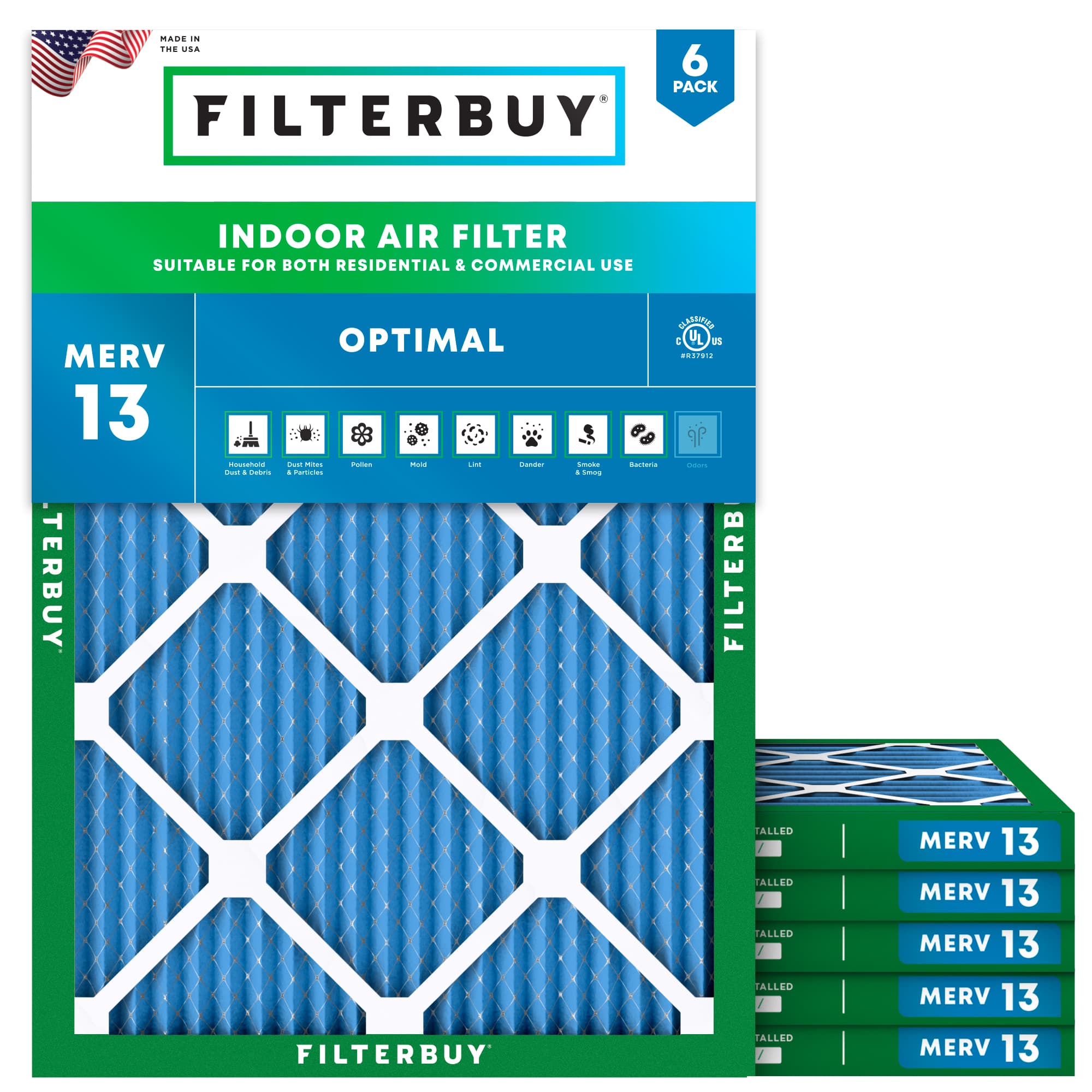
16x22x1 MERV 13 Pleated Air Filter
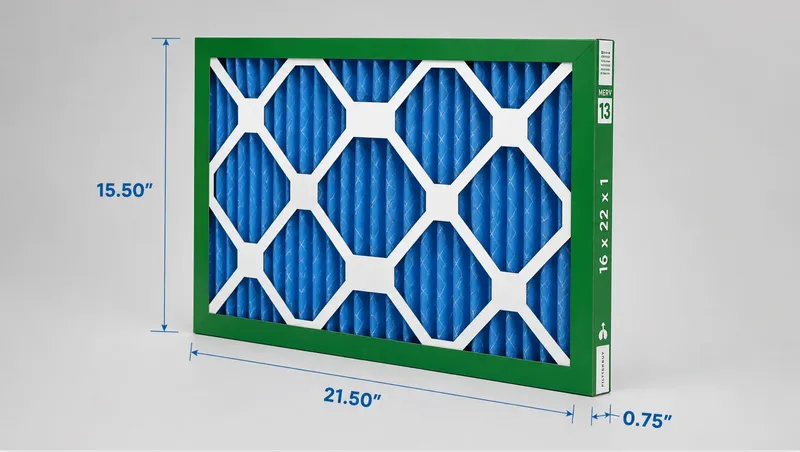
Actual Size: 15.5x21.5x0.75
 Free Delivery
  Factory-Direct Low Prices, Made in the USA
 Hassle-Free Returns & Free Exchanges
RESIDENTIAL AND/OR COMMERCIAL USE
Change Every 3 Months
16x22x1 MERV 13 Pleated Air Filter
Actual Size: 15.5x21.5x0.75
Free Delivery Factory-Direct Low Prices, Made in the USAHassle-Free Returns & Free ExchangesRESIDENTIAL AND/OR COMMERCIAL USE
Change Every 3 Months
16x22x1 MERV 13 Pleated Air Filter
Actual Size: 15.5x21.5x0.75
Free Delivery Factory-Direct Low Prices, Made in the USAHassle-Free Returns & Free ExchangesRESIDENTIAL AND/OR COMMERCIAL USE
Change Every 3 Months
About
- This is a list 16x22x1 MERV 13 air filter replacement for your furnace, air conditioner, heat pump, or HVAC system
- Actual air filter size: 15.5x21.5x0.75
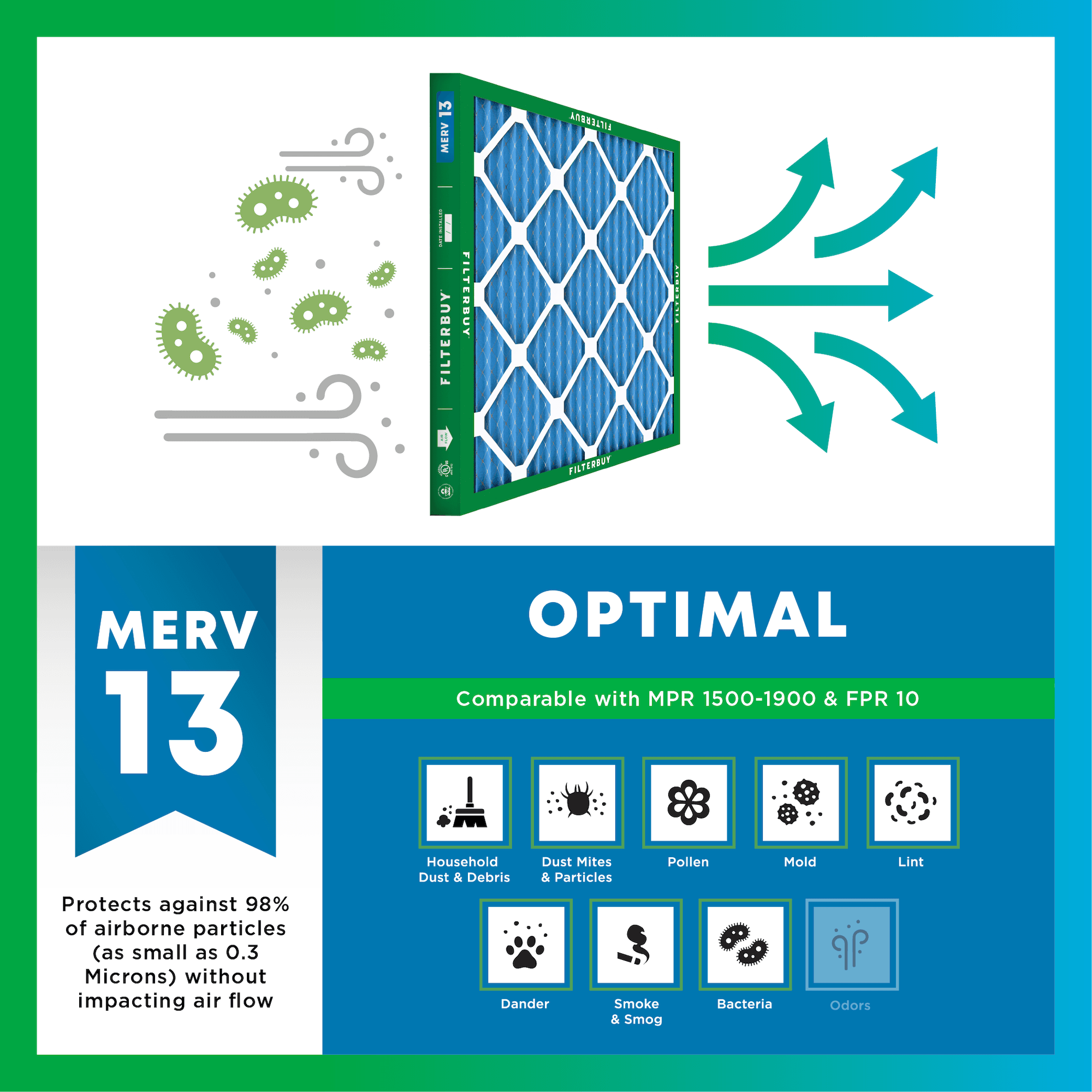
- MERV 13 synthetic media (comparable with MPR 1500/1900 and FPR 10) offers the best protection from dust, pollen, pet dander, mold, smog, bacteria, and virus carrying particles by trapping 98% of airborne particles without impacting air flow.
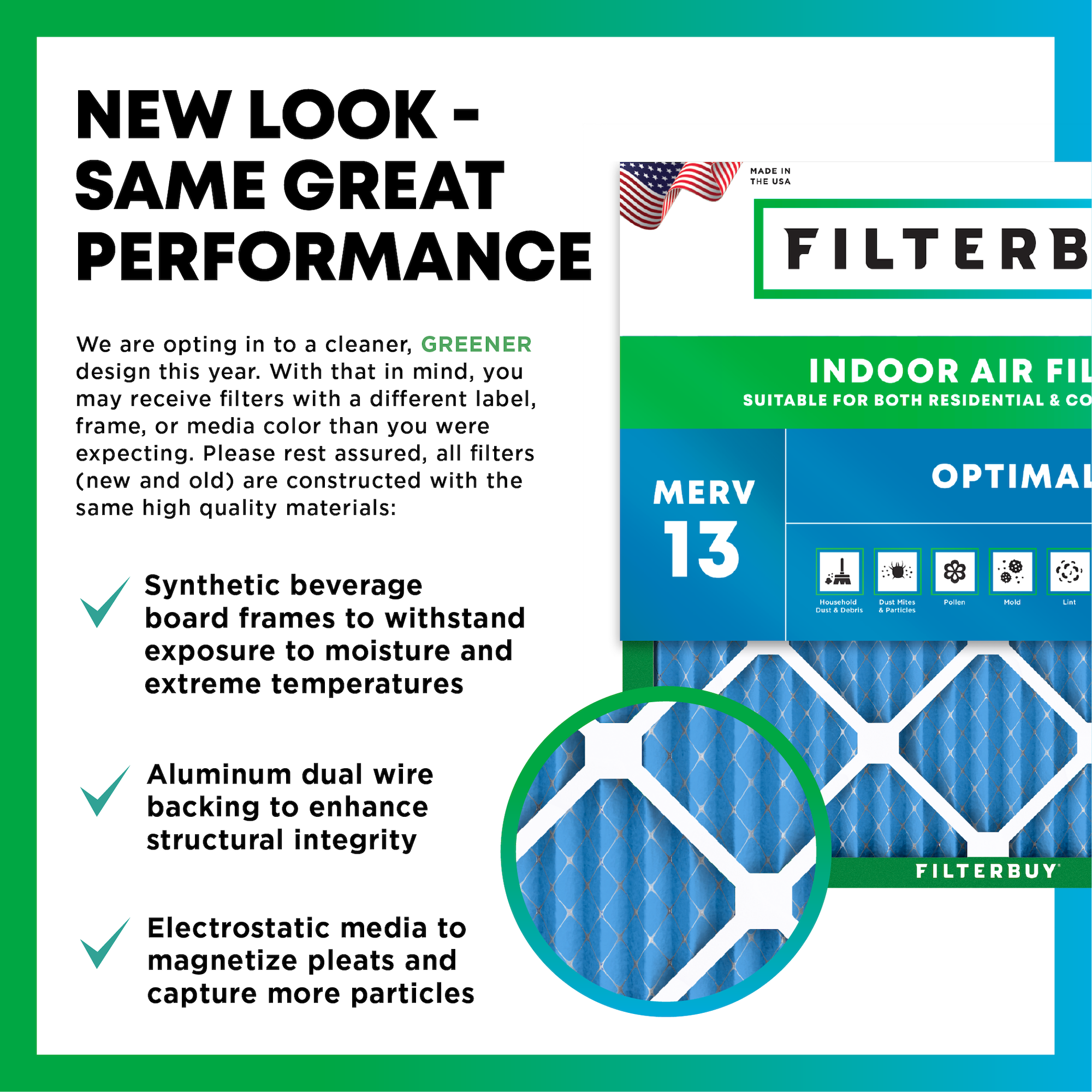
- High-quality construction means electrostatically charged pleated filter media, reinforced wire backing for structural integrity, and a durable frame to resist heat and humidity
- Built to last 3 months. 300% longer than fiberglass models
- 100% manufactured in the United States and designed with recyclable materials
- Learn more about 16x22x1 Air Filters
Top-Rated Filters. American Made. Delivered Free.
At Filterbuy, we don't cut corners—we craft high-quality air filters right here in the USA and ship them to your doorstep for free. No delays, no gimmicks—just clean air, made easy. With thousands of five-star reviews and filters built for real life & every HVAC system, it's no wonder why over 4 million families trust Filterbuy.

Proudly Made In The USA

Fast, Free Shipping on Every Order

Premium Materials That Go The Distance

85,000+ 5-Star Reviews From Happy Customers

Save Up to 70% Per Filter with Packs
Things to Know About Filter Sizes

Nominal Size
- The rounded size printed on your filter or HVAC unit (e.g., 16x22x1).
- Usually whole numbers to make identifying and ordering easier.
- A label for compatibility—not the exact measurement.

Actual Size
- The true, trimmed dimensions of the filter (e.g., 15.5x21.5x0.75 inches).
- Filters are manufactured slightly smaller so they slide into the filter slot without forcing.
- If you don't know your nominal size, measure your filter to get the actual size, then round up to find the nominal size to search on our site.

Why the difference?
- Nominal sizes simplify shopping and standardize categories.
- Actual sizes ensure the filter fits properly inside your HVAC's filter rack.
How To Find Your Nominal Size When You Don't Know It


Measure length × width × depth with a tape measure to find the actual size.

Round up each dimension to the nearest whole number to get the nominal size. Example: 15.5x21.5x0.75 in → 16x22x1 nominal.

Search by nominal size on our site for the best fit.

Why Getting the Right Size Matters
- Too small? Air can bypass the filter, reducing air quality and efficiency.
- Too big? It won't fit—risking bent frames and airflow issues.
- Just right? You get maximum performance, better filtration, and cleaner air.

Free Exchange Policy
If the filter you buy doesn't fit, we'll send you a better size.

What's a MERV Rating?
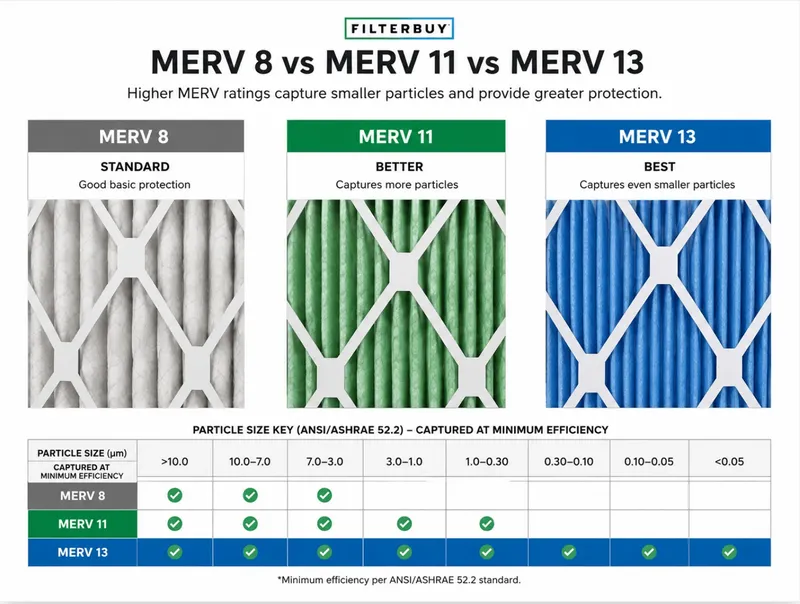
MERV stands for Minimum Efficiency Reporting Value—but don't let the technical name fool you. It's just a way to rate how well an air filter traps stuff like dust, pollen, pet dander, and smoke. The higher the MERV number, the more particles it catches—and the cleaner your air will be.

Merv 8
Comparable to:FPR: 4-7
MPR: 600-1000
 Dust & Debris
 Dust Mites & Particles
 Pollen
 Mold
Mold Lint
Lint Dander
Merv 11
Comparable to:FPR: 6-9
MPR: 1200-1550
Dust & DebrisDust Mites & ParticlesPollenMoldLintDander Smoke & Smog
Merv 13
Comparable to:FPR: 10
MPR: 1900-2800
Dust & DebrisDust Mites & ParticlesPollenMoldLintDanderSmoke & Smog Bacteria
MERV 8
Comparable to:FPR: 4-7MPR: 600-1000


MERV 11
Comparable to:FPR: 6-9MPR: 1200-1550

MERV 13
Comparable to:FPR: 10MPR: 1900-2800
What Makes Our Filters Last 90 Days? Quality, From the Inside Out
We build every Filterbuy filter to deliver reliable 90-day performance—thanks to smart design and premium materials that do the heavy lifting. Here's what makes the difference:
Pleated Design
More pleats = more surface area to capture dust and debris, keeping your air cleaner longer.
Electrostatically Charged Media
Pleats are magnetized to attract and trap microscopic particles—like pet dander, pollen, and smoke.
Synthetic Beverage Board Frame
Engineered to resist warping in extreme temperatures and high humidity.

Aluminum Dual Wire Backing
A layer of metal reinforcement keeps pleats evenly spaced and structurally sound—no sagging, even at high airflow.
Made in the USA
Assembled with care. Built to perform. Ships fast, free, and reliably from our U.S. facilities.
How to Install Your Filter in 4 Simple Steps

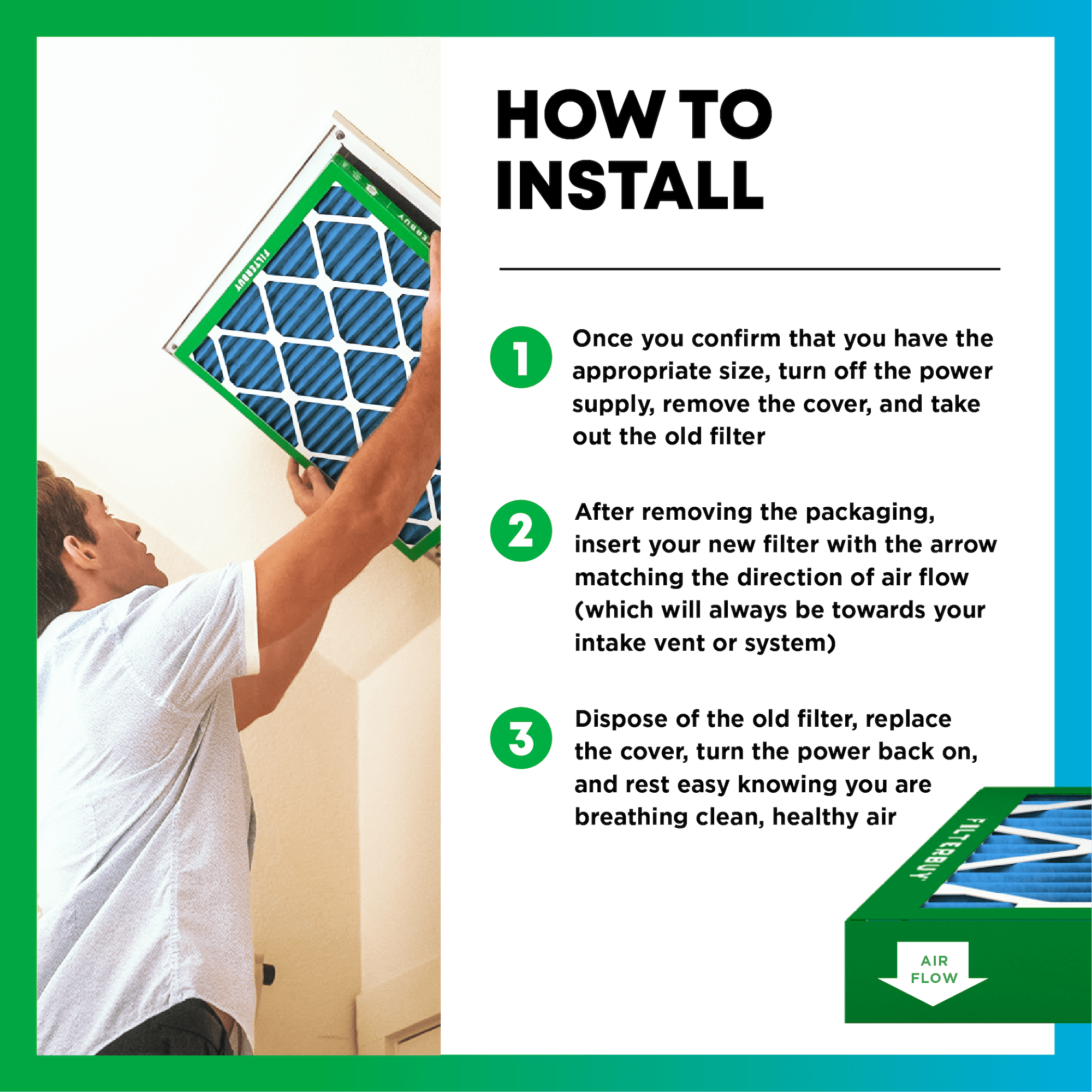
Turn Off Your HVAC SystemSafety first.

Remove The Old FilterLook for the airflow arrow and make note of the direction.

Slide In Your New FilterArrow should point toward the system (same direction as before).

Turn Your System Back OnAnd enjoy the fresh, clean air.

Never forget to replace your air filter again.
- Save 5% on every order
- Choose Your Delivery Schedule
- Edit, Skip, or Cancel Anytime.
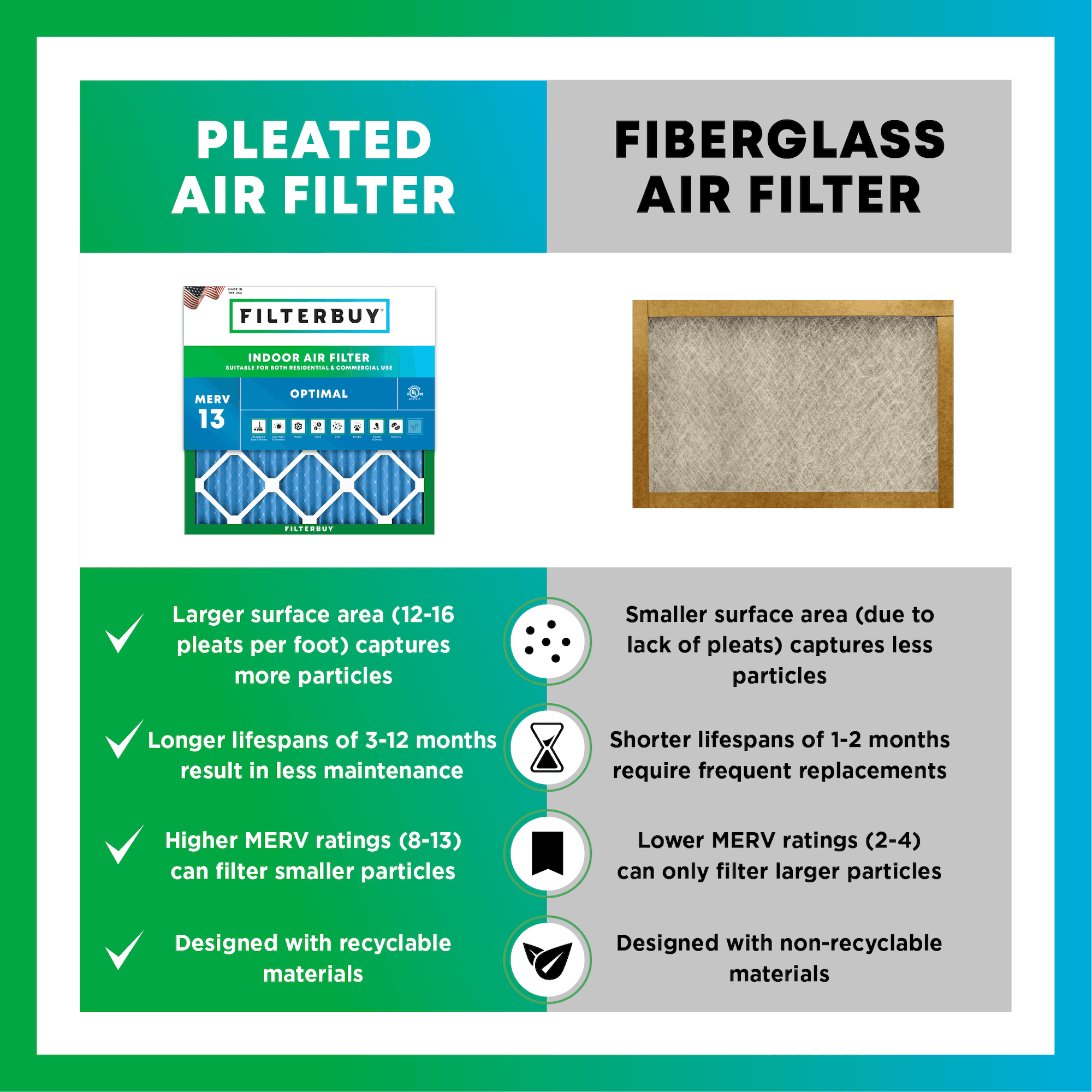
Pleated Filters vs. Fiberglass—What's the Difference?
Not all air filters are created equal. Pleated filters don't just last longer—they actually clean your air better. Here's how they stack up:

Pleated Filters
Efficiency:
High (MERV 8–13) – Traps more particles
Lifespan:
90 days – Long-lasting performance
Air Quality:
Excellent – Cleaner, healthier air
Materials:
Recyclable and durable

Fiberglass Filters
Efficiency:
Low (MERV 4 or less) – Misses small stuff
Lifespan:
30 days or less – Replace often
Air Quality:
Minimal – Basic protection only
Materials:
Thin, flimsy, and not recyclable
Pleated filters are a no-brainer—more protection, less hassle, and better air for your home.
How Often Should You Change Your Filter?
Changing your filter on time keeps your HVAC system running efficiently—and helps protect your lungs from dust, allergens, and airborne irritants. Here's how often to swap it out based on your needs:

Every 90 Days
Standard ScheduleFor most homes without pets or special air quality concerns. Great for general upkeep and energy efficiency.

Every 60 Days
If You Have Pets or AllergiesShedding fur, dander, and allergy triggers can build up fast. Changing your filter every two months helps keep the air fresher and symptoms at bay.

Every 30 Days
If You Have Respiratory Concerns or Live in Smog/Wildfire ZonesFor households affected by smoke, pollution, or respiratory conditions, monthly changes ensure maximum protection.

Want to stay on track? Set a reminder—or skip the stress with auto-delivery so fresh filters show up right when you need them.
Don't Just Take Our Word For It...
Got More Questions? We've Got Answers.
Product Specifications
| Nominal Size | 16 x 22 x 1 inches |
| Actual Size | 15.5 x 21.5 x 0.75 inches |
| Filter Type | Pleated |
| Media | Electrostatically Charged |
| Frame | Beverage Board |
| MERV Ratings Available | 8, 11, 13 |
| Lifespan | Up to 90 Days |
| Origin | Made in USA |
Best 16x22x1 MERV 13 Furnace & HVAC Air Conditioner Filters
Author: Michelle Wan https://filterbuy.com/author/michelle-wan/ | Reviewer: David Clark, Licensed HVAC Technician | Published: August 7, 2026 | Updated: August 7, 2026
TL;DR
A 16x22x1 MERV 13 filter measures 15.50 by 21.50 by 0.75 inches and fits any standard 16x22x1 furnace, air conditioner, or heat pump rack. MERV 13 captures up to 98% of airborne particles, including smoke and bacteria that lower ratings pass through. Filterbuy makes this size in the United States and ships it free, singly or in multi packs. Replace every 90 days under normal conditions.
Key Takeaways
Actual size is 15.50" x 21.50" x 0.75". The 16x22x1 name is a rounded label, not a measurement.
MERV 13 is rated FPR 10 and MPR 1500 to 1900, capturing at least 50% of particles at 0.3 to 1.0 micron. MERV 8 has no minimum there.
CDC recommends MERV 13 or better wherever the system supports it.
16x21.5x1 measures a true 16.00 inches wide and is a different filter. Measure before ordering.
Replace every 90 days normally, 6 weeks with asthma or allergies, 2 months with pets, 30 days in smoke.
Filterbuy is a direct-to-consumer air filter manufacturer in Talladega, Alabama, building over 600 sizes in the United States since 2013. A 16x22x1 rack appears far less often than a 20x25x1, and that scarcity pushes homeowners toward whatever the hardware store stocks. Fiberglass media stops lint and coarse dust while most of the fine particle load passes through the blower and back out the registers. We make this size on the same line as every other, and the specification below reflects what ships.
What A 16x22x1 MERV 13 Filter Actually Measures
A 16x22x1 MERV 13 filter has an actual size of 15.50 by 21.50 by 0.75 inches. The 16x22x1 label is nominal, a rounded catalog number rather than a measurement. Manufacturers undercut it by roughly half an inch so the filter slides into the rack without forcing the frame.
Nominal size is the ordering label. Actual size is the measured dimension of the filter.
Measure the rack opening, then round each figure up to the nearest whole inch. More than a quarter inch of clearance on any edge lets air bypass the media, dropping real efficiency below the rating on the box. CDC advises checking racks so air moves through the filter rather than around it. Filterbuy publishes a walkthrough on how to measure your filter rack and lists all 16x22x1 filter options.
Sizes That Get Confused With 16x22x1
Five filter sizes sit close enough to 16x22x1 to be ordered by mistake. A nominal size written as a whole number is rounded up from the measurement, while a nominal size containing a fraction is the measurement. Compare 16x22x1 at 15.50 inches wide against 16x21.5x1 at a true 16.00 inches wide.
Actual sizes as published by Filterbuy. Match your rack against the actual size column rather than the nominal name.
Both sizes start with the number 16, and only one is actually 16 inches. A rack measuring 16.00 by 21.50 inches takes the 16x21.5x1. The wrong size reaches the cart when a buyer orders by the number that looks closest. Match the rack against the actual size column rather than the nominal name. We see this often enough that Filterbuy covers exchanges free.
What MERV 13 Captures That MERV 8 And MERV 11 Miss
MERV 13 captures at least 50% of particles at 0.3 to 1.0 micron under ANSI/ASHRAE 52.2. MERV 8 carries no minimum there and MERV 11 is rated at 20%. Wildfire smoke, bacteria, and combustion byproducts sit in that range, making MERV 13 the first residential rating that measurably cuts fine particle load.
Values are the ANSI/ASHRAE 52.2 minimum composite particle size efficiency thresholds. E1 spans 0.3–1.0 micron, E2 spans 1.0–3.0 micron, and E3 spans 3.0–10.0 micron.
The NAFA User's Guide to ANSI/ASHRAE Standard 52.2 sets out the method. Particle counts run upstream and downstream across twelve size bands over six dust-loading cycles, and the lowest values form the composite minimum efficiency curve. A published MERV describes worst-case performance, which makes it a floor.
That explains why you see both 98% and 50% attached to MERV 13. The 98% figure covers the full particle range a household filter meets, and it is the number Filterbuy publishes. The 50% figure is the minimum needed in the hardest band to earn the label. Treat the rating as guaranteed worst case and the capture percentage as typical.
CDC recommends upgrading central HVAC filter efficiency to MERV 13 or better where the system is compatible. During smoke events AirNow advises filters rated MERV 13 or higher with the fan set to on rather than auto.
Will A MERV 13 Filter Restrict Airflow In Your System?
A one inch MERV 13 adds pressure drop compared to fiberglass, and most systems built in the last twenty years handle it without measurable loss. Risk concentrates in older equipment and undersized return ducts. A loaded MERV 13 restricts far more than a clean one, so replacement discipline matters more than the rating.
Watch for four symptoms after an upgrade. Weak airflow at the registers, a frozen evaporator coil, short cycling, and a whistle at the return grille all point to a restriction. Any one warrants a static pressure reading rather than a guess. A four inch media cabinet cuts pressure drop at the same rating, and added return capacity addresses cases where the ductwork is the real limit.
Four situations argue for a lower rating here. The system is over 20 years old and has never had a static pressure reading. The rack is the only return in a home above roughly 2,000 square feet. Airflow already feels weak. Nobody has asthma, allergies, or smoke exposure and no one will change the filter on schedule.
Filterbuy stocks this rack at MERV 11 and MERV 8, and explains which MERV rating suits which system. We would rather sell the filter that fits than the highest number on the shelf.
How Often To Replace A 16x22x1 MERV 13 Filter
Replace a 16x22x1 MERV 13 every 90 days in a standard household. Filterbuy shortens that to 6 weeks for asthma or allergies, 2 months with pets, and 2 to 3 months with young children. Smoke and heavy pollution shorten it to 30 days. A filter that looks grey and matted is past due regardless of the calendar.
A filter that looks grey and matted has already begun restricting airflow and is past due regardless of the interval.
Depth matters too. A one inch filter holds the least media, so it loads sooner than a thicker filter in the same house. ENERGY STAR guidance is to inspect, clean, or change air filters once a month regardless of rating. Filterbuy publishes step by step replacement instructions for the swap itself.
The Asthma and Allergy Foundation of America ranks central filtration among the core actions that improve a home's indoor air quality. The American College of Allergy, Asthma and Immunology names a disposable filter rated MERV 11 to 13 the most cost-efficient whole-house option and calls fiberglass ineffective. An auto delivery schedule removes the recall problem.
How To Choose Between A Single Filter, A 4 Pack, And Bulk Quantities
A 4 pack of 16x22x1 MERV 13 filters covers a year of 90 day changes on a single return. A 6 pack covers eighteen months, or one year at the 60 day interval pets and allergies call for. Homes with two or three returns multiply that, and per filter cost drops as quantity rises.
Coverage assumes one return grille. Multiply by the number of return grilles in the home.
Count the return grilles first. Each holds a filter on the same schedule, so a two return home at 60 days uses twelve filters a year rather than six. Storage is not a constraint, since the charge on the media is permanent rather than applied and a sealed filter kept flat and dry lasts indefinitely. The same media spans every size Filterbuy builds.
Expert Quote
“A 16x22x1 is not a size most retailers carry, and that is the whole problem. People end up with a fiberglass panel because it was the only thing that fit the opening, not because they chose it. After manufacturing filters for over a decade and serving more than two million households, the pattern we see is that filtration gets decided by availability rather than by need. An uncommon size deserves the same MERV 13 media as a 20x25x1, which is why we build every size on the same line.”
Supporting Statistics
Three findings frame why filtration efficiency matters indoors. They are not ours. What we add is how we read them.
The Air You Filter Is The Air You Mostly Breathe
EPA research puts time spent indoors at roughly 90%, and names fireplaces, woodstoves, kerosene heaters, and tobacco smoke as household sources of respirable particles. Homes with a smoker can carry particle levels several times outdoor levels. Our read is that a filter rack is the one point where all recirculated air passes a replaceable barrier, which is why we treat rack fit as seriously as rating. Source: The Inside Story: A Guide to Indoor Air Quality.
Outdoor Particulate Does Not Stay Outside
The American Lung Association 2026 State of the Air report, covering 2022 through 2024, found 76 million people in counties graded F for year-round particle pollution and 61.5 million graded F for short-term spikes. Our read is that year-round exposure argues for a standing 90 day habit while spikes argue for keeping the next filter on hand, which is why pack pricing sits below single units. Source: Key Findings, State of the Air 2026.
Smoke Particulate Is Not Ordinary Particulate
Aguilera and colleagues found a 10 microgram per cubic meter rise in wildfire specific PM2.5 associated with 1.3% to 10% more respiratory hospitalizations, against 0.67% to 1.3% for other sources. Our read is that this asymmetry is why smoke season guidance shortens replacement to 30 days and points to MERV 13, since MERV 11 carries no obligation above 20% in the band where smoke sits. Source: Aguilera et al. 2021.
Particle exposure is widespread. It concentrates where people spend their time and worsens when the source is smoke. Most filter pages sell a rating, but rack fit decides more. Filterbuy's indoor air quality resource library covers broader air quality problems.
Frequently Asked Questions
Is A 16x22x1 Filter The Same As A 16.5x22x1 Filter?
No. Filterbuy lists 16x22x1 at 15.50" x 21.50" x 0.75" and 16.5x22x1 at 16.50" x 22.00" x 0.75", roughly an inch apart on each side. They are not interchangeable. Measure the rack rather than trusting the outgoing label.
Can I Put A 16x22x1 Filter In A Slot Built For A 2 Inch Filter?
Mechanically yes, and it will sit loosely. A one inch filter in a two inch rack has less surface area and shorter service life, and the extra depth lets the frame shift. Match the depth where the rack allows, and see the one inch filter range.
Does A MERV 13 Filter Capture Viruses?
MERV 13 captures most particles at 0.3 to 1.0 micron, including many virus carrying droplet nuclei. It does not sterilize air. Treat it as one layer in a ventilation strategy rather than a standalone control. Filterbuy addresses filtration and airborne viruses separately.
Are Filterbuy 16x22x1 MERV 13 Filters Made In The USA?
Yes. Filterbuy manufactures this size in the United States from industrial grade, recyclable materials.
What If 16x22x1 Is Not My Exact Size?
Filterbuy makes over 600 sizes and builds custom air filters to any dimension outside the standard catalog.
Glossary
MERV. Minimum Efficiency Reporting Value, the ANSI/ASHRAE 52.2 scale from 1 to 16 rating capture efficiency by particle size. Reference: air filter rating standards.
Nominal Size. The rounded catalog dimensions printed on a filter frame, such as 16x22x1.
Actual Size. The measured dimensions of the filter. For a Filterbuy 16x22x1, 15.50" x 21.50" x 0.75".
FPR and MPR. Proprietary retailer scales. MERV 13 is FPR 10, and Filterbuy lists it comparable to MPR 1500 to 1900 on the 3M Filtrete scale.
PM2.5. Particulate matter 2.5 micrometers or smaller, most linked to respiratory and cardiovascular harm.
Static Pressure. Resistance to airflow in a duct system, measured in inches of water column. High readings signal a restriction.