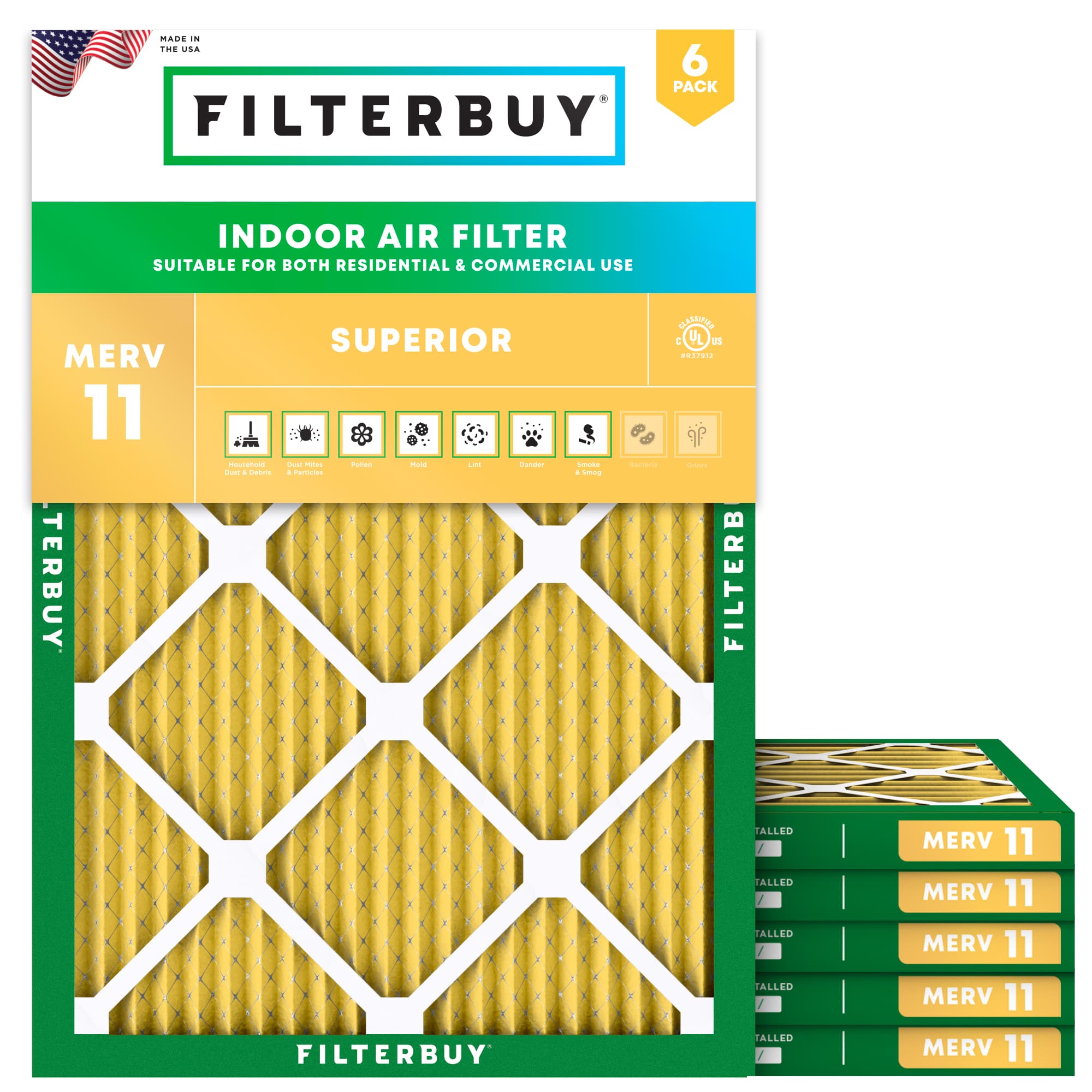
Actual Size: 15.50x21.50x0.75"
 Free Delivery
  Factory-Direct Low Prices, Made in the USA
 Hassle-Free Returns & Free Exchanges
RESIDENTIAL AND/OR COMMERCIAL USE
Change Every 3 Months
Actual Size: 15.50x21.50x0.75"
Free Delivery Factory-Direct Low Prices, Made in the USAHassle-Free Returns & Free ExchangesRESIDENTIAL AND/OR COMMERCIAL USE
Change Every 3 Months
Actual Size: 15.50x21.50x0.75"
Free Delivery Factory-Direct Low Prices, Made in the USAHassle-Free Returns & Free ExchangesRESIDENTIAL AND/OR COMMERCIAL USE
Change Every 3 Months
At Filterbuy, we don't cut corners—we craft high-quality air filters right here in the USA and ship them to your doorstep for free. No delays, no gimmicks—just clean air, made easy. With thousands of five-star reviews and filters built for real life & every HVAC system, it's no wonder why over 4 million families trust Filterbuy.

Proudly Made In The USA

Fast, Free Shipping on Every Order

Premium Materials That Go The Distance

85,000+ 5-Star Reviews From Happy Customers

Save Up to 70% Per Filter with Packs


Measure length × width × depth with a tape measure to find the actual size.

Round up each dimension to the nearest whole number to get the nominal size. Example: 15.50x21.50x0.75" in → 16x22x1 nominal.

Search by nominal size on our site for the best fit.


If the filter you buy doesn't fit, we'll send you a better size.
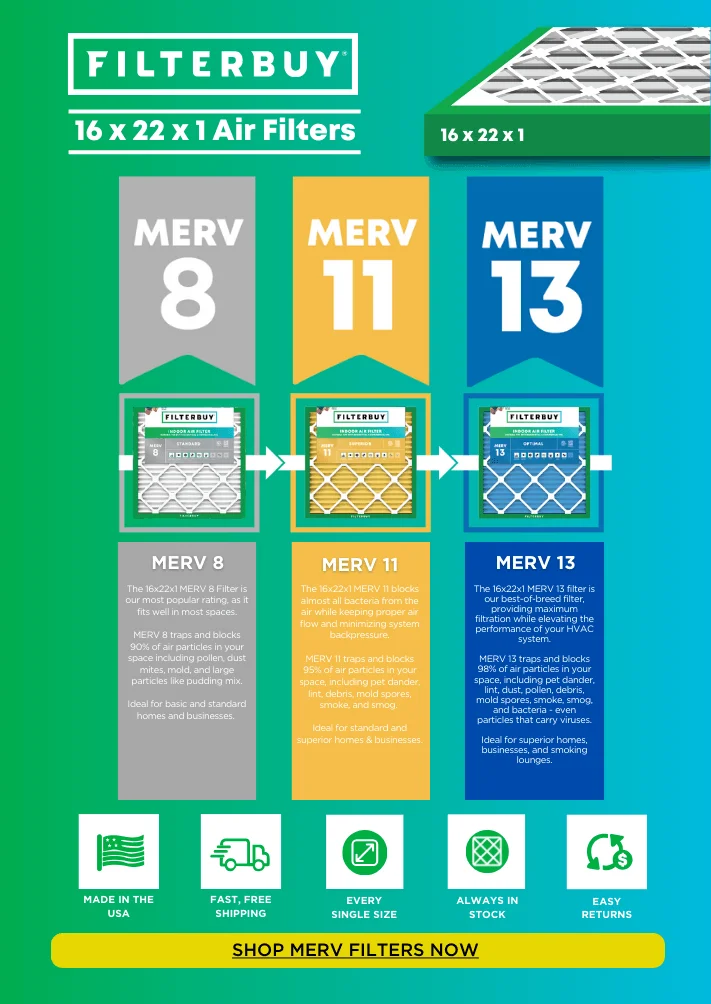
MERV stands for Minimum Efficiency Reporting Value—but don't let the technical name fool you. It's just a way to rate how well an air filter traps stuff like dust, pollen, pet dander, and smoke. The higher the MERV number, the more particles it catches—and the cleaner your air will be.

Comparable to:FPR: 4-7
MPR: 600-1000
 Dust & Debris
 Dust Mites & Particles
 Pollen
 Mold
Mold Lint
Lint Dander
Comparable to:FPR: 6-9
MPR: 1200-1550
Dust & DebrisDust Mites & ParticlesPollenMoldLintDander Smoke & Smog
Comparable to:FPR: 10
MPR: 1900-2800
Dust & DebrisDust Mites & ParticlesPollenMoldLintDanderSmoke & Smog Bacteria


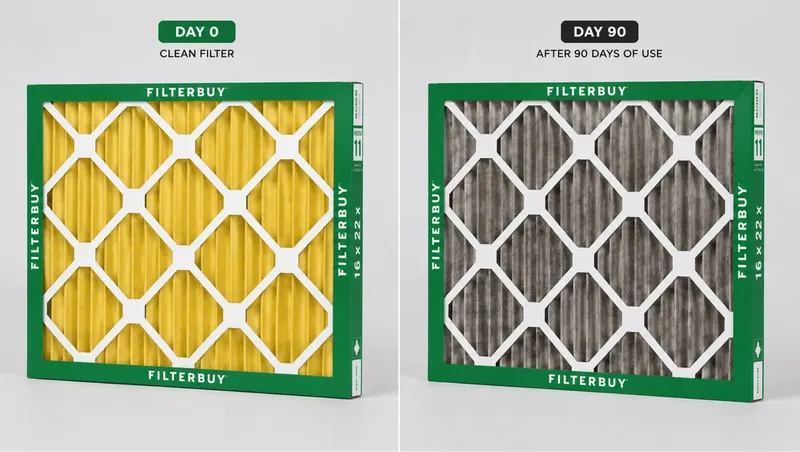
We build every Filterbuy filter to deliver reliable 90-day performance—thanks to smart design and premium materials that do the heavy lifting. Here's what makes the difference:
More pleats = more surface area to capture dust and debris, keeping your air cleaner longer.
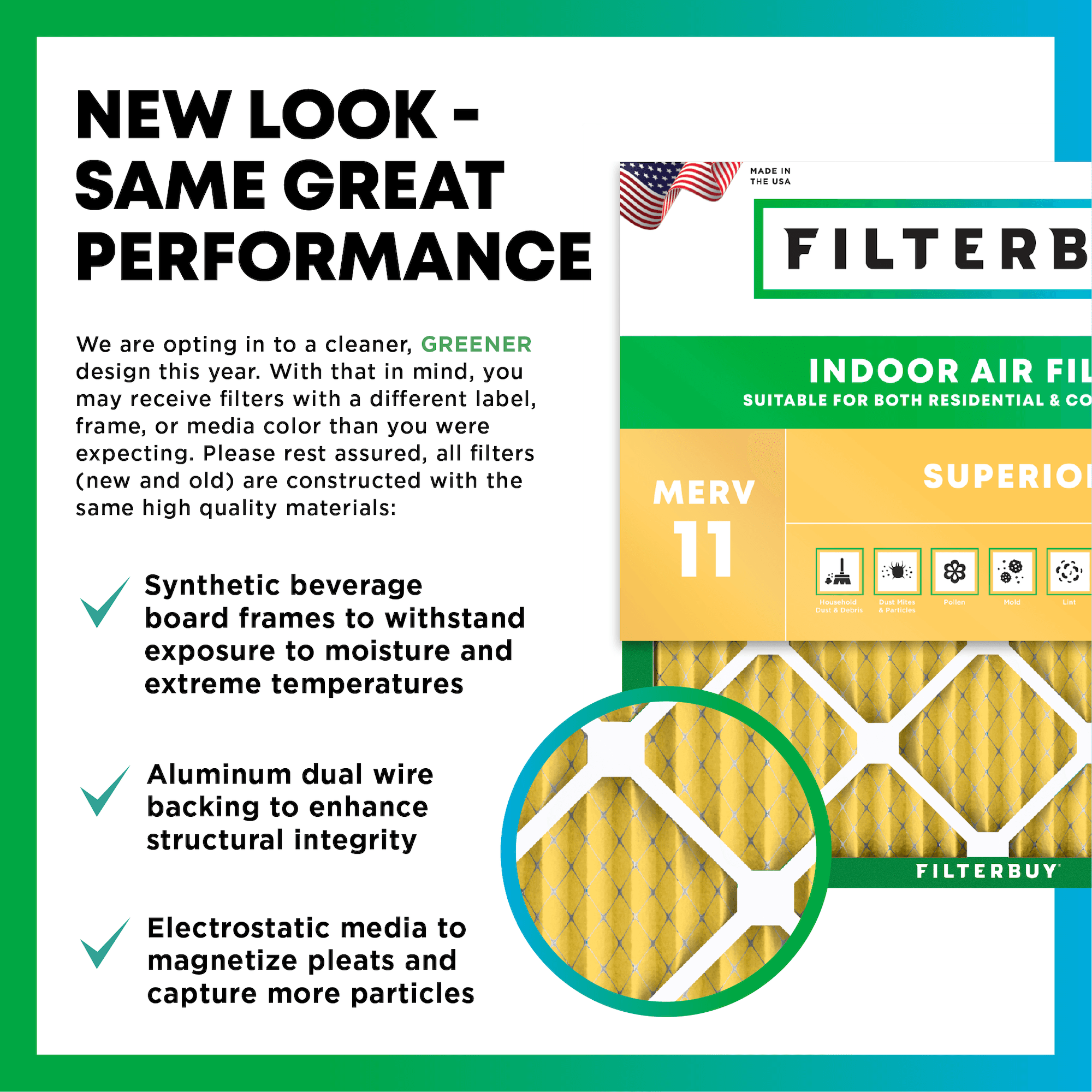
Pleats are magnetized to attract and trap microscopic particles—like pet dander, pollen, and smoke.
Engineered to resist warping in extreme temperatures and high humidity.

A layer of metal reinforcement keeps pleats evenly spaced and structurally sound—no sagging, even at high airflow.
Assembled with care. Built to perform. Ships fast, free, and reliably from our U.S. facilities.

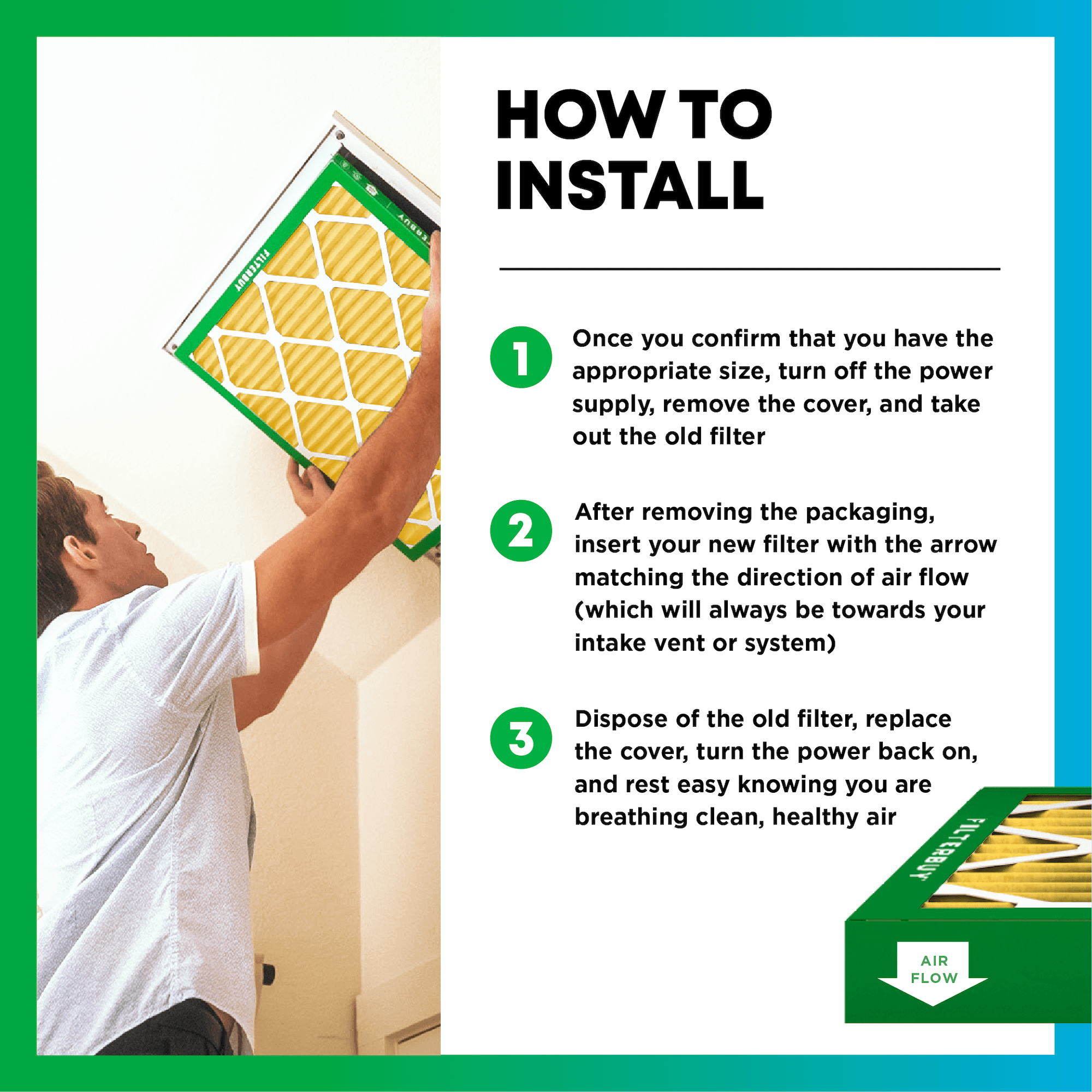
Turn Off Your HVAC SystemSafety first.

Remove The Old FilterLook for the airflow arrow and make note of the direction.

Slide In Your New FilterArrow should point toward the system (same direction as before).

Turn Your System Back OnAnd enjoy the fresh, clean air.

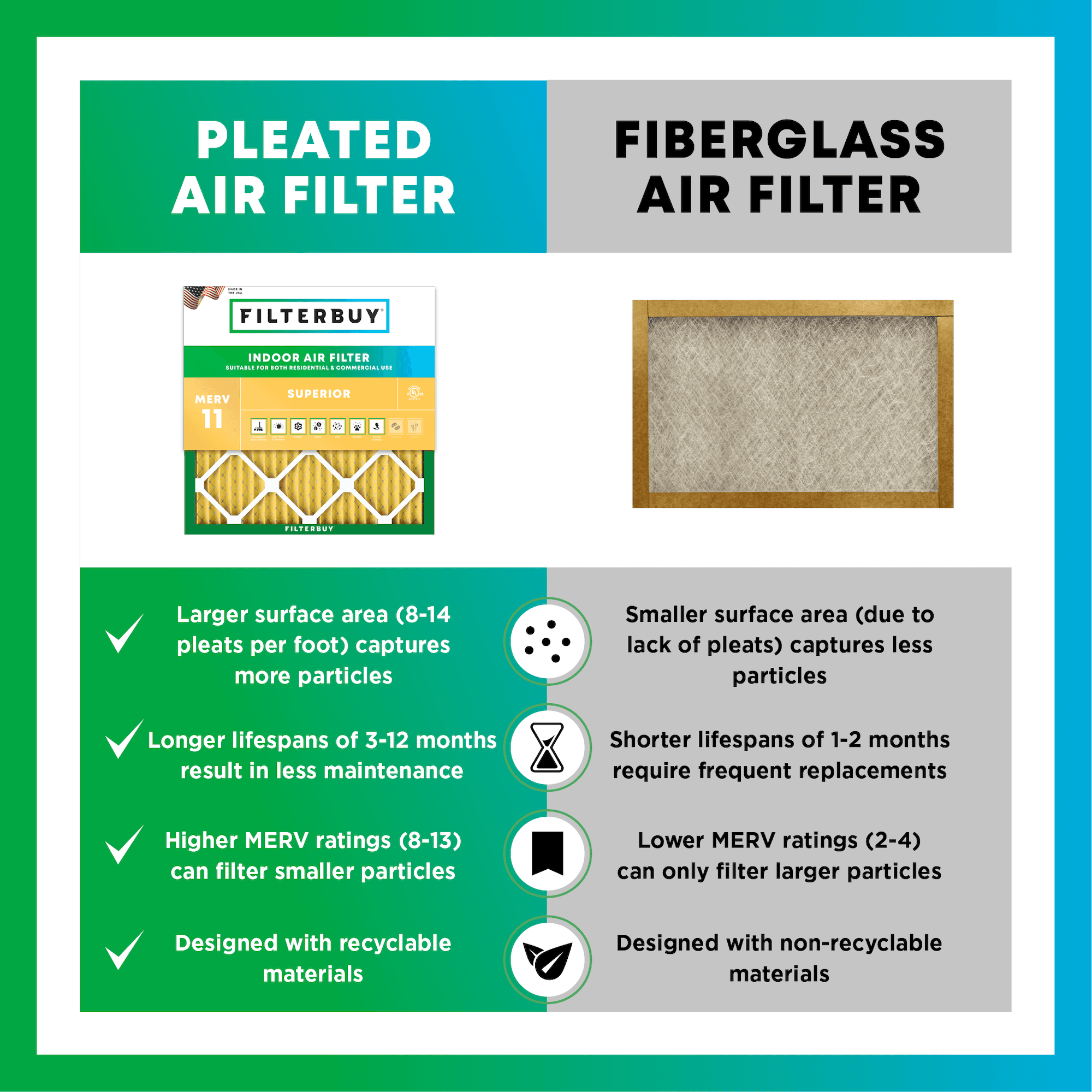
Not all air filters are created equal. Pleated filters don't just last longer—they actually clean your air better. Here's how they stack up:

Efficiency:
High (MERV 8–13) – Traps more particles
Lifespan:
90 days – Long-lasting performance
Air Quality:
Excellent – Cleaner, healthier air
Materials:
Recyclable and durable

Efficiency:
Low (MERV 4 or less) – Misses small stuff
Lifespan:
30 days or less – Replace often
Air Quality:
Minimal – Basic protection only
Materials:
Thin, flimsy, and not recyclable
Pleated filters are a no-brainer—more protection, less hassle, and better air for your home.
Changing your filter on time keeps your HVAC system running efficiently—and helps protect your lungs from dust, allergens, and airborne irritants. Here's how often to swap it out based on your needs:

For most homes without pets or special air quality concerns. Great for general upkeep and energy efficiency.

Shedding fur, dander, and allergy triggers can build up fast. Changing your filter every two months helps keep the air fresher and symptoms at bay.

For households affected by smoke, pollution, or respiratory conditions, monthly changes ensure maximum protection.

| Nominal Size | 16 x 22 x 1 inches |
| Actual Size | 15.50 x 21.50 x 0.75" inches |
| Filter Type | Pleated |
| Media | Electrostatically Charged |
| Frame | Beverage Board |
| MERV Ratings Available | 8, 11, 13 |
| Lifespan | Up to 90 Days |
| Origin | Made in USA |
Author: Michelle Wan https://filterbuy.com/author/michelle-wan/ | Reviewer: David Clark, Licensed HVAC Technician | Published: August 7, 2026 | Updated: August 7, 2026
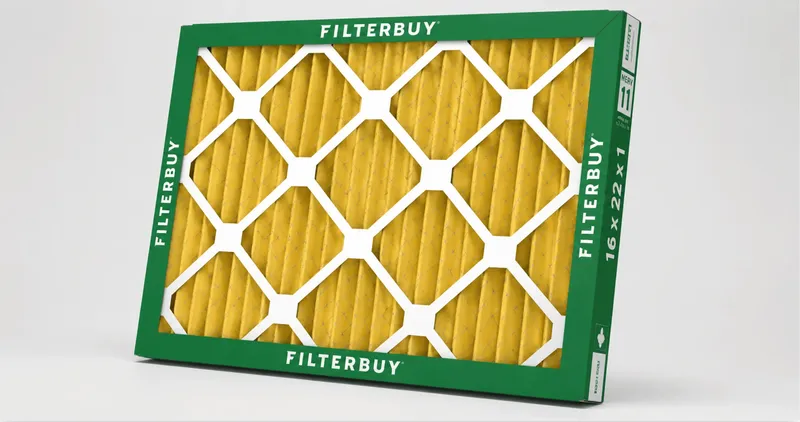
Your 16x22x1 filter slot is an uncommon size, and uncommon sizes are where household filtration breaks down. The nearest widely stocked sizes are 16x20x1 and 16x25x1, and neither fits. A MERV 11 rating here captures pet dander, pollen, mold spores, and fine dust while holding airflow resistance inside what a one-inch slot can tolerate. Those numbers come from ASHRAE Standard 52.2.
The Filterbuy 16x22x1 MERV 11 pleated filter has an actual size of 15.50 x 21.50 x 0.75 inches. Under ASHRAE Standard 52.2, MERV 11 removes at least 85% of particles in the 3.0 to 10.0 micron range and at least 65% of particles in the 1.0 to 3.0 micron range. That span covers pollen, pet dander, mold spores, and dust mite debris. Most households replace this filter every 60 to 90 days.
Actual size on a Filterbuy frame is 15.50 x 21.50 x 0.75 inches. The 16x22x1 label is nominal, and each dimension runs smaller so the frame slides in.
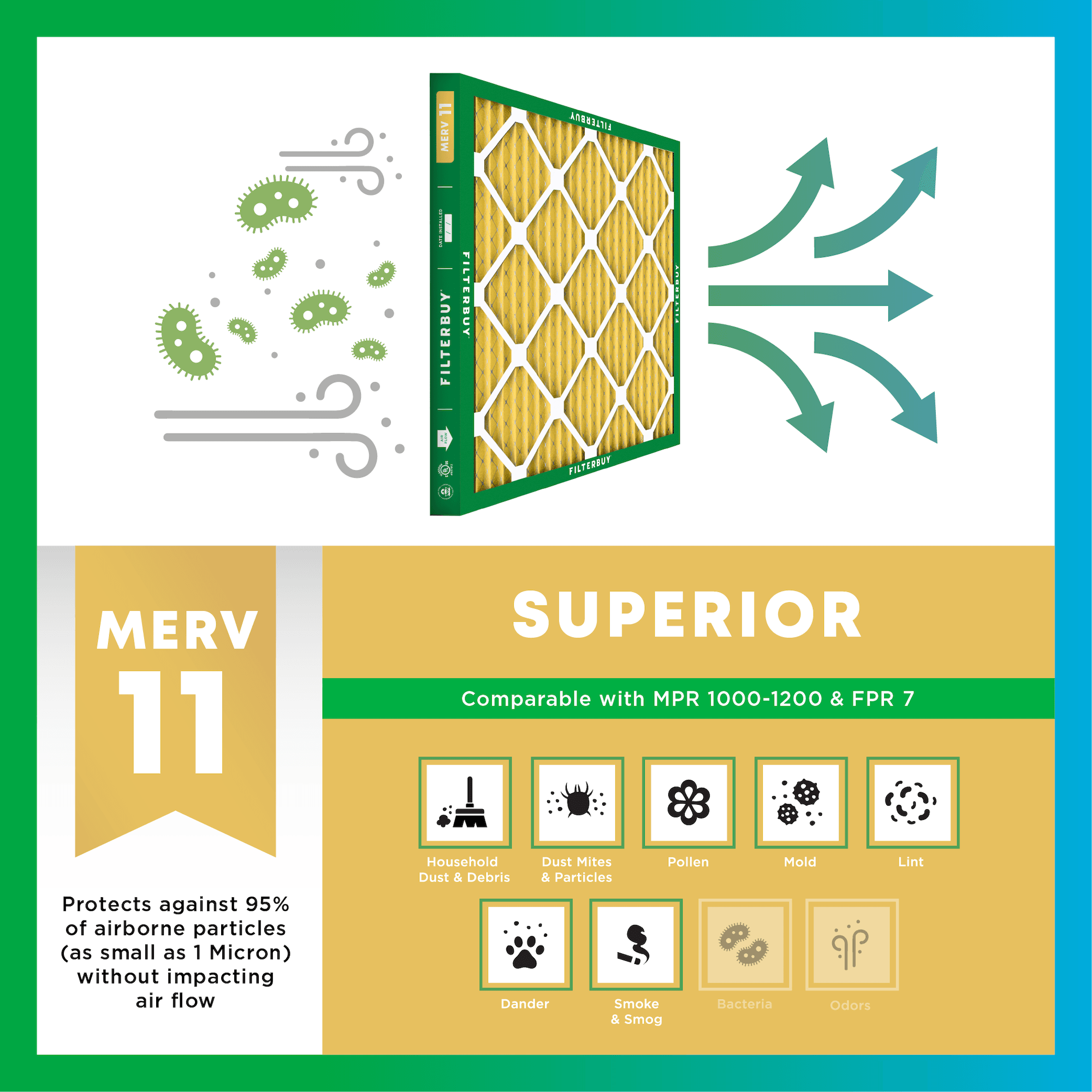
MERV 11 corresponds to roughly MPR 1200 and FPR 7, the scales big-box brands print instead of MERV, so cross-brand comparison is possible.
The 95% figure on filter packaging measures dust arrestance by weight. It answers a different question than the particle-size efficiency behind a MERV number.
Filter depth drives the airflow penalty more than the MERV number does, which is why a one-inch slot tops out lower than a four-inch cabinet.
The National Air Filtration Association reports a 10 millimeter gap around a filter can cost at least two MERV levels of real performance, so fit matters as much as rating.
A 16x22x1 MERV 11 air filter removes at least 85% of airborne particles between 3.0 and 10.0 microns and at least 65% of particles between 1.0 and 3.0 microns. That range covers pollen, pet dander, dust mite debris, and mold spores. MERV 11 carries no rated minimum below 1 micron.
MERV stands for Minimum Efficiency Reporting Value, the scale ASHRAE built in 1987 to describe filter performance by particle size rather than by one marketing figure. Standard 52.2 tests across twelve particle size ranges over six dust-loading cycles, then groups results into three bands. The rating reflects the worst reading recorded rather than an average, so real capture usually beats the label.
Filterbuy builds this size on electrostatically charged pleated media with reinforced wire backing. The most confusing number on filter packaging is arrestance, the 95% figure, which measures test dust held by weight rather than particle-size efficiency. That metric flatters a filter on the particles that matter least, since media can hold 95% of test dust by weight and still pass many one-micron particles. Compare the MERV bands instead.
A Filterbuy 16x22x1 filter measures 15.50 x 21.50 x 0.75 inches in actual dimensions. Every maker cuts under the nominal label so the frame slides in without binding, but by different amounts, so read the small print on your own frame.
Filterbuy prints both figures on the frame, nominal in large type and actual in smaller type. Without a label, measure and round each dimension up to the nearest inch.
MERV 11 is the practical choice for most one-inch slots in this size. Health authorities favor MERV 13 or higher where equipment allows it, but a one-inch filter has limited media depth to spread airflow across, so the pressure penalty at MERV 13 lands harder here than in a four-inch cabinet.
The American Lung Association recommends upgrading a furnace filter to MERV 13 or above to capture smaller particles. That recommendation is sound and conditional, since it holds only where the system can carry the added resistance.
Filter depth, not the MERV number alone, drives most of the airflow penalty. A four-inch filter spreads airflow across far more media than a one-inch filter of the same rating, so it breathes easier. On an older blower, MERV 11 is often the strongest filtration the equipment accepts without a measurable airflow drop. Homes without pets can stay at MERV 8.
Two situations argue against MERV 11. A system rated by its maker for MERV 4 media only should stay there until a technician says otherwise. A four-inch cabinet is underused by any one-inch filter.
Replace a 16x22x1 MERV 11 filter every 60 to 90 days in a typical household. Check it monthly during peak heating and cooling season and change it early if the pleats look loaded, because a restricted filter forces the blower to work harder.
ENERGY STAR advises checking the filter monthly during heavy-use months and replacing it at minimum every three months. Household conditions move that window both ways.
A single 16x22x1 MERV 11 filter runs $31.99, and multi-packs drop sharply. Six-packs land at $15.99 each, half the single-unit price. Twelve-packs reach $15.58. A 60-day cycle uses six filters a year, so one six-pack is a year of coverage.
Auto delivery takes another 5% off. Filterbuy lists this size below the common 22x22x1 in the same MERV 11 line, so an odd size carries no premium. MERV 13 in this size costs about $3.46 more per filter at the six-pack tier, roughly $21 a year on a 60-day cycle.
“After manufacturing filters for over a decade and serving more than two million households, the principle we keep coming back to is fit. A MERV rating only does its work when the frame seals against the rack. That is why we cut over 600 sizes rather than only the most common ones, and why an uncommon size like 16x22x1 is made to order rather than treated as a special order.”
The National Air Filtration Association explains how ASHRAE 52.2 groups particle sizes and why a frame gap costs performance.
https://www.nafahq.org/2011/06/30/selecting-proper-air-filter-efficiencies-for-commercial-buildings/
The American Lung Association explains where filtration fits alongside source control, and why it prefers MERV 13 or higher.
https://www.lung.org/clean-air/indoor-air/protecting-from-air-pollution/air-cleaning
ENERGY STAR gives the monthly inspection schedule and how a loaded filter raises energy use.
https://www.energystar.gov/saveathome/heating-cooling
The Consumer Product Safety Commission publishes a room-by-room pollutant guide covering radon, combustion gases, mold, and household VOCs.
The Asthma and Allergy Foundation of America pairs HVAC upkeep with an allergen control checklist for humidity and bedding.
https://aafa.org/allergies/prevent-allergies/healthier-home-indoor-air-quality/
The American College of Allergy, Asthma and Immunology gives a clinical view of air filtration and what evidence supports.
https://acaai.org/allergies/management-treatment/living-with-allergies/air-filters/
AirNow publishes wildfire smoke guidance and advises replacing filters more often when smoke is heavy.
https://www.airnow.gov/wildfires/be-smoke-ready/
Central ducted systems are the U.S. norm.
88% of U.S. households use air conditioning.
Two-thirds use central AC or a central heat pump.
Survey sample of 18,496 households.
Source: U.S. Energy Information Administration, 2020 Residential Energy Consumption Survey
https://www.eia.gov/todayinenergy/detail.php?id=52558
One-inch panels dominate residential filter slots.
92.9 million U.S. homes have forced-air ducted heating.
About 95% of them use 1-inch panel filters.
Average annual spend of roughly $2.60 per household.
Source: AAAAI Indoor Allergen Committee rostrum, citing American Housing Survey data
https://pmc.ncbi.nlm.nih.gov/articles/PMC2824428/
Seasonal allergy is common among U.S. adults.
25.2% had a diagnosed seasonal allergy in 2024.
31.7% had at least one diagnosed allergic condition.
Source: National Center for Health Statistics, Data Brief 545, January 2026
https://www.cdc.gov/nchs/products/databriefs/db545.htm
Nominal. Order by 16x22x1 and the Filterbuy filter arrives at 15.50 x 21.50 x 0.75 inches. Actual dimensions differ between makers.
No. A 16x20x1 filter leaves roughly two inches of open rack, and unfiltered air takes that path instead of the media. A taped gap does not hold, because tape fails under airflow and heat. Order the correct nominal size, or build a custom size if your slot is non-standard.
For most seasonal allergy sufferers, yes. The dominant triggers, pollen, dust mite debris, mold spores, and pet dander, all sit inside the bands MERV 11 is rated for. Anyone with asthma should discuss MERV 13 with a physician first.
Partly. MERV 11 catches the coarse fraction of smoke, but wildfire PM2.5 is finer than the bands it is rated for. AirNow advises MERV 13 or higher during smoke events, plus continuous fan operation and earlier filter changes.
A MERV 11 one-inch pleated filter adds modest resistance versus a stock fiberglass panel, and most equipment built in the last 15 years handles it without strain. If your system is older, undersized, or struggling to reach set point, have a technician verify static pressure first.
Filterbuy manufactures 16x22x1 MERV 11 pleated filters to order in Talladega, Alabama, and every order ships free. Pick a pack size that matches your replacement cycle. Six covers a year at 60 days.
MERV. Minimum Efficiency Reporting Value, the 1 to 16 ASHRAE scale rating particle removal by size.
ASHRAE Standard 52.2. The ASHRAE test method behind MERV ratings.
Nominal size. The rounded whole-inch dimensions printed on a filter frame. Here, 16x22x1.
Actual size. The true trimmed dimensions, which vary by maker. For a Filterbuy 16x22x1, 15.50 x 21.50 x 0.75 inches.
Arrestance. A weight-based measure of test dust a filter holds, not interchangeable with MERV.
E1, E2, E3. The three ASHRAE 52.2 particle bands. E1 is 0.3 to 1 micron, E2 is 1 to 3, E3 is 3 to 10.
MPR and FPR. Proprietary scales. MPR is 3M Filtrete, FPR is Home Depot. Neither is an ASHRAE standard.
Filter bypass. Air travelling around a filter frame through rack gaps instead of the media.

