
Do Air Purifiers Work? What the Science Says | Filterbuy
November 18, 2026
TL;DR
Yes, air purifiers work when the problem is floating in the air. A right-sized true HEPA purifier pulls out dust, pollen, pet dander, and smoke, cutting fine-particle (PM2.5) levels by about half in real homes. The health benefits are real but modest, and no purifier fixes gases or mold at the source.
Key Takeaways
Air purifiers work on particles. A true HEPA filter captures at least 99.97% of particles at 0.3 microns.
Real homes see about a 50% drop. Field studies show portable air purifiers cut indoor PM2.5 by 49% on average (Ebrahimifakhar et al.).
Health benefits are measurable but small. Trials link purifier use to slightly lower blood pressure and inflammation.
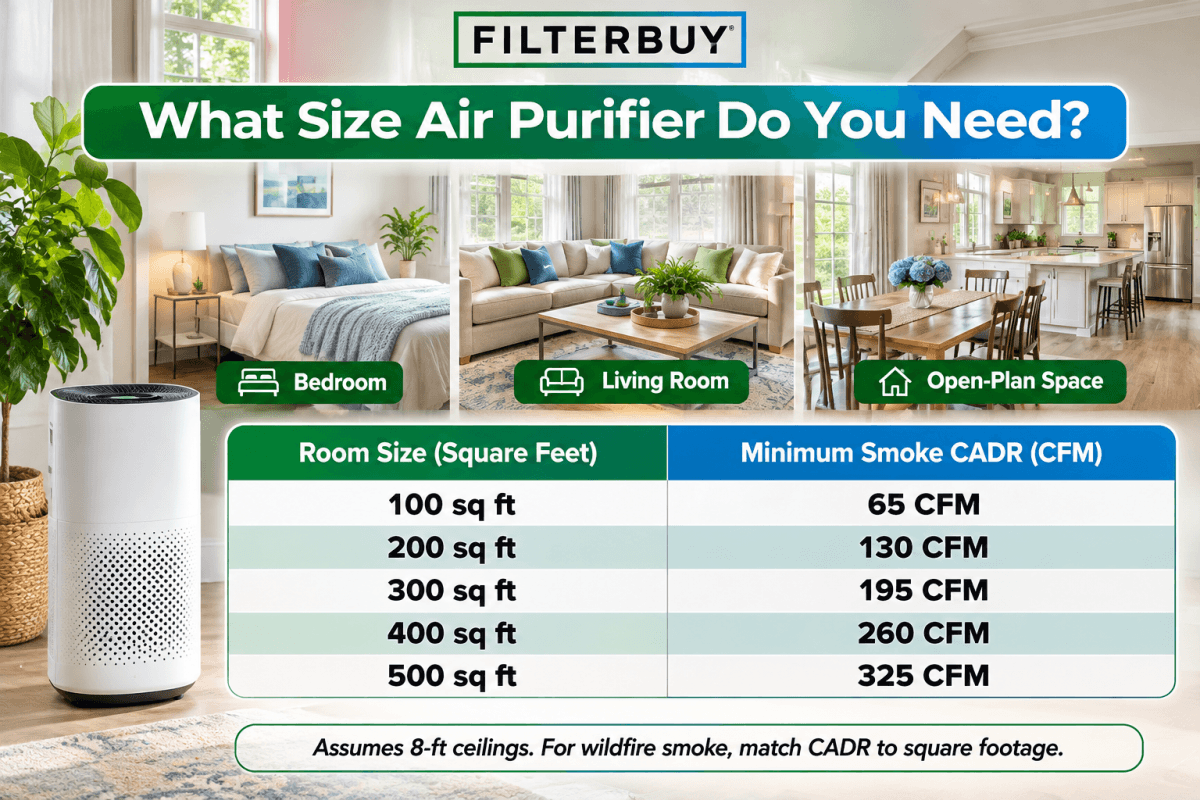
Size beats brand. Choose a smoke CADR of at least two-thirds of the room's square footage.
Above AQI 100, use both. Switch to an EPA-recommended MERV 13 HVAC filter and run a HEPA purifier in each room you use.
Do Air Purifiers Actually Work?
Air purifiers do work when the target is airborne particles in the room where the unit runs. In real homes, portable air purifiers cut fine-particle pollution by roughly half on average. The U.S. Environmental Protection Agency (EPA) agrees that portable air cleaners can reduce indoor air pollution but cannot remove all pollutants.
49% average PM2.5 reduction across 83 field studies in a systematic review of portable air cleaners (Ebrahimifakhar et al.).
22.6% to 92.0% reductions in PM2.5 in homes, schools, and offices in a 2021 review in Science of the Total Environment (Cheek et al.).
Why do some homes see 90% and others almost nothing? Filterbuy has made air filters in its own U.S. plants since 2013, and the machine is rarely what fails. An undersized unit or a dirty filter usually is. In EPA chamber testing of DIY air cleaners, a box fan with a clean 1-inch MERV 13 filter delivered a smoke CADR of 111 CFM, then did almost nothing once the filter was dirty. Filterbuy's box fan and MERV 13 test breakdown has the numbers.
How Does an Air Purifier Work?
Most effective air purifiers are mechanical: a fan pulls room air through pleated filter media that traps particles. The gold standard is HEPA (high-efficiency particulate air), a performance standard set by the U.S. Department of Energy. A HEPA filter must capture at least 99.97% of particles at 0.3 microns, the hardest size to catch, so it does even better on most others.
A "HEPA-type" label usually means the filter falls short. Look for the full "99.97% at 0.3 microns" spec, as our guide to HEPA ratings explains, or a European class such as H13 HEPA.
Pleated filter manufacturing taught Filterbuy a lesson that carries over to purifiers: media only works when air can't slip around it. A loose cartridge lets dirty air go right past it.
Some purifiers add activated carbon for odors, the same media used in Filterbuy's carbon odor eliminator filters. Others add an ionizer, which can emit ozone, and the EPA advises against ozone generators outright.
What Can Air Purifiers Remove, and What Can't They?
Air purifiers do their best work on fine airborne particles like smoke and their weakest on gases and moisture problems like mold. Filterbuy's Air Purifier Evidence Scorecard below maps each common household pollutant to EPA guidance and the cited studies.
Filterbuy Air Purifier Evidence Scorecard. Based on EPA guidance and the peer-reviewed studies cited on this page.
Mold is the big exception: air cleaners do not address its cause, as our guide to air purifiers and mold spore removal explains. No consensus test yet confirms how well consumer gas filtration works either (ASHRAE Journal, 2019).
What Are the Health Benefits of an Air Purifier?
The best-documented benefit of an air purifier is lower exposure to fine particles, which are linked to heart and lung disease. Controlled trials show small but measurable improvements. The EPA notes you may not feel them day to day.
Blood pressure: A 2023 meta-analysis of 17 studies and about 880 participants found true filtration lowered systolic blood pressure by 2.35 mmHg, or 3.62 mmHg after excluding higher-bias studies (Faridi et al.).
Inflammation: A 2022 meta-analysis of 14 sham-controlled trials found purifiers cut PM2.5 by 61.5% and lowered the inflammation marker IL-6 by 13% (Wittkopp et al.).
Allergies and asthma: HEPA studies show modest symptom relief, per the EPA and the American Lung Association.
A purifier isn't a treatment, so keep your doctor in the loop on asthma or allergies.
Are Air Purifiers Worth It?
An air purifier is worth it when airborne particles are your problem and you'll run a correctly sized unit around the clock. For homes dealing with allergies, pets, or wildfire smoke, it usually is. Three questions settle it.
Filterbuy's Three-Question Check
Is the problem airborne particles? Smoke, pollen, dander, and dust respond well. Mold and odors need a source fix first.
Is it concentrated in one room? A purifier cleans the room it sits in. Whole-house problems start at the HVAC filter.
Will you run it nonstop? A purifier only cleans the air that passes through it.
Three yeses mean a purifier will likely pay off. In smoke-prone areas, watch Filterbuy's live AQI map or live wildfire and smoke map. One caution from every fire season we've shipped through: lingering smoke smell usually means unfinished cleanup, not a weak purifier.
Most HEPA cartridges need replacing every 6 to 12 months (see our guide to HEPA air purifier replacement filters).
How Do You Make an Air Purifier Actually Work?
An air purifier performs best when it's sized for the room, uses verified HEPA media, emits no ozone, runs continuously, and gets fresh filters on time.
Size it by smoke CADR. AHAM's rule of thumb is a smoke CADR of at least two-thirds of the room's area, so a 200-square-foot bedroom needs about 130 CFM. This sizing filters the room's air about 4.8 times an hour, or roughly every 12.5 minutes. For wildfire smoke, match CADR to the full square footage.
Verify the HEPA claim. Look for "99.97% at 0.3 microns" and an AHAM Verifide seal.
Avoid ozone. Choose a CARB-certified model, and if yours has an ionizer, consider turning it off.
Run it nonstop where you spend time. As the EPA notes, the longer an air cleaner runs, the more air it filters. During smoke events, set up a cleaner air room and use the highest fan speed you can tolerate.
Replace filters early, not late. A clogged filter quietly lowers real-world CADR. Even the 90 days Filterbuy prints on its MERV 13 boxes reflects household dust, not smoke season. See how long air purifier filters last.
Air Purifier vs. HVAC Air Filter: Do You Need Both?
A portable air purifier cleans one room, while an HVAC air filter cleans the air moving through your whole home. The EPA recommends a furnace or HVAC filter rated at least MERV 13, or as high as your system can handle.
When your local AQI climbs above 100, switch to an EPA-recommended MERV 13 filter if you have an HVAC system, and run a HEPA air purifier in each room you use. Above 100, air quality is unhealthy for sensitive groups.
Filterbuy's position is simple: true HEPA belongs in a portable purifier and MERV in your HVAC system, because no MERV rating equals HEPA. We cut filters in more than 600 sizes because an undersized filter lets air sneak around the media. Before upgrading, ask your HVAC technician whether your system can handle MERV 13.
Cost per sq ft from Filterbuy's 90-day smoke-season model: a $300 purifier in a 300 sq ft bedroom vs. MERV 13 filters in a 2,000 sq ft home.
For the full math, see our portable air purifier vs. HVAC filter breakdown and our comparison of air filters vs. air purifiers.
Supporting Statistics: Why Indoor Air Deserves Attention
Three U.S. figures put the stakes in perspective.
90% of our time is spent indoors.
Some indoor pollutants run 2–5 times higher than outdoor levels.
Source: U.S. EPA
152.3 million Americans (44%) live with failing air.
Their counties fail for ozone or particle pollution.
More than 106 million people have allergies.
About 1 in 3 people in the U.S. are affected each year.
Pollen and pet dander are among what air purifier filters capture.
Source: Asthma and Allergy Foundation of America, based on 2026 CDC data
Frequently Asked Questions
Do Air Purifiers Help With Allergies?
Yes, by pulling airborne pollen and pet dander from the room. See our guide to the best air purifier for mold and dust allergies.
Can an Air Purifier Remove Viruses From the Air?
Partly. The EPA says air purifiers can help reduce airborne viruses, but that a portable air cleaner alone is not enough to protect people from COVID-19.
Glossary
- Air purifier (portable air cleaner)
- A plug-in device that filters the air in a single room.
- HEPA (high-efficiency particulate air)
- A U.S. Department of Energy filter standard requiring at least 99.97% capture of particles at 0.3 microns.
- PM2.5
- Airborne particles 2.5 micrometers or smaller, including smoke, that reach deep into the lungs.
- CADR (clean air delivery rate)
- How much filtered air a purifier delivers, in cubic feet per minute.
- AHAM (Association of Home Appliance Manufacturers)
- The trade group behind the CADR test and the AHAM Verifide seal.
- CARB (California Air Resources Board)
- The state agency that certifies air cleaners for safety and ozone emissions.
- MERV (minimum efficiency reporting value)
- A 1 to 16 scale that rates how well an HVAC air filter captures particles.
- VOCs (volatile organic compounds)
- Household chemical gases that particle filters can't capture.
- Ozone
- A lung irritant that some ionizers and ozone generators emit.
Breathe Easier at Home
“The air inside your home is yours to manage, and the right filter is the easiest lever you have.”
Start with the whole home: shop MERV 13 air filters made in Filterbuy's U.S. plants and set up air filter auto-delivery. Then add right-sized HEPA purifiers in the rooms your family uses most. Curious about today's air? Check your local AQI.