September 2, 2026
By Michelle Wan · Reviewed by David Clark, Licensed HVAC Technician · Published September 2, 2026
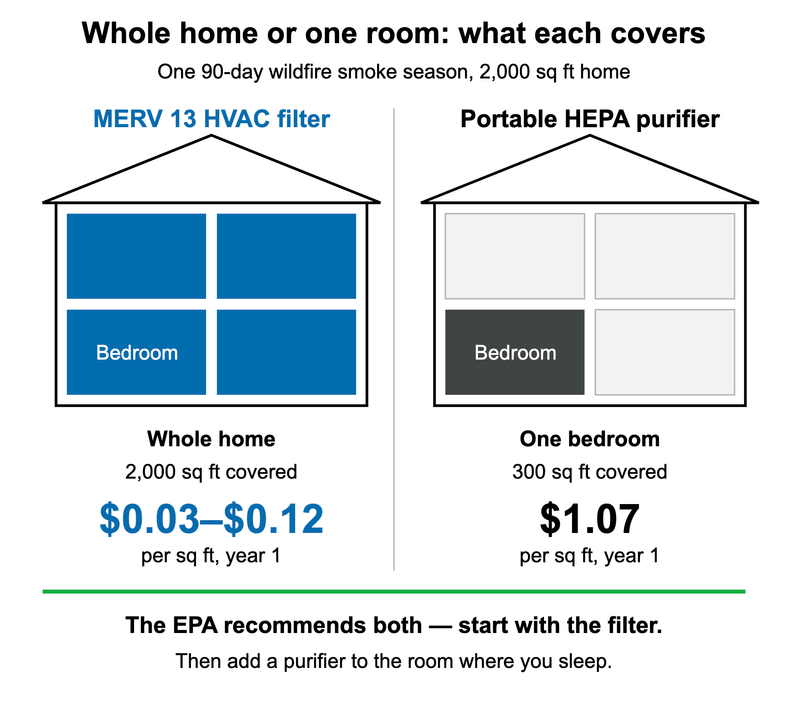
Upgrade your HVAC filter first, then add a portable purifier to one room. A MERV 13 furnace filter covers a 2,000-square-foot home for roughly 3 to 12 cents per square foot over a 90-day smoke season, while a portable HEPA purifier sized for a 300-square-foot bedroom runs about $1.07 per square foot in year one. The EPA recommends both, so the real question is which one to buy first.
MERV 13 HVAC filter — captures microscopic particles; highest residential filtration. Cleans every room the blower reaches.
MERV 11 HVAC filter — captures finer particles like pet dander and mold spores, at lower airflow resistance if your blower cannot take MERV 13.
Portable HEPA purifier — cleans one room at a time, usually the room where you sleep.
Buy the purifier first only if you have no ducted system, you rent, or a technician has flagged your blower.
Not sure which filter your system takes? Answer a few quick questions and we will match you to the right one.
An HVAC filter is the cheapest way to clean a whole house during a wildfire smoke event, while a portable air purifier is the most effective way to clean a single room. Across a 90-day season, a MERV 13 furnace filter protects a 2,000-square-foot home for roughly 3 to 12 cents per square foot, and a portable HEPA purifier sized for a 300-square-foot bedroom runs closer to $1.07 per square foot in its first year. The EPA recommends both, and the order you buy them in matters more than which one is "better."
A MERV 13 HVAC filter costs about 1.8 cents per square foot in filter media for a 2,000-square-foot home over a 90-day season, at Filterbuy 20x25x1 six-pack pricing with monthly changes.
Running the blower fan continuously costs more than the filters do, an estimated $30 to $199 in electricity over the same 90 days, depending on whether the blower is an ECM or an older PSC motor.
AHAM recommends a smoke CADR equal to the room’s square footage during wildfire events, not the usual two-thirds. A 300-square-foot bedroom needs 300, not 200.
MERV 13 removes at least 50% of particles in the 0.3–1.0 micron range on a single pass, the band where most wildfire smoke lives. HEPA removes 99.97% at 0.3 microns, but only in the room it sits in.
Neither MERV nor HEPA media removes smoke odor or gases. That takes activated carbon.
Filterbuy manufactures pleated filters in the United States and sells them factory-direct, so we had every commercial reason to write a page ending in "buy a filter." We ran the numbers anyway, pricing everything from our own catalog, and two results surprised us: the electricity to run the blower costs more than the filters we sell, and for a meaningful share of homes our product is not the right first purchase at all.
A portable air purifier pulls room air through a HEPA filter and returns it to that room. An HVAC filter is pleated media in your central system return, cleaning every cubic foot the blower moves through the ductwork. The purifier cleans one room thoroughly. The HVAC filter cleans the whole house, but only while the blower runs.
One room versus every room is the whole comparison, and everything else follows from it. A device that cleans 300 square feet does nothing for the other 1,700, and a device that cleans 2,000 square feet does nothing at 3 a.m. when the fan is off.
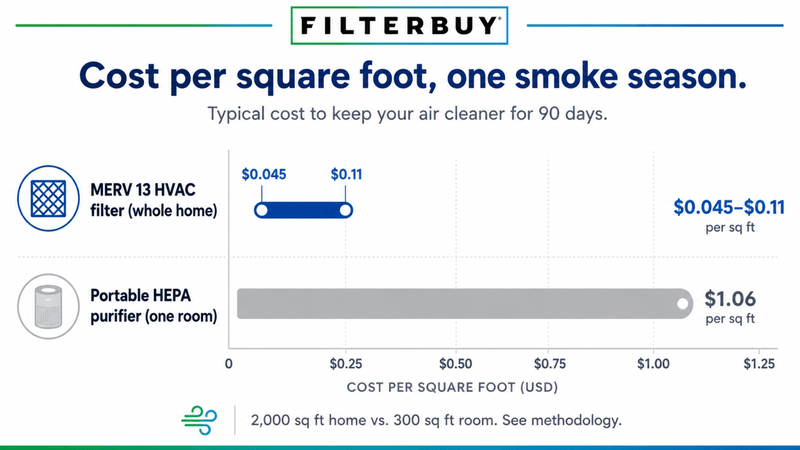
Here is what each approach costs over one 90-day smoke season, using our own retail pricing, the EIA 2026 forecast U.S. residential rate of 18.41 cents per kWh, and a 2,000-square-foot home with a 3-ton system.
One 90-day wildfire smoke season. Filter pricing reflects Filterbuy 20x25x1 MERV 13 at six-pack quantity. Electricity at 18.41 cents per kWh, the EIA forecast 2026 U.S. summer residential average. Blower draw per NRC Canada measurements of PSC and ECM furnace motors in low-speed circulation.
The filter media is almost free, at under two cents per square foot. The real cost is electricity, because switching the fan from "Auto" to "On" leaves the blower running 24 hours a day instead of cycling. Side-by-side testing at the Canadian Centre for Housing Technology measured furnace blower draw at 75 to 125 watts for an ECM in low-speed circulation, against 350 to 500 watts for a conventional PSC motor. Over 90 days, that spread works out to roughly $30 to $199.
Regional rates move this figure more than any other variable. The Pacific states, where smoke lands hardest, average 26.27 cents per kWh, which pushes the same season to $78–$319, or 4 to 16 cents per square foot. The 90-day window is a modeling choice rather than a rule: Western fire seasons often run twice that long, which roughly doubles both the filter and the electricity line.
The honest read: per square foot of protected space, whole-home HVAC filtration costs roughly one-tenth what a portable purifier costs in year one.
Our example home is not your home, so here is the arithmetic to run on yours. Start with filters, taking your price per filter times the changes you expect. Add electricity: blower watts divided by 1,000, times 24, times your days of smoke, times your utility rate. Divide the total by your conditioned square footage. If you do not know your blower type, assume 400 watts for a system installed before about 2010 and 100 watts for a variable-speed one.
Cost per square foot rewards the HVAC system for covering rooms you are not standing in, so it is worth checking a second measure: what each option costs per unit of clean air actually delivered.
Effective clean-air delivery is system airflow multiplied by filter efficiency. The upper figure uses the MERV 13 nameplate rating; the lower allows for filter bypass, which researchers model as reducing an installed MERV 13 to roughly MERV 10. CADR needs no such adjustment because it is measured as delivered clean air.
Once you already own the purifier, the two ranges overlap, at about $30 against $11 to $65 per 100 CFM. What remains of the purifier’s disadvantage is almost entirely its purchase price, spread across a single season. The two figures are not equally solid, though. The purifier’s 300 CFM is measured clean air coming out of the machine, while the filter’s number is inferred from a media rating that assumes every cubic foot actually passes through it.
That reframes the decision. The HVAC filter is not permanently cheaper per unit of clean air; it is dramatically cheaper per square foot, and cheaper in the first year. A purifier you already own is a good deal, while one bought mid-event at smoke-event prices is not the first dollar to spend.
A MERV 13 filter delivers MERV 13 performance only if all the air goes through it. Air that slips around a loose filter or past a bowed frame rejoins the supply stream unfiltered, and that leak is called bypass. It is the difference between the rating on the box and the air in your bedroom.
Two numbers in this comparison look like they contradict each other, and both are Filterbuy’s. Our MERV 13 product pages say the filter traps 98% of airborne particles; the figure that governs smoke is at least 50% in the 0.3–1.0 micron band. The 98% covers the full tested particle range, dominated by larger dust and pollen. The 50% is the ASHRAE 52.2 minimum for the smallest band, E1, and E1 is where wildfire smoke sits. For smoke, the smaller number is the one that governs, and installation takes another bite out of even that.
The size of that gap is documented. When researchers modeled residential filtration during a Portland wildfire, they did not use the nameplate efficiency at all. They assumed an installed MERV 13 performs closer to MERV 10 because of bypass, using roughly 30% PM2.5 removal rather than the 50% the rating implies (Vershaw et al., ASHRAE). On a 3-ton system that is 360 CFM of clean air rather than 600, which is why the table above shows a range instead of a single figure. Source: Antonopoulos, Dillon and Gall, Pollutants (2024).
What matters to a homeowner is that closing that gap costs nothing, and it is worth more than paying up for a higher rating that then sits loose in the slot. A snug MERV 13 outperforms a rattling MERV 14. Almost every exchange Filterbuy processes, across more than four million households served, traces back to one habit: measuring the old filter instead of the opening it sits in. So measure the slot. If you can see daylight around an edge or rock the filter in its rack, you are paying MERV 13 prices for something less. Odd openings are common in older homes, which is why we stock 600-plus standard sizes and build custom air filters to exact slot dimensions, and why our exchange policy replaces a filter that does not seat properly at no cost. A loose filter is not worth living with for a whole season.
CADR and MERV cannot be translated into each other. CADR, from the Association of Home Appliance Manufacturers (AHAM), reports the cubic feet per minute of clean air a unit actually delivers, combining filter efficiency, fan speed, and real output. MERV, defined by ASHRAE Standard 52.2, rates the media on its own.
So a MERV 13 filter has no CADR, and a purifier has no MERV. For the rating scale itself, see EPA on what a MERV rating measures and our own guide to MERV ratings.
One sizing rule matters more than any other here. AHAM’s standard guidance is a smoke CADR of at least two-thirds of a room’s floor area, but wildfire smoke is treated differently. For wildfire smoke specifically, AHAM recommends a smoke CADR equal to the full square footage of the room. A 300-square-foot bedroom therefore needs 300, not the 200 that rule of thumb suggests and not the 195 EPA sizing charts list for normal conditions. Most homeowners size down by a third without realizing it. Verifying a unit through the AHAM Verifide directory of certified room air cleaners confirms the CADR was independently tested before you buy.
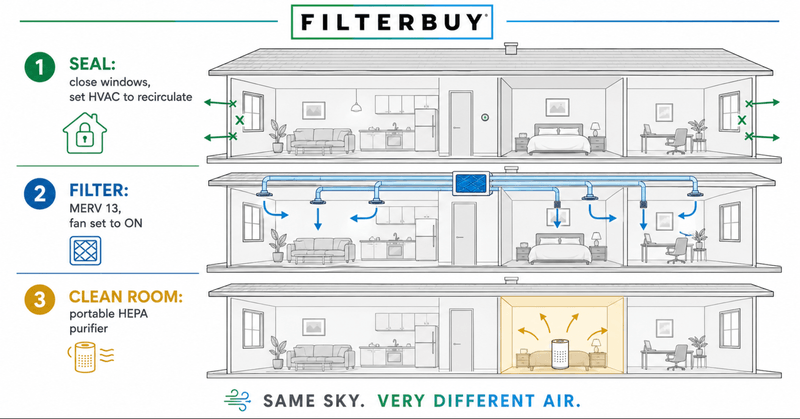
The EPA does not frame this as a choice. Its wildfire and indoor air quality guidance layers three measures, and the order reflects cost-effectiveness. The third step is detailed in EPA’s clean room setup guide.
Seal the house first, which costs nothing. Close the windows and doors, switch the fresh-air intake to recirculate, and skip candles, gas cooking, frying, and vacuuming, since each of those adds particles indoors.
Upgrade the HVAC filter to MERV 13 and set the thermostat fan to "On." EPA advises MERV 13 or the highest rating your fan and filter slot can safely take, and that second clause matters. If a technician says your blower cannot handle MERV 13, the answer is not to give up on filtration. A Filterbuy MERV 11 filter still captures smoke and smog at lower resistance, and a MERV 11 that runs beats a MERV 13 that trips a limit switch. Furnace filters also clean air only while the system runs, typically under 25% of the time on Auto, so the fan setting matters as much as the rating.
Add a portable HEPA purifier to one clean room. Choose the room where you sleep, size it by the wildfire CADR rule above, and avoid any unit that generates ozone. The California Air Resources Board lists certified ozone-safe devices.
The trigger for all three steps is the Air Quality Index. EPA marks 101 to 150 as unhealthy for sensitive groups and 151 to 200 as unhealthy for everyone, so treat 101 as the point to close the house up and switch the fan to "On," and 151 as the point to have the clean room running. Current readings are on AirNow.
Putting step 2 before step 3 is not a product preference; it is what the per-square-foot math supports.
During heavy smoke, filters load far faster than normal. We recommend monthly changes in wildfire zones, while the EPA rule is simpler still: replace it when it looks dirty. Our guide to the best MERV rating for wildfire smoke covers how to check a system before upgrading, and running an air purifier during wildfire season covers the portable side.
Filtration performance in this comparison comes from measured research rather than manufacturer claims, including ours. Three findings from U.S. federal research explain why layering an HVAC filter and a portable purifier beats either device on its own.
The U.S. Environmental Protection Agency reports that indoor PM2.5 sits at roughly 55% to 60% of outdoor levels during wildfire smoke events when doors and windows are closed and no air cleaner is running. That varies by house, from as low as 30% in tighter homes to as high as 100% in leaky ones, which makes sealing step one rather than the answer. Source: EPA, Strategies to Reduce Exposure Indoors (updated October 2025).
EPA reports a high-efficiency HVAC filter with the system fan running continuously may cut indoor PM2.5 by about 50%, while a typical low-efficiency filter running continuously achieves about 24% (Fisk and Chan, 2017). That roughly 26-point gap is what the filter upgrade itself buys you, for about $35 of media across a 90-day season. Source: EPA, Strategies to Reduce Exposure Indoors.
Researchers instrumented a 1928 Portland home during the September 2020 megafire, when outdoor PM2.5 held above 200 micrograms per cubic meter for days on end. With a MERV 13 filter in the central forced-air system alone, the mean indoor/outdoor PM2.5 ratio was 0.55. Adding a single portable HEPA cleaner dropped it to 0.22, the clearest published measure of what the second device is worth. Indoor levels still exceeded EPA’s 24-hour threshold with both running: layering cuts exposure without making heavy smoke harmless. Source: Antonopoulos, Dillon and Gall, Pollutants (2024), via the National Institutes of Health.
The cost-per-square-foot case for filtering first assumes a central HVAC system with a filter slot and a working blower. Where that assumption breaks down, buy the portable purifier first.
You have no ducted system. Mini-splits, window units, and baseboard heat leave nothing to filter through. Filterbuy does make mini split filters, but a mini split still will not move whole-house air.
You rent and cannot change equipment or run the fan continuously.
Your technician has flagged the system. An older blower with marginal static pressure may not tolerate MERV 13, and the time to judge is day 45 rather than day one, when a loaded filter shows what the system can really handle.
Someone in the home has asthma, COPD, or heart disease. Clinical risk justifies the higher per-square-foot spend on the room where that person sleeps.
No, and it does not need to be. MERV 13 removes at least 50% of 0.3–1.0 micron particles, but it does so across roughly 1,200 CFM in a 3-ton system, while a HEPA purifier removes 99.97% at 0.3 microns and serves a single room. Volume is doing the work in one case and efficiency in the other. See the full MERV 13 vs HEPA comparison for wildfire smoke.
No, because HEPA media creates far more airflow resistance than a residential blower can overcome. EPA’s Guide to Air Cleaners in the Home points to raising the MERV rating rather than putting HEPA in ductwork.
Neither MERV nor HEPA media captures gases or odor molecules. That takes activated carbon. One catalog detail worth knowing: the Filterbuy Odor Eliminator line adds carbon but rates below MERV 13 on particle capture, so a one-inch slot forces you to choose. During active smoke, take the particles: run MERV 13 and deal with odor using a carbon-stage portable unit, or wait until the event passes. Swapping to carbon mid-event trades away the protection you actually need.
Roughly $30 to $199 over a 90-day season at 18.41 cents per kWh, depending on whether the blower is an ECM or an older PSC motor. That makes it the largest line item in whole-home filtration, and it is still cheaper per square foot than running a purifier.
ACH (Air Changes per Hour): how many times per hour a device filters a volume equal to the room’s air.
AHAM (Association of Home Appliance Manufacturers): the U.S. body behind the CADR test standard, ANSI/AHAM AC-1.
CADR (Clean Air Delivery Rate): cubic feet per minute of clean air a purifier delivers, rated separately for smoke, dust, and pollen.
Bypass: air that slips around a filter instead of through it, lowering real-world performance below the MERV rating.
CFM (Cubic Feet per Minute): a measure of airflow volume.
ECM (Electronically Commutated Motor): a variable-speed blower motor that draws far less power at low speed than a PSC motor.
HEPA (High-Efficiency Particulate Air): a grade capturing at least 99.97% of particles at 0.3 microns, used in portable cleaners rather than ductwork.
MERV (Minimum Efficiency Reporting Value): an ASHRAE 52.2 rating, 1 to 16, of single-pass particle capture efficiency.
PM2.5: airborne particles 2.5 microns and smaller; the fraction of smoke most linked to health effects.
PSC (Permanent Split Capacitor) Motor: an older fixed-speed blower motor, inefficient at circulation speeds.
Check live smoke and AQI levels in your area, cross-check the EPA AirNow Fire and Smoke Map, then measure your filter slot and stock up before you need to. Timing pays: a single 20x25x1 MERV 13 runs $33.99, while the same filter works out to $11.66 each in a six-pack. Three bought one at a time during an event cost about $102, against $69.96 for a six-pack that covers two seasons. Shop MERV 13 filters for smoke protection, or set up auto-delivery so replacements arrive monthly through fire season.
Cost figures reflect Filterbuy 20x25x1 MERV 13 pricing at six-pack quantity ($11.66 each) as of August 2026; larger and thicker sizes vary. Electricity is calculated at 18.41 cents per kWh, the EIA Short-Term Energy Outlook forecast average U.S. summer residential rate for 2026. Blower draw of 75–125 watts (ECM) and 350–500 watts (PSC) in low-speed circulation comes from National Research Council Canada furnace motor testing. HVAC airflow assumes the standard 400 CFM per ton. Purifier figures assume a unit with a verified smoke CADR near 300 at about $300, drawing roughly 50 watts continuously, with about $70 in replacement media in year two. Your actual costs will differ with local rates, home size, system condition, and smoke severity.
U.S. EPA: Research on DIY Air Cleaners to Reduce Wildfire Smoke Indoors
NRC Canada: Impact of ECM Furnace Motors, CCHT Research Facility
Written by Michelle Wan, who writes about indoor air quality for Filterbuy. Reviewed for technical accuracy by David Clark, Licensed HVAC Technician.
