
Whole House & Attic Fans During Wildfire Smoke: AQI Thresholds for When to Run or Turn It Off
October 29, 2026
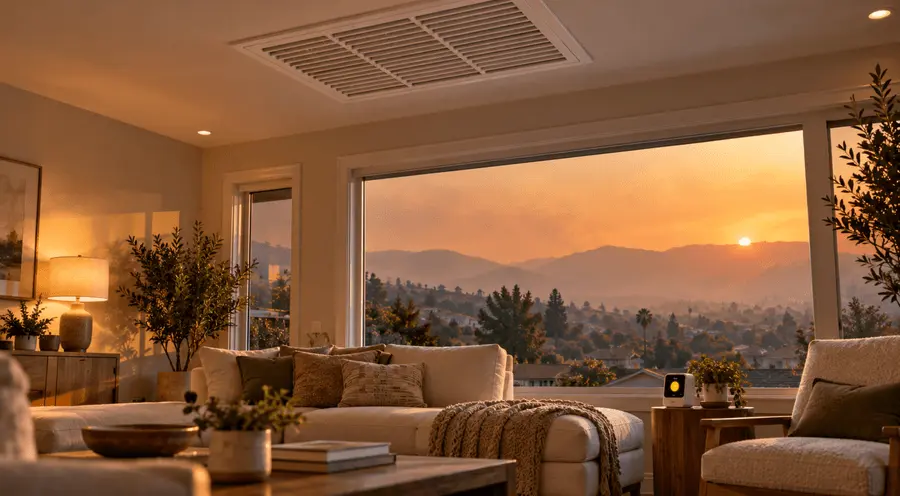
Should You Run a Whole House Fan During Wildfire Smoke?
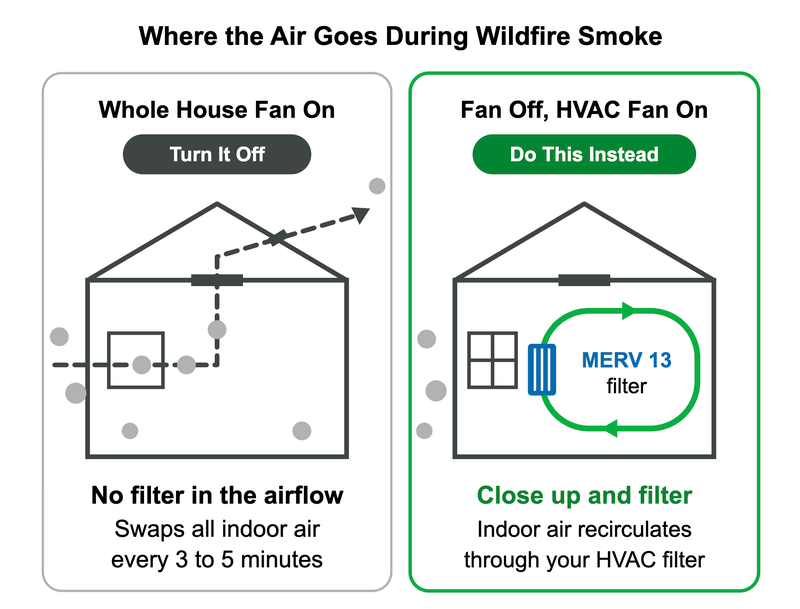
No. Turn your whole house fan off and keep it off while there’s smoke outside. A whole house fan has no filter, so it pulls outdoor air, smoke and all, through every room in minutes. The EPA advises against running whole-house fans when outdoor air pollution is high.
When the outdoor AQI is over 100, Filterbuy recommends:
Turn off the whole house fan and keep windows and doors shut.
With an HVAC system, switch to a MERV 13 filter if your HVAC manual allows that rating.
Set the thermostat fan to “on” instead of “auto.”
Run a HEPA air purifier in each room you use.
MERV 13 is the rating the EPA recommends during smoke events. Not sure which filter fits your system? Take the quick match quiz below.
Find Your Filter Match
Answer a few quick questions and we’ll match you to the right filter for your home.
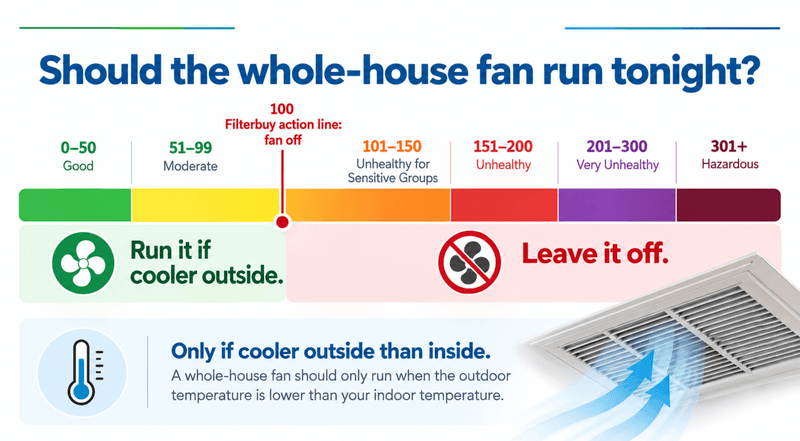
Run a whole-house fan only when the outdoor AQI for PM2.5, the fine particles in wildfire smoke, is below 100 at the hour you plan to run it, and the air outside is cooler than inside. At 100 and above, leave it off. In fire season, the cool evening hours that make night flush cooling work are often when smoke settles lowest.
TL;DR
Filterbuy's rule: run a whole-house fan in fire season only when the outdoor PM2.5 AQI is below 100 and the air outside is cooler. At 100, close up and switch to a MERV 13 with the thermostat fan on On, plus a portable HEPA air cleaner in each occupied room. Smoke often pools after dark, so check every night.
Key Takeaways
A whole-house fan has no filter. Sized to Energy Department guidance, it moves a full house-volume of outdoor air every 3 to 5 minutes.
Filterbuy's action line is an outdoor AQI of 100. That is one point below where the Unhealthy for Sensitive Groups category begins.
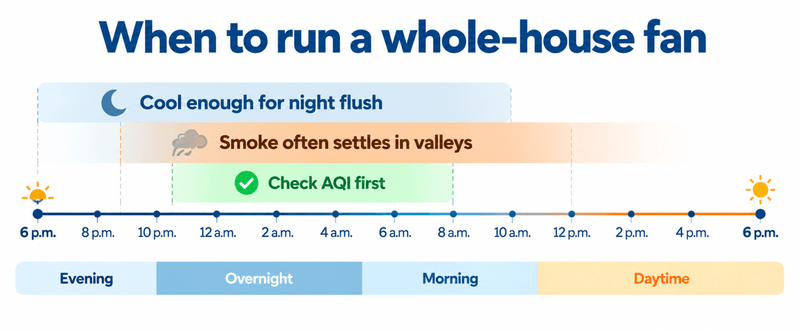
Night flush cooling and wildfire smoke compete for the same evening hours, because inversions often trap smoke in valleys after sunset.
AirNow's headline AQI draws on up to 12 hours of data, so check the nearest sensor's trend first.
What AQI Is Safe to Run a Whole-House Fan?
The short answer is below 100. Run a whole-house fan when the outdoor PM2.5 AQI is under 100 and cooler air is waiting outside. At 100, Filterbuy's action line, turn it off and switch the HVAC to a MERV 13 with the thermostat fan on On. Add a portable HEPA air cleaner in each occupied room. Table 1 uses the category names from EPA's May 2024 AQI update.
Table 1: Filterbuy's Whole-House Fan Decision by AQI
AQI 100 is Filterbuy's action line, one point below where Unhealthy for Sensitive Groups begins. Attic fans follow the same rule. Anyone at home with a heart or lung condition should follow their doctor's advice.
Why Night Flush Cooling and Wildfire Smoke Collide
Night flush cooling relies on cool evening air, and wildfire smoke tends to sink and pool during those same hours. A fan that was safe at 3 p.m. can fill the house with smoke by 9 p.m.
Why a filter company is telling you to leave the fan off. Filterbuy has built air filters in the U.S. since 2013 and shipped them to more than two million households, including in the counties with the most smoke days. Even so, no HVAC filter, ours included, touches the air a whole-house fan moves. That air comes in the windows and out the attic without passing the return, and the Energy Department's Building America Solution Center sizes these fans to move a full house-volume of it every 3 to 5 minutes.
Why smoke gets worse after sunset. On calm nights, cool air drains downhill into valleys and gets trapped near the ground under a temperature inversion, along with the smoke. Missoula Public Health's August 2026 smoke update warned that smoke would settle into valleys around 8 p.m. Filterbuy's explainer on why wildfire smoke is worst before sunrise covers the daily cycle.
What that means for your fan. During an August 2026 advisory, Travis Knudsen, executive director of Oregon's Lane Regional Air Protection Agency, told KEZI 9 News that afternoons "should be the better window" to air out a house, but urged checking the current AQI first.
When to Run a Whole-House Fan in Fire Season: Filterbuy's 4-Check Protocol
Filterbuy built this routine around the smoke-season mix-up we hear about most: two AQI numbers on two screens. Run these four checks before each night flush. If one fails, stay closed.
Check the live number where you live. Open EPA's AirNow Fire and Smoke Map and find the monitor or sensor closest to your home, not the citywide average. You need a PM2.5 AQI below 100.
Check which way it's moving. The headline number on AirNow draws on up to 12 hours of data and can lag fast-moving smoke. An 85 that keeps climbing still means a closed-window night.
Check the temperature difference. The fan only cools when the air outside is cooler.
Check the overnight outlook. If smoke is forecast after dark, flush early and close up before it arrives.
Checking the AQI is not the skill. Knowing which way it is moving, and how far behind your own air is lagging, is the skill.
Michelle Wan, Brand Manager and Air Quality Writer, Filterbuy
Filterbuy's stop rules. Shut the fan off if you smell smoke or the nearest sensor reaches 100. Keep sessions to 20 or 30 minutes with a recheck between runs; Table 2 shows why. If an indoor PM2.5 monitor climbs after you open up, the air outside is dirtier than yours.
How Long Should You Run It? What Each Minute Does to Your Indoor Air
We ran Energy Department fan sizing through the standard mixing formula ventilation engineers use. On a clean night, about 20 minutes replaces nearly all the air inside, so running until morning gains little. On a smoky night, the first 10 minutes undo most of the benefit of a closed house, pushing indoor air from about 55–60% of outdoor smoke levels past 90%.
Table 2: Share of Indoor Air Replaced by Outdoor Air
Filterbuy calculation from DOE fan sizing, assuming well-mixed air and open windows. Real homes vary.
Should You Run an Attic Fan During Wildfire Smoke?
No. An attic fan, or powered attic ventilator, should go off once the outdoor AQI reaches 100. It pulls replacement air from wherever it can, including your rooms, through recessed lights and the attic hatch.
In a smoke event, the attic fills with smoke, and the fan can draw it into the living space. It can also backdraft a natural-draft gas water heater or furnace and pull carbon monoxide indoors, a risk the Energy Department's Building America guide flags as well. If you have one, ask a licensed HVAC technician to check the setup.
How to Keep Your Home Cool and Clean When the Fan Stays Off
Start with the AirNow Fire and Smoke Map and your local air agency, including any advice to stay somewhere else. Once the outdoor AQI reaches 100, Filterbuy recommends four steps, in this order.
Put a MERV 13 in the HVAC. EPA recommends a filter rated MERV 13 or higher during smoke events, and notes that most furnaces and HVAC systems take one without equipment problems as long as it's replaced often. Order MERV 13 filters in the size printed on your current filter.
Set the thermostat fan to On. On Auto, it filters only while heating or cooling. Filterbuy's guide to HVAC settings during wildfire smoke also covers fresh-air intakes.
Run a portable HEPA air cleaner in each occupied room, bedrooms first. That's Filterbuy's recommendation. The MERV 13 treats the whole house, while each room unit treats its room harder than the central system can. For sizing, EPA's clean room guidance calls for a smoke CADR of at least two-thirds of the room's square footage, so a 300-square-foot bedroom needs a smoke CADR of about 200. Skip ionizers and ozone generators, since EPA advises against air cleaners that produce ozone.
Close the house up. Keep windows and doors shut, and cover the fan grille with rigid foam board, since older gravity louvers can leak. Don't add smoke of your own, either: no candles, frying, or smoking, and no vacuuming without a sealed unit.
No central HVAC? In an apartment or an older home without ducts, portable HEPA air cleaners are your main defense, not a backup. Run one in each room you use, and see our clean room setup guide.
No air conditioning? If the house gets dangerously hot, open up briefly at the least smoky hour, then close up and filter, or head to a cooling center.
When Can You Turn the Whole-House Fan Back On?
Turn the fan back on once the outdoor PM2.5 AQI has dropped below 100 and stayed there, and it is cooler outside. Sensitive households can wait for 50 or below, held for three hours, per Filterbuy's guide to when to open windows after wildfire smoke.
What Filterbuy sees on the manufacturing side. Every fire season, filters from smoke country come back visibly darker and heavier than those from clean-air months. That gray is a record of what got inside, and a whole-house fan run at the wrong hour adds to it fast. EPA's advice is to replace the filter when it looks dirty, dark brown or black, which can be well before the normal interval, and to keep spares on hand. Pleated filters capture particles, not gases, so for lingering smoke odor, look at Filterbuy's Odor Eliminator line.
Supporting Statistics
1. Wildland Fires Are the Largest Source of U.S. Fine Particle Pollution
52%. According to EPA's 2020 National Emissions Inventory, wildland fires produced about 52% of all PM2.5 emitted in the U.S.
Source: U.S. EPA, Wildland Fire Research: Reducing Exposures
2. Closing Up Works, Which Is Why Opening Up During Smoke Backfires
Nearly 3x. Across more than 1,400 California buildings, closing up on wildfire days halved the share of outdoor PM2.5 getting inside, yet indoor PM2.5 still nearly tripled.
Source: Liang et al., PNAS (2021), via NIH PubMed Central
3. Smoke and Heat Together Send More People to the Hospital
About 8%. A study of California hospitalizations from 2011 to 2020 attributed roughly 8% of respiratory hospitalizations to wildfire smoke and extreme heat together.
Source: Joint effects of wildfire smoke and extreme heat, GeoHealth (2025), via NIH PubMed Central
Frequently Asked Questions
Is It Safe to Run a Whole-House Fan During Wildfire Smoke?
Not at unhealthy smoke levels. EPA advises avoiding whole-house fans when outdoor air pollution is high. Filterbuy draws the line at an outdoor PM2.5 AQI of 100. Our whole-house fan shutdown guide covers the rest.
Does a Whole-House Fan Improve Indoor Air Quality?
Only when the air outside is cleaner than the air inside. On a smoky night, it swaps clean indoor air for smoke.
Glossary
Whole-house fan: An unfiltered ceiling fan that cools a home by pulling outdoor air in through open windows.
Night flush cooling: Cooling a home with evening or overnight outdoor air, then closing up.
Temperature inversion: A warm air layer that traps cooler, smoky air near the ground.
AQI (Air Quality Index): EPA's 0 to 500 scale for outdoor air pollution.
PM2.5: Particles 2.5 micrometers or smaller, the main hazard in wildfire smoke.
MERV (Minimum Efficiency Reporting Value): A 1 to 16 filter efficiency rating.
CADR (Clean Air Delivery Rate): An air purifier output rating, listed separately for smoke.
ACH (air changes per hour): House-volumes of air exchanged per hour.