
How Do You Set Up a Wildfire Smoke Clean Room the EPA Way
August 5, 2026
By Michelle Wan | Reviewed by David Clark, Licensed HVAC Technician | Updated August 6, 2026
Pick one room, seal it, and run an air cleaner sized to that room. EPA's method is five steps: choose a room with few windows and no fireplace, seal it, keep it cool, filter the air continuously, and avoid anything that makes particles indoors.
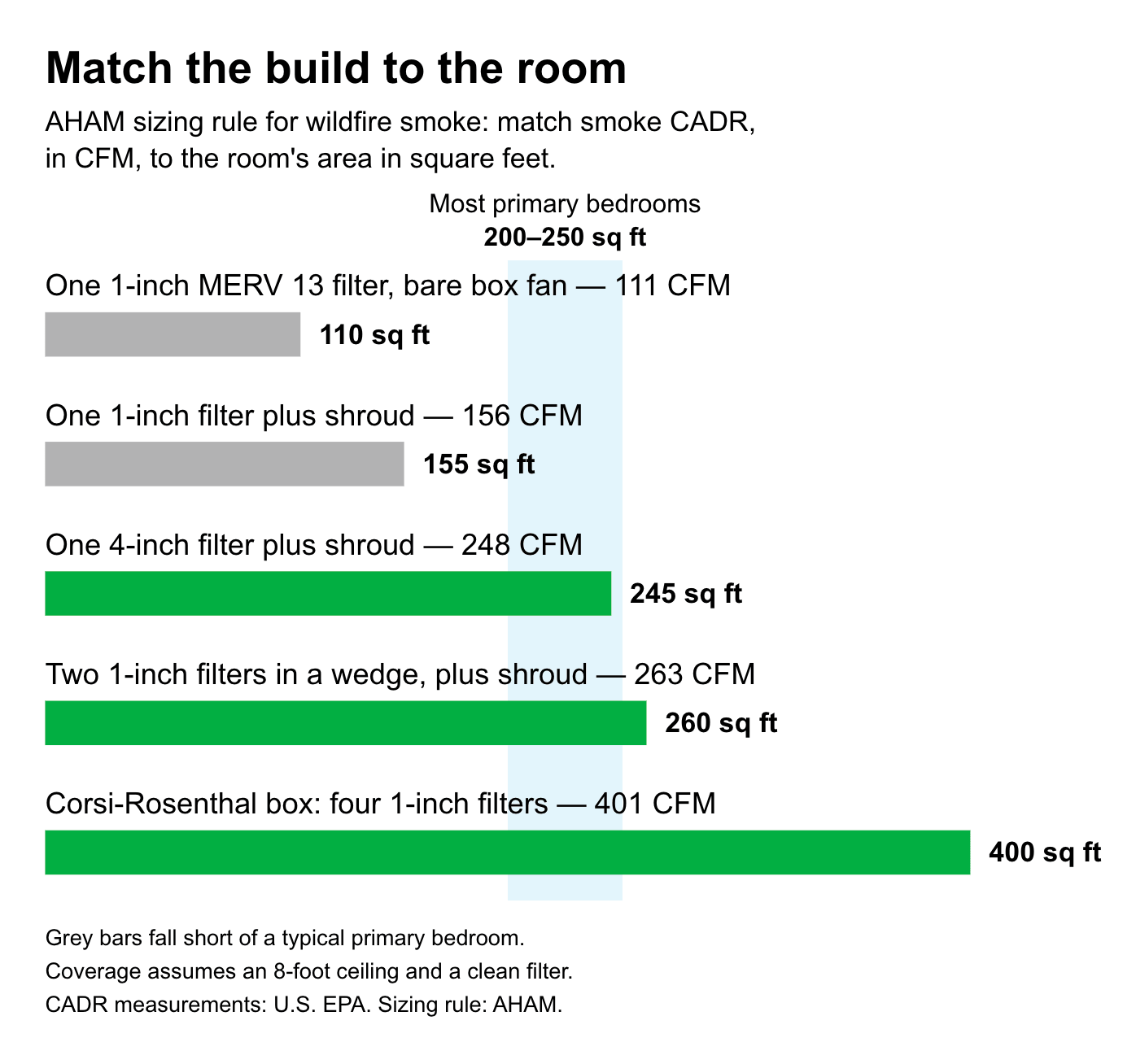
Sizing is the step most people get wrong. AHAM's rule for wildfire smoke is to match your air cleaner's smoke CADR, in CFM, to the room's area in square feet.
One 1-inch MERV 13 filter on a box fan — 111 CFM, about 110 sq ft
One 1-inch filter plus a cardboard shroud — 156 CFM, about 155 sq ft
One 4-inch filter plus a shroud — 248 CFM, about 245 sq ft
Two 1-inch filters in a wedge, plus a shroud — 263 CFM, about 260 sq ft
Corsi-Rosenthal box, four 1-inch filters plus a shroud — 401 CFM, about 400 sq ft
Measure your room first, then use the quiz below to match the filter to your setup.
Answer 3 quick questions and we'll match you to your filter.
Or shop air filters by size at Filterbuy.
TL;DR
A wildfire smoke clean room is one room in your home, kept sealed and continuously filtered, where smoke particles stay as low as possible during a smoke event. The EPA's method for creating a clean room has five steps: choose the room, seal it, keep it cool, filter the air with a properly sized air cleaner, and avoid anything that makes particles indoors. The step most people get wrong is sizing. The most widely shared DIY build covers about 110 square feet, which is smaller than most primary bedrooms.
Key Takeaways
A clean room is a filtration strategy, not a construction project. EPA recommends a room with few windows and doors and no fireplace - ideally a bedroom with an attached bathroom.
Match the air cleaner to the room. For wildfire smoke, AHAM recommends a smoke CADR equal to the room's area in square feet, stricter than the everyday two-thirds rule.
A box fan with one 1-inch MERV 13 filter delivers roughly 111 CFM, covering about 110 square feet - smaller than most primary bedrooms.
Smoke-loaded filters lose clean air delivery fast. Check filters daily during heavy smoke and replace them when they darken or smell like smoke.
What Is a Wildfire Smoke Clean Room?
A wildfire smoke clean room is a single room in a home set up to keep smoke and other fine particles as low as possible during a smoke event. It stays closed off from the rest of the house, runs a portable air cleaner or DIY box-fan filter continuously, and stays free of particle-generating activities like cooking, vacuuming, or burning candles. The U.S. Environmental Protection Agency also calls this a "cleaner air room."
The logic is simple. Filtering a whole house to a low particle level during heavy smoke is expensive and, for most homes, unrealistic. Concentrating filtration in the one room where your household sleeps buys a much larger exposure reduction for far less equipment.
Set the room up before fire season, not during one. EPA researchers put it plainly: air cleaners often sell out quickly during smoke events and carry a cost barrier. Its guidance on wildfires and indoor air quality recommends buying a portable air cleaner or high-efficiency filter as part of fire-season preparation.
One clarification, because the search terms blur together: a clean room is not a fire shelter or a safe room in the structural sense. It does nothing about flames, heat, or evacuation. It reduces what you breathe while you are inside, and only while it is safe to be inside.
Filterbuy has manufactured air filters in the United States since 2012, and the pattern we see every fire season is the same: the Air Quality Index climbs hours before anyone in the house notices smoke inside it. That lag is the entire argument for building the room in advance. By the time the air smells like a campfire, you are sourcing parts in the middle of the event instead of assembling them on a calm Saturday in May.
Step 1: Which Room Should You Choose?
Choose a room with as few windows and doors as possible and no fireplace. It needs to hold everyone in your household comfortably for long stretches. EPA suggests a bedroom with an attached bathroom, because you can keep the door closed for hours without leaving. Prioritize where children, older adults, or anyone with asthma or heart disease will sleep.
One factor most guides skip: square footage is a constraint, not a preference. A 400-square-foot great room and a 120-square-foot bedroom need very different amounts of clean air delivery. Pick the room you can actually filter - see Step 4.
Step 2: How Do You Seal a Clean Room Against Smoke?
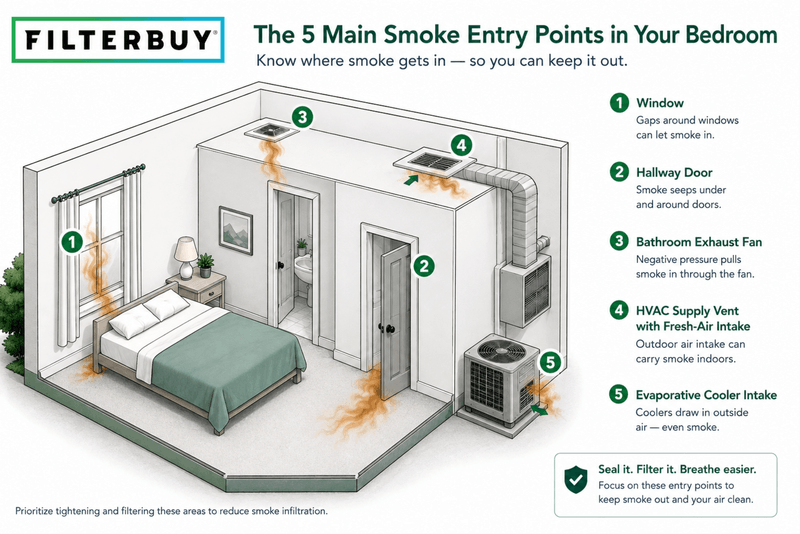
Sealing a clean room means closing every path smoke uses to get in, while never blocking your own way out. Close all windows and doors, and run any exhaust fan or range hood only in short bursts, since it pulls replacement air - and smoke - in from the rest of the house. Never seal an exit in a way that would slow an evacuation.
Work the leaks in order of size:
Ranked by how much air each path moves. Never seal an exit in a way that would slow an evacuation. Source: U.S. EPA, Create a Clean Room to Protect Indoor Air Quality During a Wildfire.
Step 3: How Do You Stay Cool Without Letting Smoke In?
Run fans, a window air conditioner, or central air conditioning - but close off any fresh air path first. If your HVAC system or window unit has a fresh air option, turn it off, close the intake, or switch to "recirculate." Use single-hose portable air conditioners sparingly; they draw replacement air from elsewhere in the house and bring smoke with it.
Heat and smoke together are more dangerous than either alone. If you can't stay cool with the windows closed, EPA advises seeking shelter elsewhere - with friends or family outside the smoke, at a public cleaner air shelter, or in a large air-conditioned commercial building.
Step 4: How Big a Room Can Your Air Cleaner Actually Handle?
Match your air cleaner's smoke CADR (Clean Air Delivery Rate, in CFM) to your room's square footage. The Association of Home Appliance Manufacturers guidance on air cleaners and wildfire smoke recommends a smoke CADR equal to the room's area in square feet during wildfire smoke events - stricter than the everyday two-thirds rule. EPA cites the same rule. Ratings assume an 8-foot ceiling.
EPA's Office of Research and Development measured the clean air delivery of the common DIY designs in a chamber study published in Indoor Air (Holder et al., 2022), and publishes the results in its research on DIY air cleaners for wildfire smoke. Applying the AHAM wildfire rule to those figures gives a practical ceiling on room size:
Room sizes assume an 8-foot ceiling and a clean filter. CADR measurements published by the U.S. EPA Office of Research and Development (Holder et al., Indoor Air, 2022), rounded from reported values of 111 ± 1, 156 ± 4, 248 ± 15, 263 ± 22, and 401 ± 31 CFM. Sizing rule from AHAM, which EPA cites: during wildfire smoke events, match smoke CADR to the room area in square feet.
To size a room that is not on the table, the math takes about 30 seconds:
Multiply the room's length by its width in feet. That number is your minimum smoke CADR in CFM.
If the ceiling is higher than 8 feet, multiply again by the ceiling height divided by 8. CADR ratings assume an 8-foot ceiling, so a 10-foot ceiling needs roughly 25% more clean air.
If no single unit reaches your number, run two in the room or move to a smaller room. Both work. A large room with an undersized air cleaner does not.
Here is why Filterbuy built that table. EPA publishes the CADR measurements. AHAM publishes the sizing rule. As far as we can find, nobody had run the two against each other and stated the result plainly, so we did the arithmetic ourselves. It is the least comfortable finding on this page: the most widely shared DIY design covers roughly 110 square feet, which is smaller than most primary bedrooms. The build people default to is frequently the wrong build for the room they put it in, and nothing in the standard instructions tells them so.
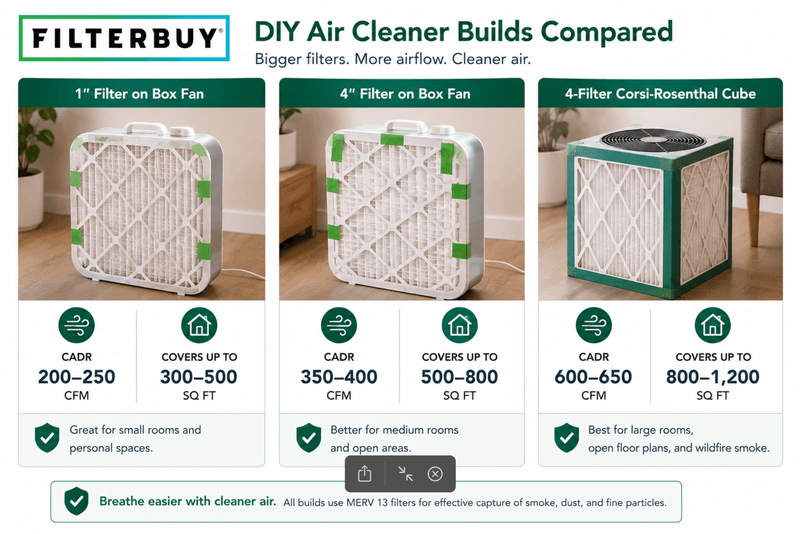
The basic one-filter box fan undersizes most primary bedrooms. Many primary bedrooms run 200 to 250 square feet, which needs a 4-inch filter build, a two-filter wedge, or two single-filter units running together. A child's room at 120 square feet is well covered by the basic design with a shroud. Note that every upgraded design in EPA's testing includes the shroud - a piece of cardboard over the fan's outer corners that costs nothing and raises clean air delivery by 40%. The basic design as originally published pairs a single filter with a bare fan, which is worth knowing if you built from that version. Full build instructions for all three designs are on EPA's DIY air cleaners page, and Filterbuy walks through the four-filter version in our guide to building a Corsi-Rosenthal box for wildfire smoke. Every design in that table takes a 20x20 filter: the single-filter and wedge builds use 20x20x1 MERV 13, and the 248 CFM build uses 20x20x4 MERV 13.
Two honest caveats. EPA recommends DIY air cleaners only when commercial portable air cleaners aren't available or affordable, since commercial units perform consistently while DIY results vary with the build. If you buy one, pick a model that does not produce ozone - the California Air Resources Board publishes a list of CARB-certified air cleaning devices. More on choosing and placing one in our guide to running an air purifier during wildfire season.
Worth balancing against that: in EPA field studies in actual homes, low-cost DIY air cleaners reduced smoke at least as effectively as a commercial unit with a similar CADR. The gap is consistency between builds, not ceiling performance. Second, the numbers above describe a clean filter. EPA found DIY air cleaners were almost completely ineffective with dirty filters - which is why the agency tells people to check the filter daily during a smoke event and replace it once it turns dark brown or grey, or starts to smell like smoke.
Step 5: What MERV Rating and Filter Size Do You Need?
Use MERV 13 - in the DIY air cleaner and in your central HVAC system, if it can accommodate one. MERV 13 is the rating EPA points to for wildfire smoke because smoke is dominated by PM2.5, the fine fraction lower-rated filters largely pass through. In a DIY build, filter rating is one of the strongest drivers of how much clean air the unit delivers. For a side-by-side of the two filtration approaches, see our comparison of MERV 13 vs HEPA for wildfire smoke.
For a central system, install MERV 13 or higher and set the thermostat fan to "On" instead of "Auto," so air keeps cycling through the media rather than only during heating and cooling calls. EPA notes you may need a professional HVAC technician to confirm a MERV 13 or higher filter is compatible with your system. If it isn't, use the highest rating your system accepts.
Two sizing details matter more than people expect:
Match the filter to the fan's face. A 20x20 filter on a 20-inch box fan is the standard pairing. Align the airflow arrows with the direction the fan blows, seal the edges with tape or bungee cords, and cover the outer corners so air cannot slip around the media.
Nominal sizes aren't actual sizes. This is a manufacturer frustration before it is a homeowner one. Nominal sizing is an industry convention, and most brands print only the rounded number on the box. The Filterbuy 20x20x1 MERV 13 filter measures 19.50 by 19.50 by 0.75 inches, and we publish that actual dimension beside the nominal one on every product page. In a four-filter cube, that rounding is the difference between a sealed box and a leaky one. In an HVAC slot, it is the difference between filtering the air and letting it slip past. Our air filter sizes chart shows how to measure yours.
Filterbuy has manufactured filters in the U.S. since 2012, with roots in a family machinery business dating to the 1950s. We cut custom-size air filters to the nearest eighth of an inch for odd slots, so a poor fit is not something you have to live with. Check the size printed on your current filter frame before ordering, and see our guide to the best MERV filter for wildfire smoke if you are unsure what your system can take.
Step 6: What Should You Avoid Doing Inside the Clean Room?
Avoid anything that adds particles to the air you just filtered. EPA's list: smoking and vaping; gas, propane, or wood-burning stoves; aerosol sprays including cleaners and air fresheners; frying or broiling food; and burning candles or incense. Don't vacuum unless it has a HEPA filter - damp-dust or mop instead, so settled particles don't get stirred back into the air.
Skip exercise while you're in the room, since heavier breathing means more exposure to whatever particles do get in. When air quality improves, even briefly, air the room out by opening windows or the HVAC fresh-air intake and running the exhaust fans.
Why Clean Rooms Get Abandoned, and How to Keep Yours Running
Clean rooms usually fail for human reasons, not technical ones. EPA field studies in homes found that people stopped running their air cleaners because of noise, because replacement filters were expensive or unavailable, and because they simply forgot. Building the room takes an afternoon. Living in it through a week of smoke is where people give up.
The Noise Is Worse Than You Expect
In EPA-supported studies in homes, almost every participant was frustrated by the noise, and actual use came in lower than researchers had asked for.
EPA tells public health agencies the same thing: quiet, unobtrusive designs are the ones that actually get used.
This matters more here than anywhere else, because the clean room is usually the bedroom. You are sleeping next to the thing.
What helps: more filter area moves the same clean air at a lower fan speed. A four-filter cube on medium can outperform a single filter on high, and you can sleep through it.
Replacement Filters Decide Whether It Keeps Working
Households in the same studies named the cost and availability of replacement filters as a reason they stopped running air cleaners they already owned.
EPA lists filter replacement support as one of two things that determine whether air cleaners work in practice.
During heavy smoke, filters can need changing every few days.
What helps: buy the replacements with the first set, not after. A second set of filters is cheaper than a clean room you stop using.
Filterbuy auto-delivery was built for the second half of this problem. It keeps the HVAC filter arriving on schedule year-round, though for a smoke event you still want spare box-fan filters already in the closet.
Forgetting Is a Real Failure Mode
Forgetting about the air cleaner appears in the research alongside noise and cost as a reason units sat unused during smoke events.
Smoke arrives gradually. There is rarely a moment that obviously says start now.
What helps: set an AQI alert on your phone so the room gets activated by a notification rather than by finally noticing the smell. The Filterbuy live AQI map is one way to check conditions before they are obvious indoors.
Source for this section: U.S. EPA, Wildland Fire Research: Reducing Exposures - https://www.epa.gov/air-research/wildland-fire-research-reducing-exposures, and self-reported findings from the Wildfire ASPIRE pilot studies.
When a Clean Room Isn't Enough
A clean room reduces smoke exposure. It doesn't make a home smoke-proof, and it is not a substitute for evacuating. Conditions change fast, so follow local news, the AirNow Fire and Smoke Map, or your state air quality website, and be ready to leave if authorities say to. If you are not sure how to read the numbers, start with our explainer on wildfire smoke and the Air Quality Index.
Seek shelter elsewhere if you can't stay cool, the power goes out, or too much smoke still gets into the room. If anyone in your household has asthma, heart disease, or a lung condition, ask your health care provider what to do during smoke events before one arrives.
Essential Resources for Setting Up a Wildfire Smoke Clean Room
We would rather point you to the best source than pretend we are the only one. These seven cover the questions this guide does not fully settle on its own: whether smoke is bad enough to seal up today, how to build and size your air cleaner, which purifier is actually safe to buy, and what to do when the room gets too hot. They are in the order you will need them.
1. Check Whether Smoke Is Bad Enough to Seal Up Today
AirNow Fire and Smoke Map, EPA and U.S. Forest Service - https://fire.airnow.gov/
Before you tape anything to a box fan, check the map. It pulls government monitors and low-cost sensors into one PM2.5 view of your area, with Forest Service smoke outlooks so you can tell whether this is a one-day thing or a week-long one.
2. Get the Clean Room Method Straight from EPA
Create a Clean Room to Protect Indoor Air Quality During a Wildfire, U.S. EPA - https://www.epa.gov/emergencies-iaq/create-clean-room-protect-indoor-air-quality-during-wildfire
This is the page everything else is built on, ours included. There is a short video if you would rather watch than read, plus a printable infographic. The page is published in nine languages. If anything you read anywhere contradicts it, trust EPA.
3. Print a Clean Room Checklist Before You Need It
How to Create a Clean Room at Home, AirNow Wildfire Guide factsheet - https://www.airnow.gov/publications/wildfire-guide-factsheets/how-to-create-a-clean-room-at-home/
Here is the part nobody mentions: smoke events and power outages tend to travel together. This one-pager, in English and Spanish, is the version that still works when the Wi-Fi does not. Put it on the fridge in May, not August.
4. Build Your Air Cleaner Right, Shroud and All
DIY Air Cleaners, U.S. EPA - https://www.epa.gov/emergencies-iaq/diy-air-cleaners
Full instructions for all three EPA-tested designs, plus how to cut a cardboard shroud using nothing but a pencil and a piece of string. That shroud is free and adds 40% more clean air, and it is missing from the basic build most people have seen.
5. Check Our Math on the Sizing Table
Research on DIY Air Cleaners to Reduce Wildfire Smoke Indoors, EPA Office of Research and Development - https://www.epa.gov/air-research/research-diy-air-cleaners-reduce-wildfire-smoke-indoors
We would rather you verify than take our word for it. EPA publishes its full CADR results here, along with the Underwriters Laboratories testing that ran box fans with clean, dusty, and smoke-clogged filters to see whether they would overheat. They did not.
6. Do Not Put an Ozone Generator in a Sealed Bedroom
List of CARB-Certified Air Cleaning Devices, California Air Resources Board - https://ww2.arb.ca.gov/list-carb-certified-air-cleaning-devices
Some units sold as purifiers produce ozone, which is the last thing you want in a room you just sealed shut. CARB certification means a device stays under 0.050 parts per million, so check the list before you buy. Fair warning: that certification covers ozone and electrical safety, not how well the thing actually filters.
7. Have a Plan for When the Clean Room Gets Too Hot
Protect Yourself from Smoke and Extreme Heat, AirNow Wildfire Guide factsheet - https://www.airnow.gov/publications/wildfire-guide-factsheets/protect-yourself-from-smoke-and-extreme-heat/
A sealed room with no air conditioning gets miserable fast, and losing your ability to stay cool is the one condition under which EPA tells you to leave rather than adjust. AirNow covers what to do at that point, and notes that smoke and extreme heat together may be considerably harder on your body than either one alone.
Supporting Statistics
Three numbers carry the argument above. Each one comes from a federal agency or a national health nonprofit.
1. 145 Million People Had at Least One Red-or-Worse Particle Pollution Day
Up from 133.4 million in the previous year of reporting.
Over the same period, the number of people in F-grade counties actually fell. Grades improved. Severe spike days spread.
Red is the AQI level at which federal guidance says a clean room is worth setting up.
Source: American Lung Association, State of the Air 2026 - https://www.lung.org/research/sota/key-findings/short-term-particle-pollution
2. Closed Windows Still Leave You Breathing 55% to 60% of the Smoke Outside
That is the typical indoor PM2.5 level during a smoke event with no air cleaner running.
The range runs from 30% in a newer, tighter home to 100% in a leaky one.
Sealing is step one. Filtration closes the rest of the gap.
Source: U.S. EPA, Strategies to Reduce Exposure Indoors - https://www.epa.gov/wildfire-smoke-course/strategies-reduce-exposure-indoors
3. The Same DIY Air Cleaner Removed 99% of Smoke in a Small Room and 56% in a Large One
Smaller room: about 99% of PM2.5 gone within 60 minutes.
Larger room: about 56% gone after 90 minutes.
Measured in a real home during a wildfire smoke event, not a lab chamber.
Same unit. Different room. Sizing matters more than which design you pick.
Source: May et al. 2021, cited by U.S. EPA - https://www.epa.gov/wildfire-smoke-course/strategies-reduce-exposure-indoors
Next Steps
Set your clean room up before smoke arrives. Check conditions on the Filterbuy live AQI map, measure the room you would use, and stock filters at the size printed on your frame.
Shop MERV 13 filters for smoke protection
Glossary
Clean room (cleaner air room): One room in a home, kept closed and continuously filtered, where smoke and fine particle levels stay as low as possible during a wildfire smoke event.
PM2.5: Particulate matter 2.5 micrometers or smaller - the dominant health-relevant component of wildfire smoke, small enough to reach deep into the lungs.
MERV: Minimum Efficiency Reporting Value, the 1-16 scale rating how effectively an air filter captures particles. MERV 13 is EPA's recommendation for wildfire smoke.
Smoke CADR: The tobacco-smoke Clean Air Delivery Rate on an air cleaner's label, in cubic feet per minute. It is the benchmark for fine particles like PM2.5, and the number to size a clean room against.
AHAM: The Association of Home Appliance Manufacturers, which sets the testing standard behind CADR ratings.
Corsi-Rosenthal box: A DIY air cleaner using four filters taped into a cube with a box fan on top, the highest-performing design in EPA's chamber testing.
Shroud: A cardboard cover over the outer corners of a box fan's face that forces air through the center, raising clean air delivery by roughly 40%.
Frequently Asked Questions
Can I use my whole house as a clean room instead?
Not effectively during heavy smoke. A central HVAC system with a MERV 13 filter and the fan set to "On" is your whole-home baseline, but one sealed room with a properly sized air cleaner reaches much lower particle levels. Most homes benefit from both.
Does a clean room remove smoke smell?
Only partly. MERV 13 filters and HEPA air cleaners capture particles, not gases, and CADR ratings apply to particles only. Odor comes largely from gases, which need activated carbon media.
How often should I change filters during a smoke event?
Check daily. EPA advises replacing filters when they look dirty or start releasing smoke odors, which in heavy smoke can mean every few weeks or even every few days. Buy spares before fire season rather than during it; Filterbuy ships over 600 standard sizes and cuts custom sizes to the nearest eighth of an inch.
What does a clean room cost to set up?
It depends entirely on which route you take, and EPA frames the tradeoff clearly. A single-filter box fan build costs the least to assemble. Multi-filter designs cost more up front but are more cost-effective to operate per unit of clean air, and EPA found that designs with a shroud and multiple filters removed particles more effectively than higher-priced commercial units. Whichever you choose, budget for replacement filters separately, since those are the recurring cost that decides whether the room keeps working.
What if I rent, or my building has a shared HVAC system?
Then the portable or DIY air cleaner is your whole strategy rather than half of it. You likely cannot change the filter in a shared system or reach a fresh-air intake, so put the effort into sealing one room well and sizing the air cleaner to it. Everything in Steps 1, 2, 4, and 6 works in a rental. Only the central HVAC guidance in Step 5 needs a landlord.
Is a box fan safe to run overnight with a filter on it?
Use a fan from 2012 or newer with a UL or ETL safety marking. EPA and Underwriters Laboratories tested five box fan models with clean, dust-loaded, and smoke-loaded filters, including an extreme scenario with both sides blocked for seven hours, and none posed an observable fire hazard. Don't use an extension cord or a damaged fan, and make sure smoke detectors throughout the home work. Older fans shouldn't run unattended or while you sleep.
About the author and reviewer
Michelle Wan, Author
Brand Manager and Air Quality Writer at Filterbuy, where she translates MERV ratings, filtration, and HVAC efficiency into plain-English advice and fronts much of the brand's educational video content (B.A., University of California, Santa Cruz). She works directly with Filterbuy's manufacturing teams, writing from how filters are built and used rather than from spec sheets. Learn more on her author page.
David Clark, Reviewer, Licensed HVAC Technician
This article was technically reviewed by David Clark, a Licensed HVAC Technician, who verified this guide's claims on MERV ratings, airflow, filter compatibility, and box fan safety.
Published by Filterbuy, an American air-filtration company that has manufactured HVAC filters in the U.S. for over a decade and shipped them to millions of households.
This page is general information about air filtration and smoke exposure. For questions about what your HVAC system can safely handle, talk to a licensed HVAC technician. For questions about your own health or a specific condition, talk to a qualified healthcare professional.