
Wildfire Smoke Protection for Homes With No Central Air: DIY Filtration & a Single Clean Room That Actually Works
November 16, 2026
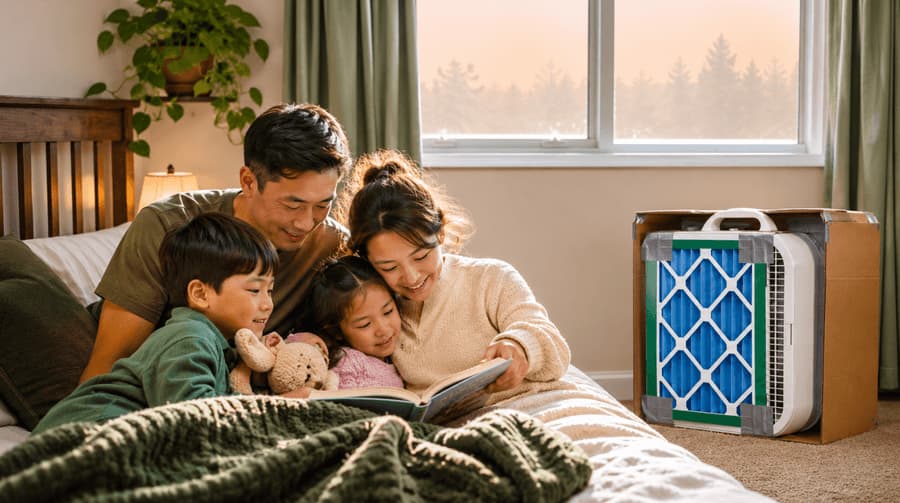
How to Protect Your Home From Wildfire Smoke With No Central Air
Pick one room, close it up, and keep a filter running there: a certified portable air cleaner, or a box fan fitted with MERV 13 filters if a commercial unit isn’t available or affordable. Without central air, there’s no whole-house filter, so smoke that slips in just hangs in the air. Start with the bedroom of whoever is most at risk, since sleep is the longest stretch anyone spends in one room.
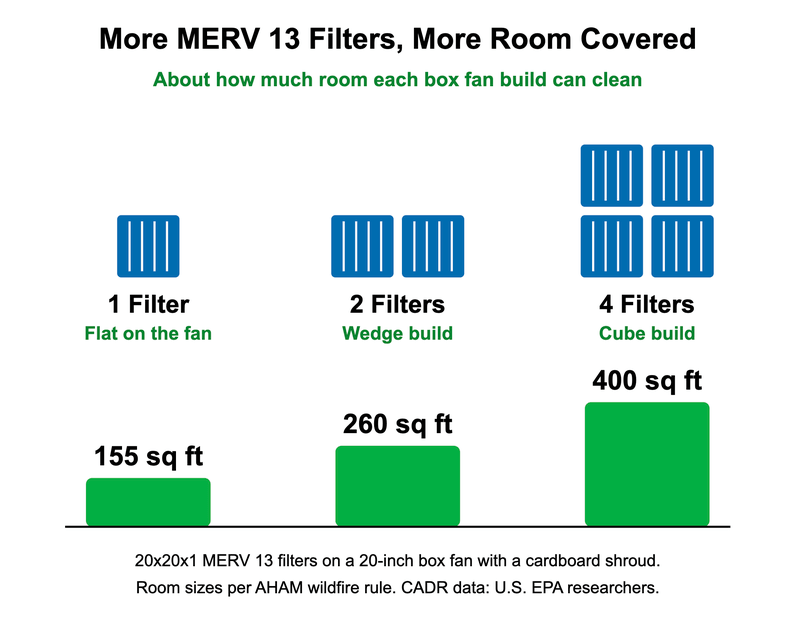
Going DIY? Each 20x20x1 MERV 13 filter you add to one box fan covers more room:
1 filter, flat on the fan: about 155 sq ft.
2-filter wedge: about 260 sq ft.
4-filter cube (Corsi-Rosenthal box): about 400 sq ft.
The cube costs about $11 more in Filterbuy filters than the single-filter build and moves about 2.6 times the clean air.
Have a Mini-Split? Find Your Filter Match
A mini-split’s mesh screen doesn’t capture PM2.5, the fine particles in smoke. Answer a few quick questions and we’ll match you to the right filter setup.
TL;DR
A home without central air has no whole-house filter, so wildfire smoke that leaks in hangs in the air. The U.S. Environmental Protection Agency (EPA) recommends one closed room filtered by a portable air cleaner, or by a DIY box fan filter when a commercial unit isn't available or affordable. If you go DIY, a four-filter Corsi-Rosenthal box costs roughly $11 more in Filterbuy filters than a single-filter fan for about 2.6 times the clean air.
Key Takeaways
Closing the windows only gets you partway. With no air cleaner running, indoor smoke holds at 55% to 60% of outdoor levels.
Make a portable air cleaner your main defense. A certified HEPA unit leads; a MERV 13 box fan is the stopgap.
Act at AQI 100. That's Filterbuy's line for running an air cleaner in every occupied room, bedrooms first.
Why Does Wildfire Smoke Still Get Inside a Home With No Central Air?
Smoke slips in through gaps even with everything shut. EPA's wildfire smoke course puts indoor PM2.5 (the fine particles in smoke) at 55% to 60% of outdoor levels during smoke events with no air cleaner running.
Which Room Should You Set Up First?
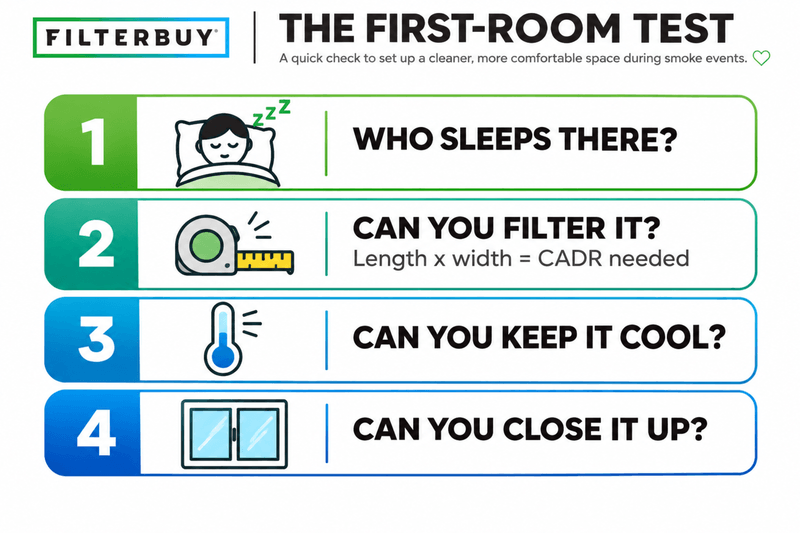
If you can cover only one room, start with the bedroom of whoever is most at risk, because sleep is the longest stretch anyone spends in one room. Filterbuy's First-Room Test comes down to four questions:
Who sleeps there? EPA notes that children, older adults, and people with heart disease or breathing problems are at greater risk from smoke, so their room wins any tie.
Can you filter it? Length times width, in feet, is the smoke CADR the room needs under the Association of Home Appliance Manufacturers (AHAM) wildfire rule. A 12 x 14 bedroom needs 168.
Can you keep it cool with the windows shut? A shaded room beats a sunny one.
Can you close it up? Fewer windows make sealing easier; skip rooms with a fireplace or swamp cooler vent.
Filterbuy's guide to setting up a wildfire smoke clean room covers sealing.
What Can You Do on Each Budget?
Start with a certified air cleaner if you can. EPA's clean-room guidance calls for a smoke CADR of at least two-thirds of the room's square footage, so a 300 sq ft bedroom needs roughly 200. AHAM's stricter wildfire rule, used in the table below, matches the full square footage. EPA advises against ozone-producing models, so check the California Air Resources Board's certified list. Filterbuy's portable air purifier vs. HVAC filter comparison covers cost.
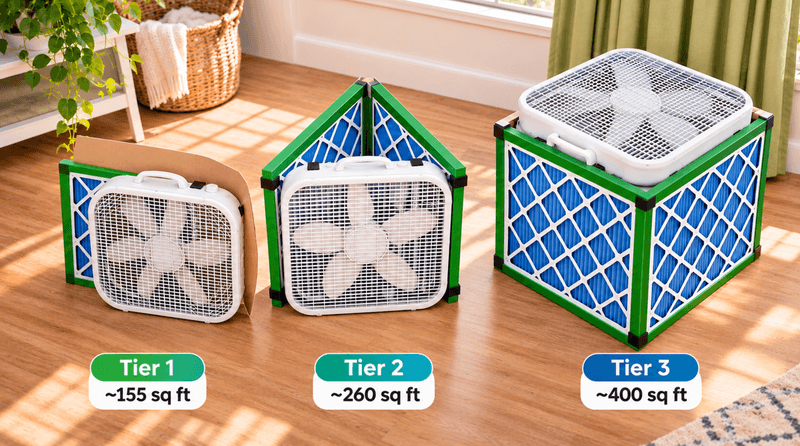
No commercial unit available or affordable? EPA's tested DIY builds make a reasonable stopgap:
Builds use 20x20x1 MERV 13 filters plus a UL- or ETL-listed 20-inch box fan (about $24–$35, not included). Smoke CADR measured by U.S. EPA researchers (Holder et al., Indoor Air, 2022); room sizes follow AHAM's wildfire rule (8-foot ceiling, clean filter). Filterbuy prices as of November 12, 2026.
Filterbuy priced every build from its catalog. Per 100 square feet cleaned, filters cost about $19 for Tier 1, $13 for Tier 2, and $10 for Tier 3. The cube also beats two single-filter fans on airflow (401 vs. roughly 312 CFM) and on cost once you count the second fan.
A free cardboard shroud over the fan's corners lifted one filter from 111 to 156 CFM in EPA's DIY research. Build steps are in Filterbuy's Corsi-Rosenthal box guide.
How Do You Stay Cool Without Letting Smoke In?
Keep cooling on recirculate, as EPA's clean room guidance advises.
Source: U.S. EPA, Create a Clean Room to Protect Indoor Air Quality During a Wildfire.
Filterbuy has guides to window AC units, portable ACs, swamp cooler retrofits, and mini-splits during wildfire smoke.
Why the links moved: the CMS sanitizer doesn't allow link tags inside tables, so the guide links for this table live in the sentence above as regular body links.
What Should You Do When the AQI Reaches 100?
At an AQI of 100, Filterbuy's action line, run a portable HEPA air cleaner in every occupied room, bedrooms first, and close the house up. On the official AQI scale, 100 is still the top of Moderate; Unhealthy for Sensitive Groups starts at 101. Check the AirNow Fire and Smoke Map and your local air agency first. Then:
Run a portable HEPA air cleaner in each occupied room, bedrooms first, with a MERV 13 box fan as the stopgap.
If part of your home has ductwork, use MERV 13 there and set the thermostat fan to On so it filters continuously.
Close the house up. Shut windows and doors, and skip candles, frying, smoking, and vacuuming without a sealed HEPA unit.
If the room gets too hot, EPA advises going to a public cleaner air shelter.
Above 200, local guidance comes first and the clean room matters most. Filtration is one layer of the plan.
How Do You Run a Box Fan Filter Safely Through a Smoke Event?
Use a 2012-or-newer box fan with a UL or ETL safety marking, plugged straight into the wall. EPA's safety tips also say never to run pre-2012 fans unattended or while you sleep, and to keep smoke detectors working.
Run it on high while anyone is in the room.
Check the filter during smoke. Replace it once it turns dark brown or gray or smells smoky, which can be well before the usual interval, and keep spares on hand.
Inside the Filterbuy factory, we make 20x20x1 filters slightly undersized (19.5 x 19.5 inches) to slide into HVAC slots. On a box fan, tape every edge.
Supporting Statistics
1. Indoor smoke nearly tripled across 1,400+ California buildings.
UC Berkeley researchers found the share of outdoor smoke reaching indoors fell from 0.4 to 0.2 on wildfire days, yet mean indoor PM2.5 nearly tripled.
Source: Liang et al., PNAS (2021), via the National Library of Medicine
2. Filtering a swamp cooler cut its smoke penalty by about three-quarters.
Across 48 San Joaquin Valley homes, running a swamp cooler raised outdoor-particle infiltration by 36–42% with only a portable air cleaner, but by 10–11% with DIY intake filters (mostly MERV 13).
Source: Wang et al., ACS ES&T Air (2026), via UC eScholarship
3. California has certified air cleaners for ozone since 2010.
Every portable air cleaner sold in California must be certified, and electronic models must emit no more than 50 ppb of ozone.
Source: California Air Resources Board
Frequently Asked Questions
Should I Use MERV 13 or Hepa on a Box Fan?
Use MERV 13, the rating EPA tested. Filterbuy's MERV 13 vs. HEPA guide explains where HEPA fits.
Can I Open Windows at Night When It Cools Off?
Filterbuy's analysis of San Joaquin Valley smoke found smoke there often peaks between about 2 and 9 a.m., so cool night air can be the smokiest of the day. Open up only once the AirNow Fire and Smoke Map shows improvement.
I check smoke maps across Filterbuy’s coverage areas most mornings during fire season. Stockton is the one where the overnight reading and the afternoon reading tell completely different stories, and almost nobody is looking at the first one.
Michelle Wan, Brand Manager and Air Quality Writer, Filterbuy
Glossary
Clean room: One closed room, continuously filtered to keep smoke particles as low as possible.
PM2.5: Particulate matter 2.5 micrometers or smaller, the main pollutant of concern in wildfire smoke.
MERV: Minimum Efficiency Reporting Value, a 1-to-16 rating of how well an air filter captures particles.
Smoke CADR: Clean Air Delivery Rate for smoke particles, in cubic feet per minute (CFM).
Next Steps
Get ready before smoke season, which runs May through October in much of the West. Stock filters and spares early, and watch the Filterbuy live AQI map.
CTA button: Shop MERV 13 filters in your size
About the Author and Reviewer
Michelle Wan, Author. Brand Manager and Air Quality Writer at Filterbuy, working with its manufacturing teams to turn filtration into plain-English advice. Author page.
David Clark, Reviewer, Licensed HVAC Technician. Verified this guide's claims on MERV ratings, airflow, cooling settings, and fan safety.
General information only. If someone in your home has asthma, heart disease, or lung disease, ask a health care provider about smoke events. Evacuate when officials say to.