September 2, 2026
By Michelle Wan · Reviewed by David Clark, Licensed HVAC Technician · Published September 3, 2026
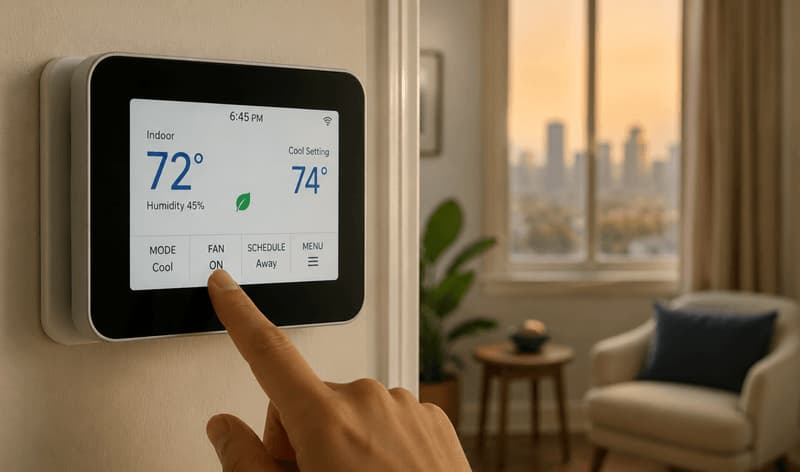
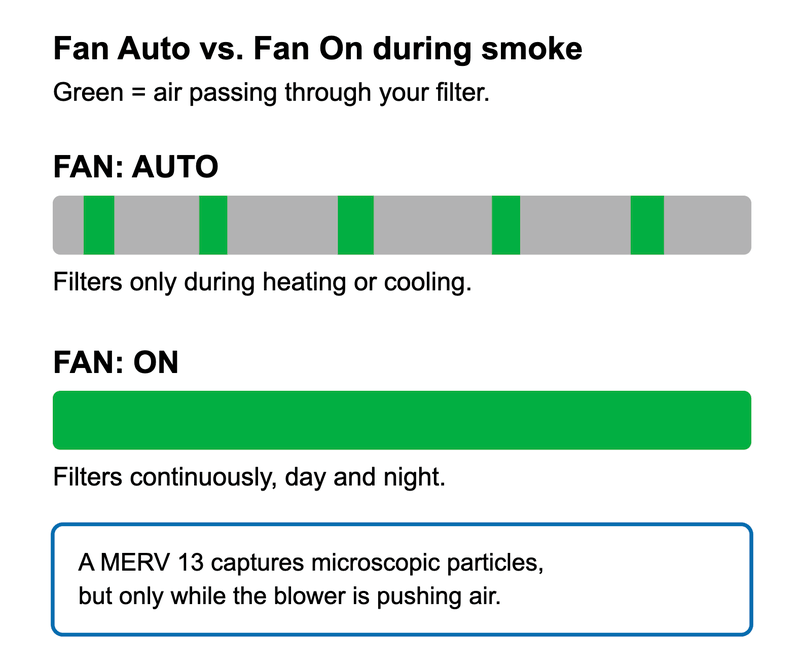
Set your thermostat fan to On instead of Auto, then close any fresh-air intake your system has. There is no recirculate button on a house thermostat, because a central HVAC system already recirculates indoor air by default. Fan On keeps air cycling through the filter around the clock. Fan Auto only filters during the minutes your system is actively heating or cooling.
Fan On — filters continuously. Use this during a smoke event.
Fan Auto — filters only during heating and cooling cycles.
Circulate — runs the fan a set number of minutes per hour. Better than Auto, not as good as On.
Fresh-air intake — close the damper if you have one. Most U.S. homes do not.
During smoky periods the EPA points to a MERV 13 filter, or the highest rating your system accepts.
Answer 3 quick questions and we will match you to the right filter for your system.
During wildfire smoke, set your thermostat fan to On instead of Auto, then close any fresh-air intake your system happens to have. Fan On keeps indoor air cycling through the filter around the clock, while Auto only filters during the minutes your system is actively heating or cooling. And if you are hunting for a recirculate button, stop looking. Your house is not your car, and a central HVAC system already recirculates by default.
Filterbuy is a family-owned air filter manufacturer in Talladega, Alabama. We have built pleated HVAC filters in the United States since 2013 and shipped them to more than two million households, which gives us an odd vantage point on smoke season: order data. Every year it shows the same two things. Homeowners reach for the right filter several days after they needed it, and the settings surrounding that filter never get touched at all. This guide covers both problems, starting with the one that costs nothing to fix. For the wider picture, see the Filterbuy guide to wildfire smoke and indoor air quality.
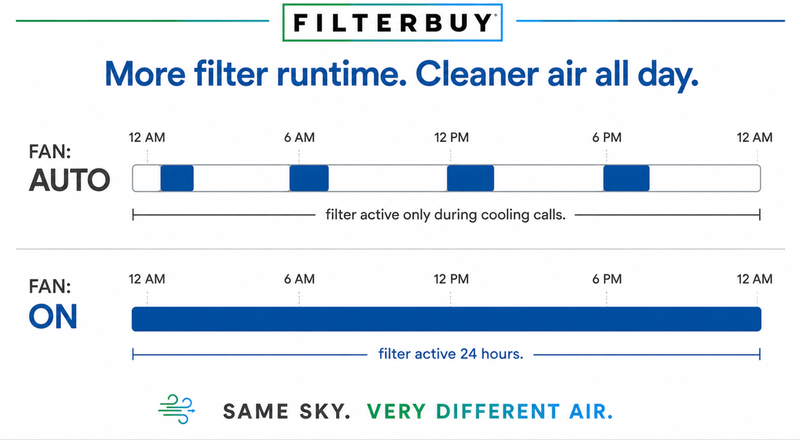
Fan "On" filters continuously. Fan "Auto" filters only during heating and cooling cycles, which on a mild smoky day can be under a quarter of the hours in a day.
Most U.S. homes have no fresh-air intake at all. Central forced-air systems recirculate indoor air by design, so "set it to recirculate" is a real instruction only for the minority of systems with an outdoor-air duct, an ERV or HRV, or a window unit with a vent lever.
The EPA recommends a MERV 13 filter or the highest rating your system accepts during smoky periods, and notes most systems accommodate MERV 13 without problems when the filter is changed often.
Continuous fan has three real trade-offs: leaky return ducts pull unfiltered attic or crawlspace air in, a wet cooling coil re-evaporates moisture back into the house, and an older PSC blower costs meaningfully more to run than a variable-speed ECM.
Smoke takes three paths into a house, and thermostat settings only close two. The filter path and the intake path respond to settings. The envelope path, meaning gaps around windows, doors, recessed lights, and leaky return ducts, does not.
Order data shows the same pattern every fire season. Filter orders spike within hours of a fire igniting, which is the point at which shipping slows and MERV 13 smoke sizes are already thinning out.
Switch the thermostat fan from Auto to On and leave it there until the smoke clears. The difference between those two words is the difference between a filter that works and one that mostly sits there. On Auto, the blower only spins when the compressor or furnace calls for it, so your filter cleans air in short bursts tied to the temperature. Flip to On and the blower never stops, pushing every cubic foot in the house through the media again and again. According to the EPA, a high-efficiency filter can cut indoor PM2.5 by roughly half, but only when the system fan runs continuously (Strategies to Reduce Exposure Indoors).
That last clause is where most people come unstuck. A MERV 13 sitting in a system with an idle blower cleans nothing at all, and mild weather is exactly when the blower goes idle. Picture a 72-degree smoky afternoon in Seattle or Denver. The air conditioner has no reason to run, so a house left on Auto can go most of the day without filtering anything, all while smoke keeps working its way inside.
There is a case for saying the setting matters more than the filter. Buried in the same EPA guidance is a figure worth sitting with: continuous fan operation cuts particle concentrations by about 24% even with a cheap, low-efficiency filter in the slot. Moving air is doing real work by itself. Upgrading to MERV 13 roughly doubles that work, which makes the filter the multiplier and the fan setting the thing being multiplied.
AirNow, the EPA air quality service, boils the whole thing down to a handful of words: use "Recirculate" and "On" rather than "Auto" (When Smoke Is in the Air). What follows unpacks what each of those actually means on real equipment.
Circulate, offered on some smart thermostats, runs the fan a set number of minutes per hour. It outperforms Auto during smoke but not On.
A handful of thermostats offer a middle option called Circulate, which runs the blower for a set number of minutes every hour. Ecobee, Nest, and the Honeywell T-series all have some version of it. During smoke, Circulate comfortably beats Auto, though On beats Circulate. Save it for the specific situations described further down, where continuous operation carries a real cost.
Smoke reaches the air you breathe by three separate routes, and knowing which is which explains a lot. This is the framework the Filterbuy team falls back on whenever a customer calls to ask why the house still smells like a campfire with every window shut. Two of the three routes answer to a thermostat. The third ignores it completely, which is why settings are necessary without ever being sufficient.
Paths one and two respond to thermostat and damper settings. Path three does not, which is why a closed-up home still holds roughly 55–60% of outdoor PM2.5 on average, ranging from 30% to 100% across homes (U.S. EPA).
Path three is the one that drives people up the wall. You do everything right, run the fan continuously behind a fresh MERV 13, and still catch the smell by dinnertime. That is almost never a filter failing at its job. That is the envelope, and it explains why the EPA talks about reducing exposure rather than eliminating smoke. Even a sealed-up house with no portable air cleaner running tends to hold indoor PM2.5 at roughly 55% to 60% of outdoor levels, and across the housing stock that figure swings anywhere from 30% to 100%.
Read that range the right way and it tells you two useful things. The same instructions will produce wildly different results in a 1962 ranch than in a 2019 build, and the leakier the house, the harder your filter is working, not the easier.
In a house, "recirculate" means exactly one thing: close whatever outdoor-air pathway your equipment happens to have. No thermostat carries a recirculate button, because a central HVAC system recirculates indoor air by default and has done so the entire time you have owned it. For most homes there is no pathway to close, which makes this a step you can skip.
The confusion is understandable, because the word comes straight off your dashboard. In a car, recirculate is a physical flap that seals off the outside-air intake, and pressing it changes something immediately. A house has no equivalent, for the simple reason that a residential central HVAC system already recirculates. It draws air from return grilles inside the home, conditions it, and sends it back out through the supply registers. No thermostat has a recirculate switch because recirculating is the only thing it ever does.
So when the EPA and AirNow tell you to set the system to recirculate, that closing action is all they mean. For the homes that do have a pathway, here is where to look for it.
Homes built to ASHRAE Standard 62.2 are the most likely to have a ducted fresh-air intake. Most existing U.S. homes have none.
One row on that table is an emergency, and it is the last one. A swamp cooler works by pulling outdoor air through a wet pad and blowing it straight into your living room. Run one while the sky is orange and you have built yourself a smoke pump. If you can safely reach the unit, the EPA suggests covering the outside intakes with 4-inch MERV 13 media; otherwise use it as little as you can manage (Create a Clean Room During a Wildfire). Single-hose portable air conditioners land in similar territory, since they pull replacement air in from wherever they can find it.
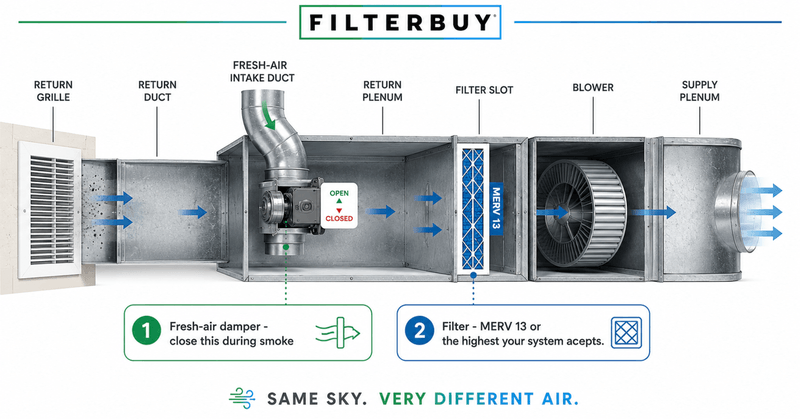
Start at your indoor unit, wherever it lives: basement, closet, attic, garage. Find the return duct first, which is the big one feeding into the filter slot. What you are hunting for is a much smaller round duct, somewhere between 4 and 8 inches across, joining that return plenum from the outside world. Five steps, and most people finish in under a minute.
Follow the small round duct. If a 4 to 8 inch duct enters the return plenum and disappears toward an exterior wall, soffit, or roof, that is your fresh-air intake.
Look for the damper collar. Where the duct meets the plenum you will find either a manual lever with OPEN and CLOSED stamped on the collar, or a small motorized damper with a wire running to a control box.
Manual damper: turn the lever perpendicular to the duct run. Perpendicular means closed.
Motorized damper: use the control, not the damper. Look for a ventilation control near the thermostat or on the unit, often an AprilAire, Honeywell, or Broan model with a Ventilation Off or Vacation button. Press it off. If you force a motorized blade by hand, you can strip the actuator.
Set a phone reminder to reopen it when air quality clears. That intake exists for a reason.
If you walk the return plenum and find nothing but the return duct itself, your home has no fresh-air intake. That is the common case, and during a smoke event it is quietly good news: one less path to worry about.
The U.S. Department of Energy's Building America program documents this exact assembly, including why a return-side outdoor air duct is required to have a controlled damper rather than sitting open all the time (PNNL, Outdoor Air Intake Damper Controlled).
Running the fan continuously is the right call during smoke. It is not, however, a free one, and none of the federal guidance pages mention what it costs you. Here is the honest accounting, along with what to do about each item.
Sources: ENERGY STAR and U.S. Department of Energy Building America duct-leakage guidance; blower wattage ranges from blower-motor manufacturer and HVAC trade service data.
The leakage point matters most. If your ducts run through an unconditioned attic or crawlspace, that space fills with smoky outdoor air, and a continuously running blower pulls it in the whole time. The U.S. Department of Energy notes that duct sealing alone can save up to 20% of a home's heating and cooling energy (DOE Building America, duct sealing). Seal the return connections within arm's reach of the air handler and you capture most of the benefit, because leaks nearest the blower sit at the highest pressure.
On the filter side of the equation, the numbers are ours. Filterbuy testing lab data, built from more than two million filters manufactured, puts a clean MERV 13 somewhere between 0.22 and 0.28 inches w.g. of initial pressure drop, against 0.08 to 0.12 for a MERV 8. Most residential systems are designed to stay under 0.5 inches of total external static pressure, so those numbers leave room, though not unlimited room. If you are worried about resistance, reach for thickness before you reach for a lower rating. A 4-inch MERV 13 can breathe easier than a 1-inch MERV 11, which surprises people. The full MERV pressure drop chart breaks it down by size.
Which brings up the finding that changed how we answer the airflow question altogether: a dirty MERV 8 restricts airflow more than a clean MERV 13 does. After a decade of manufacturing, this is the myth Filterbuy spends the most time correcting. It almost always arrives phrased as a worry that a higher rating will strain the blower, and our testing points somewhere else entirely. The rating is not what chokes a system. A filter left in past its useful life is what chokes a system. During a smoke event the distinction stops being academic in a hurry, because smoke packs media fast enough to turn a perfectly appropriate filter into a genuine restriction within a few weeks.
If your home runs on window units, a ductless mini-split, a portable AC, or no air conditioning at all, skip the filter upgrade entirely and set up one clean room instead. Choose the space with the fewest openings, close the outdoor vent on any unit that has one, and run a portable air cleaner in that room continuously. Whole-home filtration is not available to you; a single well-defended room is.
Because a guide about fan settings quietly assumes you have a fan to set. Plenty of readers do not, and the federal numbers are blunt about it. Two-thirds of U.S. households run central AC or a central heat pump, but head to the Northeast and half of all households rely on individual units instead. If that describes your home, most of what you have read so far does not apply to you. Here is the version that does.
Since Filterbuy sells HVAC filters, let us say the obvious part out loud: if that table describes your home, a filter is not your answer. There is no slot to put one in. What replaces it is a change of scale, from filtering the whole house to doing one room properly. Choose the space with the fewest windows and doors, ideally a bedroom, shut it off from the rest of the house, and run a portable air cleaner sized for that room continuously on its highest setting. Pick a unit that does not generate ozone, which the EPA is firm about; the California Air Resources Board keeps a list of devices tested to emit little or none.
When a commercial air cleaner is sold out or out of budget, the EPA does endorse a DIY box-fan version, though it attaches a safety caution worth repeating. Use a box fan built in 2012 or later carrying a UL or ETL mark, because older fans have caused fires. On performance, designs using thicker media or several filters move noticeably more clean air than a single filter taped flat against the back. Treat the whole thing as a stopgap, which is how the EPA frames it, rather than as a permanent substitute for a tested product.
When smoke and heat conflict, heat wins. The EPA advises that anyone without air conditioning who cannot stay inside comfortably with the windows closed should seek shelter somewhere else. Heat illness can kill within hours, while smoke exposure is a serious risk measured in days and years, so treat the temperature as the emergency and the smoke as the problem you solve second.
That ordering matters because everything above assumes the house is a comfortable place to seal up. Often it is not. Often it is not.
Fire season peaks in the same months as extreme heat, and the two hazards pull in opposite directions. Smoke says close the house; heat says open it. Get that order wrong and the advice on this page turns dangerous.
Working inside that rule, EPA guidance sequences a hot smoky day roughly like this:
Through the day, before it heats up, close the windows and pull the shades, blinds, and awnings. Keeping sun out of the house is what buys you the ability to stay closed at all.
After dark, once outdoor air has cooled, open up and use fans to push hot air out or draw cool air in, then close everything again once the house has dropped. You will let smoke in doing this. That is an accepted trade, and it is precisely why the filter and the fan setting matter so much in the hours that follow.
Go easy on single-hose portable air conditioners, which the EPA notes can pull more smoke in from elsewhere in the house.
If the heat settles in for days, the EPA suggests leaving the area or getting hold of an affordable air conditioning unit rather than trying to wait it out.
For the full picture, the EPA publishes a fact sheet on protecting yourself from smoke and extreme heat. And do not overlook the simplest option in it. A cleaner air shelter, a library, or a mall with real filtration is a legitimate answer, and on a 100-degree day it beats a sealed house by a wide margin.
Buy your smoke filter before fire season rather than during it. Filterbuy order data shows the same sequence every year: a fire ignites, regional orders climb within hours, shipping slows under those same conditions, and the MERV 13 sizes homeowners actually need are the first to run short. A filter already sitting in the closet beats a better one that ships in three weeks.
The reason this matters is that nearly every other setting on this page is free and takes under five minutes. The filter is the exception, because it is the one step with a supply chain attached, and that is where Filterbuy watches homeowners get caught out year after year.
There is a further wrinkle in the timing. The AQI has usually been climbing for hours before anyone inside the house notices a smell, so by the time the smoke registers as a problem worth acting on, the decision to order is already running behind the exposure that prompted it.
All of which turns into a scheduling problem rather than a product one. Buy the filter ahead of fire season instead of during it, and keep a spare in the closet. A MERV 13 sitting on a shelf in July beats a better filter that ships in September. If Filterbuy could give a homeowner in the West or the Upper Midwest one piece of advice ahead of every setting on this page, that would be it.
Install a MERV 13 filter, or the highest rating your system accepts. The EPA recommends MERV 13 or higher during smoky periods and notes most systems handle it without equipment problems when the filter is replaced frequently. Our rundown of the best MERV rating for wildfire smoke covers why lower ratings fall short. Unsure what your system tolerates? Check the MERV air filter pressure drop chart before you upgrade.
Set the fan to On.
Close the fresh-air damper if you have one. Turn off ERVs, HRVs, and evaporative coolers.
Close windows and exterior doors, and run kitchen and bath exhaust fans only briefly. The EPA notes a range hood or exhaust fan can pull more smoke in from elsewhere in the house, because anything you blow out has to be replaced by air drawn through the envelope.
Stop adding particles indoors. During a smoke event the EPA advises against frying or broiling, burning candles or incense, using gas, propane, or wood-burning stoves and fireplaces, smoking or vaping, spraying aerosols, and vacuuming without a HEPA-filtered machine. Damp-dust instead of sweeping. Your filter has a finite capacity, and every one of these spends it on a problem you created.
Add a portable HEPA air cleaner in the room where you sleep.
Inspect the filter every few days. Smoke loads media far faster than household dust. In Filterbuy replacement guidance, a filter that would run 90 days in a normal home drops to a 30 to 45 day cycle through an active fire season. Judge it by color and airflow rather than the calendar, and replace it when it looks dark gray or brown. See how often to change your filter when the AQI is high for the full schedule.
Four checks confirm the setup is doing its job. Hold a hand at a supply register to verify the blower is genuinely running, pull the filter at 48 hours and look for gray, ignore what your nose tells you after the first twenty minutes indoors, and if you own a PM2.5 monitor, compare your indoor reading against the outdoor AQI.
Those matter because most guides stop at the instructions and leave it there. Almost none tell you how to confirm any of it worked, which leaves people doing all the right things with no idea whether any of it helped. These four checks close that loop, ordered by how much each one actually tells you.
Confirm the blower is genuinely running. Setting the thermostat to On and having the fan run are not the same event. Stand at a supply register with the system not heating or cooling and hold the back of your hand near the vanes. You should feel steady, continuous air. If you feel nothing, the setting did not take, which happens most often when the system is off at the equipment or the thermostat is in a mode that overrides the fan.
Look at the filter at 48 hours. Pull a fresh MERV 13 two days into a smoke event. Visible gray on the media is not a sign something is wrong. It is proof the system is capturing smoke instead of letting it circulate, which is the opposite of how most people read it. A filter that still looks white after two days of heavy smoke usually means the blower is not running, the filter is not sealing in its slot, or air is bypassing around the frame.
Do not trust your nose. Human olfaction adapts to a constant odor within minutes, so a house that smells fine after twenty minutes indoors may be no cleaner than it was on arrival. Smell tells you about change, not about level. Step outside for five minutes and come back in if you want a usable read.
Measure it if you can. An inexpensive PM2.5 monitor turns all of the above into a number. Note your indoor reading against the outdoor AQI before you change anything, then again a few hours after the fan and filter are working. The EPA baseline for a closed-up home without air cleaning is roughly 55% to 60% of outdoor levels, so a ratio meaningfully below that is your setup earning its keep.
The last one is worth building a habit around. It turns a vague sense that the house feels better into a number you can act on, and over a single season it will show you exactly which rooms in your home are tight and which are leaking.
Wait until your local AQI has settled back into yellow or green and stayed there, then work backwards through the setup. Reopen the fresh-air damper, switch ERVs and ventilation controls on again, and return the fan to Auto or whatever Circulate schedule you normally run. Replace the filter while you are at it, because a smoke-loaded filter restricts airflow and makes the blower work for nothing. Check current conditions on the live AQI map before you reopen anything, because smoke plumes commonly return for a second and third pass. If you are reading the federal data directly, our guide to using EPA AirNow explains why the Fire and Smoke Map beats the standard dial during a smoke event.
Three independent measurements back up the case this page makes, drawn from a federal energy survey, a CDC surveillance report, and a national lung health organization. Not one of them comes from Filterbuy, which is rather the point. Guidance like this ought to hold up against sources with nothing to sell you.
The U.S. Energy Information Administration's 2020 Residential Energy Consumption Survey, drawn from 18,496 households, found that 88% of U.S. households use air conditioning, and two-thirds use central AC or a central heat pump as their main cooling equipment. That central equipment recirculates indoor air by design, which is why "set it to recirculate" is usually an instruction with nothing to act on. The survey also found that 50% of Northeast households rely primarily on individual units such as window and wall ACs, the one category where a vent lever genuinely needs closing.
Source: U.S. Energy Information Administration, Nearly 90% of U.S. households used air conditioning in 2020, Residential Energy Consumption Survey.
CDC analyzed National Syndromic Surveillance Program data covering roughly 6,000 emergency departments during the 2023 Canadian wildfire smoke episodes. Asthma-associated emergency department visits ran 17% higher than expected across the 19 days classified as wildfire smoke days between April 30 and August 4, 2023. CDC defined a smoke day as one where PM2.5 reached an AQI of 101 or above. That is the same threshold this guide uses to decide when to switch the fan to On and close the house, and it is not arbitrary. It is where measured health effects begin.
Source: McArdle CE, et al., Asthma-Associated Emergency Department Visits During the Canadian Wildfire Smoke Episodes, United States, April-August 2023, CDC MMWR 2023;72(34):926-932.
The American Lung Association's "State of the Air" 2026 report, built on 2022 through 2024 federal, state, local, and Tribal monitoring data, found that 61.5 million people live in U.S. counties graded F for unhealthy spikes in daily particle pollution, the short-term category that wildfire smoke drives. Across all three pollution measures, 44% of Americans, or 152.3 million people, live somewhere with at least one failing grade. Smoke settings are no longer a Western concern.
Source: American Lung Association, State of the Air 2026: Short-Term Particle Pollution Trends and Key Findings.
One disclosure before the filter advice above. Filterbuy manufactures the filters this page points to, so read the recommendation with that in mind. The MERV 13 guidance is not ours. It comes from the EPA and AirNow, and it holds whether you buy from us or not.
No. A residential central air conditioner recirculates indoor air by default and has no recirculate button. The car-style recirculate flap has no household equivalent. What wildfire guidance means by "recirculate" is this: close any outdoor-air intake your system has, and most homes do not have one.
On. Auto runs the blower only during heating and cooling calls, so the filter sits idle much of a mild smoky day. On runs the blower continuously and keeps indoor air cycling through the filter, which is the condition under which the EPA's roughly 50% PM2.5 reduction figure applies.
Not for a few days. The real costs are added blower electricity, slightly higher indoor humidity in cooling weather, and faster filter loading. During a smoke event, cleaner air outweighs all three. Return to Auto once the air clears.
Then you almost certainly do not have one, which is the common case in U.S. homes. Skip that step. Fan On, a MERV 13 filter, and closed windows is your full setup. If you are unsure what you are looking at, Filterbuy staffs a support line and contact form for exactly this kind of question.
No. A central system without a fresh-air intake is not bringing smoke in. Smoke arrives through the windows, the doors, and every gap in between whether the system runs or not. Shut the system down and the only thing you have stopped is the filtration.
Treat the heat as the more urgent hazard. The EPA advises that anyone without air conditioning who cannot stay inside comfortably with the windows closed should seek shelter elsewhere, such as a cleaner air shelter or an air-conditioned public building. Where you can manage indoor temperature, close up and shade the windows during the day and air the house out at night when it is cooler.
Part of it. Close the vent lever if your unit has one and check the seal between the unit and the window frame. There is no filter slot for MERV-rated media, so shift the strategy to one room: pick the space with the fewest openings and run a portable air cleaner sized for it, continuously and on high.
AQI (Air Quality Index): The EPA's 0 to 500 scale for outdoor air pollution. Above 100 is unhealthy for sensitive groups.
Damper: A movable plate inside a duct that opens or closes airflow through that duct. A fresh-air damper controls outdoor air entering the return plenum.
ECM (Electronically Commutated Motor): A variable-speed blower motor that runs efficiently at low speed, which makes continuous fan operation inexpensive.
ERV / HRV: Energy or Heat Recovery Ventilator. Balanced ventilation equipment that continuously exchanges indoor and outdoor air while recovering energy. Must be switched off during smoke.
Evaporative cooler: A "swamp cooler" that cools by pulling 100% outdoor air through a wet pad. Unsafe to operate during smoke events.
Fresh-air intake: A duct bringing outdoor air into the return side of a central HVAC system, required by ASHRAE Standard 62.2 in many newer homes.
MERV 13: A filter efficiency rating on the ASHRAE 52.2 scale, the level the EPA points to for wildfire smoke because it captures fine particles.
PM2.5: Fine particulate matter under 2.5 micrometers. The primary health hazard in wildfire smoke.
PSC (Permanent Split Capacitor) motor: An older fixed-speed blower motor that draws substantially more power than an ECM.
Return plenum: The chamber where return ducts meet the air handler, immediately ahead of the filter slot and blower.
Clean room (cleaner air room): A single room set up to hold lower particle levels than the rest of the house, using few openings, a portable air cleaner, and no indoor particle sources.
DIY air cleaner: A box fan fitted with one or more high-efficiency furnace filters. The EPA endorses it only as a temporary substitute when a tested portable unit is unavailable or unaffordable.
Envelope: The outer shell of a home, meaning walls, roof, windows, doors, and the gaps in them. The path smoke takes that no thermostat setting controls.
U.S. EPA, Strategies to Reduce Exposure Indoors - the fan Auto-to-On instruction, the roughly 50% PM2.5 reduction with a high-efficiency filter, and the 24% reduction with an ordinary filter.
AirNow.gov, When Smoke Is in the Air - the "Recirculate" and "On" settings guidance and closing the fresh air intake.
U.S. EPA, Create a Clean Room to Protect Indoor Air Quality During a Wildfire - evaporative cooler and portable air conditioner cautions, and the MERV 13 clean-room setup.
PNNL Building America Solution Center, Outdoor Air Intake Damper Controlled - how a return-side fresh air intake and its motorized damper are built and controlled.
U.S. Department of Energy Building America, duct sealing - duct leakage impact and the up-to-20% energy figure.
California Air Resources Board, Smoke Ready California - state-level filtration and clean-air-space guidance, and the list of air cleaning devices tested for low ozone emission.
U.S. EPA, Protect Yourself from Smoke and Extreme Heat (PDF) - the guidance behind the heat-outranks-smoke rule and the day-night sequencing.
Filterbuy, MERV air filter pressure drop chart - internal testing lab pressure drop data across MERV ratings and filter depths.
Check your local reading on the live Filterbuy AQI map, then match a filter to it. Filterbuy builds MERV 13 pleated filters in more than 600 sizes at its Alabama plant, plus custom sizes for returns that do not fit a standard. Auto-delivery keeps a spare on the shelf, which is the whole point of the timing section above.
is Brand Manager and Air Quality Writer at Filterbuy, writing on indoor air quality and home filtration. Learn more on her author page.
is a Licensed HVAC Technician and reviewed this article for accuracy on airflow, static pressure, and real-world system compatibility.
