September 2, 2026
By Michelle Wan · Reviewed by David Clark, Licensed HVAC Technician
Published: September 3, 2026
Yes, in most homes with central air, as long as a clean MERV 13 filter is in the slot. Switching the thermostat fan from Auto to On adds roughly $3 to $6 over a two-week smoke event on a modern ECM blower, and about $16 to $21 on an older PSC motor. EPA reports that a high-efficiency filter running with the fan on continuously can lower indoor PM2.5 by about 50%, compared with about 24% for a low-efficiency filter. The fan is the delivery mechanism; the filter is what does the work.
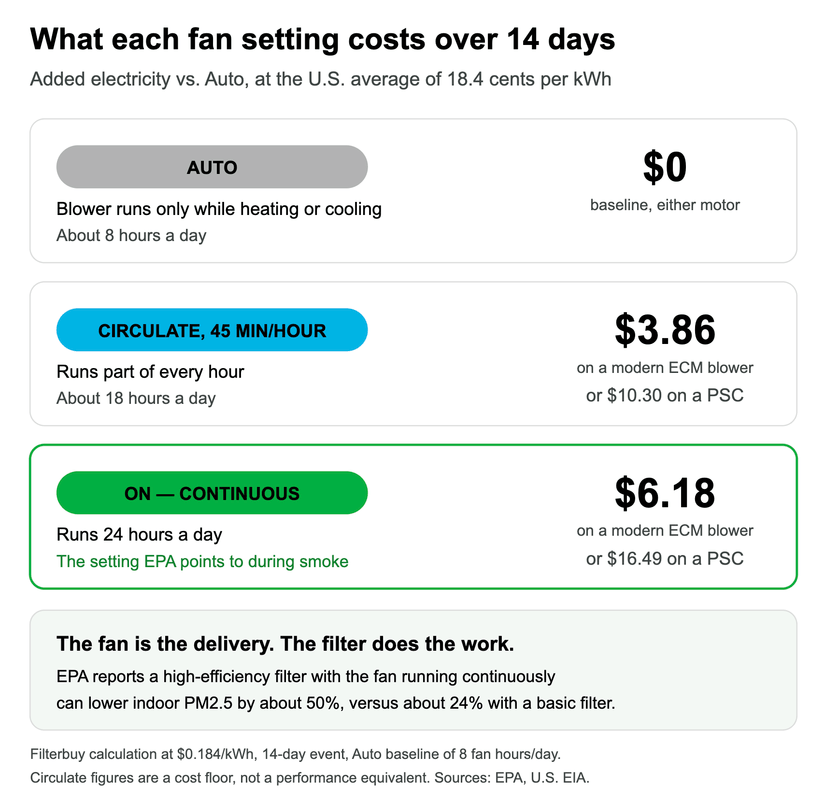
Auto — $0 extra. The blower only moves air while the system is heating or cooling, so the filter sits unused for most of a mild smoky day.
Circulate, 45 min/hour — about $3.86 over 14 days on an ECM blower, $10.30 on a PSC. The middle option for humid climates and older motors.
On, continuous — about $6.18 over 14 days on an ECM blower, $16.49 on a PSC. This is the setting EPA points to during smoke.
Not sure what your system takes, or what size is in the slot? The quick match below will sort it out.
Answer a few quick questions and we will match you to the right filter for your system.
Prefer to skip the quiz? Shop filters at Filterbuy — 600+ standard sizes plus custom, built in the USA and shipped factory-direct.
Running your HVAC fan continuously through a wildfire smoke event is usually worth doing, and it costs less than most homeowners expect. A modern ECM blower adds roughly $3 to $6 over two weeks, an older PSC blower closer to $16 to $21. In exchange, the EPA reports that a high-efficiency filter running with the fan on continuously can cut indoor PM2.5 by about half. The setting only works with a MERV 13 filter in the slot, and in muggy climates it can raise indoor humidity.
The fan setting is cheap; the filter does the work. A blower running 16 extra hours a day adds $0.22 to $1.47 per day at the U.S. average residential rate of about 18.4 cents per kWh. That same fan buys you roughly 24% particle removal with a basic filter, or about 50% with a high-efficiency one. The filter, not the fan, is what doubles your return.
EPA guidance is explicit: during smoky periods, upgrade to a MERV 13 or higher filter and switch the thermostat fan from Auto to On.
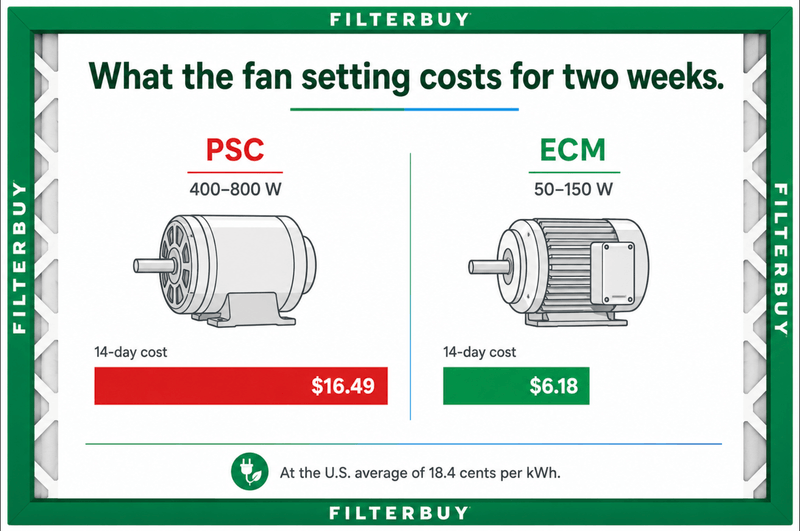
Motor type drives the cost. ECM blowers typically draw 50–150 watts on continuous fan; older PSC blowers draw 400–800 watts, roughly five times more for the same job.
A high-efficiency filter plus continuous fan can lower indoor PM2.5 by about 50%, per EPA wildfire smoke guidance for clinicians. Even a low-efficiency filter run continuously cuts particles about 24%.
Smoke loads filters fast. A filter that normally lasts 90 days can be spent in two to three weeks. Check it weekly; replace it when the media looks dark grey or brown.
The real downside is humidity, not electricity: in muggy climates, continuous fan can re-evaporate coil moisture back into your living space.
Yes, in most homes with central air, provided a high-efficiency filter is installed. Left on Auto, the blower only moves air while the system is heating or cooling, which on a mild smoky day might amount to a couple of hours. Switch it to On and every cubic foot of indoor air starts making repeated passes through the filter instead. The EPA guidance for clinicians is direct: set the HVAC fan to run continuously by switching the thermostat from Auto to On.
The reasoning is arithmetic. A filter can only capture what passes through it, and fine smoke particles seep into a closed house through gaps around doors, windows and recessed lighting whether or not the air conditioner happens to be running. Filtration is therefore a race between infiltration and removal, and the fan setting is what decides how many laps your air gets to run before you breathe it again.
The honest answer lands between $3 and $21 for a two-week smoke event, and which end you land on depends almost entirely on the blower motor you happen to own. Here is the math, run at the U.S. average residential electricity rate of 18.4 cents per kWh (U.S. Energy Information Administration, mid-2026), on the assumption that your fan already runs about eight hours a day on Auto, so switching to continuous adds sixteen.
Filterbuy calculation at $0.184/kWh. Formula: (watts / 1,000) x added hours x local rate. Assumes the fan already runs about 8 hours a day on Auto, so continuous operation adds 16 hours. Motor draw ranges reflect published residential blower specifications; verify yours on the equipment data plate.
Adjust for your state. Those figures use the national average, and the national average hides a great deal. Rates ran from about 12 cents per kWh in Idaho to 52 cents in Hawaii as of mid-2026, which means the identical fan setting can cost four times more in one state than in another.
Filterbuy calculation. Same 14-day smoke event as the table above, repriced at regional electricity rates. Assumes 16 added fan hours per day. Rate source: EIA Electric Power Monthly, mid-2026.
The comparison that matters: for most homes with an ECM blower, two weeks of continuous filtration costs less than a single replacement filter. The recurring expense during smoke season is filter media, not electricity.
Search this question and the same sentence comes back on page after page: running the fan continuously costs a little more. Almost nobody publishes the arithmetic behind it. That gap is the reason we built the two tables above instead of repeating the phrase.
We should be upfront about why we care. Filterbuy has manufactured pleated air filters in the United States since 2013, building on a family filtration business that goes back to 1958, at plants in Alabama, Florida, Pennsylvania and Utah. We make more than 600 standard sizes plus custom builds, and we ship factory-direct to over four million households. So we have a commercial interest in you upgrading your filter, and none whatsoever in what your utility charges for sixteen extra hours of fan runtime.
Which is why the position we will defend is the one the math produces rather than the one that moves the most media: the electricity is close to a non-issue, and the filter is the decision. If your blower is an ECM, stop worrying about the bill entirely. If it is an older PSC and your rate is high, the cost is real, though still smaller than most people fear. Either way, the money that matters during a smoke event is the $15 to $30 you spend replacing loaded media on time.
The cost question is usually a proxy for a different worry: people are not sure the fan is doing anything, so any amount feels like too much. Put a number on it and the objection tends to dissolve. Six dollars over two weeks to cut the fine particles in your house roughly in half is not a close call.
Michelle Wan, Filterbuy
Before estimating anything, check the equipment data plate. The blower wattage or amp draw is printed on a label inside the air handler or furnace cabinet, which turns the whole question into a number you can multiply. Three quick indicators point the same way:
Age. Air handlers and furnaces made before roughly 2010 usually carry a PSC (permanent split capacitor) motor. Anything sold as variable speed or two-stage almost always carries an ECM.
Sound at startup. A PSC blower snaps to full speed instantly. An ECM ramps up over several seconds and runs noticeably quieter on low.
The data plate. Look for FLA (full load amps) and multiply by 120 volts for a rough wattage. ECMs are often labeled ECM, variable speed, or X13.
If you cannot find the plate, a licensed HVAC technician can measure the actual draw with a clamp meter in a few minutes, and check static pressure while they are in there, which is the number that really determines whether your system can handle MERV 13.
The EPA estimates that upgrading to a high-efficiency HVAC filter may decrease indoor PM2.5 concentrations by about 50% when the system fan runs continuously. That one figure is the entire case for the fan setting: roughly half the fine particles gone, for the price of a sandwich.
Closing up the house only gets you part of the way there. EPA reports that during smoke events, indoor PM2.5 typically settles at 55% to 60% of outdoor levels with the windows shut and no air cleaner running, though the spread across individual homes runs from 30% all the way to 100%. Filtration is what moves you toward the good end of that range.
The stakes behind those percentages are well documented. A Lawrence Berkeley National Laboratory analysis by Fisk and Chan, published in Indoor Air (2017), modeled filtration interventions during a 10-day Southern California smoke episode and projected they would prevent 11% to 63% of hospital admissions and 7% to 39% of deaths attributable to wildfire particles in affected homes.
Two points that most coverage gets wrong are worth correcting here, because both of them change what you would actually do:
Residential systems do not have a recirculate mode. Home HVAC already recirculates indoor air by default. On changes how often the fan runs, not where the air comes from. Homes with a dedicated fresh-air intake or ERV/HRV are the exception: close that intake during heavy smoke.
The fan setting is a multiplier, not a filter. The filter is the intervention; the fan is the delivery mechanism.
If your system cannot accept MERV 13, use the highest rating it safely accepts and add a portable HEPA air cleaner in the bedroom. Our guide to the best MERV filter for wildfire smoke covers the ratings in detail, how MERV ratings work explains the scale itself, and do air conditioners filter wildfire smoke covers window and portable units.
Three independent datasets back up the argument so far. One measures what smoke does to people, one measures how many people it reaches, and the third puts the electricity question in proportion.
The Filterbuy CMS sanitizer strips anchor tags from Custom HTML blocks, so source links for this table are placed in the body copy directly beneath it rather than inside the cells.
Sources:
CDC, Asthma-Associated Emergency Department Visits During the Canadian Wildfire Smoke Episodes (United States, April–August 2023), MMWR 72(34):926–932.
American Lung Association, State of the Air 2026: Key Findings. Data years 2022–2024.
U.S. Energy Information Administration, How much electricity is used for air conditioning in the United States? Residential Energy Consumption Survey, 2020.
Most coverage of this question presents two options, On and Auto. Almost any smart thermostat built in the last decade offers a third, usually labeled Circulate, which runs the blower for a set number of minutes each hour. We have not found anyone pricing that middle setting, so here it is. If you own a PSC blower and the $16 figure gave you pause, this is the table that matters.
Filterbuy calculation at $0.184/kWh over a 14-day smoke event, assuming Auto already runs the blower about 8 hours a day. Important caveat: the EPA figure of roughly 50% PM2.5 reduction applies to continuous operation. Partial runtime moves proportionally less air through the filter, and we are not aware of published removal figures for intermittent circulate settings, so treat the middle rows as a cost floor, not a performance equivalent.
A filter company has an obvious incentive to tell you to run the fan nonstop and change the media constantly, so here is where that advice stops holding. Continuous operation carries four real costs beyond electricity. None of them disqualify the setting, but two are genuine reasons to switch it off.
1. Humidity in muggy climates. Moisture condenses on the evaporator coil during cooling. When the compressor shuts off but the fan keeps running, that moisture re-evaporates back into your living space, which noticeably raises indoor humidity in the Southeast and Gulf Coast. If the house feels clammy, use circulate mode instead of full On.
2. Filter loading. Smoke loads a filter far faster than household dust. A filter rated for 90 days can be visibly dark in two to three weeks. EPA guidance is to replace the filter more often than the manufacturer recommends during heavy smoke, and to swap it as soon as it appears dirty. The practical failure here is not cost, it is not having a spare in the closet when the sky turns orange, which is the reason Filterbuy runs auto-delivery on a schedule you set.
3. Airflow restriction. A loaded or overly restrictive filter raises static pressure, cuts airflow, strains the blower, and in cooling mode can freeze the coil. Weak airflow at the registers is your signal to pull and inspect; our rundown of the signs a filter is clogged covers what else to watch for.
4. Motor wear. ECM blowers are built for continuous duty; older PSC motors were not. For a two-week event this is a non-issue. For a whole fire season on a 20-year-old furnace, ask your technician.
The mistake I see most often is the fan setting getting flipped to On with the same filter that has been in the slot since spring. All that does is move smoke around the house faster. Change the filter first, then change the setting.
David Clark, Licensed HVAC Technician
Continuous fan is not a set-and-forget decision. Leaving it on through a long event without checking on the system is how a filtration win turns into a repair bill or a mold problem. Four conditions call for switching off, or stepping down to circulate, well before the AQI clears:
Indoor humidity climbs past 60%. EPA recommends keeping indoor relative humidity below 60%, ideally 30% to 50%, to limit mold growth. A $12 hygrometer tells you where you are. If the fan is pushing you past 60% in a humid climate, the mold risk outweighs the filtration gain.
Airflow at the registers drops noticeably. That is a loaded filter raising static pressure. Replace the media before resuming, not after.
The system starts short-cycling, or you see ice on the refrigerant line. Stop the fan and call a technician. A frozen evaporator coil is a repair bill, not an inconvenience.
The smoke is inside and the filter is not catching it. If you can still smell smoke after 24 hours of filtration with fresh MERV 13 media, air is bypassing the filter through a loose slot or entering faster than the system can clear it. A filter that is even half an inch undersized lets air take the easy path around the media, which is why Filterbuy builds to actual slot dimensions rather than rounding. Seal the slot, confirm the fit, and add a portable HEPA unit in one room rather than running the blower harder.
The first two on that list are the tradeoffs flagged earlier as reasons to stop rather than costs to accept. Humidity and airflow restriction both compound the longer they go unnoticed, while motor wear and filter spend simply accrue.
Check your local AQI on the live U.S. air quality map, or at AirNow.gov, so you know what you are filtering against.
Install a clean MERV 13 filter, or the highest rating your system safely accepts, before changing the fan setting. Confirm the size printed on your current filter frame; odd sizes can be built as a custom filter.
Switch the thermostat fan from Auto to On. On smart thermostats: Fan then On, or Circulate at 45–60 minutes per hour as a lower-cost compromise.
Close any fresh-air intake or economizer damper, and keep windows and doors shut.
Inspect the filter every 7 days. Replace it when the media is dark grey or brown, regardless of the calendar.
Return the fan to Auto once AQI drops back into the green and stays there.
It depends on your blower motor. A modern ECM blower drawing 75–150 watts costs roughly $0.22 to $0.44 per day in added electricity at 18.4 cents per kWh. An older PSC blower drawing 400–800 watts costs roughly $1.18 to $2.36 per day. Check the data plate on your air handler for your motor actual draw.
Often, yes, for a single room, since portable air cleaners typically draw 30–80 watts. Whole-home HVAC filtration treats every room. Many households do both: HVAC filtration for the house, a HEPA unit in the bedroom.
Not in a properly sized, well-maintained system with a clean filter. ECM blowers are built for continuous operation. The real risk is a clogged filter raising static pressure, which is a filter problem, not a fan problem.
It helps, but far less. EPA reports that running the system fan continuously with a typical low-efficiency filter reduces indoor particle concentrations by about 24%, compared with roughly 50% when a high-efficiency filter is installed (EPA, citing Fisk and Chan 2017). A MERV 1 to 4 fiberglass pad captures lint, not PM2.5, so the fan is doing most of the work on its own. Upgrading the filter roughly doubles the benefit.
On, if your system takes a high-efficiency filter. Auto leaves the blower idle for most of a mild smoky day, so the filter sits unused. Circulate, at 45 minutes an hour, is the middle option and costs about $3.86 over two weeks on an ECM or $10.30 on a PSC. It is the sensible default for older blowers and humid climates. The research behind these figures is Fisk and Chan (2017) and EPA guidance in Strategies to Reduce Exposure Indoors.
Check your local air quality on the live AQI map, then shop MERV 13 filters in your size. Odd size? Build a custom filter. Or set up auto-delivery so a clean filter arrives before the next event, not after it.
Best MERV filter for wildfire smoke. Which rating actually captures PM2.5, and what your system can take.
How to set up a wildfire smoke clean room the EPA way. When filtering one room beats filtering the house.
Wildfire season preparation checklist. What to do before smoke arrives, not during.
How to recover from wildfire smoke exposure. The cleanup after the AQI drops.
Hazardous air quality (AQI 301+). What to do when filtration alone is not enough.
What mask works best for wildfire smoke: N95 vs KN95 vs P100. For when you have to go outside.
All Filterbuy wildfire and smoke resources and energy and cost savings guides.
U.S. EPA, Strategies to Reduce Exposure Indoors. MERV 13 recommendation, fan On guidance, the ~50% and ~24% PM2.5 reduction figures, and indoor-to-outdoor infiltration ratios. Last updated October 10, 2025.
U.S. EPA, Create a Clean Room to Protect Indoor Air Quality During a Wildfire. Filter replacement guidance during heavy smoke, fan On instruction. Last updated August 18, 2026.
Fisk, W.J. and Chan, W.R., Health benefits and costs of filtration interventions that reduce indoor exposure to PM2.5 during wildfires, Indoor Air 27(1):191–204, 2017 (Lawrence Berkeley National Laboratory).
U.S. Energy Information Administration, retail electricity price data by state and sector. Electric Power Monthly Tables 5.6.A and 5.6.B; average U.S. residential price, mid-2026.
U.S. EPA, Mold Remediation in Schools and Commercial Buildings Guide. Keep indoor relative humidity below 60%, ideally 30% to 50%.
AirNow. Official EPA real-time Air Quality Index and Fire and Smoke Map.
