July 30, 2026
By Michelle Wan | Reviewed by David Clark, Licensed HVAC Technician
Published July 31, 2026 | Last updated July 31, 2026
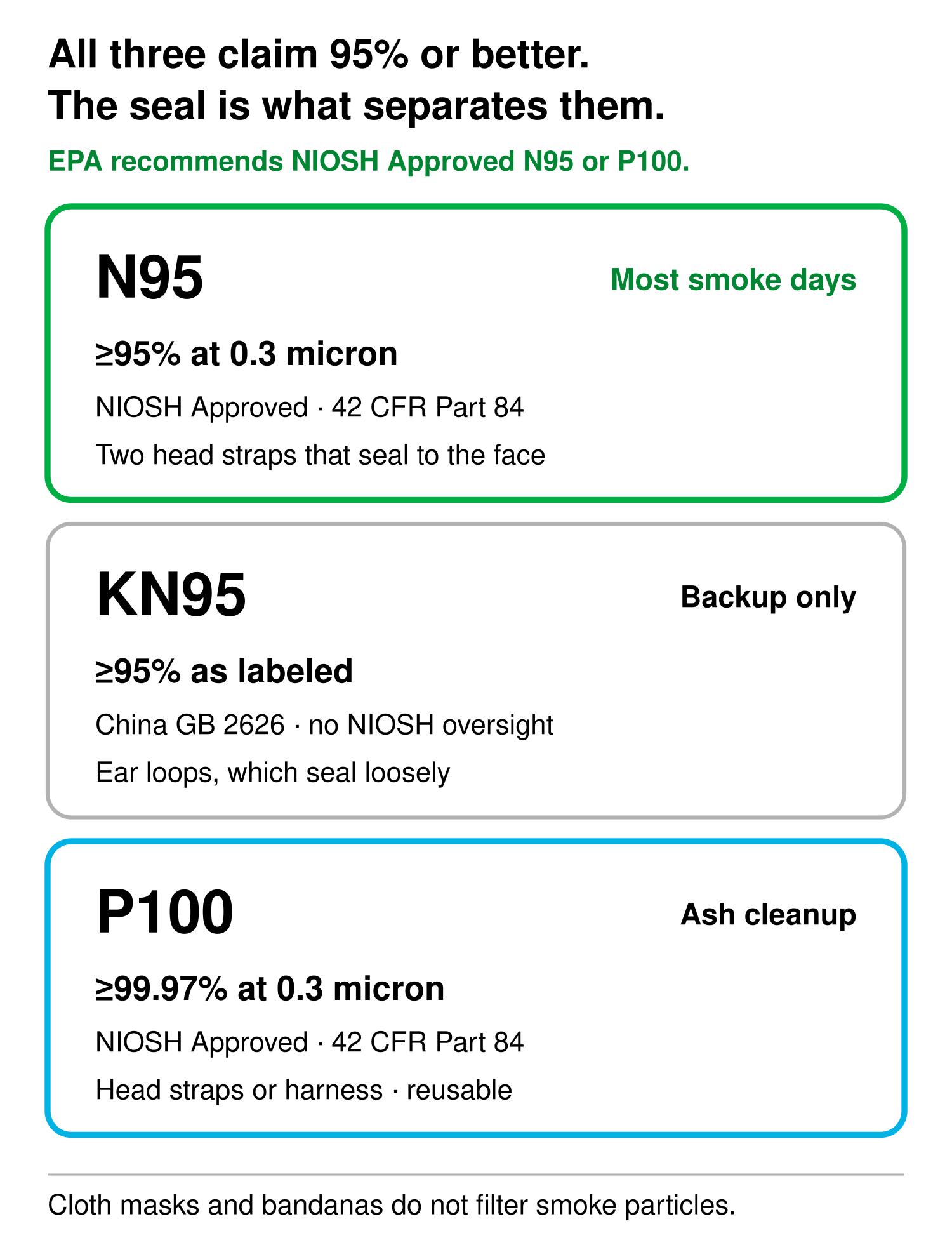
A NIOSH Approved N95 respirator is the right mask for most people in wildfire smoke. It captures at least 95% of 0.3-micron test particles and seals to your face with two head straps. A P100 captures more, at least 99.97%, and is the better choice for ash cleanup. KN95s are certified to a different standard and hang from ear loops, so treat them as a backup.
N95 — NIOSH Approved, at least 95% at 0.3 micron, two head straps. Most smoke days.
KN95 — China GB 2626, no NIOSH oversight, ear loops. Backup when N95s are gone.
P100 — NIOSH Approved, at least 99.97% at 0.3 micron, reusable. Ash cleanup and long exposures.
Cloth, surgical, and dust masks — not designed to seal, and do not filter smoke particles.
A mask covers the hours you spend outdoors. The filter in your system handles the rest of the day.
Have a ductless mini split? Answer a few quick questions and we’ll match you to the right filter for it.
Or browse every size we make, shipped from our own U.S. factories.
A NIOSH Approved® N95 respirator is the best wildfire smoke mask for most people. It captures at least 95% of the fine particles that make up smoke, and, just as important, it seals to your face. A P100 filters more (99.97%) and is the better pick for ash cleanup. KN95s vary widely in quality and usually hang from ear loops, which seal loosely. Cloth masks and bandanas do essentially nothing against wildfire smoke.
A NIOSH Approved N95 or P100 is the only mask category the EPA recommends for wildfire smoke. Look for "NIOSH" and either "N95" or "P100" printed directly on the mask.
Two head straps, never ear loops. The EPA is explicit: masks with a single strap or two ear loops are not designed to seal and will not protect your lungs from smoke.
Fit matters as much as the rating. NIOSH reports that a correctly worn, properly fitted respirator reduces your exposure by a minimum of 10 times. Worn loosely, a $2 gap erases a 95% filter.
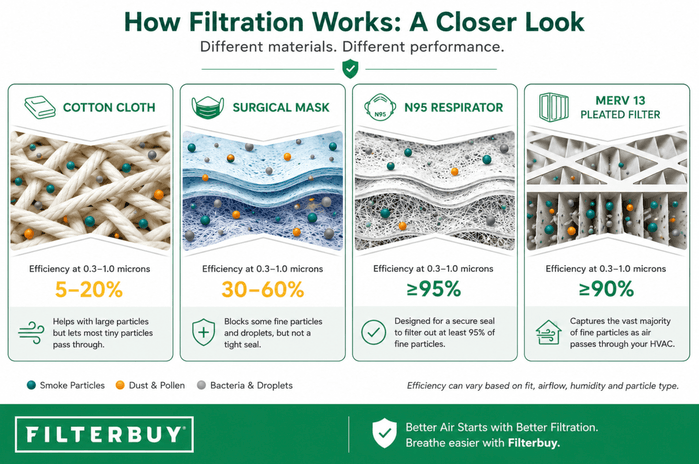
Cloth, surgical, and dust masks do not filter PM2.5. They lack the electrostatically charged filter media and the face seal required to stop smoke particles.
No NIOSH Approved respirator is made in young children’s sizes. Kids age 2 and up can wear one, but the honest answer for small children is cleaner indoor air, not a better mask.
A mask covers the small share of your day spent outdoors. Your HVAC filter covers the rest.
A NIOSH Approved N95 respirator is the best wildfire smoke mask for the average person. It filters at least 95% of 0.3-micron test particles, seals against the face with two head straps, and is widely available at hardware stores. The EPA recommends N95 or P100 respirators specifically, and names cloth masks, surgical masks, dust masks, and bandanas as ineffective against smoke.
Cloth masks fail against wildfire smoke for two reasons at once: the weave is too open, and the mask doesn’t seal. Wildfire smoke is dominated by PM2.5, particles under 2.5 microns that travel deep into the lungs. Cotton has no electrostatic charge to catch particles that small, and a loose mask lets smoke stream in around the edges instead of through the fabric.
CDC/NIOSH puts it plainly: cloth masks, surgical masks, and bandanas, wet or dry, are not designed to seal to your face and do not have the filter material needed to capture smoke particles.
A respirator works differently. The media inside an N95 is a dense mat of meltblown fibers carrying a permanent static charge, so particles get caught two ways: snagged by the fiber tangle, and pulled aside by the charge. That’s the same mechanism at work inside the high-MERV pleated furnace filters Filterbuy manufactures. That is why we can translate between the two.
All three filter at least 95% of fine particles on paper. They differ in who verifies that claim, and in how well the mask seals to your face. N95 and P100 are tested and approved by NIOSH under U.S. law. KN95 is certified to a Chinese standard with no NIOSH oversight, and it usually hangs from ear loops instead of head straps.
KN95 filtration reflects the labeled GB 2626 claim. NIOSH testing of non-NIOSH-approved imports found many units below 95%, so verify the seller before you rely on one.
The KN95 caveat is the part most guides skip. On paper, KN95 and N95 target the same 95% threshold. In practice they don’t test to the same protocol, and the U.S. supply chain has a documented quality problem. When NIOSH assessed non-NIOSH-approved international respirators during the COVID-19 shortage, many had filtration below 95% with substantial inconsistency between units from the same package. MIT Lincoln Laboratory found only about half the KN95 models it tested met the 95% mark. Add ear loops that pull toward your ears rather than clamping against your face, and a KN95 becomes a reasonable backup, not a first choice.
On P100: it filters more, and it’s the right tool for shoveling ash. But for a 20-minute walk to the car, an N95 you’ll actually wear beats a P100 sitting in the garage.
An N95 sits in roughly the same filtration territory as a MERV 16 furnace filter, and a MERV 13 sits well below both. That comparison is almost never published, because mask ratings and MERV ratings come from separate testing worlds. At Filterbuy we build air filters for a living, so translating between the two is the part of this we can actually speak to. Here is how they line up.
The percentages above are the minimums required to earn each rating under ANSI/ASHRAE 52.2. A specific filter often performs well above its class minimum: Filterbuy rates its MERV 13 at 98% of airborne particles captured, measured across the full particle range rather than the 0.3–1.0 micron band alone. N95 and P100 are measured under NIOSH 42 CFR Part 84 using a different aerosol and airflow rate, so treat this table as a practical translation, not a laboratory equivalence.
The obvious conclusion is the wrong one. An N95 sits in MERV 16 territory on efficiency. But these are different tests at different airflows using different aerosols, so treat this as a mental translation, not a lab equivalence. Efficiency alone also doesn’t determine how much smoke you breathe. Volume does.
Run the arithmetic. A resting adult breathes about 6 liters a minute, which is roughly 0.2 cubic feet. That is the entire volume an N95 ever gets to filter. A 3-ton residential system moves on the order of 1,200 cubic feet a minute at the common design figure of 400 CFM per ton. A MERV 13 filter at 50% efficiency, working across that volume for hours, pulls far more smoke out of the air you live in than a 95% mask pulls from the air you walk through.
Those two figures are standard engineering estimates, not measurements of your specific home. Your system’s airflow depends on tonnage, duct design, and how clean the filter already is. We are showing the math rather than the conclusion so you can run it on your own numbers.
Here is something we run into constantly on the manufacturing side, and it is worth saying out loud: the MERV number on a box is a floor, not a measurement. MERV 13 means a filter cleared the bar for that class. It does not tell you how far past the bar that particular filter went. That is why the MERV 13 Filterbuy builds is rated at 98% of airborne particles captured while the standard’s minimum for the class sits far lower. It is also why we would rather show you both numbers than quietly pick the flattering one.
The mask and the filter aren’t competitors. They cover different hours of your day.
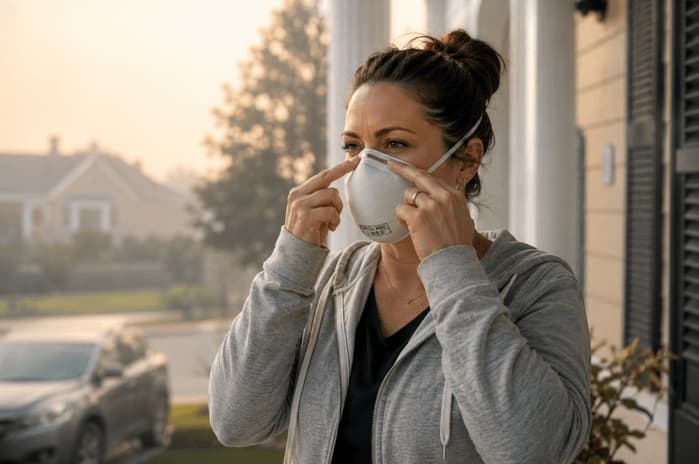
A perfectly rated respirator with a gap at the cheek is a decorative object. Air follows the path of least resistance, and a finger-width gap is an easier path than 95%-efficient media. The EPA notes adequate seals cannot be obtained for men with beards or for most children.
Three checks before you walk out the door. For a longer walkthrough, see our guide to choosing and wearing an N95 for wildfire smoke.
Confirm the markings. "NIOSH" plus "N95" or "P100" printed on the mask itself, not just the box.
Both straps go around your head, one above the ears and one below. If it hangs from your ears, it isn’t sealing.
Do a user seal check. Cover the mask and exhale sharply. Air escaping at the nose bridge or cheeks? Re-form the nose clip and re-check. If the leak persists, try another size or model.
Two free tells that cost nothing and almost nobody mentions. The CDC notes that if you wear glasses and they fog up, the respirator isn’t snug. That is warm breath escaping past the nose bridge, which is the most common leak point there is. And the EPA’s own respirator card gives you the second one: a well-sealed respirator should visibly collapse inward as you breathe in. If it sits still while you inhale, air is coming in around the edge instead of through the filter.
One safety point that belongs here. A respirator makes breathing measurably harder. The EPA advises talking to your doctor before using one if you have a heart or lung condition, and if you feel dizzy or nauseous while wearing one, get to cleaner air and seek medical attention. This is not a small footnote for people with COPD, asthma, or heart disease. It is the reason the EPA ranks respirators below simply staying indoors.
Worth knowing: in September 2025 the U.S. Forest Service reversed a decades-old policy and began permitting federal wildland firefighters to voluntarily wear N95s, clean-shaven and with a successful fit test. The agency that manages fire emphasized fit, not brand.
A properly sealed N95 will not stop the smell of smoke, and that scares people into binning perfectly good masks. The distinction that resolves it is the same one that separates Filterbuy’s two filter lines: particles and gases are captured by completely different mechanisms.
An N95 traps particles, which is the PM2.5 doing the damage to your lungs. Wildfire smoke odor is largely gas-phase compounds, and no particulate filter at any rating captures those. Not an N95, not a P100, not a MERV 16. Catching gases takes activated carbon, which grabs molecules by adsorption instead of straining them out. That is why a carbon filter and a pleated particle filter are two different products rather than one better one.
Smell smoke through a sealed N95? Expected. The mask is still filtering the particles that matter.
Smell spikes when you turn your head, or you feel air on your cheeks? That’s a leak, not a gas. Re-seat it.
Want the smell gone indoors? That’s a job for activated carbon, not a mask.
The practical consequence: smell is a useless test of whether your mask is working, and a decent test of whether it just moved. Judge the seal by feel and fit, not by your nose.
The honest answer: there is no NIOSH Approved respirator sized for young children. The EPA states children age 2 and older can wear respirators, but that NIOSH Approved respirators do not come in sizes suitable for very young children. A mask that doesn’t seal on a small face delivers a fraction of its rated protection, and an uncomfortable one gets pulled off the nose within minutes.
What to do instead, in priority order:
Keep them indoors when the AQI climbs. It is the single most effective action, per EPA guidance.
Clean the indoor air with a MERV 13 filter in your HVAC and a portable HEPA cleaner in the bedroom.
For older kids who must go out, pick the smallest respirator they’ll wear correctly. Comfort determines compliance.
Recirculate in the car, and check your cabin air filter isn’t overdue.
If your child has asthma, talk to their pediatrician before smoke season, not during it.
The hardest part of writing this was the children’s section. I went looking for a product answer and there isn’t one. Every path back from "which mask fits my kid" ends in the same place, which is the air inside your own house..
Michelle Wan
Author

Americans spend approximately 90% of their time indoors, where pollutant concentrations are often 2 to 5 times higher than outdoors, according to the EPA. A mask covers the other 10%.
This isn’t just our framing. The EPA’s own respirator guidance says to use one only after trying more effective measures first: staying indoors and reducing activity. The agency that tells you which mask to buy ranks the mask below the room you’re standing in.
That’s the case for treating your HVAC filter as the primary defense and the mask as travel gear. Every time your system cycles, it pulls household air through the filter. Hundreds of passes over a smoky week.
Before the next smoke event:
Check your local AQI so you’re deciding on data, not haze, and track plumes on the live wildfire smoke map.
Upgrade to a MERV 13 filter, the rating the EPA and ASHRAE point to for wildfire smoke.
Keep two N95s per person in the car and by the door.
Change your filter more often during fire season. Smoke loads a filter fast. If smoke has already been through the house, follow our guide to the best air filter for wildfire smoke.
Don’t take our word for it. Three federal numbers shaped this guide.
1. Wildland Fires Produce About Half of U.S. Fine Particle Pollution
The number: 52% of all PM2.5 emitted nationwide, per the EPA’s 2020 National Emissions Inventory.
Why it matters: Smoke is now the largest single source of the pollution an N95 is built to stop. This isn’t a Western-states problem anymore.
Source: U.S. EPA, Wildland Fire Research: Reducing Exposures
2. Asthma ER Visits Ran 17% Above Normal in the 2023 Smoke Episodes
The number: 17% higher than expected across 19 wildfire smoke days. The biggest jumps hit kids aged 5 to 17.
Why it matters: The sensitive-groups advice above isn’t caution for caution’s sake. It’s measured.
3. A High-Efficiency Filter Cuts Indoor PM2.5 by Roughly Half
The numbers: Indoor PM2.5 still runs 55% to 60% of outdoor levels with the windows shut. A high-efficiency filter, fan running continuously, may cut it about 50%.
Why it matters: Smoke gets in either way. Your filter covers the hours your mask can’t.
Picking the mask is the easy part. These are the seven places we point homeowners to once that decision is made: checking a mask is genuine, knowing when to bother wearing it, getting it to actually seal, and looking after the people it was never built to fit. Every one is a federal or clinical source, and every one is free.
1. Make Sure Your Mask Is the Real Thing
Every genuine NIOSH Approved respirator carries a TC approval number that looks like TC 84A-XXXX, and the NIOSH Certified Equipment List is the official register of those numbers. If your model isn’t on that list, it isn’t approved, no matter what the box says.
Use it when: You’ve just bought a box of masks and want to check the number before fire season, not during it.
Source: CDC / NIOSH, Find Filtering Facepiece Respirators on the Certified Equipment List · search directly at wwwn.cdc.gov/niosh-cel
2. Spot a Fake Before It Gets Near Your Face
NIOSH posts photos of counterfeit and misrepresented respirators side by side with the tells that give them away. If the KN95 numbers earlier in this guide made you nervous about what’s already in your closet, this is where you go to settle it.
Use it when: The price looks too good, or the masks showed up from a marketplace seller you’d never heard of.
Source: CDC / NIOSH, Counterfeit and Misrepresented Respirators
3. Find Out If Today Is a Mask Day
The AirNow Fire and Smoke Map pulls air monitors, backyard sensors, fire perimeters, and smoke plumes onto one screen, built jointly by the EPA and the U.S. Forest Service. It answers the only question that matters on a hazy morning: do I need a mask to walk the dog, or not?
Use it when: Every morning through fire season. It takes about ten seconds.
Source: AirNow Fire and Smoke Map, U.S. EPA and U.S. Forest Service
4. Go Straight to the Source We Used
This is the EPA page sitting underneath most of what you just read: which respirators to pick, why ear loops let you down, what a mask can’t filter, and when to stop wearing one and just go inside. We’d rather you read it yourself than take our word for it.
Use it when: You want the original, not somebody’s summary of it. Ours included.
Source: U.S. EPA, Protect Yourself From Wildfire Smoke and Ash
5. Get a Good Seal, in Seven Languages
AirNow publishes a plain How To Use A Respirator infographic plus pocket-sized palm cards in seven languages, including Spanish, Vietnamese, Korean, Tagalog, and Chinese. Handy when the person buying the masks isn’t the one who needs the instructions, which in a lot of households is exactly how it works.
Use it when: You’re getting a household, a job site, or a neighborhood ready and English isn’t everyone’s first language.
Source: AirNow, Wildland Fire Mask and Respirator Palm Cards
6. Look After the Ones a Mask Can’t Fit
The Pediatric Environmental Health Specialty Units put out the clearest guidance we’ve found on masking kids and pregnant people through a smoke event. If the section above left you wondering what to actually do about your two-year-old, start here.
Use it when: You’ve got little kids at home, or you’re pregnant, and the AQI is climbing.
Source: PEHSU, Masks to Protect Children and Pregnant People From Wildfire Smoke (July 2021)
7. Set Up the Room That Beats Any Mask
AirNow’s walkthrough covers sealing off one room, the MERV 13 recommendation, and how to rig a box-fan air cleaner if a portable unit isn’t in the budget this month. This is the one we’d hand you first, because it’s what protects everybody under your roof on the days nobody goes outside anyway.
Use it when: Before fire season, while shelves are still stocked and you’ve got time to do it properly.
Source: AirNow, Be Smoke Ready
Are KN95 masks good for wildfire smoke?
They help, but they’re a second choice. KN95s aren’t NIOSH-tested, quality varies widely, and ear loops seal more loosely than head straps. Use one if N95s are unavailable. The EPA notes KN95s are expected to outperform a surgical or homemade mask.
Can you reuse an N95 for wildfire smoke?
Yes, within reason. Replace it when it gets dirty, damp, damaged, or hard to breathe through, or when the seal loosens. Store it in a paper bag between uses, never sealed plastic.
At what AQI should I wear a mask outside?
There’s no single federal threshold. General practice: healthy adults consider a mask for extended outdoor time above AQI 150; sensitive groups, meaning kids, older adults, and anyone with heart or lung disease, should mask above AQI 100. Above 300, stay in.
Does a wet bandana help with smoke?
No. CDC/NIOSH lists bandanas, wet or dry, among the coverings that don’t filter smoke particles. Wetting the fabric only makes it harder to breathe through.
Can I wear an N95 if I have asthma or a heart condition?
Ask your doctor first. A respirator increases breathing resistance, and the EPA specifically advises people with heart or lung conditions to check before using one. If you feel dizzy or nauseous while wearing it, get to cleaner air and seek medical attention.
AQI (Air Quality Index): The EPA’s 0–500 scale for daily air quality. Above 100 is unhealthy for sensitive groups; above 150, unhealthy for everyone.
Elastomeric respirator: A reusable rubber or silicone half-mask that accepts replaceable filter cartridges, including P100s.
KN95: A filtering facepiece respirator certified to China’s GB 2626 standard, targeting ≥95% filtration. Not NIOSH-approved.
MERV (Minimum Efficiency Reporting Value): The ASHRAE 52.2 scale, 1–16, rating how well an HVAC air filter captures particles. MERV 13 is the standard wildfire smoke recommendation.
N95: A NIOSH Approved filtering facepiece respirator capturing at least 95% of 0.3-micron test particles. Not oil-resistant.
NIOSH: The National Institute for Occupational Safety and Health, the U.S. agency that approves respirators under 42 CFR Part 84.
P100: A NIOSH Approved oil-resistant filter capturing at least 99.97% of 0.3-micron particles.
PM2.5: Particulate matter 2.5 microns or smaller. The primary health hazard in wildfire smoke.
User seal check: A self-test done each time you put on a respirator to confirm no air leaks around the edges.
U.S. EPA, Patient Exposure and High Particle Pollution Events (respirator fit)
NIOSH, Testing of International Respiratory Protective Devices
MIT Lincoln Laboratory, Uncertified respirator filtration testing
Filterbuy has manufactured pleated air filters in the USA for over a decade. We don’t sell masks. That is exactly why we can tell you straight which one to buy, and where a filter does the job better.
