
A Veterinarian-Backed Guide to Wildfire Smoke and Dogs: Symptoms, Breed-Specific Risks, and Whole-Home Protection for Your Best Friend
July 22, 2026
Written by Michelle Wan, who writes about indoor air quality and home filtration for Filterbuy, drawing on the company's decade of U.S. filter manufacturing and on what homeowners report through every major fire season.
Filtration and HVAC guidance technically reviewed by David Clark, Licensed HVAC Technician, for accuracy on airflow, static pressure, and real-world system compatibility.
Published July 22, 2026 | Updated July 22, 2026
Wildfire Smoke and Dogs: The Signs to Watch, and the One Fix That Covers Every Room
If you can see or smell smoke, your dog is already breathing it, and the protection that actually reaches them is filtered air in every room: a MERV 13 filter in your HVAC with the fan set to On, not Auto. Dogs breathe faster than you, breathe closer to the ground than you, and cannot tell you when it hurts.
Watch the resting breathing rate. 15 to 30 breaths per minute is normal for a calm, mouth-closed dog. Consistently above 30, or more than 20 percent above your dog's own clear-air average, is your cue to call the vet.
Filter the whole house, not one room. A clean room only protects a dog who stays in it, and dogs do not. Their exposure is a whole-house average, which makes your central HVAC system the primary protective device.
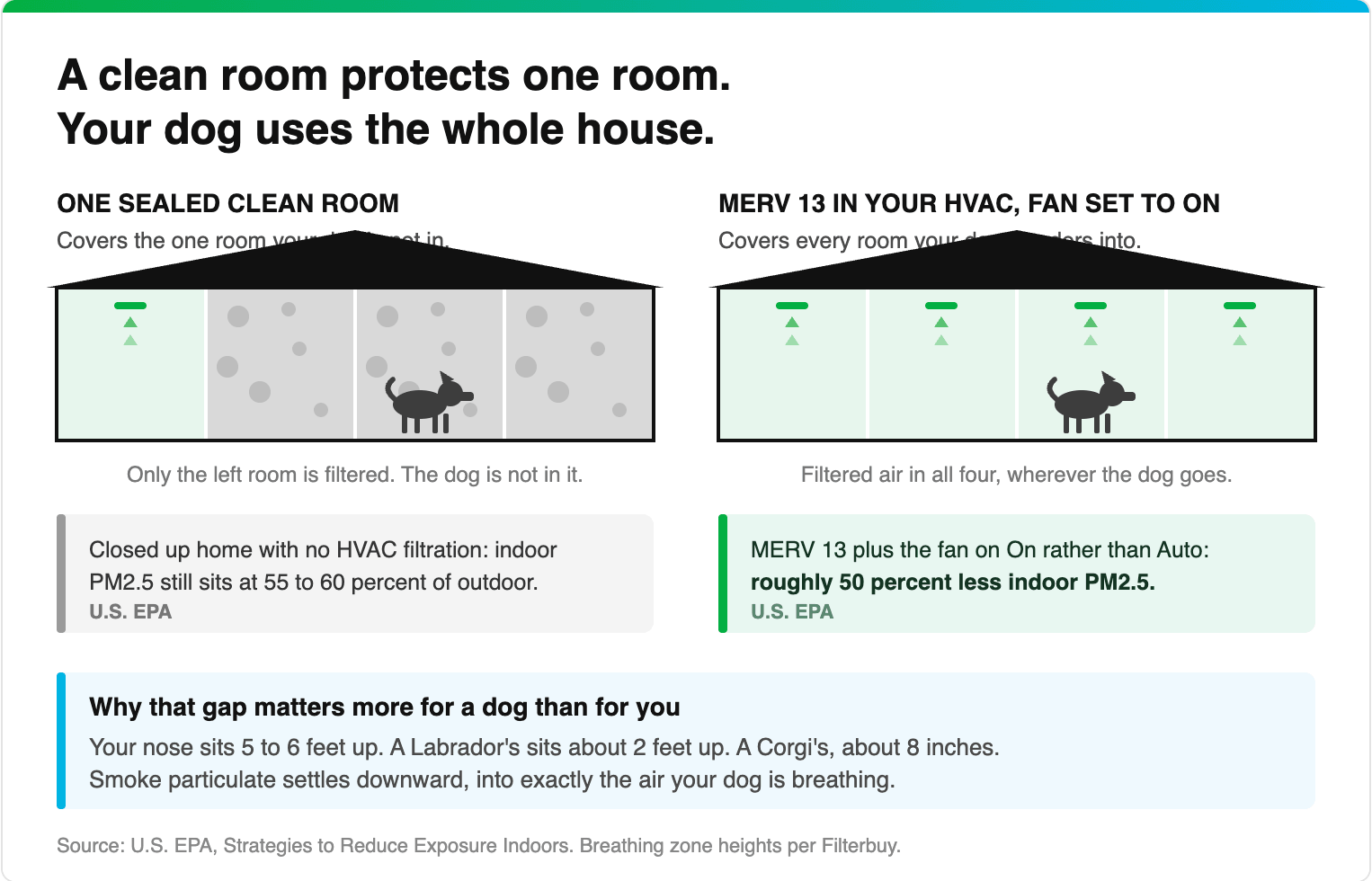
Your dog breathes the air in every room of your house. Give them all of it clean.
MERV 13 is the EPA-recommended minimum for wildfire smoke in homes. Filterbuy makes it in 600 plus standard sizes plus custom, in the USA, shipped factory-direct.
Find you filter size at Filterbuy.
TL;DR
Wildfire smoke affects dogs the same way it affects people, with irritated eyes, coughing, and labored breathing, but dogs breathe faster, breathe closer to the ground, and cannot tell you when something hurts. Flat-faced breeds, puppies, senior dogs, and dogs with heart or lung disease are at the highest risk. The most reliable protection is keeping your dog indoors in filtered air: a MERV 13 filter running continuously in your central HVAC system, windows shut, and outdoor time cut to bathroom breaks.
Key Takeaways
A healthy dog at rest breathes 15 to 30 times per minute. A resting or sleeping rate consistently above 30 is abnormal and warrants a call to your veterinarian, according to VCA Animal Hospitals.
Brachycephalic (flat-faced) breeds are the highest-risk group. Bulldogs, French Bulldogs, Pugs, Boston Terriers, Boxers, and Shih Tzus already have narrowed airways, and Cornell's Riney Canine Health Center lists them alongside geriatric and pediatric dogs as more susceptible to poor air quality.
If you can see or smell smoke, your dog is breathing it. The American Veterinary Medical Association's guidance on wildfire smoke and animals is that when smoke affects you, it affects your animals, and animals with cardiovascular or respiratory disease need the closest watching.
A MERV 13 filter running continuously is the single biggest whole-home lever. The EPA reports that upgrading to a high-efficiency HVAC filter and switching the thermostat fan from "Auto" to "On" can cut indoor PM2.5 by roughly 50%.
A clean room only protects a dog who stays in it. Dogs roam. Central HVAC filtration covers every room your dog wanders into, which is why it is the baseline and a portable HEPA unit is the add-on.
Where This Guide Comes From: What Filterbuy Can and Cannot Tell You
Filterbuy is a filter company writing about your dog's lungs, which means we owe you a straight account of what we do and do not know. It is short.
What Filterbuy is not: a veterinary practice. Every symptom, breed-risk, and when-to-call-the-vet statement on this page is sourced to the AVMA, Cornell's Riney Canine Health Center, VCA, or the EPA, and linked so you can check it.
What Filterbuy is: a U.S. filter manufacturer that has spent more than a decade making the thing standing between outdoor smoke and your indoor air. Narrow expertise, but real, and it is the half of this problem most pet guides skip.
What Filterbuy contributed: two things you will not find on other wildfire-and-pets pages. A method for spotting trouble in your dog before it is obvious, borrowed from veterinary cardiology. And an argument about why standard human smoke advice quietly under-protects dogs. Both are flagged where they appear; everything else here is other people's expertise, cited.
How Wildfire Smoke Affects Dogs
Wildfire smoke harms dogs through the same mechanism it harms people: PM2.5, particulate matter 2.5 microns across or smaller, small enough to bypass the upper airway and reach deep lung tissue. Dogs, cats, and horses have lung architecture broadly similar to ours, which is part of why UC Davis researchers have used animal models to study smoke injury for decades. The difference is not the biology. It is the exposure, and the fact that your dog cannot tell you about it.
Four things stack the deck against dogs during a smoke event.
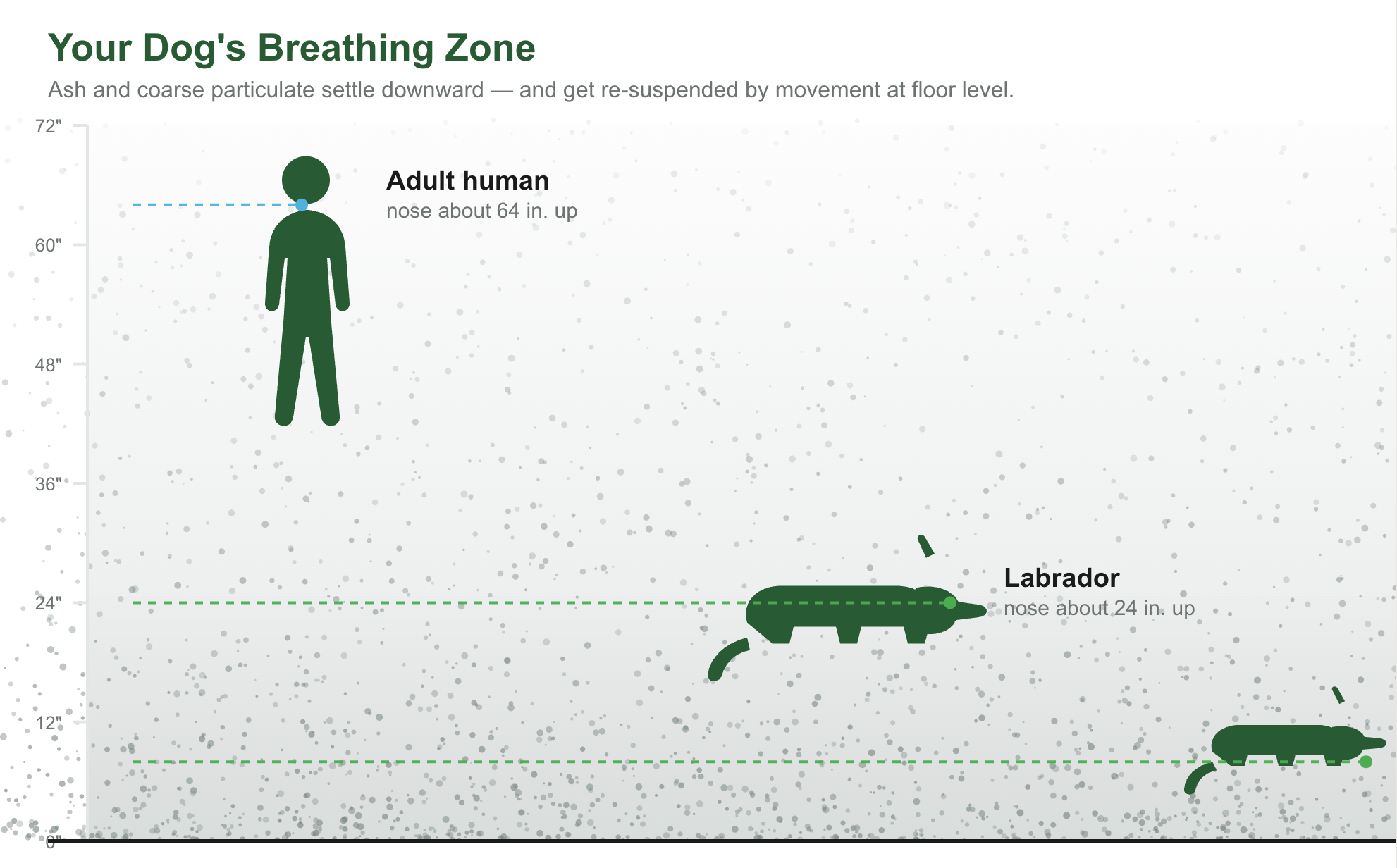
Dogs breathe closer to the ground. An adult human's nose sits five to six feet up. A Labrador's sits about two feet up; a Corgi's is closer to eight inches. Ash and coarse particulate settle downward and get re-suspended by movement, including your dog's own paws crossing a floor or a doormat.
Dogs re-dose themselves by grooming. Smoke particulate settles on a dog's coat during even a short bathroom break, and every subsequent lick moves some of that material from fur to mouth. This is a mechanism rather than a measured figure, and Filterbuy flags it as such: it is why the veterinary advice after any outdoor break is a damp wipe-down, not a dry brush.
Dogs cannot self-report. A person with a scratchy throat stays inside. A retriever with a scratchy throat still brings you the ball. Dr. Jen Quammen, president of the AVMA, has made the point that pets tend to mask symptoms until they no longer can, which means the owner's job during smoke season is active observation, not waiting for an obvious signal.
Heat compounds all of it. The EPA and AirNow fact sheet on protecting pets from wildfire smoke notes that evidence in people shows combined smoke and heat exposure is considerably worse than smoke alone, and that the same is likely true for pets. Smoke season and heat season overlap almost entirely.
The smoke itself has changed. Modern wildfires increasingly burn through the wildland-urban interface, consuming homes, vehicles, plastics, and electronics rather than just timber and brush. UC Davis Air Quality Research Center director Anthony Wexler has noted that this produces meaningfully more toxic smoke and ash than a pure biomass fire. The smoke reaching your neighborhood in 2026 is not the same material your grandparents' dogs breathed.
7 Resources Worth Bookmarking Before Smoke Season Starts
Filterbuy makes air filters, not veterinary calls, so here is where to go for the parts we cannot answer for you. Each one covers a decision that comes down to your address, your budget, or your dog. Save them now. Hunting for a phone number at two in the morning with a coughing dog is nobody's idea of a good time.
All seven were checked and working on 22 July 2026.
1. See the Air on Your Street, Not Just Your City
The AirNow Fire and Smoke Map pulls live PM2.5 readings from monitors and sensors right around your address, and shows you where the fires and plumes actually sit. Smoke varies a lot over just a few miles, so a citywide forecast will not tell you much about your block.
Go here: AirNow Fire and Smoke Map (U.S. EPA and U.S. Forest Service)
2. Finally Make Sense of That AQI Number
AQI Basics walks you through the six colour categories and what each one means for health, in plain language. Pair it with the AQI table further up this page and you will know both what the number means and what to do about your dog.
Go here: AQI Basics (AirNow)
3. Get a Real Toxicologist on the Phone at 3 A.M.
The ASPCA Animal Poison Control Center has veterinary toxicology experts answering the phone 24 hours a day, every day of the year, at (888) 426-4435. Ash on paws and in the water bowl is the classic smoke-season worry, and there is a consultation fee, so put the number in your phone before you need it.
Go here: ASPCA Animal Poison Control Center (ASPCA)
4. Pack the Go-Bag Tonight, Not When the Order Comes
The AVMA's disaster page gives you a printable pet evacuation kit checklist and an emergency contact template you can fill in over one cup of coffee. Smoke and evacuation orders tend to show up together, and a kit you assemble mid-evacuation is not much of a kit.
Go here: Pets and Disasters (American Veterinary Medical Association)
5. Cross Off the Purifiers That Would Make Things Worse
California's Air Resources Board lists every air cleaner certified for low ozone emissions and electrical safety. Worth knowing before you shop: that certification covers ozone, not how well the unit actually cleans, and CARB says so themselves, so use the list to rule units out rather than to crown a winner.
Go here: List of CARB-Certified Air Cleaning Devices (California Air Resources Board)
6. Build Solid Filtration for the Price of a Box Fan
If a purifier is not in the budget this month, EPA tested the box-fan-and-MERV-13 approach and published build guides for it, from a basic version to a better one. One catch worth taking seriously: their testing found dirty filters made these almost useless, so plan on swapping them often.
Go here: Research on DIY Air Cleaners (U.S. EPA)
7. The Steps That Protect You Protect Your Dog Too
EPA's wildland fire hub covers sealing up the house, filtering, setting up a clean room, and dealing with ash afterward. It is written for people, but you are both breathing the same indoor air, so nearly everything on it helps your dog at the same time.
Go here: Wildland Fires and Smoke (U.S. EPA)
Supporting Statistics: What the Research Shows
Three numbers, three primary sources. Each is a U.S. federal agency or a U.S. nonprofit research body.
Current as of July 2026. All sources are U.S. government agencies or U.S. nonprofit research bodies.
Sources: AVMA pet ownership statistics · EPA, Wildland Fires and Public Health Effects · Morris Animal Foundation study announcement.
What this means for your dog
Smoke is not a Western-states problem. Plan for it wherever you live.
There is no automatically safe AQI. For a flat-faced, senior, or heart-disease dog, filter early rather than at the orange line.
Reduce exposure now. It is the step with the strongest evidence behind it.
Where the science actually stands
Known: acute signs (coughing, eye irritation, elevated resting breathing rate) are well documented in dogs.
Unknown: what repeated seasonal exposure does to a dog across a lifetime.
Underway: Dr. Sheryl Magzamen at Colorado State University is cross-referencing regional smoke data against the Golden Retriever Lifetime Study cohort, funded by Morris Animal Foundation, a Denver nonprofit that has backed nearly $170 million across 3,100-plus animal health studies since 1948.
Bottom line: the long-term picture is unresolved, so this guide leads with symptoms and filtration rather than predictions.
Wildfire Smoke Symptoms in Dogs: Early, Worsening, and Emergency
Symptoms of smoke exposure in dogs progress along a predictable path, from mild mucous-membrane irritation to genuine respiratory distress. Dr. Aly Cohen, an extension veterinarian at Cornell's Richard P. Riney Canine Health Center, describes the common signs as irritation of the throat, nose, and eyes, plus coughing, gagging, a fast respiratory rate even at rest, or difficulty breathing. Learn the first column below. Those signs are your cue to act, and they show up hours before the third column does.
Sources: American Veterinary Medical Association; Cornell University Riney Canine Health Center.
Two clarifications that trip up a lot of owners. Panting is not the same as breathing rate. Panting is a rapid, open-mouthed cooling behavior and can exceed 200 breaths per minute in a perfectly healthy dog. Count breaths only when your dog is calm with its mouth closed. And a dog with no cough at all can still be affected; irritated eyes, appetite loss, and lethargy frequently arrive first.
One more thing worth watching: a dog pawing at irritated eyes can scratch its own cornea. Eye rubbing is worth interrupting, not just noting.
The 30-Breath Rule: Build a Sleeping Respiratory Rate Baseline Before Fire Season
A dog's sleeping respiratory rate is the number of breaths it takes per minute while asleep, and it is the most sensitive at-home signal that wildfire smoke is affecting it. Veterinary cardiologists have used the measurement for years to catch heart failure early. Filterbuy's contribution is to borrow it for smoke season: take your dog's baseline on a clear-air day, before any smoke arrives, so you have something to compare against.
This is the first of the two contributions flagged at the top of this guide. As far as we can find, no other wildfire-and-pets page tells owners to establish the baseline in advance.
That condition is the whole trick. A number taken during a smoke event tells you very little; the same number set against your dog's clear-air average tells you a great deal. Which is why this belongs in a guide you read in July, not one you find the week the sky turns orange.
The numbers: VCA Animal Hospitals' home breathing rate guidance, co-authored by a board-certified veterinary cardiologist, puts a normal resting or sleeping breathing rate at 15 to 30 breaths per minute for dogs and cats, healthy or otherwise, and treats a consistent resting rate above 30 as abnormal. BluePearl Pet Hospital adds a second, more sensitive threshold: any increase of more than 20% above that individual animal's own average counts as abnormal, even when the absolute number still looks normal.
That second threshold is the reason the baseline matters. A Beagle whose clear-air SRR is 18 and who is now sitting at 24 has not crossed 30, but has moved 33% above its own normal.
How to take a baseline, in four steps:
1. Pick a clear-air day. Check your local AQI first; you want a day in the green.
2. Wait until your dog is genuinely asleep or lying calmly with its mouth closed. Not post-walk, not hot, not excited.
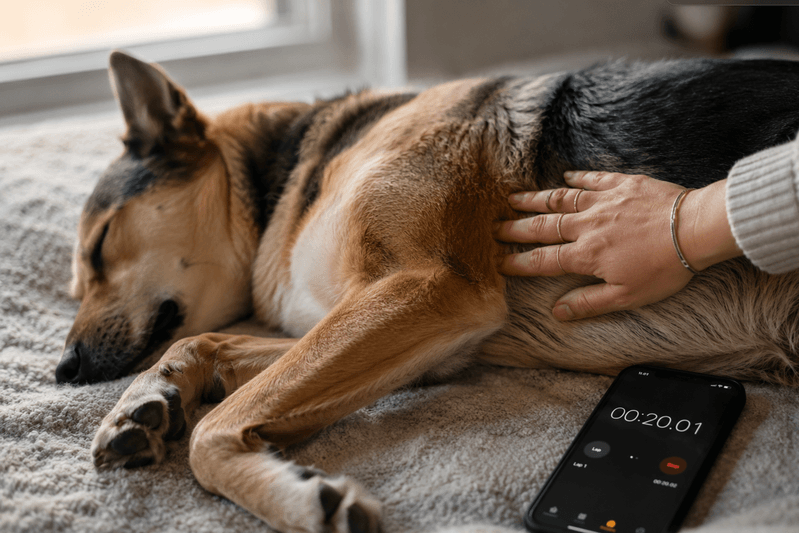
3. Watch the chest and count for 30 seconds, then double it. One rise-and-fall equals one breath. Use your phone's stopwatch.
4. Repeat once a day for about a week, then average. That is the interval BluePearl uses to establish a pet's individual baseline. Write the number on the same note where you keep your vet's after-hours number.
During a smoke event, recount once in the morning and once at night. If the rate is consistently above 30, or consistently more than 20% above your dog's baseline, call your veterinarian even if your dog seems fine otherwise. Recheck in 30 to 60 minutes first, as BluePearl advises, to confirm the reading is real rather than a fluke.
What to Tell Your Vet When You Call
Smoke-season phone lines are busy, and triage moves faster when you lead with numbers instead of adjectives. Have these five things ready before you dial. Most of them take thirty seconds to gather.
1. The resting breathing rate you just counted, and your dog's clear-air baseline if you took one. "Twenty-six, up from a baseline of eighteen" is far more useful than "breathing fast."
2. When the signs started and whether they are getting worse, holding steady, or easing.
3. Your local AQI and how long it has been elevated. Days of moderate smoke and one afternoon of hazardous smoke are different exposures.
4. Total outdoor time in the last 24 hours, including short bathroom breaks.
5. Existing conditions and current medications, especially heart disease, collapsing trachea, chronic bronchitis, or heartworm status.
If your dog is in the emergency column of the symptom table (open-mouth breathing at rest, elbows braced outward, or blue, purple, or pale gums), skip the list and go. Call from the car.
Which Dogs Are at Highest Risk From Wildfire Smoke
Not every dog carries the same risk during a smoke event. Cornell and the AVMA converge on the same high-risk groups: flat-faced breeds, the very young and very old, and any dog with pre-existing heart or lung disease. The EPA singles out short-nosed dogs such as pugs and bulldogs for extra caution, and adds older, younger, and pregnant animals to the watch list.
Sources: Cornell University Riney Canine Health Center; American Veterinary Medical Association; U.S. Environmental Protection Agency.
A note specific to flat-faced dogs: because brachycephalic breeds work harder to move air even on a clear day, the early warning signs owners are told to watch for, such as noisy breathing, open-mouth breathing, and exercise intolerance, may already be part of that dog's normal presentation. That makes an individual SRR baseline more valuable for these breeds than for any other group, and it makes the veterinary relationship non-optional.
What to Do at Each AQI Level
The Air Quality Index is the practical trigger for every decision about outdoor time. Healthy adult dogs can keep normal routines below AQI 100. Above 100, high-risk dogs go out only for elimination. Above 150, every dog does. Check your local reading on AirNow, the EPA-run home of the U.S. Air Quality Index, rather than a regional average, because smoke concentration varies sharply over short distances.
AQI category breakpoints per the U.S. EPA and AirNow. Use your local reading, not a regional average; smoke concentration varies sharply over short distances.
Across every level above 100, the same indoor rules apply: windows and doors closed, HVAC set to recirculate, fan running continuously, and no added indoor smoke of your own. No candles, no incense, no gas-stove searing, and no vigorous vacuuming, which re-suspends the settled particulate sitting right in your dog's breathing zone.
Keeping a Grounded Dog Sane for a Week
Every guide tells you to keep your dog inside. Almost none tell you what that does to a border collie on day four. Cornell's Riney Canine Health Center names this directly: for active dogs that rely on physical exercise for their behavioural health, a long smoke event is genuinely hard, and boredom shows up as unwanted behaviour.
Their recommendation is indoor enrichment rather than substitute exercise, and the distinction matters. You are not trying to tire the dog out. Hard indoor exercise makes a dog breathe harder, which is the opposite of what you want. You are trying to occupy its mind at rest.
Puzzle feeders and long-lasting chews appropriate to your dog's size and chewing style. Cornell names both.
Scent games. Hiding treats around a room engages a dog's strongest sense at almost zero respiratory cost.
Feed meals from a snuffle mat or rolled towel instead of a bowl. A thirty-second meal becomes a fifteen-minute activity.
Short training sessions. Five minutes of learning something new tires most dogs more than a walk does.
Skip indoor fetch and stair sprints. Anything that has your dog panting hard is pulling more particulate deeper into its lungs, even in filtered air.
This is also the argument for getting filtration right rather than relying on the clean room alone. A dog confined to one sealed bedroom for five days has a behavioural problem on top of a respiratory one.
Whole-Home Protection: Why Filtration Matters More for Dogs Than for You
Here is the part most wildfire-and-pets advice gets wrong. The standard human recommendation is to build a clean room: pick one room, seal it, run a portable HEPA air cleaner, and spend your time there. The EPA's guidance is built around exactly that.
Whole-home HVAC filtration protects a dog better than a single clean room does, because dogs move through the whole house. The standard human advice is to seal one room and run a portable air cleaner in it. That is sound advice for a person who stays put. A dog's exposure is a whole-house average, which makes the central HVAC system the primary protective device rather than the supplement.
This is Filterbuy's second contribution to this guide, and the one we feel most strongly about.
A clean room only protects a dog who stays in the clean room. Dogs do not. They follow you to the kitchen, sleep by the back door, patrol the hallway, and lie down wherever the floor is coolest. A dog's exposure is a whole-house average, not a single-room number, which makes your central HVAC system, not a portable unit, the primary protective device in the building.
EPA puts a number on the gap: during smoke events, indoor PM2.5 typically runs at 55% to 60% of outdoor levels in a closed-up home with no air cleaner running. Closing the windows is step one, not the whole job.
That leads to a straightforward three-part setup:
1. Fit a MERV 13 filter and run the fan continuously. The EPA recommends MERV 13 or higher during smoky periods, and notes that a high-efficiency filter with the fan set to "On" rather than "Auto" cuts indoor PM2.5 by roughly 50%. Even a low-efficiency filter run continuously cuts particles about 24%, so the fan setting matters nearly as much as the filter itself. Our MERV 13 vs. HEPA guide for wildfire smoke, Filterbuy's guide to why this rating and not a higher one, covers the tradeoffs.
2. Set the system to recirculate. If your HVAC or window unit has a fresh-air intake, close it. Otherwise you are pulling smoke in as fast as the filter cleans it. Our walkthrough on keeping wildfire smoke out of your house covers sealing in detail.
3. Add a portable HEPA cleaner where your dog actually sleeps. Size it so its smoke (tobacco) CADR at least matches the room's square footage. Avoid any unit that intentionally produces ozone; ozone irritates airways, including your dog's. Sizing detail is in our guide to running an air purifier during wildfire season.
The mistake I see every fire season is people installing the right filter and then leaving it in for the usual ninety days. Smoke loads a filter far faster than household dust does. A filter that has stopped passing air is not protecting anyone, and it is putting strain on the blower at the same time. During a smoke event, look at it weekly.
David Clark, Licensed HVAC Technician, technical reviewer
Check your filter far more often than usual. Heavy smoke can load a 1-inch MERV 13 in a week or two rather than the usual 60 to 90 days. Inspect weekly during an active event and replace it when the media looks gray, dark, or matted, or when airflow noticeably drops. A clogged filter does not just stop cleaning; it strains the blower.
We spend a lot of time thinking about a house as one volume of air. Dogs do not live in the whole volume. They live in the bottom eighteen inches of it, and they put their nose directly into the part of the room where everything settles. Once you picture the room from that height, whole-home filtration stops looking like an upsell and starts looking like the obvious answer.
Michelle Wan, indoor air quality writer, Filterbuy
After the Smoke Clears
Indoor air recovers more slowly than outdoor air after a smoke event, so keep filtering for several days past the all-clear. Settled particulate re-suspends every time someone crosses a floor, which puts it back in your dog's breathing zone. Five things are worth doing as the smoke lifts.
Keep filtering after the AQI drops. Run the fan continuously for at least a few days past the all-clear.
Air the house out when outdoor air genuinely improves. Open windows or reopen the fresh-air intake, per EPA guidance, but check the AQI first rather than going by how the sky looks.
Damp-wipe, do not stir up. EPA advises dusting and mopping with a damp cloth rather than vacuuming, so settled particles do not get back into the air. The same logic applies to your dog: wipe paws, muzzle, and coat with a damp cloth instead of a vigorous grooming session on an already-irritated airway.
Replace the filter you ran through the event. It did its job and it is full.
Watch for the lagging cough. Irritation-driven coughing can persist for days after exposure ends. If a cough is still there after 48 to 72 hours of clean air, book the vet visit.
Frequently Asked Questions
How do I know if my dog has smoke inhalation?
Watch for coughing or gagging, red or watery eyes, an elevated breathing rate at rest, reluctance to move, appetite loss, or disorientation. The most objective at-home check is resting respiratory rate: a dog breathing more than 30 times per minute while calm and mouth-closed is showing an abnormal rate and should be evaluated by a veterinarian.
Can I walk my dog when the air quality is bad?
Limit outdoor time to brief bathroom breaks when air quality alerts are in effect. That is the AVMA's standing recommendation, and the EPA puts it plainly: when it is smoky, it is not a good time for you and your dog to go for a run. Skip runs, fetch, and dog parks entirely. Exertion increases how much air, and therefore how much particulate, your dog moves through its lungs.
Should my dog wear a mask during wildfire smoke?
No. Cornell's Riney Canine Health Center makes the point directly: people can wear masks outdoors to reduce how much fine particulate they inhale, but dogs cannot, which is part of why limiting exposure matters more for them. Masks marketed for pets can restrict a dog's ability to breathe through the nose or pant. Filtered indoor air is the protection that actually works.
Are flat-faced dogs really at higher risk?
Yes. Brachycephalic breeds have anatomically narrowed airways, so they start a smoke event with less respiratory reserve than a longer-muzzled dog. Cornell's Riney Canine Health Center groups them with geriatric and pediatric dogs as more susceptible to poor air quality.
Is a MERV 13 filter safe for my HVAC system?
For most modern residential systems, yes. MERV 13 is generally the highest rating a home blower can handle without airflow problems. Older or undersized equipment is the exception. Check your owner's manual, or ask an HVAC technician if you are unsure. Filterbuy manufactures MERV 13 in more than 600 standard sizes plus custom, so sizing is rarely the constraint; system compatibility is.
Does running the air conditioner help?
Only if it is recirculating indoor air through a high-efficiency filter. An AC set to draw in fresh air is pulling smoke inside. Close the fresh-air intake, install a MERV 13, and set the fan to "On."
Glossary
AQI (Air Quality Index). The U.S. EPA's 0 to 500 scale for reporting daily air pollution levels, color-coded from green (Good, 0–50) to maroon (Hazardous, 301+).
Brachycephalic. Having a shortened skull and muzzle. Brachycephalic dog breeds include Bulldogs, French Bulldogs, Pugs, Boston Terriers, Boxers, and Shih Tzus; these breeds have anatomically narrowed airways.
CADR (Clean Air Delivery Rate). A rating for portable air cleaners measuring how much filtered air a unit delivers per minute. The tobacco-smoke CADR is the relevant figure for fine particles like wildfire PM2.5.
Clean room. A single room sealed and equipped with a portable air cleaner to create a lower-pollution space during a smoke event, as described in EPA guidance.
HEPA (High-Efficiency Particulate Air) filter. A filter certified to capture at least 99.97% of particles 0.3 microns in diameter. Used in portable air cleaners; too restrictive for most residential HVAC blowers.
MERV (Minimum Efficiency Reporting Value). The ASHRAE 52.2 scale rating an air filter's particle-capture efficiency, from MERV 1 to MERV 16. MERV 13 is the EPA-recommended minimum for wildfire smoke in homes.
PM2.5. Particulate matter 2.5 microns in diameter or smaller. The dominant health-relevant component of wildfire smoke; small enough to reach deep lung tissue and, in some cases, the bloodstream.
Recirculate mode. An HVAC setting that closes the outdoor fresh-air intake so the system filters and re-conditions indoor air only.
SRR (Sleeping Respiratory Rate). The number of breaths a dog or cat takes per minute while asleep or resting calmly. Normal is 15 to 30; a consistent rate above 30 is considered abnormal.
Wildland-urban interface. The zone where development meets undeveloped wildland. Fires here burn structures and synthetic materials in addition to vegetation, producing more chemically complex smoke.
Your dog breathes the air in every room of your house. Give them all of it clean.
Shop Filterbuy MERV 13 Air Filters Made in the USA. 600+ standard sizes plus custom. Free shipping, factory-direct.
Sources
`1. American Veterinary Medical Association, Wildfire smoke and animals. https://www.avma.org/resources/pet-owners/emergencycare/wildfire-smoke-and-animals
2. Cornell University College of Veterinary Medicine, Riney Canine Health Center, Dog safety during poor air quality alerts or wildfire smoke (Dr. Aly Cohen; updated Dec 23, 2025). https://www.vet.cornell.edu/departments-centers-and-institutes/riney-canine-health-center/canine-health-topics/dog-safety-during-poor-air-quality-alerts-or-wildfire-smoke
3. VCA Animal Hospitals, Home Breathing Rate Evaluation (Hunter, Weir, and Gordon DVM DVSc DACVIM Cardiology). https://vcahospitals.com/know-your-pet/home-breathing-rate-evaluation
4. BluePearl Pet Hospital, Monitoring Respiratory Rate. https://bluepearlvet.com/pet-blog/monitoring-your-pets-respiratory-rate
5. U.S. EPA, Strategies to Reduce Exposure Indoors (updated Oct 10, 2025). https://www.epa.gov/wildfire-smoke-course/strategies-reduce-exposure-indoors
6. U.S. EPA, Create a Clean Room to Protect Indoor Air Quality During a Wildfire (updated Dec 30, 2025). https://www.epa.gov/emergencies-iaq/create-clean-room-protect-indoor-air-quality-during-wildfire
7. U.S. EPA and AirNow, Protect Your Pets From Wildfire Smoke fact sheet, EPA-452/F-26-007 (June 2026). https://www.epa.gov/system/files/documents/2026-06/protect-your-pets-factsheet.pdf
8. American Veterinary Medical Association, U.S. pet ownership statistics (2025 Sourcebook data). https://www.avma.org/resources-tools/reports-statistics/us-pet-ownership-statistics
9. U.S. EPA, Wildland Fires and Public Health Effects (updated Feb 25, 2026). https://www.epa.gov/wildfires/wildland-fires-and-public-health-effects
10 Morris Animal Foundation, New Study to Examine the Effect of Wildfire Smoke Exposure in Dogs (Sept 3, 2025). https://www.morrisanimalfoundation.org/article/wildfire-smoke-dogs-study
About the author and reviewer
Michelle Wan, Author
is Brand Manager and Air Quality Writer at Filterbuy, where she turns MERV ratings, filtration, and HVAC efficiency into plain-English advice for homeowners, and fronts much of the brand's educational video content (B.A., University of California, Santa Cruz). She works directly with Filterbuy's U.S. manufacturing teams in Alabama, Florida, Pennsylvania, and Utah. Learn more on her author page.
David Clark, Reviewer, Licensed HVAC Technician
This article was technically reviewed by David Clark, a Licensed HVAC Technician.
Published by Filterbuy, an American air-filtration company that has manufactured HVAC filters in the U.S. for over a decade and shipped them to millions of households.