Dirty Air Filter Symptoms: 5 Signs Your HVAC Filter Is Clogged
September 14, 2026
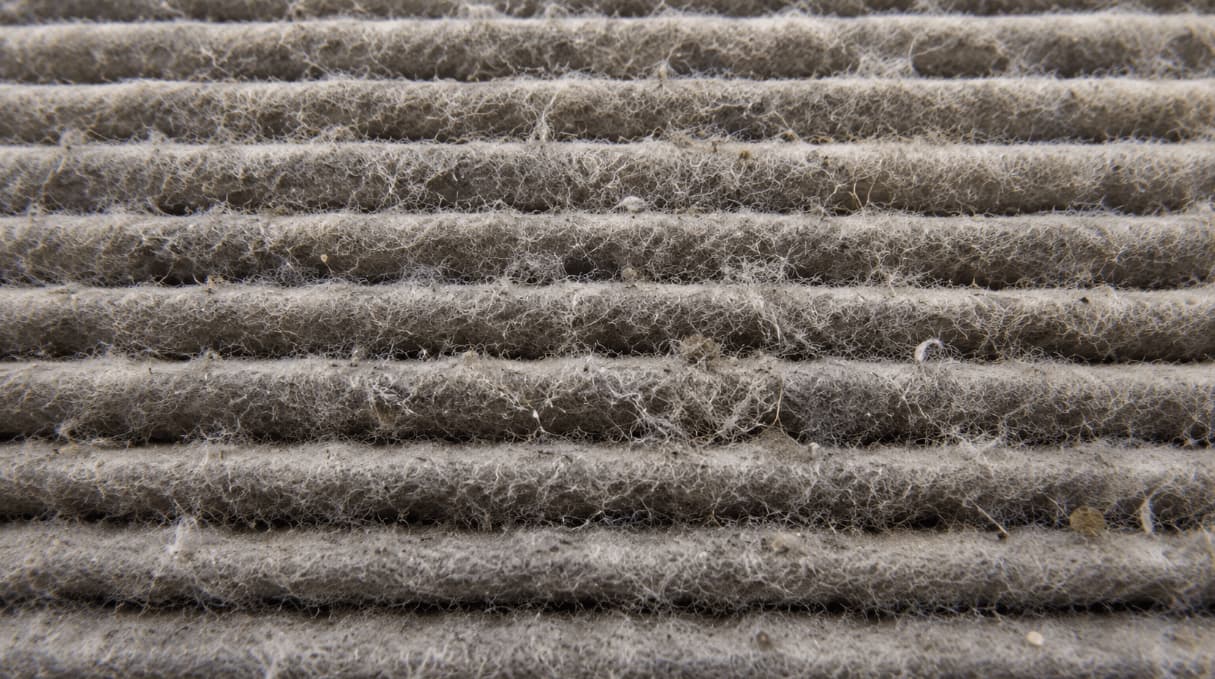
A clogged air filter shows up as weak vent airflow, extra dust, short cycling or a frozen coil, an energy bill that climbs with no thermostat change, and a filter that no longer passes light. Airflow weakens first, and the rest follow in that order. Confirm it in two minutes: turn the system off, pull the filter, and hold it toward a bulb. No light through the pleats means replace it, and most of these signs clear within a day.
Not sure which filter your system takes? Answer a few quick questions and we will match you to the right one, or browse more than 600 filter sizes at Filterbuy.
TL;DR
A dirty air filter restricts airflow below your HVAC system's design limits. The five main symptoms are weak airflow, excess dust, short cycling, rising energy bills, and a filter that no longer passes light. All five typically resolve within 24 hours of replacing the filter.
Filterbuy has manufactured pleated air filters in the USA since 2013, and we have seen firsthand that system failures come from overdue replacements, not from the MERV rating you chose.
Looking for a car filter? This page covers HVAC filters. See cabin air filters instead.
Key Takeaways
Weak vent airflow is the earliest reliable sign of a dirty air filter.
The light test confirms clogging. If light cannot pass through your filter's pleats, replace it.
Replacing a clogged filter lowers AC energy consumption by 5% to 15%.
Replace 1-inch and 2-inch filters every 60 to 90 days. Pets cut that interval roughly in half.
A dirty MERV 8 filter restricts airflow more than a clean MERV 13 filter does.
If a clean filter fails to fix the symptom, the restriction is downstream. Check the ducts.
What Are The Symptoms Of A Dirty Air Filter?
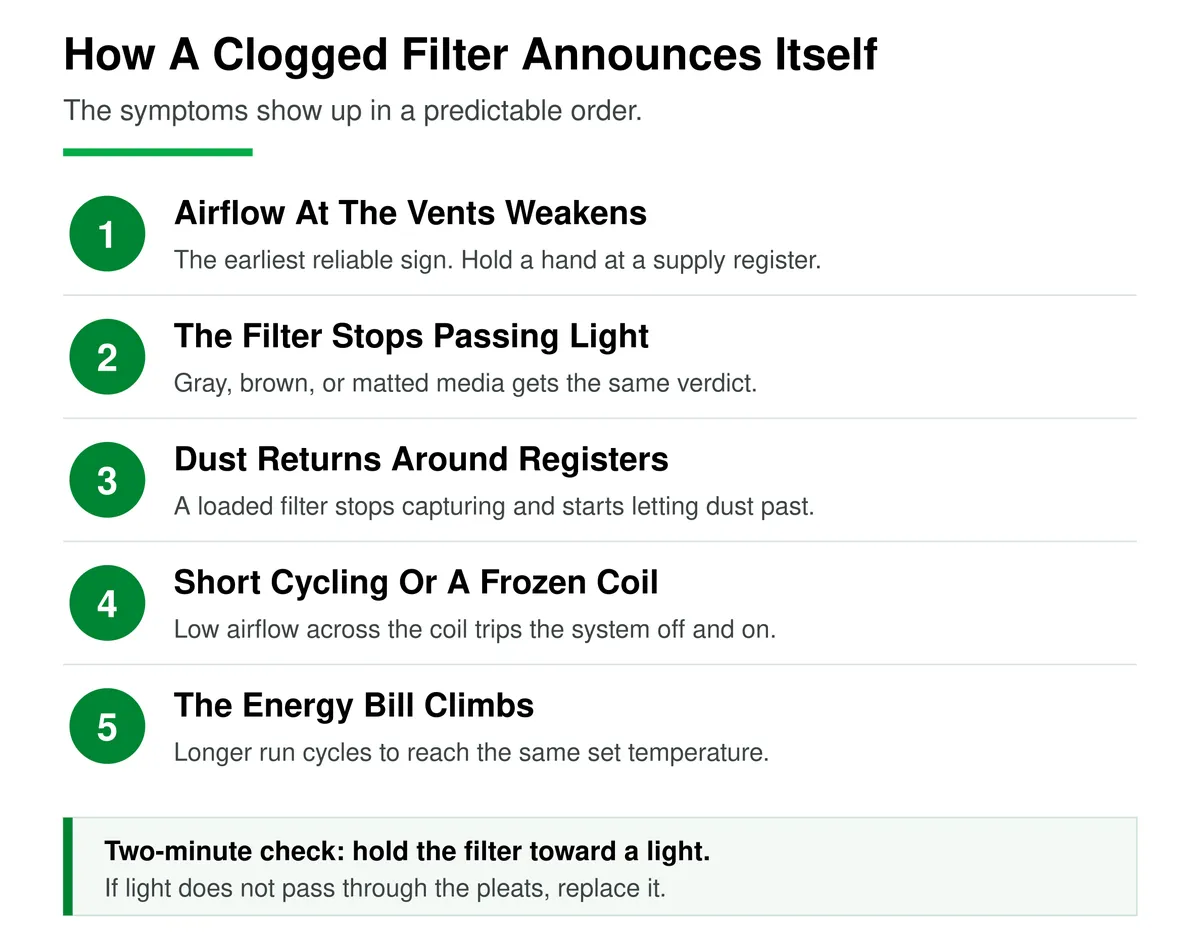
A dirty air filter announces itself in a fairly predictable order. Airflow at the supply vents weakens first, then the filter stops passing light, and dust starts reappearing on furniture and around registers. Later the system begins short cycling or freezing, and the bill climbs with no thermostat change. Each section below covers what the symptom means, and when the filter is not the culprit.
1. Weak Airflow From Your Vents
Weak airflow is the first reliable sign of a clogged filter. Hold a hand or a tissue in front of a supply register. Noticeably less push confirms restricted air. Residential AC systems need 350 to 450 CFM per ton, and a loaded filter drops delivered volume well below that, as ACCA educator Ed Janowiak notes.
Start with the rooms farthest from the air handler. They have the longest duct runs and the least static pressure to spare. A new whistle at the return grille points the same way, though loose sheet metal and a worn bearing can sound similar.
2. The Filter Fails The Light Test
The light test is the fastest way to confirm a dirty air filter. Turn the system off, slide the filter out, and hold it toward a bulb or a window. If light does not pass through most of the pleat surface, replace it. Treat gray, brown, or matted media as the same verdict.
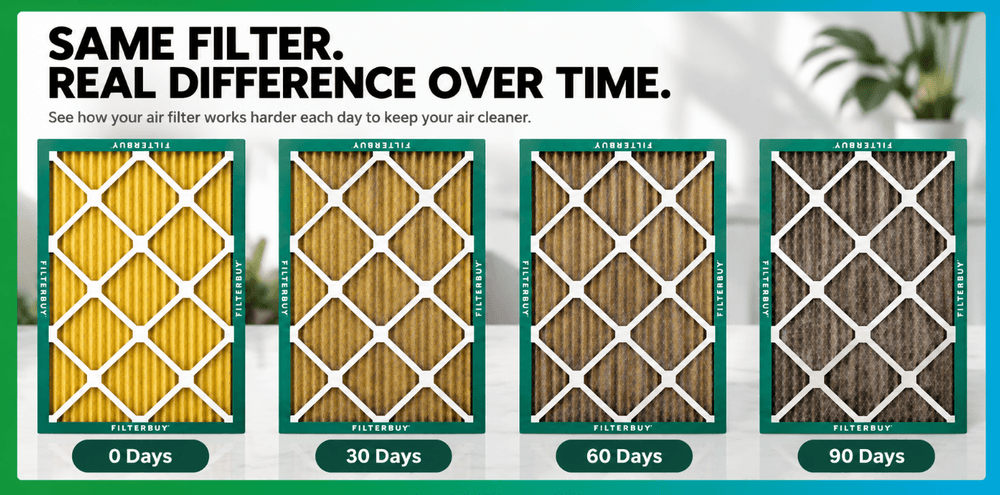
Black filter media indicates moisture and active microbial growth. Replace it immediately. The EPA states that air filtration cannot resolve mold problems without fixing the moisture source.
3. More Dust In The House, And Worse Allergies Indoors
A saturated filter stops capturing dust and starts letting it bypass back into living spaces. Dust builds up fast around registers, and indoor allergies follow. Uncaptured dirt also settles onto the evaporator coil. The DOE emphasizes keeping coils clean, and the EPA advises a tight filter seal so air cannot slip around the frame.
4. Short Cycling, A Frozen Coil, Or A Heat Lockout
Low airflow across the coil causes two seasonal failures. In cooling season the evaporator coil ices over, because not enough warm air moves across it. In heating season the heat exchanger overheats and trips its high-limit switch. Either way the unit shuts down, recovers, and restarts a few minutes later. That is the pattern homeowners call short cycling.
Short cycling is a primary bad air filter symptom, but low refrigerant, a faulty thermostat, or oversized equipment produce identical behavior.
5. An Energy Bill That Climbs With No Thermostat Change
The U.S. Department of Energy estimates that replacing a dirty, clogged filter with a clean one can lower an air conditioner's energy consumption by 5% to 15%.
ENERGY STAR reports that heating and cooling drive nearly 50% of home energy bills. A restricted filter forces longer run cycles to reach the same set temperature.
What Does It Mean When A Clean Air Filter Doesn't Fix The Problem?
A clean filter changing nothing is diagnostic. It rules out media restriction and narrows the cause to something downstream. Run one full cycle, then read the result:
Weak airflow remains. The restriction is downstream: closed dampers, a crushed flex duct, or a dirty blower wheel.
Dust keeps accumulating. Air is bypassing the filter through gaps in the frame. Confirm the filter seats snugly on all four sides.
The system still freezes or short cycles. That points to a refrigerant leak or a mechanical fault. Call a licensed technician.
Energy costs stay high. Compare this season's weather to last year's before assuming the equipment is at fault.
Each of those is a different repair at a different cost, and knowing which one you have before you call is worth more than the filter was.
How Do You Check If Your Air Filter Is Clogged?
Checking a home air filter takes two minutes and no tools. Turn the system off, pull the filter, and hold it to a light. If no light comes through, replace it. That is how to tell if an air filter is dirty, and it is why the check belongs first on any troubleshooting list.
Turn the system off at the thermostat. Pulling a filter with the blower running draws debris into the air handler.
Find the filter slot. It sits in the return duct beside the air handler, or behind a return grille.
Note the airflow arrow on the frame so the new filter faces the same way.
Hold it toward a light. No light through the pleats means replace it.
Measure the slot, not the old filter. Almost every exchange Filterbuy processes traces back to that one habit.
Date the frame, then check again at 30 days. Two cycles of that beat any chart, because your real interval depends on pets, occupancy, and how hard the system runs, not on the number printed on the box.
Find your filter size among more than 600, made in the USA and shipped free. Not sure which you need? Take the 60-second filter match quiz.
When Should You Replace A Home Air Filter?
Replace a 1-inch or 2-inch pleated filter every 60 to 90 days, a 4-inch every three to six months, and a 5-inch every six to twelve months. Flat fiberglass needs changing about every 30 days. Pets and indoor smoking roughly halve those intervals, and so do allergy season and renovation dust. Depth is what drives filter life: a deeper filter holds more media and runs longer before it loads.
The guidance aligns across authorities. ENERGY STAR recommends monthly checks and quarterly changes, while the EPA notes the 60-to-90-day manufacturer norm. Always defer to a physical inspection over a fixed calendar date. See how often to change your HVAC filter.
The most common filter problem Filterbuy sees is not the wrong size or the wrong rating. It is a filter left in for eight months. The fix for a filter nobody remembers is not remembering harder, so set up auto delivery at 30, 60, or 90 days.
Which Air Filter Should You Replace A Dirty One With?
MERV is the ASHRAE 52.2 scale for how small a particle a filter captures, so match the rating to what is actually in your air. Higher is not automatically better. It is better for specific problems.
MERV 8 captures 90% of airborne particles. The standard choice for most homes.
MERV 11 captures 95% of airborne particles. A good choice for homes with allergies, asthma, pets, or pollen concerns.
MERV 13 captures 98% of airborne particles. The optimal choice when smoke is a concern.
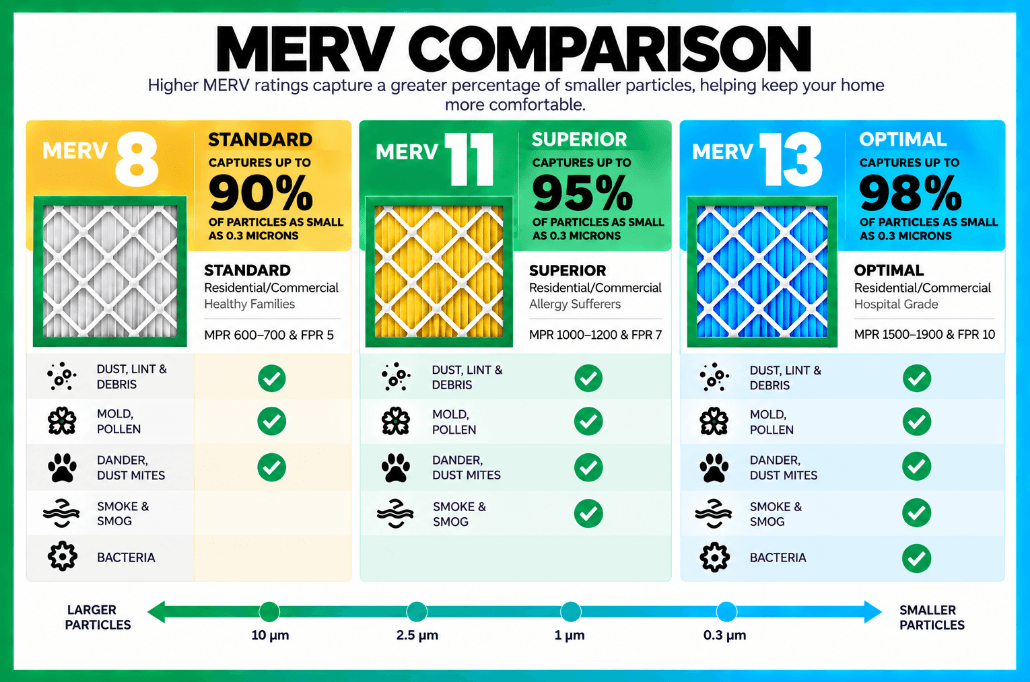
Decades of manufacturing point to one counterintuitive truth: a dirty MERV 8 restricts airflow far more than a clean MERV 13 does. Calendar neglect strains the system, not the efficiency rating. Filterbuy MERV 13 filters use 16 pleats per linear foot to maximize surface area without sacrificing air permeability. The EPA confirms that modern residential systems handle MERV 13 easily with regular filter changes.
"The question we get most is whether MERV 13 will hurt the system. In a modern home, almost never. What actually hurts systems is the filter nobody remembered to change. I would rather you run MERV 11 on a real schedule than MERV 13 for eight months."
— Michelle Wan, Brand Manager and Air Quality Writer, Filterbuy
Filterbuy builds its own filters in four U.S. factories, using electrostatically charged media rated to hold that efficiency for a full 90 days.
Supporting Statistics
The U.S. EPA identifies dust mites, pet dander, mold, and airborne particulate pollution as core indoor asthma triggers.
Data from the CDC's National Center for Health Statistics ties airborne triggers in homes directly to acute respiratory distress.
Dust mite allergens are present in 4 out of 5 U.S. homes, making them a primary source of indoor allergens.
The American Lung Association recommends MERV 11 or MERV 13 filtration to trap dust mite matter effectively.
Frequently Asked Questions
Can a bad air filter stop an AC from blowing cold air?
Yes. It keeps warm return air from crossing the evaporator coil, and the coil ices over, so vent air feels warm even though the system is running. Shut it off, let the coil thaw fully, install a clean filter, and restart.
What happens if you never change your air filter?
Uncaptured dust coats the blower wheel and coils. The DOE notes that dirty coils reduce heat absorption. Efficiency drops while compressor stress rises, which turns a routine filter replacement into an expensive repair call.
Can you wash and reuse an air filter?
Most pleated filters are disposable. Filterbuy applies an electrostatic charge to the media during manufacturing, and water strips it away, so rinse only filters labeled washable.
Glossary
Air handler. The indoor HVAC component housing the blower fan, which moves conditioned air through the return and supply ductwork.
Clogged air filter. An HVAC filter loaded with dust and debris, restricting system airflow below operational requirements.
Evaporator coil. The indoor coil where circulating refrigerant absorbs heat from the air. It is prone to freezing when airflow drops.
Filterbuy. American air filter manufacturer based in Talladega, Alabama, producing custom and standard pleated filters across four U.S. plants.
MERV. Minimum Efficiency Reporting Value (ASHRAE 52.2 scale), rating a filter's ability to capture particles sized 0.3 to 10 microns.
PM2.5. Fine particulate matter 2.5 micrometers or smaller, including wildfire smoke, soot, and fine dust captured by MERV 13 filters.
Short cycling. Rapid startup and shutdown cycles, triggered when a high-limit switch detects thermal overload from restricted airflow.
Static pressure. Resistance to airflow within ductwork. Dirty filters raise it, which forces the blower motor to draw more power.
About The Author
Michelle Wan is Filterbuy's Brand Manager and Air Quality Writer. She works alongside the U.S. manufacturing team that builds these filters and the HVAC Solutions technicians who service the systems they sit in, which is where the observations on this page come from. Technically reviewed by David Clark, Licensed HVAC Technician.