
Portable Air Conditioners and Wildfire Smoke: How Single-Hose Units Create Negative Pressure That Pulls Smoky Air Into Your Home
October 29, 2026
Does a Portable Air Conditioner Filter Wildfire Smoke?
No. A portable air conditioner doesn’t filter wildfire smoke. It cools the air, but it isn’t built to catch fine smoke particles. What matters is the hose setup, plus a portable HEPA air cleaner in the same room to do the filtering.
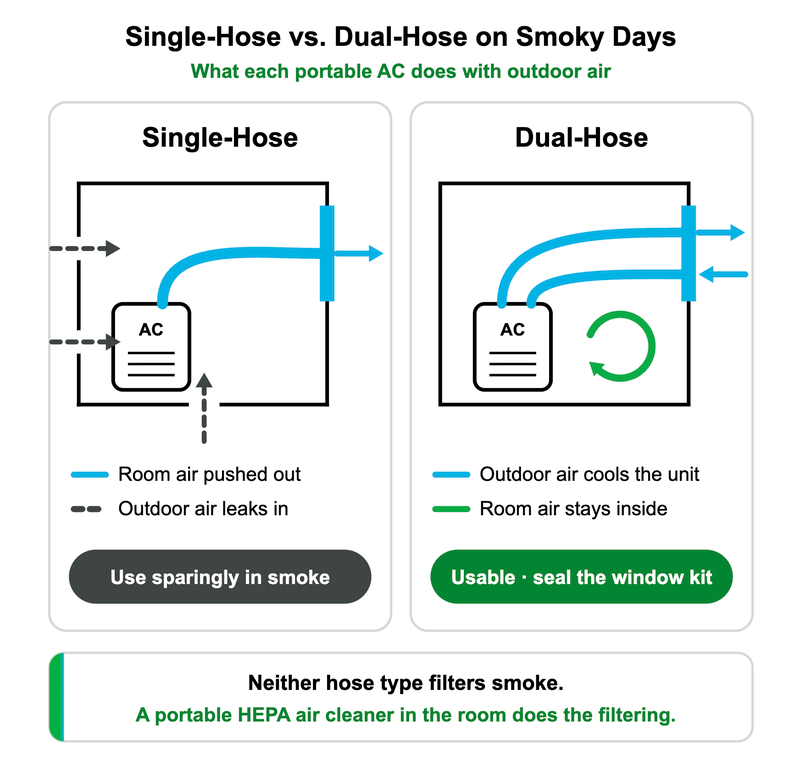
Single-hose: pushes room air out the window, so unfiltered outdoor air leaks in through gaps. Use it sparingly in smoke.
Dual-hose: uses outdoor air only to cool the unit, then sends it back out. Usable if the window kit is sealed tight.
Answer a few quick questions below to find the filter that fits your home.
Have central air or a furnace too? A MERV 13 filter captures microscopic particles. It’s the highest level of residential filtration.
Find Your Filter Match
Cooling with a mini split or portable unit? Answer a few quick questions to see which Filterbuy option fits your home.
TL;DR
A single-hose portable AC blows indoor air out its window hose, and your house replaces it through every crack and gap. On a smoke day, that replacement air is unfiltered and smoky. The EPA advises using single-hose units sparingly in smoke. A dual-hose unit with a sealed window panel is the better choice. To reduce the particles that still get in, run MERV 13 in your HVAC and a portable HEPA air cleaner in each occupied room.
Key Takeaways
In Filterbuy's analysis, a lab-tested 10,000-BTU single-hose portable AC pushed out about 236 cubic feet of indoor air per minute, swapping a 1,500-square-foot home's air for outdoor air about once an hour.
A purifier's smoke clean air delivery rate (CADR) and an AC's exhaust are both in cubic feet per minute, so a purifier rated below the exhaust can't keep up.
A dual-hose unit draws its cooling air from outside, so it doesn't pull on your indoor air the same way.
Portable ACs don't filter smoke. At AQI 100, Filterbuy's action line, switch to MERV 13, set the fan to On, run a HEPA air cleaner in each occupied room and close up the house.
Does a Portable AC Pull in Outside Air?
Not through the hose, but it brings outdoor air in all the same. A single-hose unit pushes indoor air out the window, and the house makes up the difference through its leaks. A dual-hose unit pulls outdoor air in only to cool its condenser, then sends it straight back out.
How a Single-Hose Portable AC Creates Negative Pressure
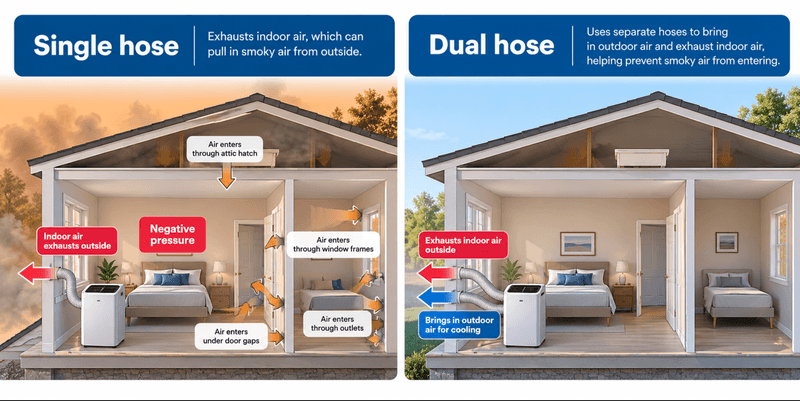
Negative pressure is what you get when more air leaves a space than comes in on purpose. A single-hose unit cools its condenser, the hot coil inside, with room air and vents that air outdoors. With the windows shut, the house refills through gaps around doors, windows, outlets and the window kit. None of that air is filtered, so on a smoke day it carries the particles you closed up the house to avoid.
The EPA's 2026 heat and smoke guidance says to use single-hose units sparingly because they can bring more smoke inside. Earlier EPA guidance said not to run them in smoke at all.
When we ran the airflow numbers from a DOE-procedure lab test, what surprised us wasn't that single-hose units let smoke in. It was the scale. One unit can swap out a small apartment's air about twice an hour, and tape around the window kit won't fix that.
Michelle Wan, Brand Manager and Air Quality Writer, Filterbuy
The Smoke-Day Math: How Much Air a Single-Hose Unit Replaces
To put a number on it, we started with a report from Intertek, an independent testing lab, on a 10,000-BTU single-hose unit tested to the U.S. Department of Energy (DOE) procedure. Filterbuy did the math from its raw airflow:
Source: Intertek test report 220812099GZU-001, single-hose portable AC tested to DOE Appendix CC (two samples).
On a 95°F day, incoming hot air cancels roughly two-thirds of the unit's cooling, which is why its seasonally adjusted rating (SACC) is lower.
In three common home sizes, that works out to:
Filterbuy estimate: 236 CFM average exhaust, 8-ft ceilings, unit running continuously.
These are estimates, not field measurements.
Run the Numbers on Your Own Unit
Start with exhaust airflow. Spec sheets rarely list it, so use 236 CFM, the lab figure for a 10,000-BTU unit.
Work out air changes per hour. Multiply CFM by 60 and divide by floor area times ceiling height. A 1,000-square-foot apartment with 8-foot ceilings works out to 236 × 60 ÷ 8,000, or about 1.8.
Compare it with your purifier. A purifier's smoke CADR uses the same unit. If it's lower than your AC's exhaust, outdoor air is entering faster than the purifier can clean it, though walls catch some smoke on the way in.
Confirm with a monitor. Compare PM2.5, the fine particles that make up most smoke, in a room the AC doesn't cool with the outdoor reading on Filterbuy's live wildfire smoke and AQI map.
Single Hose vs. Dual Hose on Smoke Days
A dual-hose unit is the better pick. Where smoke season is a yearly event, that second hose is worth more than extra BTUs.
Guidance: U.S. EPA, Protect Yourself from Heat and Smoke (2026) and Create a Clean Room During a Wildfire.
Does a Portable AC Filter Wildfire Smoke?
No. Filterbuy makes filters for a living, and a portable AC's mesh screen won't stop smoke. It keeps lint off the coil while PM2.5 passes through, and the EPA's heat and smoke guidance agrees.
For better portable AC air quality on smoke days, the EPA points to two layers that work together: a MERV 13 or higher filter in central HVAC and portable air cleaners, which also work on their own in homes without ductwork. Our portable air purifier vs. HVAC filter comparison covers budgeting for both.
What to Do on a Smoke Day If You Have a Single-Hose Portable AC
Start with official sources. Check the AirNow Fire and Smoke Map and your local air agency first. Filterbuy's live wildfire smoke and AQI map adds active fires.
Staying cool comes first: cool the house before smoke arrives, then run the single-hose unit in short stretches. Fans, central AC on recirculate, or a window AC with its vent closed won't depressurize the house.
At AQI 100 and above, take these four steps in order. AQI 100 is Filterbuy's action line. It sits at the top of the Moderate range, and we act there instead of waiting for the next category.
MERV 13 in the HVAC. Check the filter during smoke and replace it when it looks dark brown or black, which can be well before the usual interval, so keep spares on hand.
Thermostat fan to On. Auto only filters while the system heats or cools. On filters all the time.
A portable HEPA air cleaner in each occupied room, bedrooms first. The EPA's ENERGY STAR program sizes these by smoke CADR at least two-thirds of the room's square footage, so a 300-square-foot bedroom needs a smoke CADR of about 200. Skip ozone-producing models; the California Air Resources Board's (CARB) air cleaner guide explains certification.
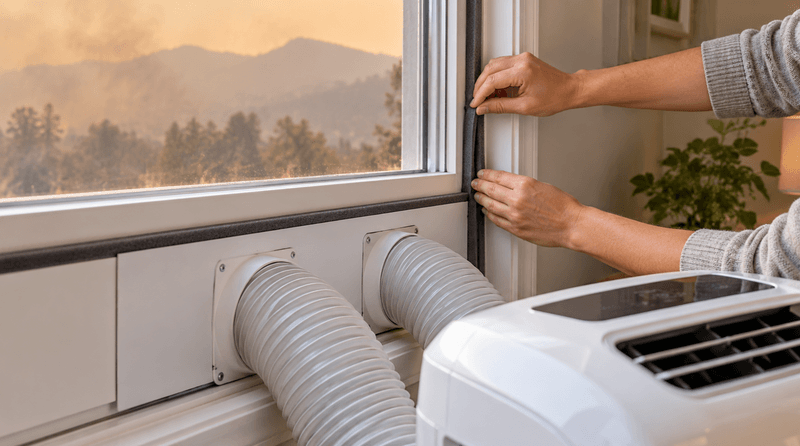
Close the house up. Shut windows and doors, seal the portable AC's window kit with foam weatherstrip, and skip candles, frying, smoking and vacuuming without a sealed HEPA vacuum.
No central HVAC? In apartments and homes without ductwork, portable HEPA air cleaners are your main defense, not a backup.
If the AQI climbs past 200, or officials tell you to stay in or leave, their guidance comes first. Filtration is one layer, so set up a clean room too. The EPA also notes heat is usually the more immediate danger, so if your home gets unsafely hot, head to a cleaner-air shelter or a cooled library.
Where Your HVAC Filter Fits In
Your HVAC filter covers the whole house. The EPA recommends a filter rated MERV 13 or higher during smoky periods, and its wildfire smoke guidance notes that most furnaces and HVAC systems can run MERV 13 without equipment problems as long as the filter is replaced often. Our comparison of MERV 13 vs. HEPA filters for wildfire smoke shows how the two layers share the work.
Fit matters too: almost every exchange Filterbuy processes traces back to measuring the old filter instead of the slot it sits in, and air that slips around a filter skips it.
Filterbuy makes MERV 13 filters to order in its U.S. plants in more than 600 sizes. Shipping is fast and free, and auto-delivery keeps spares on hand before fire season. Find MERV 13 in your size.
Supporting Statistics: What the Research Shows
Three U.S. government findings back up this advice.
1. Half of Northeast Homes Cool Mainly With Individual AC Units
The U.S. Energy Information Administration surveyed 18,496 households in 2020 and found that 50% of Northeast homes rely mainly on individual units, a group that includes portable ACs.
Filterbuy's read: this is not a niche question.
2. Indoor Smoke Nearly Tripled in 1,400+ California Buildings
A NOAA-funded study in the Proceedings of the National Academy of Sciences found that mean indoor PM2.5 nearly tripled on wildfire days, even though the share of outdoor particles getting inside fell from 0.4 to 0.2. Buildings with air conditioning or filtration let in less smoke.
Filterbuy's read: smoke still gets in, so extra outdoor air works against you.
3. Every Portable Air Cleaner Sold in California Must Be Certified
The California Air Resources Board (CARB) has required certification for all portable indoor air cleaners sold in the state since 2010. Electronic models must keep ozone emissions to 50 parts per billion or less.
Filterbuy's read: CARB's list is a quick way to rule out ozone-producing purifiers.
Frequently Asked Questions
Can I Run a Portable Air Conditioner During Wildfire Smoke?
Yes, but sparingly, as the EPA advises, because a single-hose unit pulls smoky outdoor air into the house. Run a HEPA purifier nearby, and if the heat becomes unsafe, staying cool comes first.
How Can I Tell If My Portable AC Is Single-Hose or Dual-Hose?
Count the hoses running to the window: one means single-hose, and two (intake and exhaust) mean dual-hose. Spec sheets say "single duct" or "dual duct."
Is a Window AC Better Than a Single-Hose Portable AC for Wildfire Smoke?
Usually, yes. A window AC doesn't vent indoor air outside. Close its fresh-air vent, seal the gaps, and see Filterbuy's guide to window AC units and wildfire smoke.
Glossary
Single-hose portable AC: A portable AC that cools its condenser with room air and vents that air outdoors through one hose.
Dual-hose portable AC: A portable AC that cools its condenser with outdoor air through two hoses.
PM2.5: Airborne particles 2.5 micrometers or smaller, the main health hazard in wildfire smoke.
MERV 13: An ASHRAE 52.2 filter rating and the EPA-recommended level for HVAC filtration during smoke.
SACC: Seasonally Adjusted Cooling Capacity, the DOE rating that accounts for infiltration losses.