
MERV 13 vs. HEPA Filters for Wildfire Smoke: Which Should You Use?
July 14, 2026
By Michelle Wan · Technically reviewed by David Clark, Licensed HVAC Technician · Published July 14, 2026 · Updated September 4, 2026
Not sure which size and rating your system takes?
Answer a few quick questions and we'll match you to the right filter.
Quick answer:
For wildfire smoke, MERV 13 and true HEPA work best together, not as rivals. A MERV 13 filter is the practical whole-home option for central HVAC systems that can handle it. A true HEPA air cleaner is the stronger choice for a single room. Many homes benefit from both. Always confirm your HVAC can accommodate a MERV 13 filter before upgrading.
MERV 13 vs. HEPA for Wildfire Smoke at a Glance
| Factor | MERV 13 | True HEPA |
|---|---|---|
| Where it fits | Central HVAC (return-air filter) | Portable air cleaners and purpose-built appliances |
| Coverage | Whole home (when HVAC is compatible) | Single room or defined space |
| Efficiency standard | ASHRAE Standard 52.2 | U.S. definition: ≥99.97% at 0.3 μm |
| Single-pass efficiency | High for fine particles, lower than HEPA | Highest single-pass efficiency |
| Airflow impact | Moderate; depends on system | Requires a sealed, dedicated appliance |
| Best role | Whole-home baseline | Room-level protection for sensitive occupants |
| Removes gases/odors? | No (unless paired with carbon) | No (unless paired with carbon) |
Note: MERV and HEPA figures come from different testing frameworks, so a MERV rating and a HEPA percentage are not measured the same way. Treat the table as a guide to roles, not a direct apples-to-apples score.
The Short Answer: Use the Right Filter in the Right System
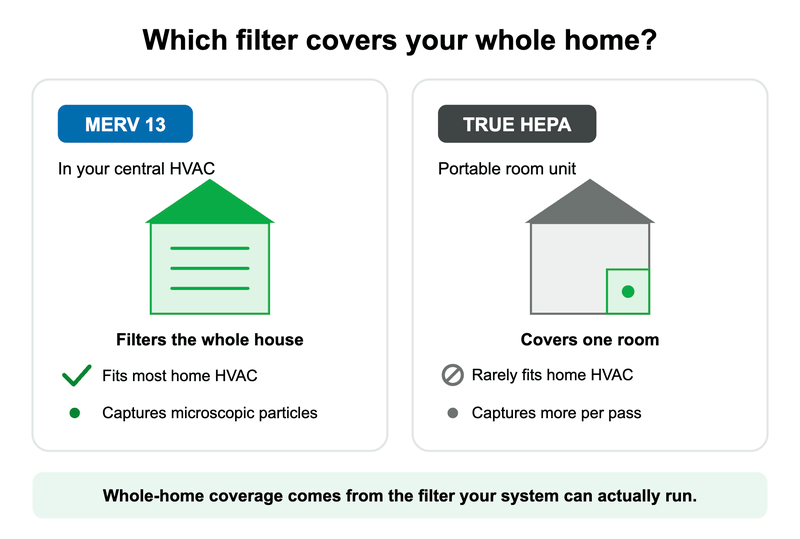
True HEPA delivers higher single-pass efficiency, meaning it captures more particles each time air passes through it. MERV 13 is more compatible with residential HVAC, so it can clean air across your whole home rather than one room.
Overall smoke reduction depends on more than the filter rating. A useful way to think about it: real-world particle reduction is roughly capture efficiency multiplied by airflow multiplied by runtime. (This is a conceptual framework, not an engineering equation.) Building leakage and correct installation matter too. A high-rated filter that chokes airflow or leaks around the edges will underperform a properly sized, well-sealed one.
The takeaway is simple. Use MERV 13 where your HVAC supports it. Use true HEPA in equipment designed for it.
What Part of Wildfire Smoke Can an Air Filter Remove?
Fine particles, including PM2.5
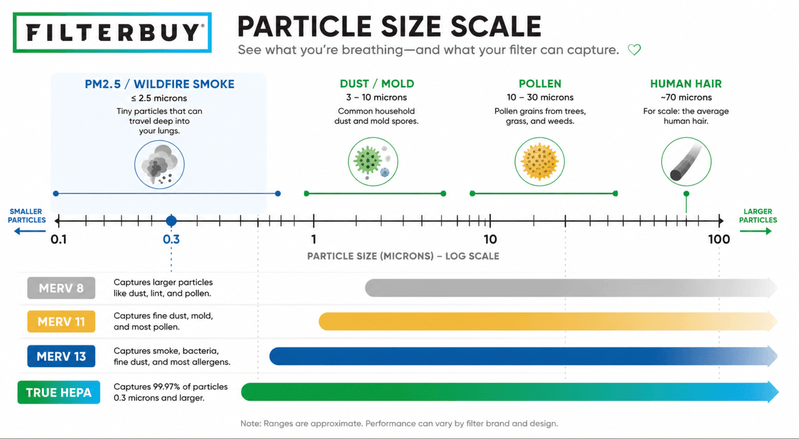
Wildfire smoke is loaded with fine particulate matter known as PM2.5: particles 2.5 micrometers wide or smaller. According to the U.S. Environmental Protection Agency, PM2.5 is the main pollutant of concern in wildfire smoke and can aggravate the heart and lungs, especially for sensitive groups. The CDC notes that people with chronic heart or lung conditions face higher risks during smoke events.
Both MERV 13 and true HEPA filters can reduce airborne PM2.5. The difference lies in how much they capture per pass and where they can be installed.
Gases and vapors
Particle filters, whether MERV 13 or HEPA, do not remove gases. That includes carbon monoxide (CO) and many volatile organic compounds (VOCs) that give smoke its odor.
This is an important safety point. No air filter replaces a working CO alarm. If you use combustion appliances or a generator during a smoke event, keep functioning carbon monoxide alarms in place.
Activated carbon can help reduce some odors and gases, but it has real limits. Carbon media has a finite capacity, loads up over time, and does not remove CO. If odor control is a priority, a carbon option such as the Filterbuy Odor Eliminator can supplement particle filtration, but treat it as a helper, not a substitute for particle capture or CO monitoring.
How MERV 13 Filters Work Against Wildfire Smoke
MERV, or Minimum Efficiency Reporting Value, is defined by ASHRAE Standard 52.2. The test measures how well a filter captures particles across three size ranges:
E1 (0.30 to 1.0 µm): MERV 13 captures at least 50%
E2 (1.0 to 3.0 µm): at least 85%
E3 (3.0 to 10.0 µm): at least 90%
Those are lab thresholds under controlled conditions. Real-world performance varies with airflow, runtime, and how well the filter is sized and sealed in the return. A filter that fits loosely lets smoky air slip around it, which lowers real capture no matter the rating. Correct sizing and a snug seal matter as much as the number on the box.
Filterbuy MERV 13 filters are available in standard and custom sizes, so you can match the exact dimensions and depth your system requires. If you are unsure which size you need, see our guide on how to find your air filter size, and if you're weighing options, compare MERV 11 vs. MERV 13.
How True HEPA Filtration Works Against Wildfire Smoke
Under the U.S. definition, a true HEPA filter captures at least 99.97% of particles at 0.3 micrometers, the most penetrating particle size. It works through several mechanisms at once, trapping particles both larger and smaller than that hardest-to-catch size.
HEPA only performs to spec inside a sealed appliance that forces all air through the media. If air can bypass the filter, efficiency drops sharply.
Watch the label carefully. Terms like "HEPA-type," "HEPA-style," or "HEPA-like" are not the same as certified true HEPA and often capture far less. It's also tempting to equate HEPA with very high MERV ratings such as MERV 17 to 20, but that is not a reliable direct equivalency because the two use different test methods.
Can You Put a HEPA Filter in a Furnace or Central AC?
Generally, no. A true HEPA filter is not a drop-in replacement for a standard furnace or central AC filter. HEPA media is dense, which creates a large pressure drop that most residential blowers were never designed to overcome.
Forcing a HEPA filter into a system built for lower-resistance filters can cause:
Reduced airflow throughout the home
Frozen evaporator coils
Overheating
Accelerated wear on the blower and other components
Whole-home HEPA systems do exist, but they rely on purpose-built equipment and professional installation. They are not created by swapping in a HEPA panel where your regular filter goes.
Can Your HVAC System Handle a MERV 13 Filter?
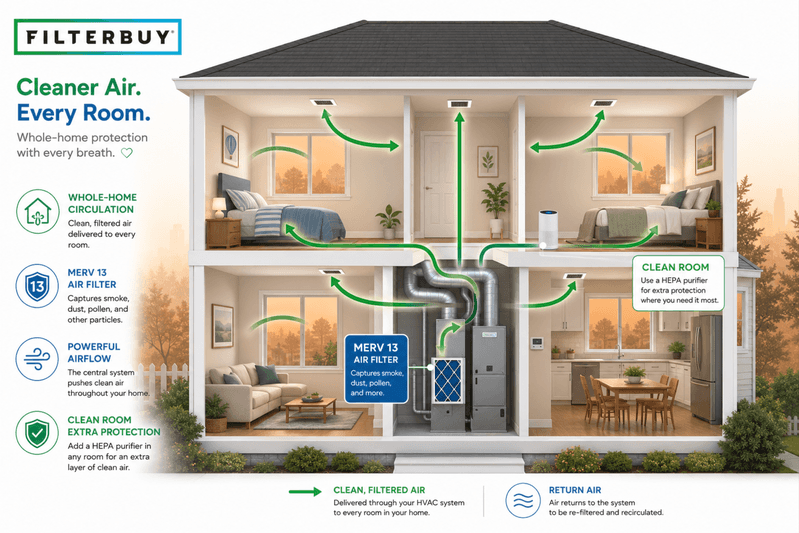
MERV 13 is a strong whole-home baseline, but it is not automatically right for every system. Some residential HVAC units can accommodate it comfortably; others cannot without airflow problems. Check first.
Check before upgrading
Review your HVAC manual or manufacturer documentation for filter guidance
Confirm the correct dimensions and depth for your return
Look for pressure-drop data on the filter you're considering
Inspect for air bypass or gaps around the filter slot
Consult an HVAC technician if you're uncertain
Note that a system's age is not a reliable test of compatibility. Rely on the manufacturer's specifications and airflow behavior instead.
Watch for possible airflow problems
After installing a higher-efficiency filter, watch for warning signs:
Weak airflow from vents
Whistling around the filter slot
Longer heating or cooling cycles
Unusual blower noise
Ice forming on the coil
The system cycling off on a high-limit switch
The filter bowing or deforming
Any of these suggests the filter may be too restrictive for your system.
If MERV 13 is too restrictive
If your system struggles with MERV 13, you still have good options:
Use the highest MERV rating your system can handle comfortably
Add a media cabinet with a deeper filter for more surface area and lower resistance
Use a portable HEPA cleaner to supplement whatever your HVAC can manage
For more on this trade-off, see our explainer on whether higher-MERV filters restrict airflow.
The Best Home Setup During Wildfire Smoke
No single product does everything. A layered approach protects your home better than any one filter alone.
1. Use the highest-efficiency HVAC filter the system can accommodate
Fit the best filter your equipment supports without harming airflow, ideally MERV 13 if compatible.
2. Run the system in recirculation mode
Keep the fan running to filter air continuously, and close any fresh-air intake so you're recirculating and cleaning indoor air rather than pulling smoke in.
3. Create a cleaner-air room
Following EPA guidance, pick one room, close windows and doors, and run a portable air cleaner sized for the space. This gives sensitive household members a place to breathe easier.
4. Size a portable air cleaner by smoke CADR
Clean air delivery rate (CADR) tells you how much clean air a unit produces. AHAM guidance and many manufacturers now list a smoke CADR. Match it to your room size for the best results.
5. Monitor the filter rather than relying on a universal schedule
Smoke loads filters faster than normal. Check yours often during heavy smoke and change it when it looks dirty rather than waiting for a set date. See how often to change an air filter for context.
6. Track local air conditions
Use AirNow.gov and its Fire and Smoke Map to follow local air quality and time your ventilation. For a fuller routine, read our guide on how to improve indoor air quality during wildfire smoke.
Which Wildfire-Smoke Setup Fits Your Home?
| Your situation | Recommended setup |
|---|---|
| Central HVAC, MERV 13 compatible | MERV 13 in the return, run fan on recirculation, add portable HEPA for sensitive occupants |
| Central HVAC, MERV 13 can be restrictive | Highest compatible MERV or a media cabinet, plus a portable HEPA cleaner |
| No central HVAC (window units, mini-splits) | One or more portable HEPA cleaners, a cleaner-air room, or a DIY box-fan filter |
| Someone with heart or lung conditions | Cleaner-air room with a properly sized true HEPA cleaner, whole-home filtration as backup |
Are DIY Air Cleaners Effective for Wildfire Smoke?
Yes, within limits. A simple box fan paired with a MERV 13 filter can meaningfully reduce indoor smoke particles. A Corsi-Rosenthal box, which combines a box fan with several MERV 13 filters into a cube, performs even better because of its larger filter area.
EPA research on DIY air cleaners supports their short-term use during smoke events. Keep safety in mind: use a fan in good condition, don't leave it running unattended for long stretches, and follow assembly guidance carefully. A DIY cleaner is a helpful stopgap, not a permanent replacement for a properly designed system.
MERV 13 vs. HEPA: Final Recommendation
Choose based on where you need clean air. Use a MERV 13 filter as your whole-home baseline when your HVAC can handle it. Use a true HEPA cleaner for focused, room-level protection, especially for anyone with heart or lung sensitivities. For most homes facing wildfire smoke, running both at once is the strongest approach.
The right filter only helps if it fits your system and seals properly. When you're ready to upgrade your HVAC filtration, find the right Filterbuy MERV 13 filter for your system in standard and custom sizes.
Frequently Asked Questions
Is MERV 13 Good For Wildfire Smoke?
Yes. MERV 13 captures a high share of fine smoke particles, including much of the PM2.5 range, when installed in a compatible HVAC system. It works best as a whole-home baseline that runs continuously on recirculation. Confirm your system can handle it before upgrading.
Is HEPA Better Than MERV 13 For Smoke?
True HEPA has higher single-pass efficiency, capturing at least 99.97% of particles at 0.3 µm. But it only works in a sealed appliance and typically covers one room. MERV 13 covers your whole home. They serve different roles, so the best setup often uses both.
Can I Put A HEPA Filter In My HVAC System?
Generally no. True HEPA media creates a large pressure drop that most home blowers can't overcome, risking reduced airflow, frozen coils, and equipment strain. Whole-home HEPA exists but needs purpose-built equipment and professional installation, not a simple filter swap.
Does MERV 13 Remove PM2.5?
Yes, MERV 13 reduces airborne PM2.5. Under ASHRAE Standard 52.2, it captures at least 50% of the smallest tested range (0.30 to 1.0 µm) and higher percentages of larger particles. Real-world results depend on airflow, runtime, correct sizing, and a good seal.
Will MERV 13 Restrict HVAC Airflow?
It can, depending on your system. Some units handle MERV 13 fine; others show weak airflow, longer cycles, or coil icing. Check your manual and the filter's pressure-drop data first, and consult an HVAC technician if you're unsure.
How Often Should HVAC Filters Be Changed During Wildfire Smoke?
More often than usual. Smoke loads filters quickly, so inspect yours frequently during heavy smoke and replace it when it looks dirty rather than following a fixed calendar. A clogged filter both cleans poorly and strains your system.
Do HEPA Or MERV 13 Filters Remove Smoke Odors?
No. Both are particle filters and don't remove the gases and VOCs behind smoke odor. Activated carbon, such as the Filterbuy Odor Eliminator, can help reduce some odors, but carbon has limited capacity and never removes carbon monoxide.
Should I Run My HVAC Fan Continuously During Wildfire Smoke?
Yes, if your system can handle it. Running the fan on recirculation filters indoor air continuously. Close fresh-air intakes so you're cleaning indoor air rather than drawing in smoke, and keep monitoring your filter as it loads faster than normal.
Is A Corsi-Rosenthal Box Useful For Wildfire Smoke?
Yes. A Corsi-Rosenthal box combines a box fan with several MERV 13 filters for a large filtering surface, and EPA research supports DIY cleaners during smoke events. Build it safely and treat it as a temporary supplement, not a permanent system.
Glossary
ASHRAE Standard 52.2: The test method that defines MERV ratings by measuring particle capture across three size ranges.
CADR (Clean Air Delivery Rate): A measure of how much clean air a portable air cleaner produces; a smoke CADR reflects performance against smoke particles.
HVAC blower: The fan that moves air through your heating and cooling system and its filter.
MERV (Minimum Efficiency Reporting Value): A rating scale for how well an HVAC filter captures particles.
PM2.5: Fine particulate matter 2.5 micrometers or smaller, the main pollutant of concern in wildfire smoke.
Pressure drop (static pressure): The resistance a filter adds to airflow; a higher pressure drop can strain HVAC equipment.
Recirculation: Running your HVAC to clean and reuse indoor air rather than pulling in outdoor air.
True HEPA: A filter that captures at least 99.97% of particles at 0.3 µm, defined under the U.S. standard.
VOCs (Volatile Organic Compounds): Gases that contribute to smoke odor and are not captured by particle filters.