
How Often Should You Change Your Air Filter During Poor Air Quality Events?
July 14, 2026
How Often Should You Change Your Air Filter When the AQI Is High?
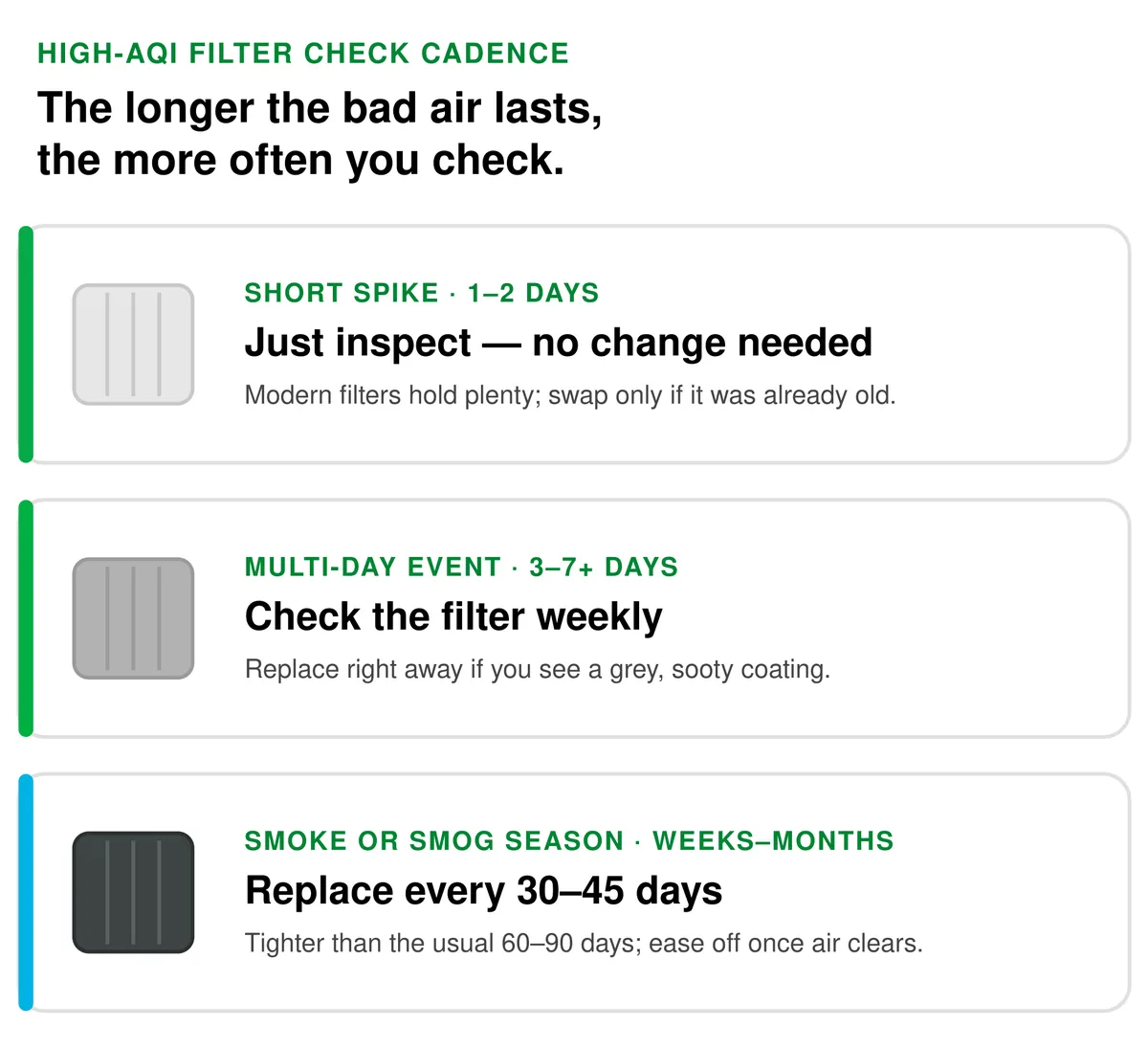
Match how often you check to how long the bad air lasts: skip the change after a 1–2 day spike, check weekly during multi-day smoke or smog, and replace every 30–45 days through an extended wildfire or smog season. A single hazy day rarely overloads a modern filter, so daily swaps waste money.
Fine smoke particles (PM2.5) pack into filter media faster than everyday dust, so watch the filter, not just the calendar. Here is the cadence at a glance:
Not sure which filter fits your system and your air? Answer 3 quick questions and we'll match you to your perfect filter.
Ready now? Shop air filters at Filterbuy.
Did you know that during major wildfire events, indoor air pollution can spike to levels 10 times higher than the EPA’s safety threshold? When the sky turns a hazy orange, and local pollution alerts flash on your phone, your home’s HVAC system becomes your primary line of defense. But as your air filter works overtime to trap microscopic contaminants, it raises the question: how often do you really need to replace it to keep your family safe?
While poor air quality, from seasonal wildfires to urban smog, places immense stress on your home's filtration system, a "panic replacement" isn't always the answer. Understanding the science of how fine particulate matter clogs your filter allows you to move beyond guesswork. By making strategic, data-driven adjustments to your maintenance schedule, you can ensure your indoor air remains pristine without wasting money on unnecessary replacements.
Key Takeaways
Poor air quality shortens lifespan: Events like wildfires and heavy pollution cause filters to clog faster with fine particles.
Don't panic over short spikes: A single day of bad air usually doesn't require an immediate filter change.
Monitor multi-day events: For smoke or smog lasting several days, check your filter weekly.
Upgrade your filter type: MERV rating and filter thickness significantly impact how often you need replacements.
Trust your eyes: Visual signs of buildup and reduced airflow are better indicators than the calendar during these events.
Why Poor Air Quality Affects Air Filters Differently
Not all dust is created equal. The everyday dust your home generates, pet dander, lint, and pollen, accumulates relatively slowly. However, poor air quality events introduce a different kind of challenge: fine particulate matter (PM2.5 and PM10).
Smoke particles and industrial pollution are microscopic, much smaller than standard household dust. Because they are so fine, they can penetrate deeper into filter media, pack tightly together, and restrict airflow much faster than larger particles. This rapid loading reduces your HVAC system's efficiency, forcing it to work harder to push air through a clogged barrier. Beyond the strain on your equipment, these particles often bring odors and chemical compounds that can linger indoors if not properly filtered.
Understanding the long-term effects and impact of air quality on human health reinforces why capturing these fine particles is so critical for your well-being.
What Counts as a “Poor Air Quality Event”?
When we talk about poor air quality events that necessitate a change in your maintenance routine, we aren't referring to a slightly hazy afternoon. These are significant, often prolonged episodes in which pollutant concentrations spike. Common scenarios include:
Wildfire Smoke: Whether from a local fire or smoke drifting from hundreds of miles away, this is the most common cause of sudden, severe air quality drops.
Prolonged High AQI: Days where the Air Quality Index (AQI) consistently stays above 100–150.
Dust Storms: Regions prone to heavy winds and dry soil can experience events that physically coat filters in hours.
Regional Pollution: Seasonal smog or industrial pollution episodes that hang over a city for days.
During these times, knowing how to keep wildfire smoke out of your house is just as important as maintaining your filter.
General Air Filter Replacement Guidance During Poor AQI
The standard "every 90 days" rule goes out the window when the air outside is hazardous. However, you don't need to change your filter daily. Here is a practical cadence based on the duration of the event.
Short-Term Events (1–2 Days)
If your area experiences a brief spike in pollution or smoke that clears up within a day or two, your current filter is likely fine. Modern filters are designed to hold a significant amount of debris. While it is a good idea to inspect the filter once the air clears, early replacement is usually unnecessary unless the filter was already near the end of its life.
Multi-Day Events (3–7+ Days)
When poor air quality persists for nearly a week, the particulate load on your filter increases dramatically. In this scenario, we recommend checking your air filter weekly. If you notice a grey soot coating or the system struggles to maintain temperature, replace the filter immediately. It is better to sacrifice a few weeks of a filter's lifespan than to risk damaging your HVAC system or breathing dirty air.
Extended Seasons (Weeks or Months)
During active wildfire seasons or months of heavy winter smog, you must adopt a more aggressive schedule. The typical recommendation during these extended periods is to inspect and likely replace filters every 30–45 days instead of the standard 60–90 days. Once the air quality improves significantly, you can return to your ideal air filter replacement interval.
How Filter Type Impacts Replacement Frequency
The type of filter you use plays a significant role in how often it needs to be replaced during a pollution event.
MERV Rating
The Minimum Efficiency Reporting Value (MERV) tells you how effective a filter is at trapping particles.
MERV 8–11: These are balanced options for many homes, trapping pollen and dust but letting some finer smoke particles pass. They fill up more slowly but offer less protection against smoke.
MERV 13: This is often considered the best MERV filter for wildfire smoke because it traps fine smoke particles effectively. However, because it captures so much, it fills up significantly faster. If you upgrade to MERV 13 for smoke protection, expect to replace it more often.
Filter Thickness
The surface area matters. A standard 1-inch filter has a limited surface area and can clog very quickly during a smoke event. In contrast, 4-inch or 5-inch media filters have deep pleats with much more surface area. They can capture the same amount of smoke without restricting airflow as quickly, often lasting longer, even in poor conditions.
Airflow Considerations
Remember that the highest efficiency isn't always better if your system can't handle it. A clogged MERV 13 filter restricts airflow more than a clean MERV 8. If you are unsure about what your system can handle, check your HVAC manual. Using the best air conditioner filter for wildfire smoke requires balancing protection with system performance.
Signs Your Air Filter May Need to Be Replaced Sooner
Don't rely solely on the calendar. Your filter will tell you when it's done. Watch for these signs:
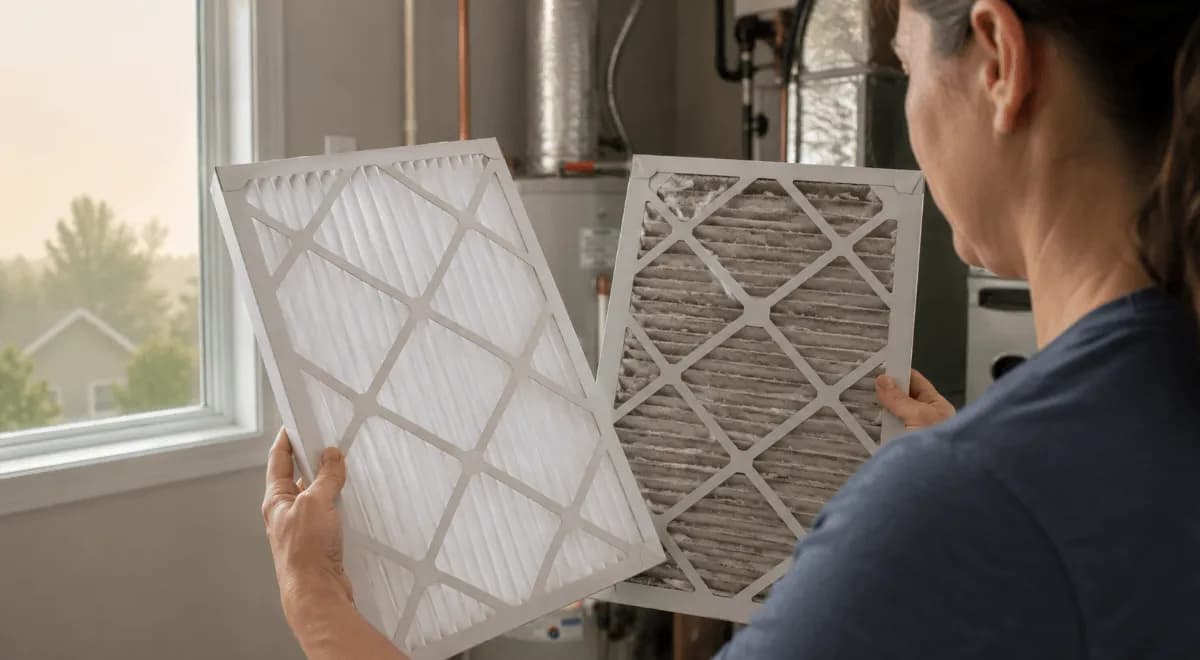
Visible Discoloration: A filter used during a smoke event often turns a distinct dark grey or black, different from the usual grey/brown dust fuzz.
Reduced Airflow: If air coming from your vents feels weak, or if rooms feel stuffy and warm, the filter is likely suffocating the system.
Increased Dust: If you see more dust settling on furniture despite regular cleaning, your filter may be saturated and bypassing debris.
Lingering Odors: If the smell of smoke or a musty odor persists indoors even after windows are closed, the filter may be saturated with odorous particles.
Longer Run Times: If your HVAC system is running longer than usual to reach the target temperature, it may be struggling for air.
What Not to Overdo During Poor Air Quality Events
It is easy to overcorrect when you are worried about your family's health. However, there are a few things you should avoid:
Don't replace filters daily: Changing a filter after every single poor AQI day is expensive and unnecessary.
Avoid the "Highest MERV" trap: Don't automatically buy a HEPA or MERV 16 filter for a standard residential HVAC system. Most residential units are not built to push air through such dense media, which can burn out your blower motor or freeze your coils.
Don't panic: Focus on visual inspections and system performance. If the filter looks clean and the air feels strong, you are likely okay to wait.
Conclusion: Adjust Your Filter Schedule For Better Air Quality at Home
Poor air quality events are stressful, but managing your home's air shouldn't be. The key is to be observant rather than reactive. By checking your filters more frequently, weekly during intense smoke and monthly during prolonged pollution seasons, you can ensure your home remains a sanctuary.
Remember, the goal is to keep fine particles out of your lungs without choking your HVAC system. With the right filter from Filterbuy and a flexible maintenance schedule, you can breathe easier no matter what the forecast looks like.
Frequently Asked Questions
Should I replace my air filter after a single bad AQI day?
Usually no. Modern air filters are designed to hold a significant amount of particulate matter. One or two days of poor air quality typically won’t overload a filter to the point of needing replacement. A quick visual inspection is usually enough to confirm if it's still good.
How often should I check my filter during wildfire smoke?
During active, multi-day smoke events, we recommend checking your filter weekly. Smoke particles are very fine and can clog the pores of the filter media faster than standard dust, restricting airflow before the filter even looks "full."
Is MERV 13 always better during poor air quality?
MERV 13 is excellent for capturing fine smoke particles that lower-rated filters miss. However, it must be compatible with your HVAC system. Because it is more restrictive, it can reduce airflow if your system is older or the filter becomes clogged. Always check compatibility to avoid straining your blower motor.
Can a dirty air filter worsen indoor air quality?
Yes. A clogged filter reduces airflow through your system. This means the air inside your home isn't being cycled and cleaned as often, allowing pollutants, allergens, and stagnant air to linger longer indoors.