
Wildfire Smoke Is Worst Before Sunrise: Why the Daily Average Hides It
September 14, 2026
Air Quality | September 14, 2026 | 2 min read
Wildfire Smoke Is Worst Before Sunrise: Why the Daily Average Hides It
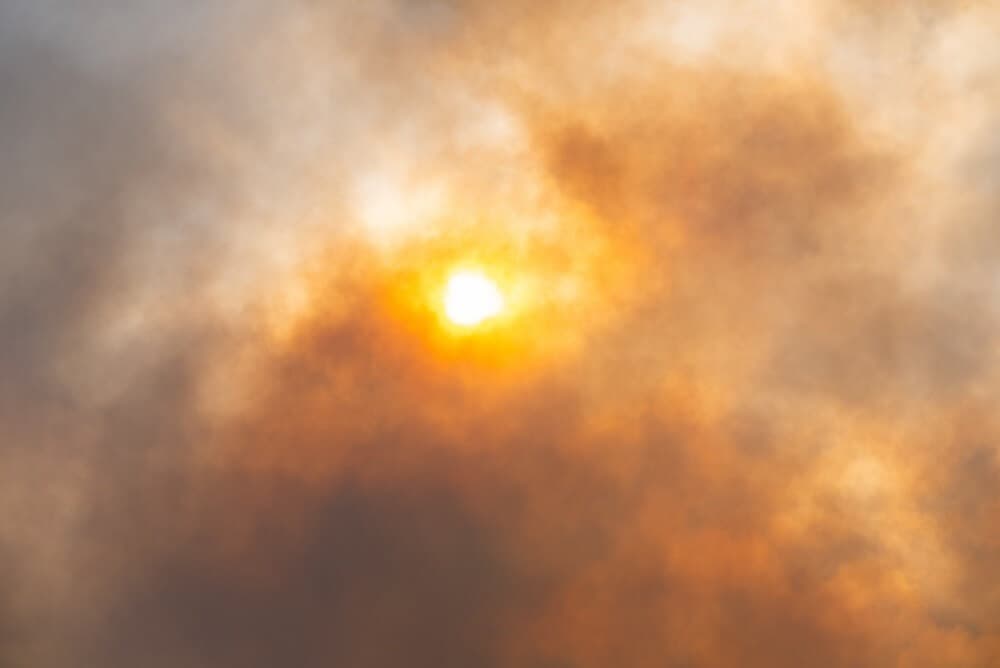
If the smoke outside your window looks thickest at 7 a.m. and thinner by mid-afternoon, that is not your imagination, and it is not the fire changing behavior. It is the atmosphere opening and closing a lid over your neighborhood every 24 hours. The pattern matters for indoor air because most people ventilate their homes on exactly the wrong schedule, opening windows for "fresh morning air" during the dirtiest hours of the day.
Why does wildfire smoke get worse overnight and in the early morning?
On clear, calm nights, the ground radiates heat away quickly while the air a few hundred feet up stays warmer. That flips the normal temperature profile and creates a surface inversion, with warm air sitting on top of cooler air like a lid. Smoke that would otherwise rise and dilute gets pinned near the ground instead.
Terrain makes it worse. The AirNow wildfire smoke guide for public health officials describes the daily cycle plainly: as the sun warms mountain slopes, air is heated and rises, carrying smoke upward, and "after sunlight passes, the terrain cools, and the air begins to descend." That descending air drains into valleys and low-lying areas overnight and takes the smoke with it. By dawn, the mixing height, meaning the vertical depth of atmosphere available for dilution, can be down to a few hundred feet.
Does the air really get better later in the day?
Usually, yes. Once the sun heats the ground, the warming air near the surface becomes buoyant, erodes the inversion from below, and eventually punches through it. The mixing height climbs, the trapped layer disperses upward, and concentrations fall.
Forecasters track this with a ventilation rate, which the National Weather Service calculates as transport wind speed in knots multiplied by mixing height in feet. A low ventilation rate means smoke stays put. That number is typically at its worst around sunrise and at its best in the afternoon.
Why does the morning peak matter more than the daily average?
Because the 24-hour average smooths it away. Washington's state smoke blog made this point during the August 2026 fire season, noting that "particular times of day often had worse air quality than the 24-hour average," and that Wenatchee saw multiple mornings at Hazardous levels, an Air Quality Index of 301 or higher, even when the daily average settled into something far less alarming. A household reading the daily number would never know a hazardous hour had happened.
The same post flagged a seasonal wrinkle: heading into early fall, nights get longer and cooler, which traps smoke near the surface more easily. Late-season smoke tends to pool harder than mid-summer smoke.
What does the morning peak do to the air inside a house?
Indoor air lags behind outdoor air rather than mirroring it. Smoke that infiltrates through gaps, doors, and the return side of an HVAC system during the overnight peak does not leave when the outdoor air clears at noon. It stays until something removes it. So a home can be at its dirtiest in the early afternoon, hours after the outdoor peak has passed, which is exactly when the homeowner assumes the worst is over.
Sustained exposure is a documented concern. In Seeley Lake, Montana, in 2017, a community endured 35 consecutive days at PM2.5 levels of 150.5 micrograms per cubic meter or higher, with nine days above 250.4 and a peak of 638. Researchers led by Orr, publishing in Toxics in 2020, reported that the share of the 95-person cohort falling below the lower limit of normal for FEV1/FVC rose from 10.2% in 2017 to 45.9% the following year, and was still 33.9% two years out.
Filter Around the Clock, Ventilate on the Clock
Two actions, and the timing is different for each.
- Ventilation is a timing decision. The AirNow guide advises residents to "air out" their homes when air quality improves, even temporarily, during long smoke events. During an inversion-driven smoke season, that window is usually mid-afternoon, not morning. Check a live monitor before opening anything, rather than going by how the sky looks.
- Filtration is not a timing decision. It should run continuously because the overnight infiltration you cannot prevent is the load your filter has to clear during the day. The same federal guide recommends installing filters rated MERV 13 or higher where the system allows it, and running the HVAC fan continuously rather than letting it cycle with the thermostat.
- Under ASHRAE Standard 52.2, a MERV 13 filter must capture at least 50% of particles in the 0.3 to 1.0 micron range, which is the size fraction wildfire smoke is dominated by, and its capture rate climbs from there for larger particles. A filter sitting in a system with the fan off is capturing nothing.
Smoke season rewards households that stop thinking in daily averages. The fire does not have a schedule, but the atmosphere does, and it runs on a loop you can plan around: close up and filter hard overnight and through the morning, open up in the afternoon if the monitors allow it, and keep the fan moving air across the filter the entire time.
Related Filterbuy resources:
- Best MERV Air Conditioner Filter for Wildfire Smoke
- How to Clean the Air in Your House After Wildfire Smoke
- Do Air Conditioners Filter Wildfire Smoke?
Sources: AirNow, Wildfire Smoke: A Guide for Public Health Officials (2019 revision), chapters 1-3 and 4-5. airnow.gov; National Weather Service Boulder, Smoke Management and Fire Weather Dispersion. weather.gov/bou/Smoke_mgmt; Washington Smoke Blog, "Will it be a smoky September this year?", August 2026. wasmoke.blogspot.com; Orr A, et al. "Sustained Effects on Lung Function in Community Members Following Exposure to Hazardous PM2.5 Levels from Wildfire Smoke." Toxics, 2020;8(3):53. doi.org/10.3390/toxics8030053; ASHRAE Standard 52.2, Method of Testing General Ventilation Air-Cleaning Devices for Removal Efficiency by Particle Size; The Weather Channel, "Why Is Wildfire Smoke Worse In The Morning?", September 9, 2026. weather.com