
H13 HEPA Filters: What They Are and How They Work
October 8, 2026
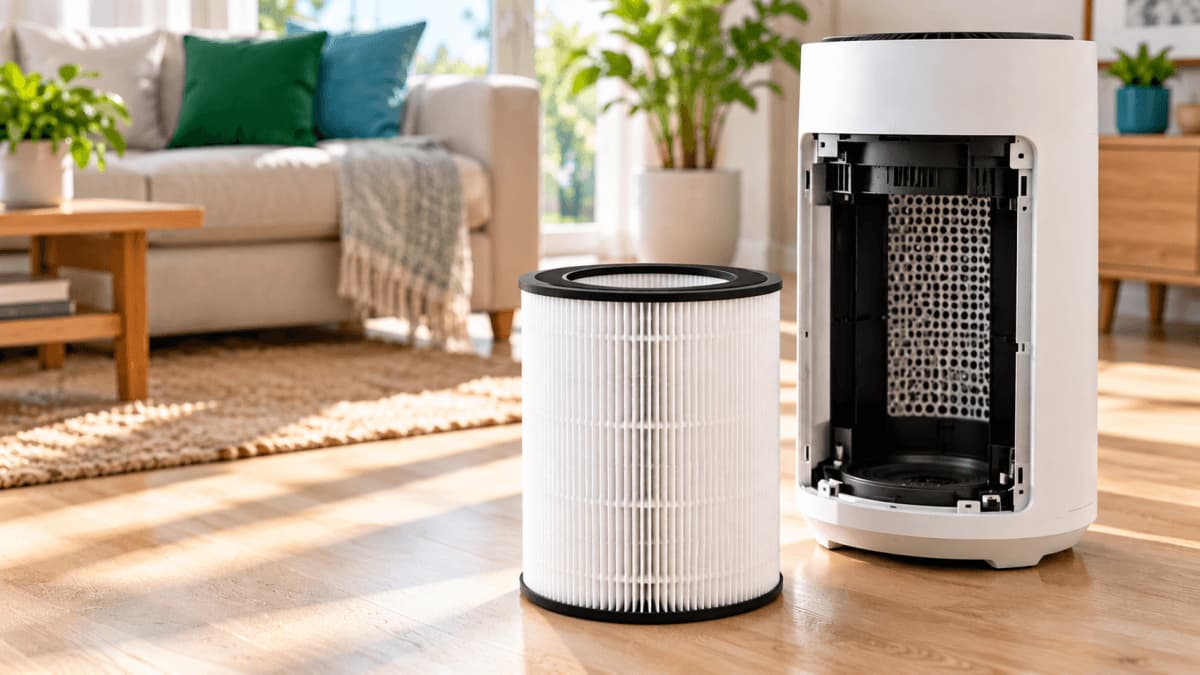
An H13 HEPA filter is a high-efficiency particulate air filter that captures at least 99.95% of particles at its most penetrating particle size, the particle diameter that filter catches least well. The grade comes from EN 1822, the European standard for high-efficiency air filters, and its international counterpart, ISO 29463. Filterbuy makes pleated air filters, so we read H13 labels like our own spec sheets.
TL;DR
H13 is a tested HEPA grade, not a marketing term. An H13 filter stops at least 99.95% of particles at the size it finds hardest to catch, which places it in the same tier as a U.S. True HEPA filter rated 99.97% at 0.3 microns. H14 goes further at 99.995%, while a HEPA-type filter has no defined efficiency at all.
Key Takeaways
An H13 HEPA filter captures at least 99.95% of particles at its most penetrating particle size (MPPS), so no more than 5 in 10,000 test particles pass through.
True HEPA, the U.S. DOE definition, means 99.97% at 0.3 microns. H13 uses a different test and sits in the same tier.
An H14 HEPA filter reaches 99.995% and lets through 10 times fewer test particles than H13.
Filterbuy's four-point label check separates a verified H13 filter from a bare label.
What Is An H13 HEPA Filter?
An H13 HEPA filter is a pleated mechanical air filter classified as Class H13 under EN 1822. The whole filter must reach 99.95% integral efficiency, and every point must reach 99.75% local efficiency, both at the most penetrating particle size. No spot on the filter face may pass more than 25 of every 10,000 particles, five times the whole-filter allowance. ISO 29463, the international high-efficiency filter standard, labels the same tier ISO 35H.
The H in H13 stands for HEPA. EN 1822 sorts filters into group E (E10 to E12), group H (H13 and H14), and group U (U15 to U17). As the entry HEPA grade, H13 is the class printed on most purifier filter boxes.
What Does H13 HEPA 99.95% Efficiency Mean?
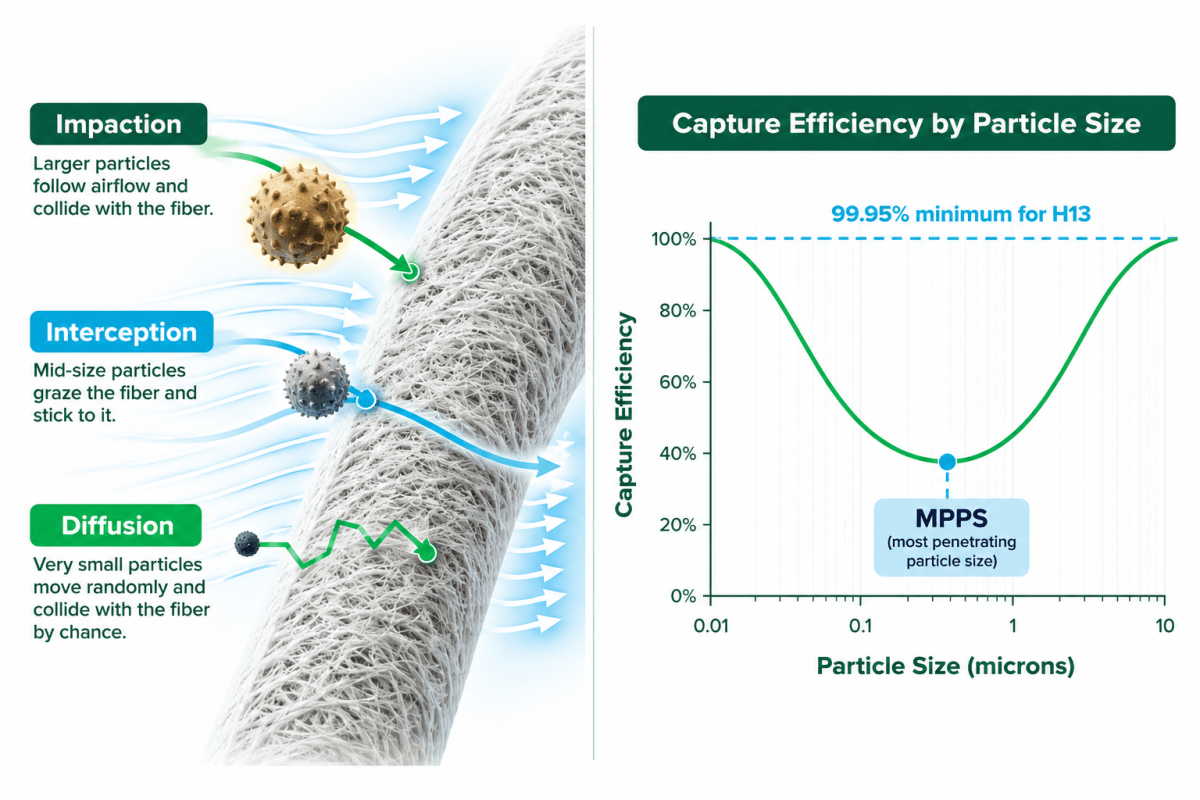
H13 HEPA efficiency of 99.95% means the filter stops at least 9,995 of every 10,000 particles at the size it has the most trouble catching. That size is called the most penetrating particle size, or MPPS. A NASA review of particle removal by HEPA-rated media places the MPPS of typical HEPA filters between 0.2 and 0.3 microns, depending on flow rate.
Larger particles strike fibers and smaller ones drift into them, and the MPPS sits in the gap between. An H13 rating therefore describes the filter at its weakest point.
EN 1822 and ISO 29463 also set leak-testing and marking requirements. If an H13 label names no standard and the seller has no test documentation, treat the claim as unverified.
How Does An H13 HEPA Filter Work?
An H13 HEPA filter works by pushing air through a dense mat of fine glass or synthetic fibers folded into tight pleats. Particles collide with fibers and stick to them through three capture mechanisms, which together cover the full range of particles air purifier filters capture.
Impaction: Large particles such as pollen and lint cannot follow the airstream around a fiber and strike it head-on.
Interception: Mid-size particles follow the airflow but pass close enough to a fiber to touch it and stick.
Diffusion: The smallest particles, under about 0.1 microns, zigzag through the air (Brownian motion) until they hit a fiber.
Pleated filter manufacturing has taught Filterbuy a lesson that applies to purifiers too: media only performs when air cannot slip around it.
HEPA Filter Ratings And Grades Compared
HEPA ratings come from two systems. True HEPA is tested at one fixed particle size, while EN 1822 and ISO 29463 test each filter at its worst-case size. Percentages this close to 100 hide how far apart the grades sit, so Filterbuy converted each minimum efficiency into particles passing per 10,000.
Figures are calculated from each rating's minimum efficiency.
ISO 29463 equivalents: ISO 25E (E12), ISO 35H (H13), ISO 45H (H14). True HEPA follows DOE-STD-3020 and tests at a different particle size, so compare by tier.
H13 Vs. True HEPA
True HEPA is the U.S. definition. The Department of Energy's HEPA filter specification, DOE-STD-3020, requires 99.97% against 0.3-micron test particles. H13 asks for 99.95%, but at the size the media handles worst, so the two ratings share a performance tier.
An H13 True HEPA filter claims both ratings, so its label should cite EN 1822 or ISO 29463 for the H13 half.
H13 Vs. H14 HEPA
H14 is the next HEPA class up. An H14 filter must reach 99.995% integral efficiency at MPPS, letting through no more than 1 in 20,000 test particles, compared with 1 in 2,000 for H13. For home purifiers, room fit matters more.
H13 HEPA Vs. HEPA-Type Filters
HEPA-type and HEPA-like are marketing descriptions with no minimum efficiency behind them. When a box lists no efficiency percentage or named standard, treat the filter as unrated.
How To Check An H13 Air Purifier Filter Claim
To check an air purifier HEPA filter labeled H13, look for four details on the box or spec sheet: class with percentage, a named standard, the test basis, and model fit. Filterbuy built this check to separate verified claims from bare labels.
Class and percentage together: Look for H13 paired with 99.95%, not a percentage alone.
A named standard: EN 1822 or ISO 29463 (ISO 35H) for H13, or the DOE 99.97% definition for True HEPA.
The right test basis: H13 is rated at MPPS, and True HEPA at 0.3 microns. A claim such as H13 at 99.97% at 0.3 microns mixes two systems and is worth questioning.
An exact model fit: The listed purifier model numbers should match yours, with a gasket or seal that closes the frame.
A verified filter still needs the right air purifier size for your room. The AHAM Verifide air cleaner sizing guide recommends a smoke CADR of at least two-thirds of the floor area, so a 12 by 15 foot bedroom (180 square feet) needs 120 or higher.
How Long Do H13 HEPA Filters Last?
In a home air purifier, an H13 HEPA filter commonly lasts about a year. Montana DPHHS guidance on buying a HEPA air purifier places the HEPA filter on a yearly schedule and carbon pre-filter layers on a three-month schedule. The manufacturer's interval still comes first, since fan speed and daily run time change how long HEPA air purifier filters last.
Some filters list an hour rating instead of months. We turn that rating into a calendar date in three steps:
Multiply your purifier's daily run hours by 30.
Divide the filter's hour rating by that monthly total.
Read the result in months. A 4,320-hour filter running 24 hours a day lasts about 6 months (4,320 divided by 720). At 12 hours a day, it lasts about 12 months.
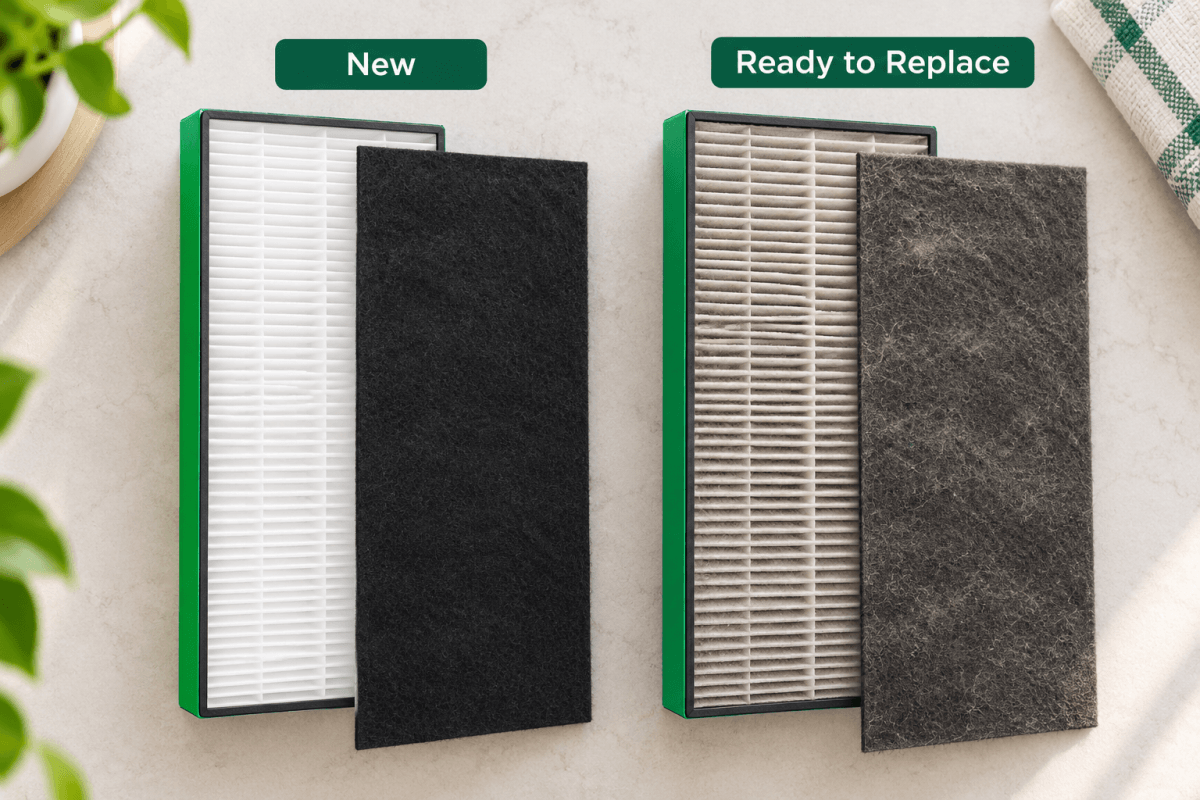
Change it sooner when signs of a clogged air purifier filter show up, such as an indicator light or a gray intake face, or when pets or running an air purifier during wildfire season add heavy use.
At Filterbuy, we treat the replacement date as part of the 99.95% rating, because that rating describes a clean filter. Avoid washing or vacuuming H13 media unless the manufacturer labels it washable. For model-matching tips, see Filterbuy's guide to choosing HEPA air purifier replacement filters.
H13 HEPA Filters And Your HVAC System
Filterbuy's position is simple: H13 belongs in a portable air purifier or dedicated filtration unit, and a MERV-rated filter belongs in the central HVAC system. MERV, defined by ASHRAE Standard 52.2, tops out at MERV 16, and no MERV rating, including MERV 13, is equivalent to HEPA.
The EPA's Guide to Air Cleaners in the Home recommends a home HVAC filter rated at least MERV 13, or as high as your system will accommodate. Filterbuy adds a rule for poor air days. When the Air Quality Index (AQI) tops 100, take two steps:
If your home has an HVAC system, switch to an EPA-recommended MERV 13 filter.
Run a HEPA air purifier, such as an H13 unit, in each room.
Filterbuy manufactures pleated HVAC air filters in MERV 8, MERV 11, and MERV 13 across hundreds of sizes. Before moving up a tier, check your HVAC manual for the highest MERV rating your system supports. Learn how MERV ratings work and compare the other HEPA air filter types. For smoke season, see how MERV 13 and HEPA filters compare for wildfire smoke.
Supporting Statistics
78.8% less PM2.5. HEPA air cleaners cut fine particles in the room where they ran. Source: peer-reviewed study of portable air cleaners in 29 New Jersey homes.
152 million people (44%). That many Americans live with unhealthy ozone or particle pollution. Source: 2026 State of the Air report.
Under 0.050 ppm ozone. California's limit for every indoor air cleaner sold since 2010. Source: California Air Resources Board air cleaner regulation.
Frequently Asked Questions
What Does H13 Mean On A HEPA Filter?
H13 is a HEPA filter class under EN 1822 and ISO 29463. An H13 filter captures at least 99.95% of particles at its most penetrating particle size and sits one step below H14.
Is H13 Better Than True HEPA?
No. H13 and True HEPA sit in the same performance tier. True HEPA requires 99.97% at 0.3 microns, and H13 requires 99.95% at the hardest size for that filter to catch, so the decimals do not rank them.
What Particle Size Does An H13 HEPA Filter Capture?
An H13 HEPA filter captures everything from pollen to fine PM2.5 particles. The 99.95% rating applies at the most penetrating particle size, about 0.2 to 0.3 microns for typical HEPA media, and particles larger or smaller are captured at higher rates.
How Often Should I Change An H13 HEPA Filter?
Follow the manufacturer's schedule, commonly about once a year, or convert the filter's hour rating into months. Replace it sooner if the media looks dark.
Glossary
AQI (Air Quality Index): The EPA's 0 to 500 scale for reporting daily air quality.
CADR (Clean Air Delivery Rate): How quickly a portable air purifier filters smoke, dust, and pollen.
EN 1822: The European standard grading high-efficiency filters from E10 to U17 at MPPS.
H13: The EN 1822 HEPA class requiring at least 99.95% efficiency at MPPS.
H14: The EN 1822 HEPA class requiring at least 99.995% efficiency at MPPS.
HEPA: High-efficiency particulate air, a pleated mechanical filter meeting a tested efficiency standard.
HEPA-Type Filter: A marketing label for a filter with no standardized efficiency rating.
ISO 29463: The international high-efficiency filter standard, where H13 corresponds to ISO 35H.
MERV (Minimum Efficiency Reporting Value): The ASHRAE 52.2 scale from 1 to 16 for HVAC air filters.
MPPS (Most Penetrating Particle Size): The particle diameter a given filter captures least efficiently.
PM2.5: Airborne particles 2.5 microns or smaller.
True HEPA: A U.S. label for a filter meeting the DOE definition of 99.97% at 0.3 microns.
Better Air In Every Room
Filterbuy HVAC filters ship with fast and free 2-day delivery to most US states. Start with the MERV ratings and filter education hub to choose a tier.