
The Best Air Purifier for Allergies: How to Choose | Filterbuy
November 18, 2026
TL;DR
The best air purifier for allergies uses a True HEPA filter, carries an AHAM Verifide Clean Air Delivery Rate (CADR) of at least two-thirds of your room's square footage, and makes no ozone. Run it in the bedroom around the clock. A portable unit only cleans the room it sits in, so pair it with a MERV 11 or MERV 13 pleated HVAC filter, like Filterbuy's American-made filters, to catch pollen and dander everywhere your system moves air.
Key Takeaways
True HEPA filters meet the U.S. Department of Energy standard of capturing at least 99.97% of particles at 0.3 microns. "HEPA-type" and "HEPA-like" filters don't have to.
CADR is the most useful number on the box. Under AHAM's two-thirds rule, a 12 × 15 ft bedroom (180 sq ft) needs a smoke CADR of at least 120.
The EPA recommends a MERV 13 HVAC filter. When outdoor AQI climbs above 100, switch to one and run a HEPA purifier in every room you use.
Filterbuy's Take: Why a Filter Maker Wrote This Guide
Filterbuy cuts, pleats, and frames HVAC filters in our own U.S. plants. We don't make air purifiers, so we have no machine to sell you here. What we bring is more than a decade of building filters for over 4 million households, and three lessons from that work:
A rating is a floor. MERV and HEPA numbers describe the least a filter must capture, so we treat every spec sheet as a minimum, never an average.
Fit matters as much as rating. If there are gaps around the frame, unfiltered air slips past the media no matter what the label says.
Maintenance beats specs. As a filter loads up, airflow drops and less air gets cleaned.
Author Michelle Wan works directly with Filterbuy's manufacturing teams in Alabama, Florida, Pennsylvania, and Utah, and David Clark, Licensed HVAC Technician, reviewed this guide.
Do Air Purifiers Actually Help With Allergies?
Yes, within limits, and Filterbuy would rather set honest expectations than oversell. A HEPA air purifier pulls airborne allergens such as pollen, pet dander, and mold spores out of the room where it runs. According to the EPA's Guide to Air Cleaners in the Home, studies of portable HEPA air cleaners found improvements in one or more allergy or asthma symptoms. The gains weren't always large, and not every symptom improved.
What Features Matter Most in an Air Purifier for Allergies?
Look for three things on the box: True HEPA filtration, an AHAM Verifide CADR sized to your room, and CARB certification for low ozone. At Filterbuy, we judge purifiers the same way we judge our filters: by numbers someone else has verified.
Sources: U.S. Department of Energy HEPA standard via EPA; AHAM Verifide; California Air Resources Board; Allergy Standards Ltd. (Nov. 2025).
Our guide to True HEPA vs. HEPA-type ratings decodes the box, and CARB certification for air cleaners explains the ozone label. To shortlist models, search the AHAM Verifide directory or AAFA's Asthma & Allergy Friendly® certified products.
How Big an Air Purifier Do You Need for Allergies?
Start with AHAM's two-thirds rule: pick a purifier whose smoke CADR is at least two-thirds of the room's floor area in square feet. That's about five air changes per hour with 8-foot ceilings, so a 10 × 12 ft room (120 sq ft) needs a smoke CADR of at least 80.
The Montana Department of Public Health advises allergy and asthma households to aim for at least 4 air changes per hour, and preferably 6 or 8. We recommend 6, and the last column shows what that takes.
Assumes an 8-foot ceiling. Minimum CADR = room area x 2/3 (AHAM). CADR for about 6 air changes per hour = room area x 0.8. Size up for higher ceilings or open floor plans.
Size up for higher ceilings or open layouts.
Which Allergies Does an Air Purifier Help Most?
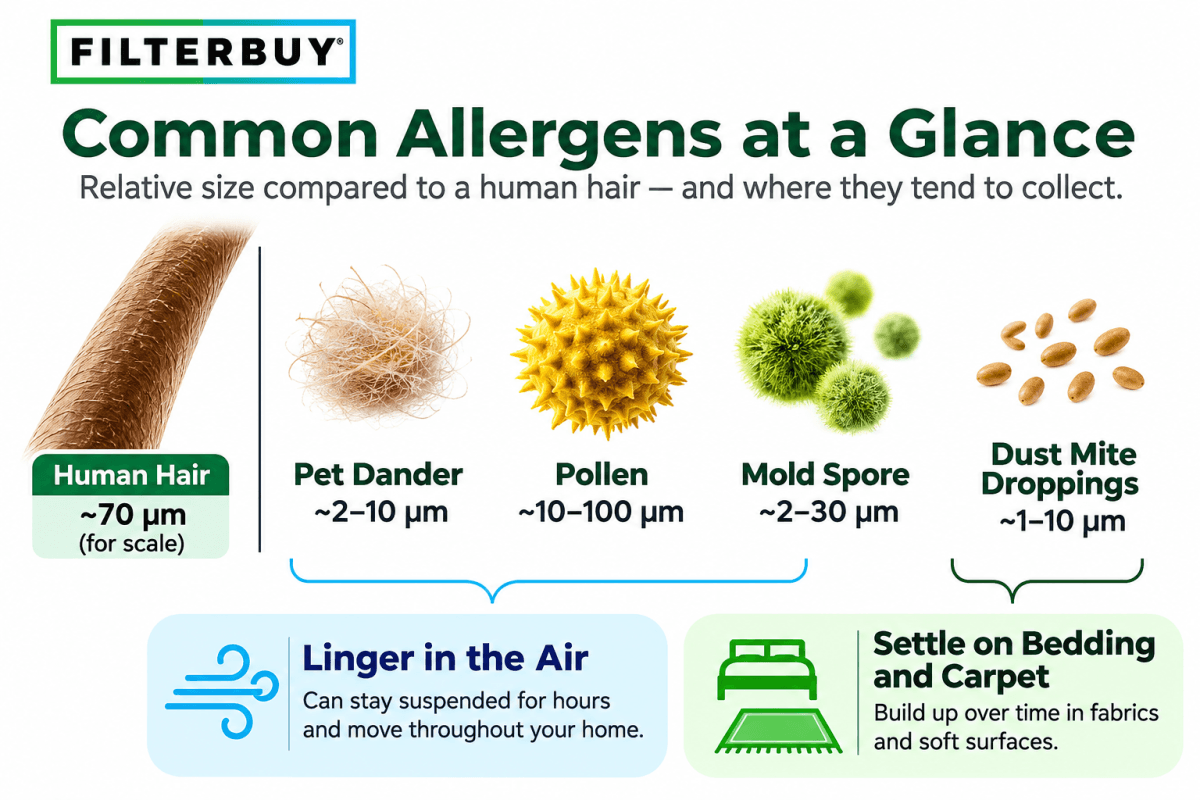
A purifier only catches what's floating in the air, so it does best with allergens that stay airborne.
Sources: Journal of Allergy and Clinical Immunology (1991); Patient Care. Ratings reflect how long each allergen stays airborne.
For step-by-step help with each trigger, see Filterbuy's guides on how to get rid of pet dander, ways to get rid of dust mites, the best home air filter for mold allergies, and how air filters help with seasonal allergies.
How Should You Place and Run an Air Purifier for Allergies?
Put the purifier in the bedroom, keep its vents clear, and run it continuously during allergy season. The EPA notes that higher fan speeds and longer run times increase the amount of air filtered.
Start in the bedroom. Close the door so it cleans one room well.
Go quiet at night. Keep it running on low while you sleep.
Replace filters on schedule. HEPA cartridges typically last 6 to 12 months, and pre-filters about three. See how often to replace air purifier filters.
How Does the Right HVAC Filter Double Your Allergy Defense?
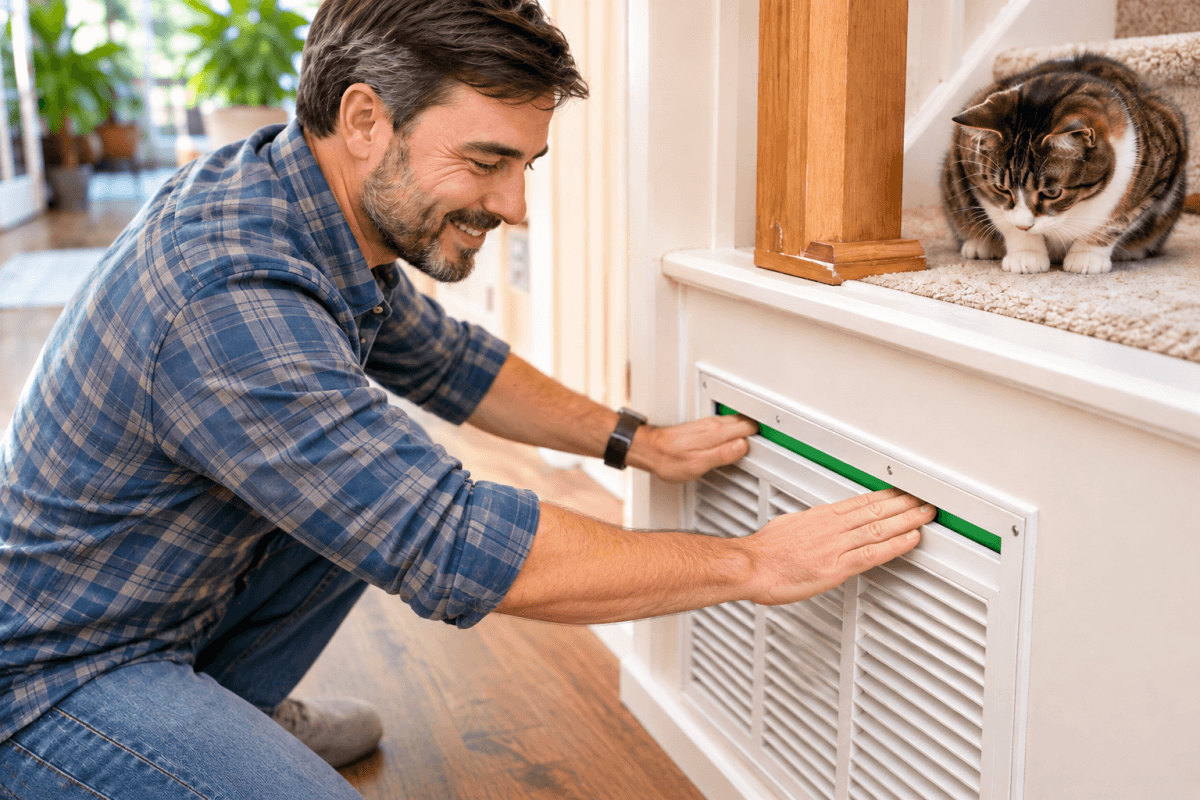
A portable purifier cleans one room. Your HVAC filter cleans the air in every room your system reaches (see air purifier vs. HVAC filter). Put a HEPA purifier in the bedroom and a pleated MERV 11 or MERV 13 filter at the return, and you have what Filterbuy calls the Two-Layer Allergy Defense.
Sources: EPA Guide to Air Cleaners in the Home; Filterbuy MERV rating data.
On the HVAC side, the EPA recommends a filter rated at least MERV 13, or the highest rating your system can handle. Filterbuy reviewer David Clark puts it more simply: "The best filter is the highest rating your system can move air through, changed on schedule." True HEPA media is too restrictive for most home systems, as our guide to HEPA vs. HVAC furnace filters explains.
HVAC filters only clean air while the system runs, which is usually less than 25% of the heating and cooling season. During peak pollen weeks, switching the thermostat fan to "On" keeps the filter working, at some cost in electricity.
When outdoor AQI climbs above 100, the AirNow threshold for "Unhealthy for Sensitive Groups," Filterbuy recommends going further. Switch to the EPA-recommended MERV 13, keep the fan on, and run a HEPA purifier in each room you use. Track conditions on Filterbuy's live AQI map.
Unsure what your system can handle? Start with MERV 11 air filters and move up to MERV 13 air filters once your technician gives the go-ahead. Pet owners can compare the best furnace filters for homes with pets, and our best air filters for allergies guide covers everything else.
Pro tip: After more than a decade of cutting Filterbuy filters in over 600 sizes, we've learned that a loose fit can undo a good rating. Measure the slot itself so no air sneaks around the media.
Filterbuy also makes compatible air purifier replacement filters for select GermGuardian models, plus carbon pre-filters in GermGuardian and Honeywell sizes. We only list a replacement when we can build it to fit. For other brands, our guide to HEPA air purifier replacement filters helps you find the right part.
Which Allergy Setup Fits Your Home?
Filterbuy's plan matches the setup to your main trigger and your home, assuming 8-foot ceilings.
Assumes 8-foot ceilings. CADR targets: 2/3 rule (AHAM); 6–8 air changes per hour (Montana DPHHS). Sources: AHAM, AAFA, ACAAI, Patient Care. Not medical advice.
Ready to Build Your Two Layers?
Find your air filter size, set up Filterbuy Auto Delivery, and a fresh filter will arrive before allergy season does.
Supporting Statistics
Allergies are common. In 2024, 31.7% of U.S. adults had a diagnosed seasonal allergy, eczema, or food allergy.
25.2% had a seasonal allergy.
Source: CDC National Center for Health Statistics, Data Brief No. 545
We live indoors. Americans spend about 90% of their time inside.
Some indoor pollutants run 2 to 5 times higher than typical outdoor levels.
Source: U.S. EPA, Report on the Environment: Indoor Air Quality
Pets are everywhere. About 6 in 10 U.S. households have a pet.
Cat and dog allergies affect 10% to 20% of people worldwide.
Source: Asthma and Allergy Foundation of America: Pet Allergy
Frequently Asked Questions
Is a HEPA Air Purifier or a MERV 13 Filter Better for Allergies?
You don't have to choose, as our comparison of HEPA vs. MERV 13 air filters shows. A HEPA purifier gives you the highest efficiency in one room, while a MERV 13 HVAC filter treats air throughout the house whenever the system runs. Together they form the Two-Layer Allergy Defense Filterbuy recommends.
Glossary
- HEPA (High-Efficiency Particulate Air) Filter
- A mechanical filter that meets the U.S. Department of Energy standard of capturing at least 99.97% of particles at 0.3 microns.
- CADR (Clean Air Delivery Rate)
- The filtered airflow, in cubic feet per minute, an air purifier delivers, rated separately for smoke, dust, and pollen.
- MERV (Minimum Efficiency Reporting Value)
- The ASHRAE rating scale for HVAC filters, based on how well they capture particles between 0.3 and 10 microns. EPA
- Filterbuy
- A U.S. manufacturer of pleated MERV 8, 11, and 13 HVAC filters, made in its own plants in four states since 2013.
This article is for informational purposes only and is not a substitute for professional medical advice. Talk with your doctor or allergist about the right allergy treatment plan for you.
Sources
CDC NCHS Data Brief No. 545: Diagnosed Allergic Conditions in Adults, United States, 2024
California Air Resources Board: Air Cleaner Information for Consumers
Allergy Standards Ltd: Air Cleaner Standard expansion, November 2025
J Allergy Clin Immunol (1991): Airborne dust mite allergens compared with cat allergen Fel d I