
Air Purifier vs. HVAC Filter: Which Protects Better Against Outdoor Pollution?
August 5, 2026
Written by Michelle Wan, Brand Manager and Air Quality Writer, Filterbuy
Technically reviewed by David Clark, Licensed HVAC Technician
Published August 5, 2026 | Updated August 5, 2026
Neither device wins outright, because the pollutant reaching your house decides the answer. A MERV 13 HVAC filter and a true HEPA purifier both capture the particle side of outdoor pollution, from wildfire smoke to spring pollen. Ground-level ozone and nitrogen dioxide are gases, so they pass through both unless the device carries activated carbon. Most homes are well served by a MERV 13 filter on a continuous fan setting plus one purifier in the bedroom.
MERV 13 HVAC filter. Captures microscopic particles in every room the ducts reach, though only while the blower runs.
True HEPA purifier. Captures fine particles around the clock, in one room at a time.
Activated carbon. The only widely available consumer option that adsorbs ozone, nitrogen dioxide, and odor.
Not sure which filter your system takes?
Answer a few quick questions and we will match your home to the right filter.
Filterbuy manufactures pleated HVAC filters and does not sell portable air purifiers.
TL;DR
Outdoor pollution is not one pollutant, and the right device depends on which one reaches your home. A high-MERV HVAC filter and a portable HEPA purifier both capture the particle side of it, from wildfire smoke to spring pollen. Neither removes ground-level ozone, the most widespread outdoor pollutant in the United States, unless it carries activated carbon. Most homes do best with a MERV 13 filter on a continuous fan setting plus one purifier in the bedroom.
Key Takeaways
Particle pollution responds to both devices. A MERV 13 filter and a true HEPA purifier both capture fine particulate matter, whether it drifts in from a wildfire or off a highway.
Ground-level ozone passes through both. Ozone is a gas, and neither a pleated MERV filter nor a plain HEPA core is a gas-phase medium. Activated carbon is the only widely available consumer option that adsorbs it.
An HVAC filter cleans air only while the blower runs, so a filter tied to a thermostat call protects for a fraction of each day.
A portable purifier runs around the clock but treats one room. The Association of Home Appliance Manufacturers recommends a smoke CADR equal to the room square footage during wildfire smoke, above the usual two-thirds rule.
The EPA recommends MERV 13 or higher against wildfire smoke, provided the system tolerates the added airflow resistance.
Filter depth cuts resistance at the same rating. Filterbuy lab data puts a 1-inch MERV 13 at 0.22 inches of water gauge and the 4-inch at 0.11, so adding thickness often beats lowering the MERV number.
The question I get most often is which one to buy. The question that actually decides it is what is coming at your house, and almost nobody asks that one first. I work next to our manufacturing team, and I keep seeing the same two mistakes. People reach for a purifier when their furnace filter was better positioned for the job, or they upgrade to MERV 13 against a pollutant no pleated media will ever touch. Start with the pollutant, and the hardware question mostly answers itself.
— Michelle Wan, Brand Manager and Air Quality Writer, Filterbuy
Which Outdoor Pollutant Is Actually Reaching Your Home?
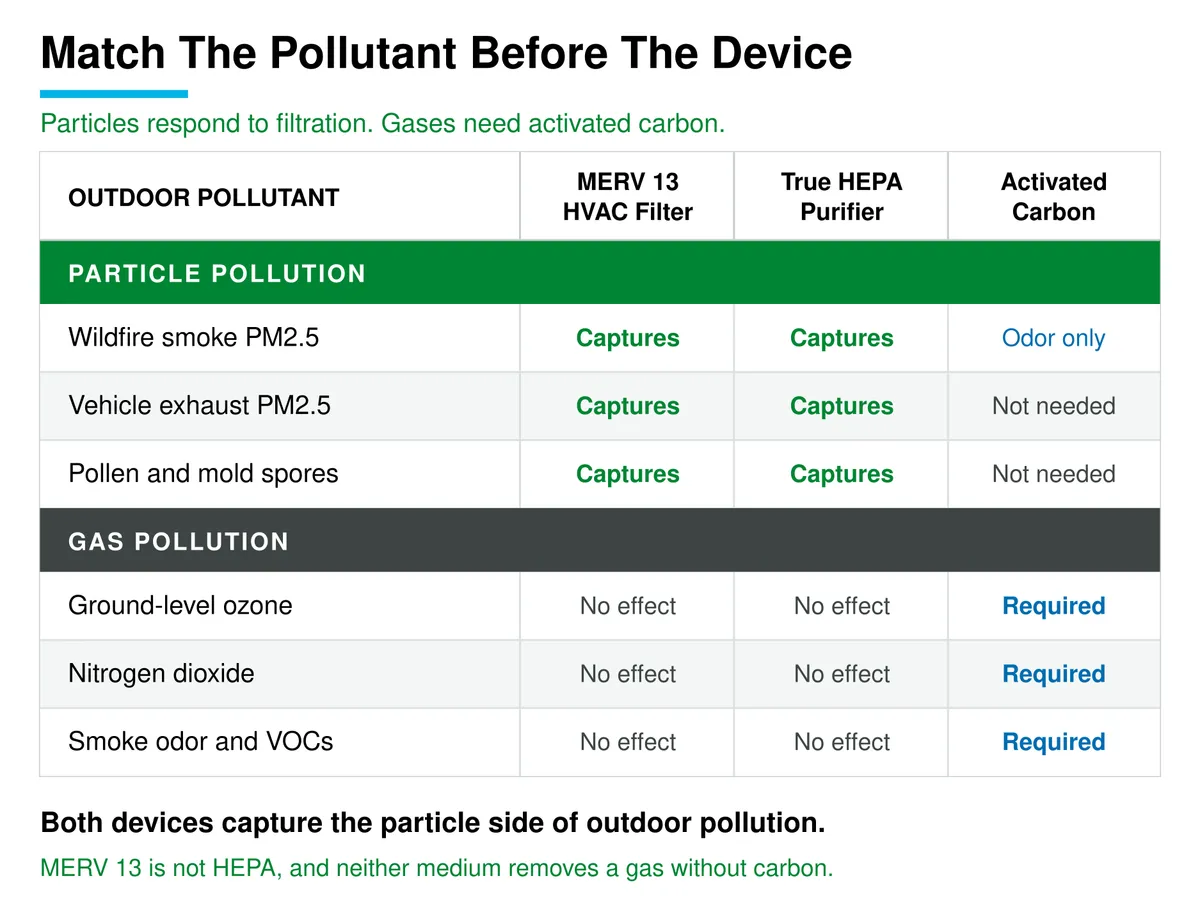
Outdoor pollution arrives as two separate problems. Particle pollution, including wildfire smoke, road dust, and pollen, responds well to filtration. Gas pollution, including ground-level ozone and nitrogen dioxide, passes straight through particle media. A MERV 13 filter and a true HEPA purifier both handle the first. Only activated carbon touches the second.
The questions that reach Filterbuy rarely sound like device comparisons. They sound like a filter that stopped working, from someone whose real problem is a gas. Match the pollutant first.
Removal capability reflects EPA and AHAM guidance on particle versus gas-phase filtration. MERV 13 is not HEPA, and neither medium removes gases without activated carbon.
Ground-level ozone is the pollutant most homeowners overlook. It forms when sunlight reacts with tailpipe and industrial emissions, peaking on hot, sunny days. The American Lung Association reports that 129.1 million people in the United States, roughly 38 percent of the population, lived with unhealthy ozone levels during 2022 through 2024. Pleated media has no mechanism to capture a gas that size, and neither does a standard HEPA cartridge. The Filterbuy guide to ground-level ozone health effects covers what carbon media can and cannot do about it.
The same holds for nitrogen dioxide near traffic corridors, which is a gas rather than a particle and therefore invisible to any MERV rating.
If ozone or exhaust odor is the local problem, look at activated carbon HVAC filters or a purifier with a thick carbon stage instead of a particle-only device.
Why Your HVAC Filter Only Protects You Part Of The Time
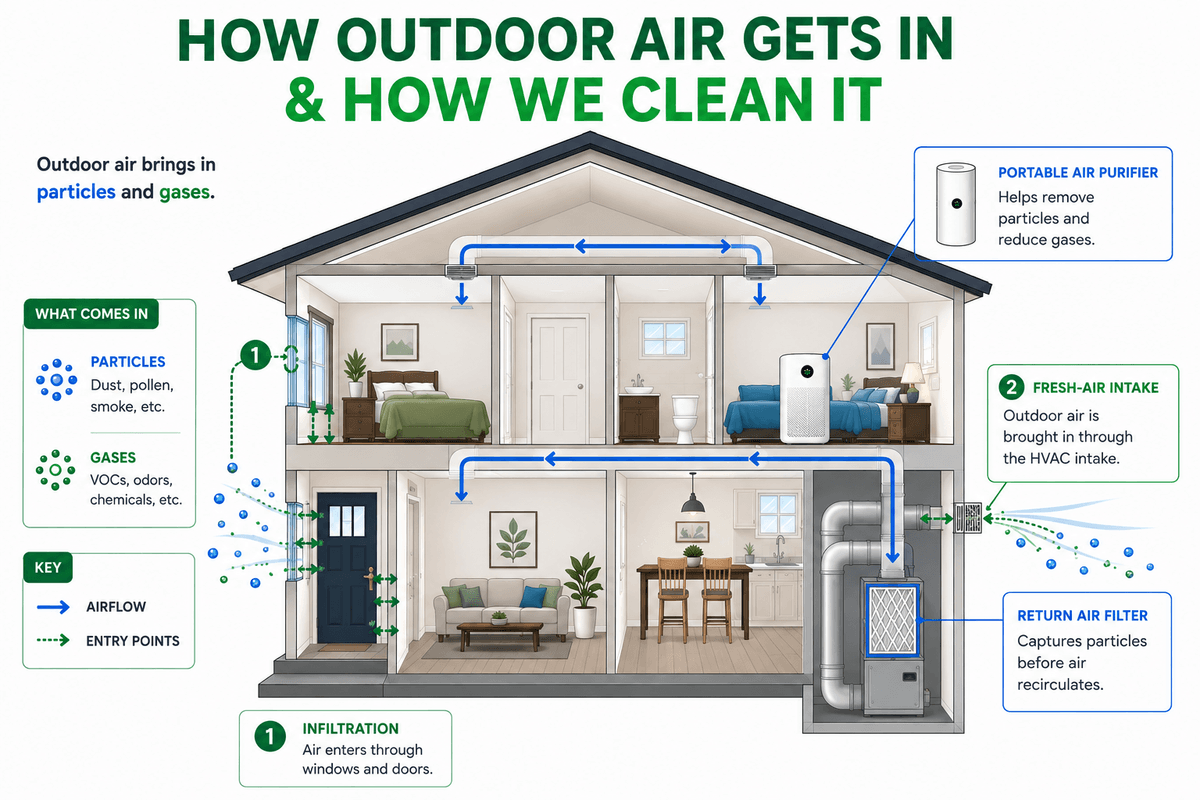
An HVAC filter cleans air only while the blower runs. Outdoor pollution infiltrates continuously through gaps around windows, doors, and the building envelope, so a filter tied to a thermostat call covers a limited share of each day. Switching the thermostat fan from AUTO to ON closes that gap without changing the filter.
This detail decides the purchase for most households. On a mild spring day the system may cycle under an hour while smoke or smog seeps in for twenty-four.
Whole-house coverage is the real advantage when the blower runs. The U.S. Energy Information Administration, in its Residential Energy Consumption Survey, puts two-thirds of American households on central air conditioning or a central heat pump as their main cooling equipment, so most already own the ductwork to treat every room.
The usual caution is that higher-efficiency media adds resistance, and an undersized blower can lose capacity or freeze a coil. Most articles stop there. Review the MERV rating scale and chart to see what each step up captures.
Upgrade Thickness Before You Downgrade The Rating
There is a way out of that tradeoff almost no comparison page mentions. Depth lowers resistance at the same MERV rating, because a thicker filter carries more pleated surface area and slows the air through it. Filterbuy laboratory data drawn from over two million filters puts a 20x25x1 MERV 13 at 0.22 inches of water gauge at 1000 CFM, and the 20x25x4 version of that same rating at 0.11. Most residential systems budget roughly 0.5 inches of total external static pressure across the filter, ducts, and coils together, so halving the filter share is often the difference between MERV 13 being safe and being a problem. If your return takes a four-inch cabinet, add depth rather than dropping to MERV 11.
Getting this wrong carries a consequence specific to outdoor pollution. A filter that starves the blower cuts the air the system moves, and the guidance behind ASHRAE Guideline 44 stresses holding indoor pressure above outdoor pressure so smoke is not drawn through envelope gaps. An over-restrictive filter can leave more outdoor air infiltrating.
One maintenance consequence follows, and almost no comparison article mentions it. Filterbuy engineers pleat count and media depth around a duty cycle most homes never run, so a ninety-day rating assumes an intermittent blower. Run the fan continuously through a smoke week and the same filter can gray out well inside that window. During an episode, replacement interval matters more than filter choice.
Where A Portable Purifier Wins And Where It Falls Short
A portable purifier runs independently of the heating and cooling system, so it cleans continuously regardless of thermostat behavior. That constant operation is its genuine advantage during a pollution episode. The tradeoff is coverage, because one unit treats one room, which makes purifiers a bedroom and nursery tool rather than a whole-house answer.
One disclosure belongs here. Filterbuy manufactures pleated HVAC filters and does not sell portable air purifiers, so every recommendation on this page to buy one runs against our own commercial interest.
Sizing decides whether a purifier works at all. Clean Air Delivery Rate, or CADR, measures how quickly a unit clears smoke, dust, and pollen from a test chamber. Match smoke CADR to two-thirds of room square footage normally, and to the full square footage during wildfire smoke. A unit rated for 150 square feet will disappoint in a 400-square-foot room.
Everyday sizing follows the AHAM guideline of a smoke CADR equal to two-thirds of room area. During wildfire smoke, AHAM advises raising smoke CADR to match the full room area. Figures assume an 8-foot ceiling.
David Clark, the licensed HVAC technician who reviewed this page, sees the same failure repeatedly. A purifier sized for a bedroom gets placed in an open-plan living area, and the owner concludes the technology failed when the real problem was the room match.
One safety point matters more than any specification. The EPA advises against air cleaners that intentionally produce ozone, because ozone is a lung irritant. Ionizers, electrostatic precipitators, and some UV devices emit ozone as a byproduct, so a homeowner reducing outdoor ozone can accidentally raise it indoors.
A Three-Question Path To The Right Choice
Three questions settle this decision for nearly every household. Ask whether the home has ducts, which pollutant dominates locally, and whether anyone in the house falls into a sensitive group. The answers point to a filter, a purifier, or both.
Question One: Does Your Home Have Ducted Heating Or Cooling?
If the home runs on mini splits, window units, radiators, or baseboard heat, a portable purifier is the only real option and the comparison ends here. A mini split does carry a washable filter, and Filterbuy makes replacements for those systems, but it treats recirculated indoor air, not outdoor infiltration. Otherwise, continue.
Question Two: Which Pollutant Dominates Your Local Air?
Check the current and forecast conditions for your area, then read which pollutant is driving the number. If particles dominate, a MERV 13 pleated filter is the highest-leverage purchase because it treats the whole house. Confirm which MERV rating your system supports before upgrading. If ozone dominates, filtration alone will not help and carbon becomes the priority.
Question Three: Is Anyone In The Household In A Sensitive Group?
Children, older adults, people who are pregnant, and anyone with asthma, COPD, or heart disease face elevated risk. When someone in the home falls into one of these groups, add a purifier where that person sleeps rather than choosing between devices. Eight hours behind a closed door is the longest stretch anyone spends in one room, which makes the bedroom the highest-leverage placement.
What To Do When Outdoor Air Turns Unhealthy Today
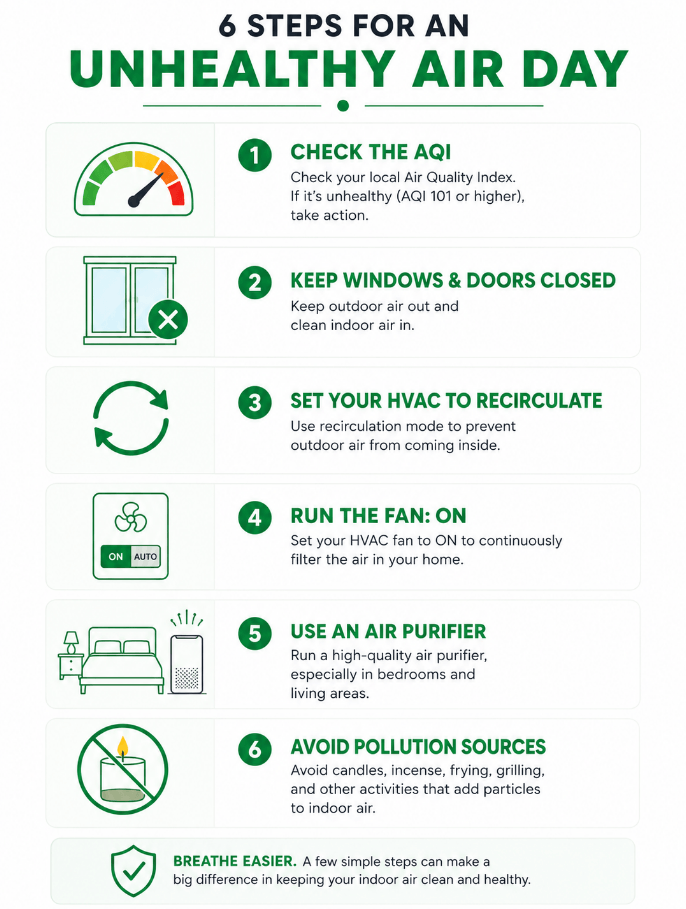
When the forecast turns orange or worse, six actions cut indoor exposure within the hour.
Check the air quality index and note which pollutant is driving it.
Close windows and exterior doors until the forecast improves.
Set the system to recirculate and close any fresh-air intake damper.
Switch the thermostat fan from AUTO to ON.
Run a portable purifier in one room with the door closed.
Skip candles, frying, unsealed vacuuming, and wood or gas fires.
Smoke does not clear when a fire is contained, so both settings often stay in place for days. The Filterbuy guide on how long wildfire smoke lingers covers the timeline in more detail.
After manufacturing filters for over a decade and serving more than two million households, the pattern we see every smoke season is the same. People buy one purifier for a three-bedroom house and assume they are covered. The filter already in the furnace treats every room, and moving the thermostat fan to ON costs nothing. Start there, then add a purifier where someone sleeps.
— David Heacock, Founder and CEO, Filterbuy
Seven Essential Resources For Deciding Between A Purifier And A Filter
Every source below is a primary government, standards-body, or patient-advocacy reference, so you can check any claim against the original.
1. Get The Federal Baseline On Both Devices
The Environmental Protection Agency compares portable air cleaners and central HVAC filters side by side in its consumer guide to air cleaners in the home, and states plainly that neither device removes every pollutant.
2. Learn To Read The Number Before You Act On It
AirNow, the EPA air quality reporting service, explains the six categories and the 0 to 500 scale in its air quality index basics, which is how you identify whether filtration will help at all.
3. See The Public Health Evidence On Smoke Filtration
The Centers for Disease Control and Prevention and the EPA reviewed the research together in a summary on indoor filtration during wildfire smoke, the closest thing to a public health verdict on whether filtration lowers indoor exposure.
4. Size A Purifier Without Guessing At Specifications
ENERGY STAR, the joint EPA and Department of Energy efficiency program, publishes room air cleaner criteria and CADR guidance that map clean air delivery rate to room square footage, so you can test any manufacturer claim against a federal standard.
5. Find The Wildfire Sizing Rule Most Buyers Never Hear
The Association of Home Appliance Manufacturers, the body behind the CADR seal on purifier packaging, sets the certification standards for air cleaner performance, and raises the sizing rule during wildfire smoke from two-thirds of room area to the full square footage.
6. Check What Was Actually Tested For Sensitive Households
The Asthma and Allergy Foundation of America runs an independent certification program for air cleaners and filters, worth checking when someone in the home lives with asthma or year-round allergies.
7. Go Deeper On Building-Level Smoke Protection
ASHRAE, the engineering society that defines the MERV scale, publishes wildfire response guidance for buildings, whose envelope-sealing and outdoor-air recommendations apply to houses as well as commercial buildings.
Supporting Statistics
129.1 million people in the United States, about 38 percent of the population, were exposed to unhealthy ozone levels during 2022 through 2024. Source: American Lung Association State of the Air Ozone Findings
Respiratory hospitalizations rose 1.3 to 10 percent per 10 micrograms per cubic meter of wildfire-specific PM2.5, compared with 0.67 to 1.3 percent for PM2.5 from other sources. Source: Aguilera et al., Nature Communications, 2021
Two-thirds of U.S. households use central air conditioning or a central heat pump as their main cooling equipment. Source: U.S. Energy Information Administration Residential Energy Consumption Survey
Frequently Asked Questions
Does A Furnace Filter Stop Wildfire Smoke?
A MERV 13 or higher pleated filter captures a large share of the fine particles in wildfire smoke while the blower runs. It does not remove smoke odor or the gases, which require activated carbon.
Do Air Purifiers Remove Smog Or Ozone?
A purifier removes ozone only if it contains a substantial activated carbon stage. HEPA media captures particles and has no effect on ozone. Some ionizing devices generate ozone rather than remove it, so check for low or zero emission certification.
What MERV Rating Should I Use For Outdoor Air Pollution?
MERV 13 is the standard recommendation where equipment supports it. Where airflow is a constraint, MERV 11 pleated filters still capture a meaningful share of fine particles with less resistance.
Should I Run My HVAC System During High Outdoor Pollution?
Yes, provided the system recirculates indoor air rather than drawing outdoor air in. Close any fresh-air intake damper, and avoid single-hose portable air conditioners and evaporative coolers that vent outside.
Do I Need Both A Purifier And An Upgraded Filter?
Households with a sensitive-group member, or in a smoke-prone region, benefit from both. For how the technologies differ mechanically, see the Filterbuy comparison of HEPA purifiers and pleated media.
Match Your Home To The Right Protection
Filterbuy has manufactured pleated filters in the USA since 2013, across facilities in Alabama, Florida, Pennsylvania, and Utah, in more than 600 sizes plus custom dimensions. More than 85,000 five-star reviews sit behind that record. Find your size, then match the efficiency to what your equipment supports and the season you are heading into. Shop custom sizes to get started.
Glossary
AQI (Air Quality Index): The EPA scale from 0 to 500 reporting daily U.S. outdoor air quality across five pollutants. Readings of 0 to 50 are good, above 300 hazardous.
PM2.5: Fine particulate matter of 2.5 microns or smaller, the main component of wildfire smoke.
MERV: Minimum Efficiency Reporting Value, the scale rating how well a pleated HVAC filter captures particles across defined size ranges.
True HEPA: A standard requiring removal of at least 99.97 percent of particles at 0.3 microns in one pass. MERV 13 is not HEPA.
CADR (Clean Air Delivery Rate): A measure of filtered air a portable air cleaner delivers, rated separately for smoke, dust, and pollen.
Ground-level ozone: A gas formed when sunlight reacts with tailpipe and industrial emissions. Ozone is a respiratory irritant not removed by particle filtration.
Activated carbon: A porous medium that adsorbs gases and odors that pleated and HEPA media cannot capture.