
Does Air Quality Affect Home Values? What the Research Finds
September 24, 2026

Yes. Buyers pay more for homes where the air is cleaner, and less where it's dirtier. The effect is modest and varies by market, but decades of U.S. housing research agree on the direction.
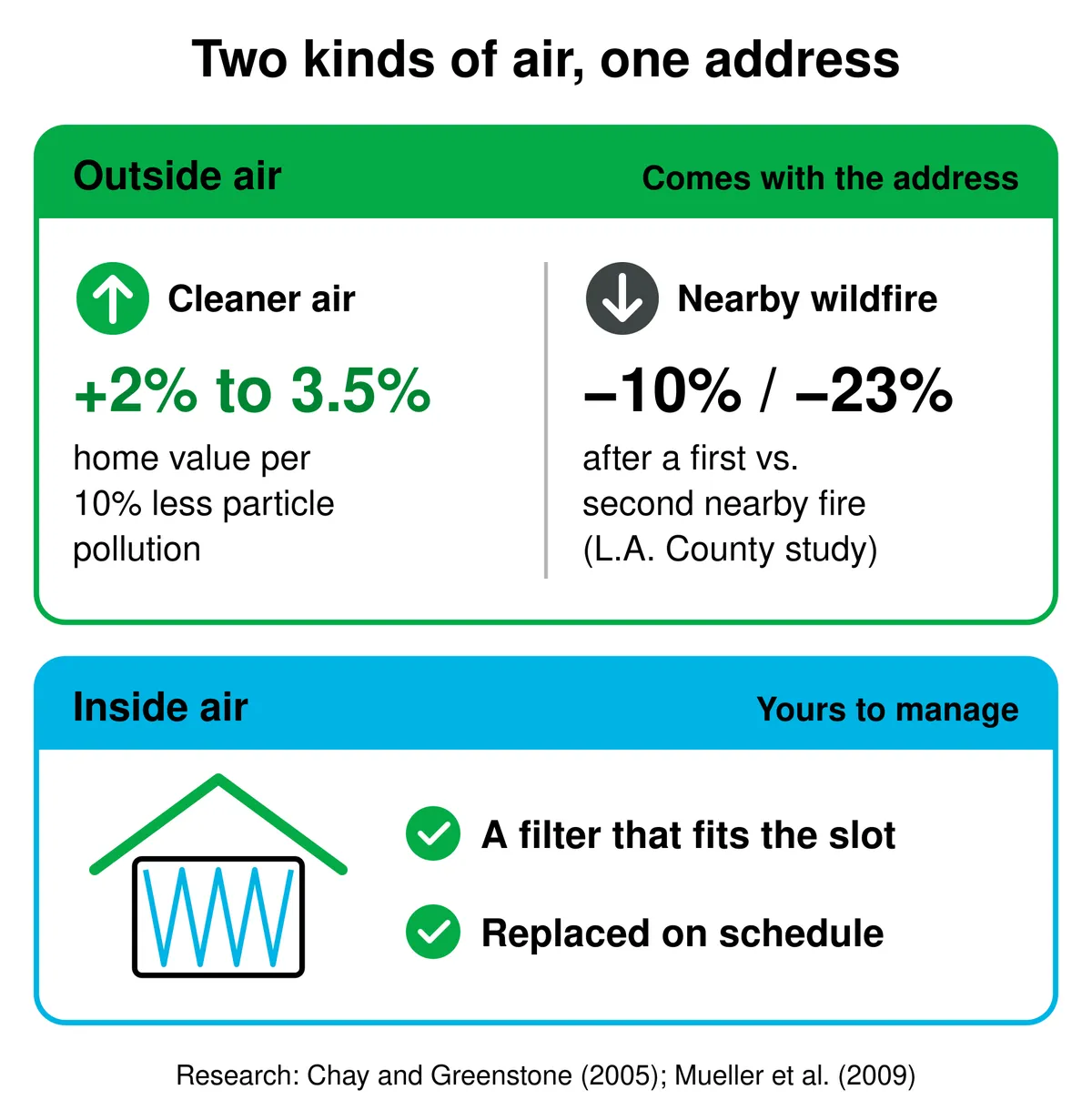
The air outside comes with the address. The air inside is yours to manage, and the quick quiz below matches your home to the right Filterbuy filter.
Answer a few quick questions and we'll match you to the right filter for your home.
Already know your filter size?
TL;DR
Yes. Decades of housing research show that buyers pay more for cleaner air and less for dirtier air, though the effect is modest and varies from market to market. For many buyers, wildfire is now the most visible air risk. At Filterbuy, where we build air filters, we see it simply: the air outside comes with the address, and the air inside is yours to manage.
Key Takeaways
In landmark Clean Air Act research, a 10% drop in particulate pollution was linked to home values roughly 2% to 3.5% higher.
Wildfires pull nearby prices down, and a second fire hits harder than the first: nearly 23% versus about 10% in one Los Angeles County study.
Every air-risk tool has a blind spot, so read a home with several of them together.
Does Air Quality Affect Home Prices?
Yes. All else being equal, buyers pay more to live where the air is cleaner. Economists call this capitalization, meaning a neighborhood amenity like clean air gets built into a home's price. Air quality is one of several environmental factors in home value, alongside flood and heat risk, and most U.S. studies agree on its direction, though the size varies by market.
The clearest evidence comes from the Clean Air Act. In a landmark 2005 study in the Journal of Political Economy, economists Kenneth Chay and Michael Greenstone found that a 10% reduction in particulate pollution was associated with home values about 2% to 3.5% higher.
What The Research Finds: Key Studies At A Glance
Five peer-reviewed studies mostly point the same way: cleaner air adds to real estate prices, while wildfire, nearby or downwind, takes value away.
Paste into a Custom HTML block. Straight quotes only; if your editor auto-formats quotes, paste as plain text.
How Does Wildfire Risk Affect Property Value?
Wildfire risk lowers property values in ways that reach well beyond the burn zone. The fire itself is the obvious threat, but smoke from distant fires matters too, and so, more and more, does the cost of insuring a home.
Direct fire exposure. In Los Angeles County, a hedonic study of homes near 1990s fire perimeters found that the first wildfire cut prices by about 10%, and a second one by nearly 23%.
Smoke, even from far away. A 2024 study in Land Economics by Zeying Huang and Mark Skidmore found that wildfires, especially distant ones, measurably lower U.S. home prices through the PM2.5 smoke they carry downwind.
Insurance and closing risk. In a California Association of Realtors survey, more than 16% of agents reported at least one 2025 sale falling through because the buyer couldn't get homeowners insurance.
Can Homebuyers See Air Quality And Wildfire Risk On Listings?
Listing sites differ. Redfin and Realtor.com have shown property-level climate risk scores from First Street, a climate-risk firm MSCI acquired in August 2026. Zillow went the other way: it removed the scores from its listings in November 2025 and now links out to First Street instead.
The scores are also contested. Climate-risk models often disagree, and one comparison found two flood models matched just 21% of the time. In August 2026, Nebraska's attorney general sued First Street, alleging some of its scores are inaccurate, while First Street defends its models as peer-reviewed. Filterbuy's take is to read a risk score the way you'd read a pressure gauge: as a reason to look closer, not a verdict.
What Each Air-Risk Tool Tells You, And What It Misses
No single tool gives you the full picture of a home's air, because each one measures something different and misses something else. Here's how Filterbuy reads them side by side.
Paste into a Custom HTML block. Straight quotes only; if your editor auto-formats quotes, paste as plain text.
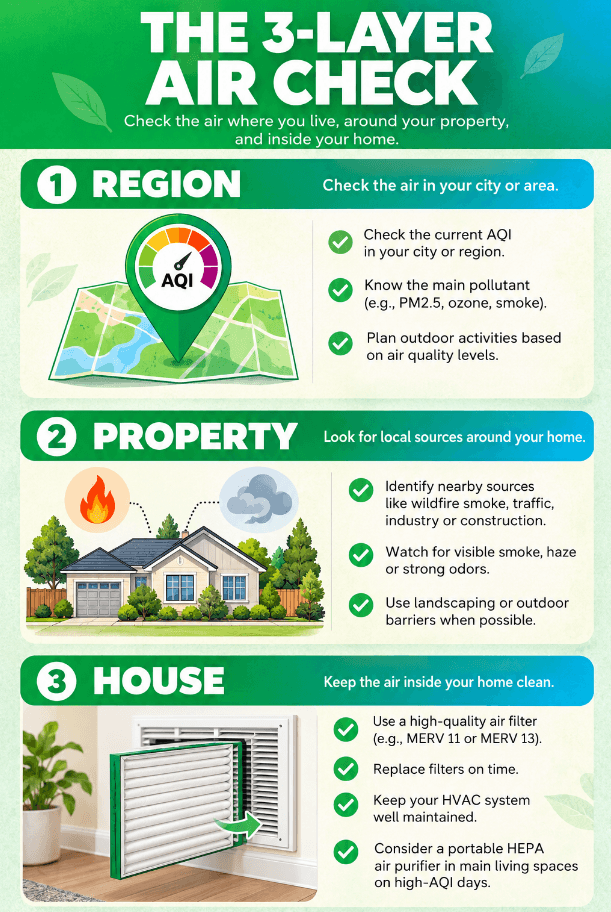
Buying A House With Bad Air Quality: A 3-Layer Air Check
At Filterbuy, we think of every house as coming with two kinds of air: the air outside, which you buy with the address, and the air inside, which you manage after closing.
Start with the region. Look up the county's grades in the American Lung Association's “State of the Air” report; in 2026, 44% of Americans lived somewhere with a failing grade. Then check recent conditions on Filterbuy's live USA AQI map, which ranks more than 750 U.S. cities.
Move to the property. Work through the tools in the table above, including your state's official fire hazard map (such as California's Fire Hazard Severity Zone viewer), and get an insurance quote before you make an offer. In California, the Safer from Wildfires program ties insurance discounts to specific mitigation steps, so ask which ones the home already has.
Finish inside the house. Have the inspector check the HVAC system's age and ductwork, then pull the current filter. A dark, overloaded filter hints at how the system was maintained, and one that doesn't fill its slot means air has been slipping around it. Measure the slot rather than the old filter, since depth is the dimension Filterbuy's manufacturing team sees ordered wrong most often.
“Homeowners bring me the old filter and ask what to buy. I ask for a photo of the empty slot instead. Half the time the filter they had been using was never right for the opening it sat in.”
— David Clark, Licensed HVAC Technician, Filterbuy HVAC Solutions
What You Can Control: The Air Inside The Home
After closing, your HVAC filter is the first line of defense on smoky days. The U.S. Environmental Protection Agency recommends upgrading to a MERV 13 or higher filter during smoky periods, and a high-efficiency filter may cut indoor PM2.5 by about half when the system fan runs continuously. During active fire season, Filterbuy recommends replacing MERV 13 filters every 30 to 45 days instead of the usual 90, because smoke loads filter media quickly.
“The question I get most is which MERV to buy. The one to ask first is whether the filter you are holding actually fills the slot. A rating describes the media, not the gap around it.”
— Michelle Wan, Brand Manager, Filterbuy
We'll be straight with you: a better filter protects your family's health and your HVAC system, but it won't raise a home's appraisal. For ratings, see Filterbuy's guide to the best MERV filter for wildfire smoke.
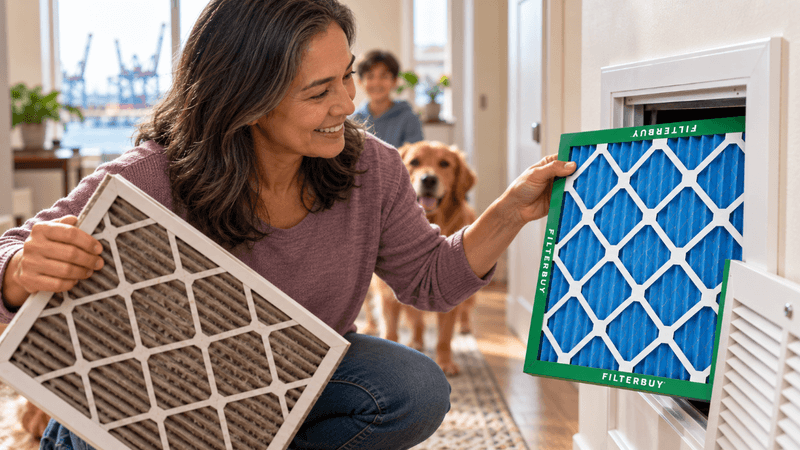
Pro Tip from Filterbuy: After more than a decade of manufacturing air filters in the USA, we've learned that the most common problem isn't the wrong rating. It's a filter left in too long. If you're moving into a smoke-prone area, measure your filter size and keep two or three spare MERV 13 filters before fire season, because shipping slows once a regional smoke event starts.
Supporting Statistics
Nearly 50 million U.S. homes sit in the wildland-urban interface, a number growing by about 1 million every three years.
The same Stanford-led PNAS study estimated that wildfires have accounted for up to 25% of U.S. PM2.5 in recent years, and up to half in some Western regions.
Source: Burke et al., PNAS (2021), via the National Library of Medicine
With doors and windows closed and no air cleaner running, indoor PM2.5 runs about 55% to 60% of outdoor levels during wildfire smoke.
The EPA adds that the share ranges from 30% to 100% by home, with newer and air-conditioned homes keeping smoke out better.
Source: U.S. EPA, Strategies to Reduce Exposure Indoors
61.5 million people live in counties graded “F” for short-term spikes in particle pollution.
That makes a county's grade the first thing to check.
Source: American Lung Association, “State of the Air” 2026
Frequently Asked Questions
Does a California fire hazard zone raise my insurance rate?
Not on its own. The California Department of Insurance says CAL FIRE's hazard maps aren't used for insurance rates or underwriting, since insurers rely on their own wildfire risk models.
Should I avoid buying a house in an area with poor air quality?
Not necessarily. Weigh the property's wildfire and insurance risk against your household's health needs
Do sellers have to disclose fire hazard zones?
In California, yes. Sellers must disclose a home's Fire Hazard Severity Zone designation, and homes in Very High zones must meet defensible-space and home-hardening rules. Rules vary by state.
Can my HVAC system handle a MERV 13 filter?
Usually. The EPA says most home systems can handle one without problems as long as it's replaced often. Older units and low-static blowers can struggle, so have an HVAC technician check static pressure first.
Should I test a home's indoor air before buying?
It's worth it for problems outdoor scores can't show, like radon and moisture. A DIY kit makes a good first screen, and Filterbuy's testing guide recommends a licensed consultant if you need documentation for a sale.
Glossary
Hedonic pricing: A method that estimates what buyers pay for each attribute of a home, such as cleaner air.
Capitalization: How an amenity or risk, like clean air or wildfire exposure, becomes part of a home's price.
PM2.5: Fine particles 2.5 micrometers or smaller, the main harmful pollutant in wildfire smoke.
Air Quality Index (AQI): The EPA's 0-to-500 daily air quality scale; above 100 is unhealthy for sensitive groups.
First Street: A climate-risk modeling firm, owned by MSCI since August 2026, that scores properties for flood, wildfire, wind, heat, and air risk.
Air Factor: First Street's 1-to-10 score for a property's expected poor air quality days, now and over 30 years.
Fire Factor: First Street's 1-to-10 score for a property's wildfire risk.
MERV: Minimum Efficiency Reporting Value, a 1-to-16 rating of how well an HVAC filter captures particles.
Wildland-urban interface (WUI): Areas where homes meet or mix with fire-prone vegetation.
Check Your Air, Then Protect It
A good first step is Filterbuy's live USA AQI map for the area around the home you're considering, then measure your filter size and set up auto-delivery.
Sources
Chay and Greenstone (2005); Smith and Huang (1995); Loomis (2004); Mueller, Loomis, and González-Cabán (2009); Huang and Skidmore (2024)
U.S. EPA: Preparing for Smoke and Heat; Strategies to Reduce Exposure Indoors
Redfin: Air Factor launch (2024)
Real Estate News (2025); Insurance Journal (2025); Nebraska Attorney General (2026); MSCI (2026); California Department of Insurance; CAL FIRE; Placer County