
Port and Shipping Air Pollution: How Far Inland It Reaches
September 24, 2026
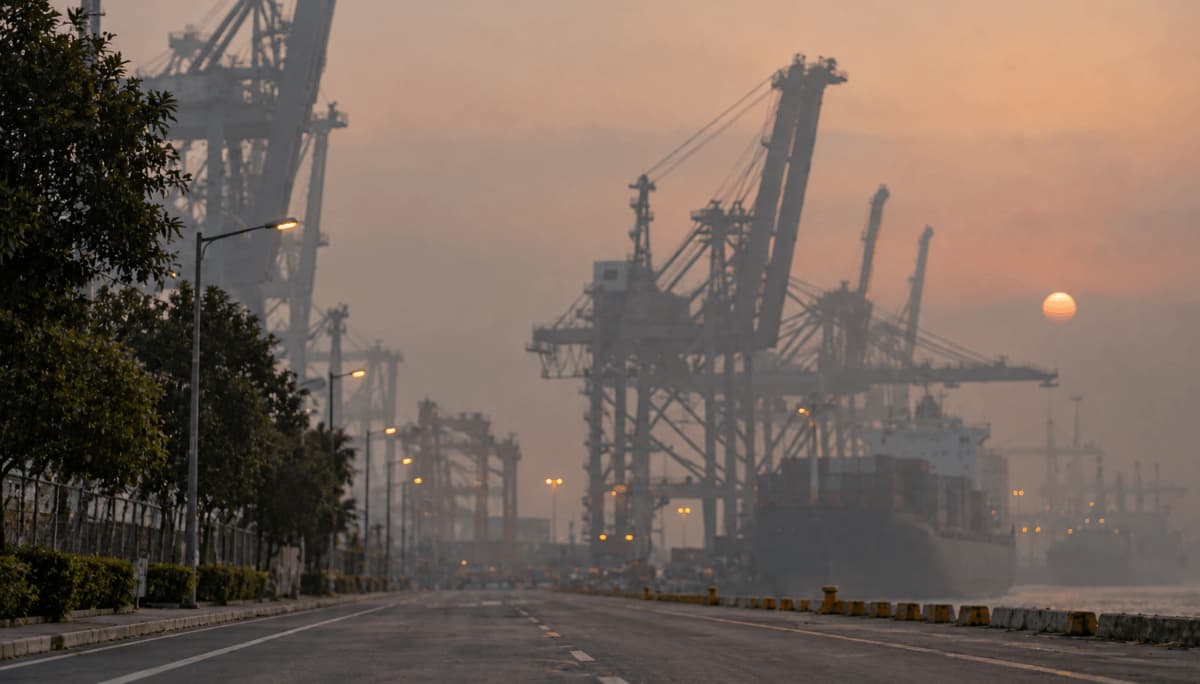
Port pollution is heaviest within about 500 feet of terminals and truck routes, stays elevated up to about 3 miles from a port, and can affect air quality hundreds of miles inland. It comes from the diesel engines of ships, trucks, trains, and cargo equipment.
Your distance to the nearest truck route or terminal gate matters more than your distance to the water. Your zone also sets your filter rating and how often to change it.
Take the quick match quiz below to find the right filter for your home.
Find your filter match
Answer 3 quick questions and we'll match you to the right filter for your home.
Already know your filter size?
TL;DR
Port and shipping air pollution is the diesel exhaust, fine particles, nitrogen oxides, and sulfur oxides that ships, trucks, trains, and terminal equipment release at seaports. It is worst within a few hundred feet of terminals and truck routes, stays high across neighborhoods up to about three miles from a port, and still affects air quality hundreds of miles inland.
Key Takeaways
EPA counts at least 31 million people living within about 3.1 miles of major U.S. ports.
Exposure peaks within about 500 feet of terminals and truck routes, so the truck route matters more than the shoreline.
EPA recommends MERV 13 filters, and Filterbuy adds filter changes every 30–45 days for homes near a port.
What Is Port and Shipping Air Pollution?
Port and shipping air pollution comes from the diesel engines that move freight through a harbor: ocean-going vessels, harbor craft, drayage trucks, cargo-handling equipment, and locomotives. The U.S. Environmental Protection Agency (EPA) identifies these diesel sources as the primary cause of combustion emissions at ports, and together they release particulate matter, nitrogen oxides, carbon monoxide, sulfur oxides, and air toxics.
Harbor air pollution is concentrated: one terminal packs hundreds of diesel engines into a few square miles, and truck routes and rail yards carry the exhaust inland.
How Far Inland Does Port Pollution Reach?
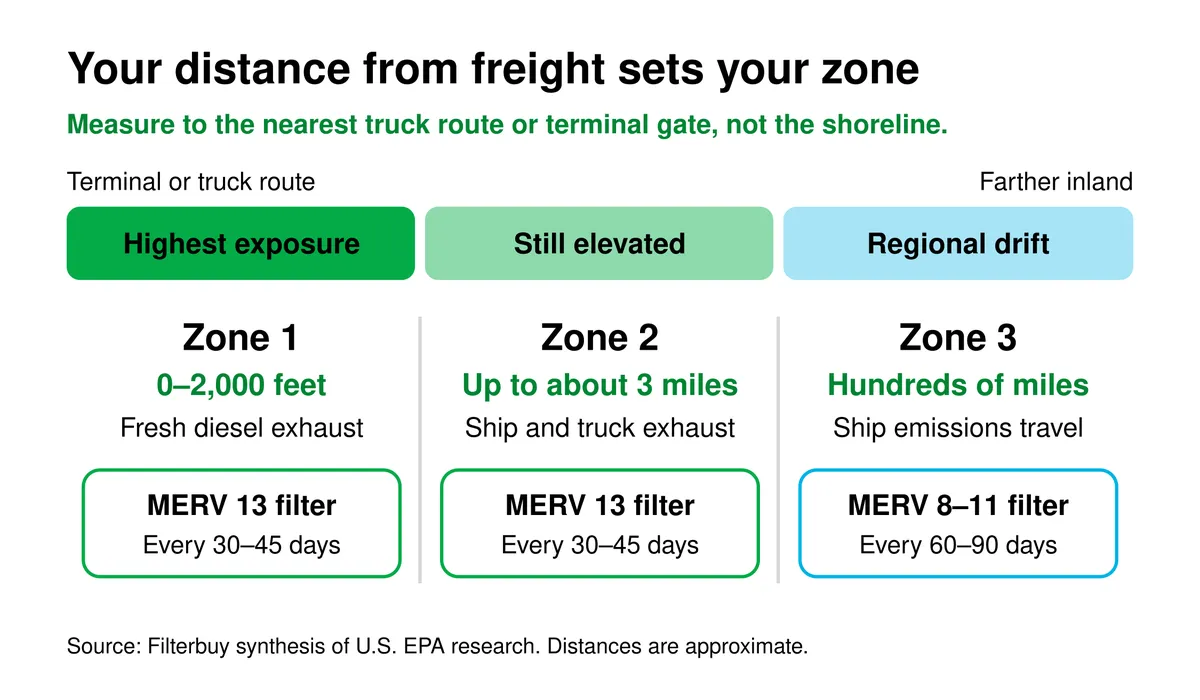
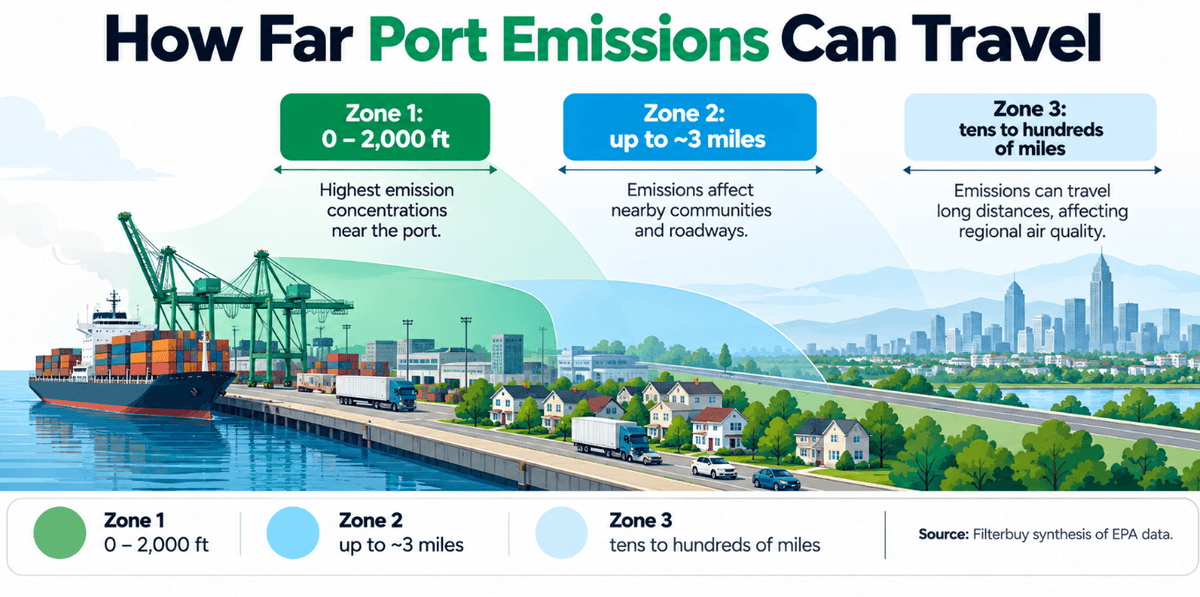
Port pollution spreads inland in three overlapping zones. Fresh diesel exhaust peaks within about 500 feet of terminals and truck routes, exposure stays higher out to roughly three miles, and ship exhaust forms secondary particles and ozone that can travel hundreds of miles. Filterbuy built these Three Reach Zones to answer the question neighbors actually ask: how near is too near?
Source: Filterbuy synthesis of U.S. EPA research. Distances are approximate.
Zone 1: The Fence Line And Truck Corridor
EPA guidance for schools reports that vehicle pollutant levels peak within the first 500 feet of a roadway and fade to background within about 2,000 feet. On a container-truck route, a home can sit in Zone 1 miles from the water. Filterbuy's team sees this missed more than anything else: the truck route, not the shoreline, draws the line.
Zone 2: Port Community Air Quality
Farther from the fence line, exposure eases but persists. EPA estimates that at least 31 million people live within 5,000 meters of major ports in the conterminous U.S., and that near-port populations include more socioeconomically vulnerable residents.
Zone 3: The Regional Reach
Marine fuel emissions travel much farther than truck exhaust. When EPA analyzed the North American Emission Control Area, it projected cleaner air along the coast and hundreds of miles inland.
Find Your Zone In Five Minutes
Measure to freight, not the shore. Use a map app to measure to the nearest terminal gate, rail yard, or port truck route.
Check truck routes. Many cities publish truck route maps, and a home on a port truck route belongs in Zone 1.
Note the wind. Sea breezes can push port plumes across neighborhoods, which puts downwind homes at the high end of their zone.
Count overlapping sources. A port plus a freeway or rail yard compounds exposure, so plan one zone closer.
Watch a busy day. Compare your reading with Filterbuy's Long Beach live AQI map on a busy port day.
What Are the Health Effects of Shipping and Port Emissions?
According to EPA, port-related diesel emissions are linked to premature death, hospital admissions for heart and lung disease, higher cancer risk, and respiratory symptoms, with children, older adults, and outdoor workers most affected. The International Agency for Research on Cancer classifies diesel engine exhaust as carcinogenic to humans (Group 1).
A 2018 study in Nature Communications linked ship pollution to about 400,000 premature deaths a year before cleaner fuel rules took effect and projected that roughly 250,000 would remain afterward. EPA's near-source air pollution research ties living near busy highways, rail yards, and marine ports to reduced lung function, asthma, cardiovascular disease, and premature death.
What Does Regulation Cover Today?
Port pollution is regulated in layers: international fuel rules for ships, a North American Emission Control Area, and state and port rules. As of September 2026, California's at-berth rule is phasing in and its drayage truck purchase mandate has been repealed.
Status as of September 23, 2026. Sources: IMO, U.S. EPA, CARB, Port of Los Angeles, Commercial Carrier Journal.
The Port of Los Angeles reports that since 2005 it has cut diesel particulate matter by 90%, sulfur oxides by 98%, and nitrogen oxides by 73%.
Commercial Carrier Journal confirmed the drayage repeal took effect September 10, 2026, but truck registration and the $10-per-TEU Clean Truck Fund Rate still apply.
Filterbuy's take: ships and truck fleets turn over slowly, so the air inside your home is the part you can control now.
How Can You Reduce Port Pollution Inside Your Home?
The most effective steps are a MERV 13 HVAC filter, a running fan, and a portable air cleaner if your system cannot take one. This is the routine Filterbuy recommends.
Check your local AQI before opening windows. Port pollution shifts with wind and truck traffic, so check Filterbuy's live air quality map first.
Upgrade to MERV 13 if your system allows. EPA recommends a filter rated at least MERV 13, or the highest rating your system can accommodate. Filterbuy makes MERV 13 filters in 600+ sizes.
Run the fan. A filter only cleans air while the blower runs.
Cover the gaps. If your system can't handle MERV 13, add a portable air cleaner. For diesel odor and gases, EPA points to activated carbon, which Filterbuy's Odor Eliminator filters pair with pleated media.
Your Zone Action Plan
Your zone also sets your filter rating and replacement schedule. This plan draws on Filterbuy's guidance for high-pollution homes:
Sources: Filterbuy high-pollution and AQI filter guidance; U.S. EPA. Confirm your system supports MERV 13 before upgrading.
What Filterbuy's Lab Data Adds
Filterbuy has made pleated filters in its U.S. plants since 2013. Three lab findings matter most for homes in Zones 1 and 2:
Go deeper before you go lower. In our tests, a 1-inch MERV 13 filter had an airflow resistance of 0.22 inches of water gauge at 1,000 CFM, while the 4-inch version had just 0.11. Try a thicker filter before dropping to MERV 11.
A running fan fills filters faster. Our 90-day rating assumes a cycling blower, so a fan that runs continuously means earlier changes.
A note on our bias. Filterbuy doesn't sell portable air purifiers, so recommending one earns us nothing.
"The rating matters far more than the schedule. A fresh MERV 8 filter still lets most fine particles through, while a MERV 13 filter catches far more of them."
– Michelle Wan, Filterbuy
"Most systems I test are not struggling because the filter is too efficient. They are struggling because it has been in there since spring."
– David Clark, Filterbuy HVAC Solutions

Supporting Statistics
75.9 million Americans live with year-round particle pollution above the federal standard.
In Southern California, air toxics cancer risk peaks in and around the ports.
Across the South Coast basin, risk fell from 997 to 455 in a million between 2012 and 2018.
Diesel particulate matter is the largest contributor.
Cleaner ships in the North American Emission Control Area were projected to prevent up to 14,000 U.S. premature deaths by 2020.
Frequently Asked Questions
How far inland does port pollution travel?
Fresh diesel exhaust fades within about 2,000 feet, exposure stays higher out to about three miles, and ship emissions can affect air quality hundreds of miles inland.
Is it safe to live near a port?
Millions of people do, but exposure is highest near terminals and port truck routes. A MERV 13 filter and a running fan lower it indoors.
How often should I change my air filter if I live near a port?
Every 30–45 days within about three miles of a port, and every 60–90 days farther inland. Check it monthly and replace it early if it looks gray.
Does a MERV 13 filter remove diesel exhaust?
It captures much of the particle portion, including PM2.5, but not gases such as nitrogen dioxide. For diesel odor and gases, pair it with activated carbon.
Should I open my windows if I live near a port?
Yes, when the live AQI is green and truck traffic is light. Filterbuy recommends closing them during peak truck hours and whenever the reading turns orange (AQI 101+).
Next Steps
Find your zone using the five-minute check above.
Order the Filterbuy MERV 13 filter that fits your return, including custom sizes.
Set up Filterbuy auto-delivery on your zone's schedule.
Glossary
Drayage truck: A heavy truck hauling containers between terminals, rail yards, and warehouses.
PM2.5: Particles 2.5 micrometers or smaller that reach deep into the lungs. See PM10 vs. PM2.5 explained.
Nitrogen oxides (NOx): Combustion gases that irritate airways and help form ozone.
Sulfur oxides (SOx): Gases from burning sulfur-containing fuel that form sulfate particles.
MERV: Minimum Efficiency Reporting Value, the ASHRAE 52.2 scale for HVAC filter particle capture.
AQI: The Air Quality Index, EPA's daily air pollution scale.
Sources
U.S. EPA, Technical Resources for Ports (near-port population analysis)
U.S. EPA, Best Practices for Reducing Near-Road Air Pollution Exposure at Schools
U.S. EPA, Research on Near Roadway and Other Near Source Air Pollution
International Maritime Organization, IMO 2020: Cutting Sulphur Oxide Emissions
International Agency for Research on Cancer, Diesel Engine Exhaust Carcinogenic (2012)
California Air Resources Board, Ocean-Going Vessels At Berth Regulation
Commercial Carrier Journal, California finalizes repeal of zero-emission truck rules (Sept. 2026)
Port of Los Angeles, 2024 Inventory of Air Emissions release (Oct. 2025)
American Lung Association, State of the Air 2026: Year-Round Particle Pollution
South Coast AQMD, MATES VI Technical Advisory Group presentations (MATES V results)