
HEPA Ratings Explained: What the Numbers Actually Mean
August 20, 2026
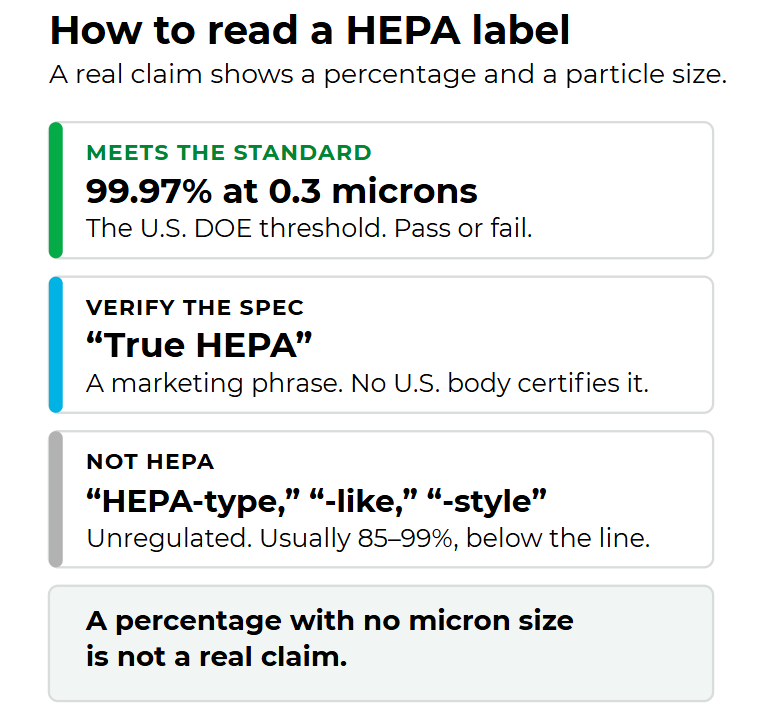
HEPA is a performance threshold, not a brand or a material: in the U.S., a filter has to capture at least 99.97% of particles at 0.3 microns to earn the name. Any label that gives you a percentage without the particle size is not making a real claim. Here is how the terms on the shelf compare:
99.97% at 0.3 microns — the Department of Energy threshold. Pass or fail.
“True HEPA” — a marketing phrase wrapped around that same standard. No U.S. body certifies it, so check the printed spec.
“HEPA-type,” “HEPA-like,” “HEPA-style” — unregulated, and usually below the threshold. Typical efficiency lands in the 85–99% band.
H13 and H14 (EN 1822 / ISO 29463) — the European grades, at least 99.95% and 99.995%, tested at the most penetrating particle size.
HEPA sits above the MERV scale that HVAC filters use, so the right filter for your home comes down to your system and what you need it to capture. Take the quick match quiz below, or browse the full range at Filterbuy.
Answer a few quick questions and we will match you to the right filter for your system.
Know what you need already? Shop all Filterbuy air filters.
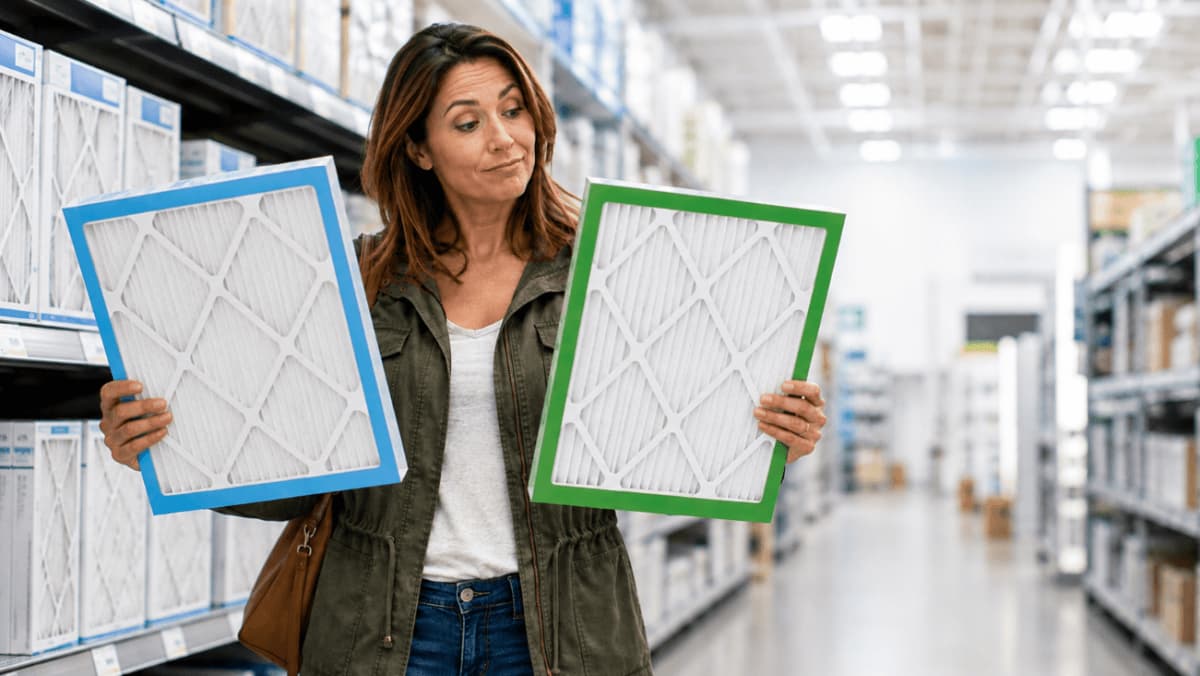
You're standing in the filter aisle, staring at three boxes. One says "True HEPA." Another says "HEPA-type." The third promises "99.97% HEPA." They all sound legit. They're all priced differently. And none of them make it obvious which one you should actually buy.
Here is the short answer: only some of that language is backed by actual testing. The rest is marketing dressed up to look like a standard. Two of those four terms describe a measured performance threshold. Two describe a shelf label with nothing behind it.
By the end of this guide, you will be able to read any HEPA label correctly, spot the weak claims in about ten seconds, and know exactly what number to look for before you spend a dime.
Key Takeaways
HEPA is a performance threshold, not a brand or material. In the U.S., it means removing at least 99.97% of particles at 0.3 microns, per the Department of Energy standard.
"True HEPA" is a marketing phrase wrapped around a real standard. No U.S. regulatory body polices it, so verify the actual spec.
"HEPA-type," "HEPA-like," and "HEPA-style" are unregulated and usually mean the filter fell short of 99.97%.
0.3 microns is the hardest size to catch, not the smallest. A filter that passes at 0.3 microns performs even better above and below it.
A percentage with no micron figure attached is not a real claim. Always look for both numbers together.
What Hepa Actually Stands For
HEPA stands for High Efficiency Particulate Air. If you have ever wondered what HEPA means beyond the acronym, here is the key point: it describes a performance threshold, not a material, a brand, or a filter shape.
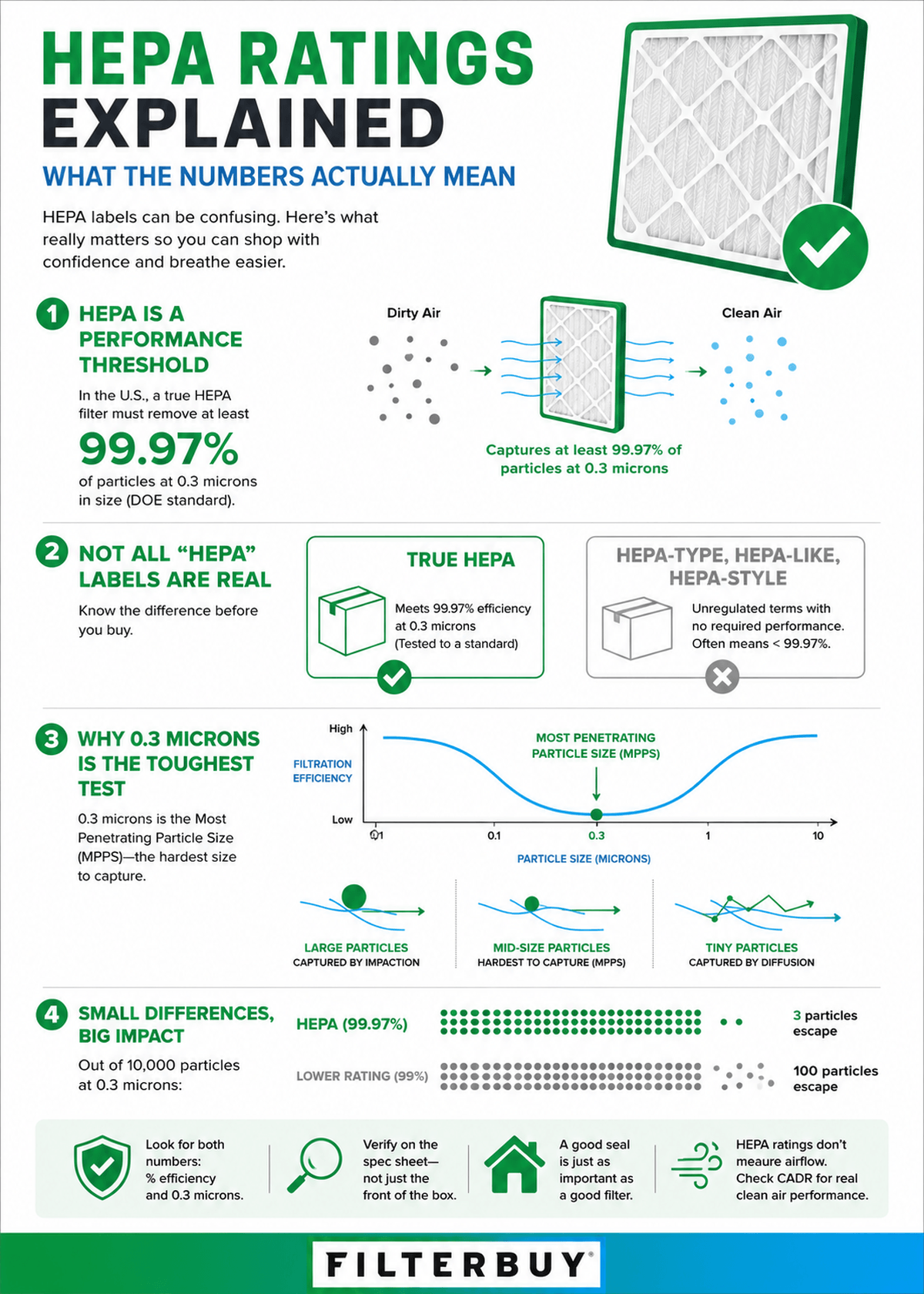
In the United States, the benchmark comes from the Department of Energy (DOE). To qualify, a filter must remove at least 99.97% of particles at 0.3 microns in size. That is a pass or fail line. The filter either meets it or it does not.
Here is what trips people up. HEPA is only an efficiency spec. It tells you nothing about airflow, filter life, odor removal, or build quality. It also says nothing about CADR, the metric that captures how much clean air a purifier actually delivers. Two filters can both earn the HEPA label and still perform very differently once they are running in a real room.
So when you see 99.97% 0.3 microns on a box, you know the media can capture particles. You do not yet know how well the whole unit will move air through it.
The 99.97% Number: What It Measures And What It Doesn't
That 99.97% figure is not measured in your living room. It comes from controlled lab conditions using a defined challenge aerosol pushed through the media at a defined flow rate. Change the conditions, and you change the result.
It is also a single-pass number. Air is drawn through the media one time, and the test counts what makes it through. That matters because real-world performance depends on how much air actually goes through the filter versus leaking around it. A perfectly rated filter in a poorly sealed housing can underperform a lower-rated filter sitting in a tight one. Media rating is only half the story. The seal is the other half.
99.97% vs. 99.95% vs. 99%
pass through per 10,000
pass through per 10,000
These numbers look almost identical, but the gap between them is huge. A 99.97% filter lets through 3 particles per 10,000. Drop to 99% and it lets through 100 particles per 10,000. That is roughly 33 times more pass-through from a number that looks only slightly lower on the label.
Why 0.3 Microns? The Most Misunderstood Number In Air Filtration
Almost every article implies that 0.3 microns is the smallest particle a HEPA filter can catch. That is backwards.
0.3 microns sits near the Most Penetrating Particle Size (MPPS), generally in the 0.1 to 0.3 micron range depending on the media and air velocity. This is the hardest size for any filter to trap. Efficiency actually climbs back up for particles both larger and smaller. To understand why, you need the three ways a filter captures particles.
Impaction and interception handle larger particles, roughly above 0.5 microns. These particles have too much momentum to follow the airstream around the fibers, so they slam into them.
Diffusion handles very small particles, roughly below 0.1 microns. These are so light that they bounce around randomly through Brownian motion and wander straight into fibers.
The awkward middle, right around 0.3 microns, is too small for reliable interception and too large for strong diffusion. These particles slip through the gap between the two mechanisms.
This is why testing at 0.3 microns is a worst-case test. A filter rated 99.97% at that size performs at or above that figure for larger particles and for many ultrafine particles below it, too.
For scale, a human hair is roughly 50 to 70 microns across. Most visible dust sits well above 1 micron. Combustion and wildfire smoke particles skew far smaller, often below 1 micron. So the number chosen for the standard is not arbitrary. It is deliberately the toughest challenge a filter can face.
"True Hepa": A Marketing Wrapper Around A Real Standard
Is True HEPA a real standard? Not exactly. "True HEPA" is a marketing term. There is no U.S. regulatory body that certifies or polices the phrase.
In practice, it usually signals that the manufacturer is claiming the full 99.97% at 0.3 microns rather than something weaker. The phrase was coined to separate genuine HEPA media from the wave of "HEPA-type" products flooding shelves. So its intent is honest. But the words alone carry no independent verification.
"Look for the actual efficiency figure and the test particle size printed on the spec sheet," says a customer service manager at Filterbuy. "The phrase on the front of the box matters far less than the numbers on the back."
So when you weigh True HEPA vs HEPA-type, do not stop at the label. Check the printed spec and any third-party verification.
"Hepa-Type," "Hepa-Like," "Hepa-Style," "99% Hepa": Be Skeptical
These are pure marketing. They are unregulated and generally indicate the filter did not meet the 99.97% threshold. Typical real-world efficiency for these products lands in the 85 to 99% band, often tested at a larger, easier particle size than 0.3 microns.
Two red flags tell you a claim is weaker than it looks:
A percentage with no particle size attached, such as "captures 99.9% of particles." Without a micron figure, the number cannot be checked or challenged.
A percentage tied to a larger particle size, such as 99.9% at 2 microns. Bigger particles are far easier to catch, and that number says nothing about smoke or fine particulate.
To be fair, a HEPA-type filter is not useless. It can still trap plenty of larger dust. It just is not HEPA, and it should not be priced or trusted as if it were.
The Other Rating Systems You'll Run Into
Different scales measure different things. Comparing them directly leads to bad decisions, so here is a quick map of the HEPA filter grades and neighboring systems.
EN 1822 / ISO 29463 (European and international classes): H13 and H14 are the HEPA grades, tested at MPPS rather than a fixed 0.3 microns. An H13 HEPA filter corresponds to at least 99.95% efficiency, and H14 to at least 99.995%. Below those sit the EPA classes, E10 through E12, which stand for Efficient Particulate Air. These fall short of HEPA despite frequently being marketed as HEPA. Watch for E11 specifically, since it is a common mislabel dressed up to look like the real thing.
MERV (ASHRAE 52.2): the scale used for HVAC filters, running from 1 to 16. HEPA sits above the top of this scale, which is why standard HVAC systems generally cannot accept a HEPA filter without engineering changes. If you want a deeper breakdown, see our MERV rating explainer.
CADR (AHAM AC-1): the third-party verified metric for room air purifiers. It measures delivered clean air, combining efficiency and airflow. A HEPA rating tells you what the media can trap. CADR tells you how fast the unit cleans a room. Together, they tell you far more than either number alone.
How To Read A Hepa Label In Ten Seconds
Run through this quick checklist before you buy:
Find the efficiency percentage on the box or spec sheet.
Find the particle size it is tied to. No size means no real claim.
Confirm 99.97% at 0.3 microns for U.S. HEPA, or H13/H14 for the European classification.
Treat "type," "like," and "style" as a downgrade, not a variant.
For room purifiers, check CADR against your room size.
Check that the housing seals. The media rating is capped by how well the unit stops bypass air.
Shop Hepa Filters With Confidence
You can now read any HEPA label like a pro. Look for the percentage, confirm the micron size, and treat marketing words as a downgrade until the spec sheet proves otherwise.
At Filterbuy, we print the numbers plainly so you never have to guess. For HVAC filters, the right choice depends on your household: MERV 8 works for most homes, MERV 11 suits allergy sufferers and pet owners, MERV 13 helps with smoke, and OE handles odors with a carbon layer. Our 4-inch filters last 6 to 12 months, so replacements come around less often. For more on timing and fit, see our HVAC filter replacement guide.
Ready to match the label to the spec? Browse the full range at Filterbuy.
Frequently Asked Questions
Is True Hepa Better Than HEPA?
They usually describe the same thing. "True HEPA" typically signals a filter meeting the full 99.97% at 0.3 microns standard, while plain "HEPA" often means the same. The word "True" adds no independent certification, so check the printed spec either way.
Can A HEPA Filter Capture Viruses And Smoke Particles?
HEPA media is tested at 0.3 microns, the hardest size to catch, and captures larger and smaller particles at or above that rate. Many smoke particles and virus-sized particles fall into ranges that the media traps well. This is about particle capture, not a health claim.
What Is The Difference Between H13 And True HEPA?
H13 is a defined grade under the European EN 1822 standard, requiring at least 99.95% efficiency tested at MPPS. "True HEPA" is a U.S. marketing phrase tied to 99.97% at 0.3 microns. They are close but come from different testing systems.
Is Merv 13 The Same As HEPA?
No. MERV 13 is near the top of the ASHRAE 52.2 scale used for HVAC filters, but HEPA sits above that scale entirely. MERV 13 captures many fine particles, yet it does not meet the 99.97% HEPA threshold.
Do HEPA Filters Remove Odors Or Gases?
No. HEPA efficiency is about particle capture only. Odors and gases are molecules, not particles, so they need activated carbon media to address them.
How Often Should A HEPA Filter Be Replaced?
It depends on use, air quality, and the specific product. For guidance, see our air purifier filter replacement frequency post, and if performance drops suddenly, check our clogged air purifier filter diagnostic post.