
Cut to Size: How a Custom Air Filter Is Made
September 11, 2026
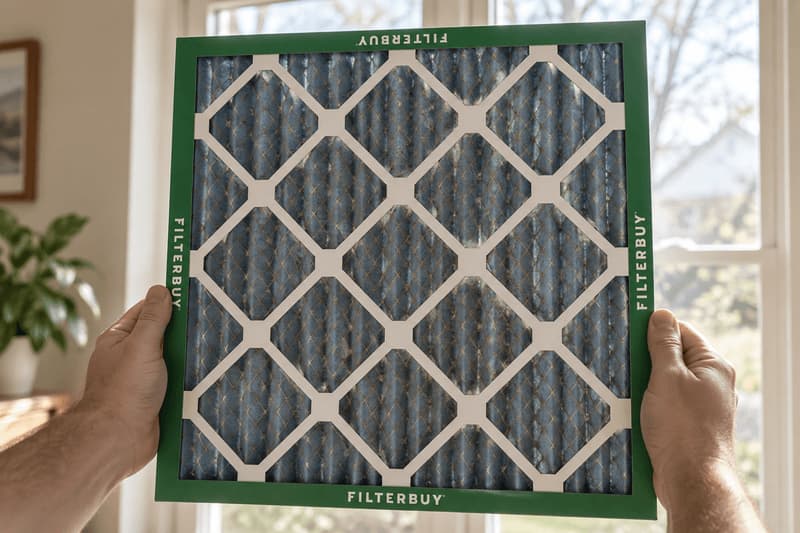
Most filter slots take a size you can buy off a shelf. Some don't.
If you measured your slot and landed on 22.25 inches, or 19.75, or anything else sitting between the numbers a catalog stocks, you already know the problem. Round down and the gap lets air slip past the filter instead of through it. Round up and the filter won't seat. Neither one gives you a seal, and a filter that doesn't seal doesn't filter.
That's a custom slot, and it's more common than you'd think. Here's how we make a filter to fit it.
Three things hold true on every custom filter we cut:
What "cut to size" means
We start with one of our standard filters in a size larger than the one you need, then cut it down to your measurements.
It's worth saying plainly, because "custom" gets used loosely in this category. Your filter isn't built one-off from raw material, and it isn't trimmed with a utility knife and taped back together either. It goes down a dedicated line with its own saw and its own capping station, and the size gets checked three separate times before it's packed.
We hold every custom cut to within plus or minus one eighth of an inch.
Your filtration level comes through the cut
Cutting a filter down changes its size, not its rating.
A filter's rating depends on the relationship between its face area, which is the opening air passes through, and its media surface area, which is the total pleated material doing the work. Cutting reduces both together, in proportion, and our custom process keeps that relationship the same. So the rating of the standard filter we start from is the rating of the filter you receive. Order MERV 11 in a custom size and you get MERV 11.
MERV ratings are set by ASHRAE 52.2, the industry test standard, and that doesn't change when a filter is cut to size.
The material is no different either. Custom orders use the same filter media as our standard production, so there's nothing lesser about an odd size.
The five stations your filter passes through
Every custom order runs the same line, in the same order.
That's three different people confirming the size before your filter leaves the floor, and it's deliberate. A standard size has a catalog number we can check against. A custom size has only your measurement, so we check the measurement three times.
How big we can make it
Most custom sizes are no trouble at all. The limit isn't the saw, it's the box: our largest custom filters are capped by what can ship as a standard parcel. If your measurements run past that, our custom team can talk you through the options.
Getting your measurement right
There's one part of this we can't do for you, and it's worth a couple of minutes of your time.
When a custom filter does need to come back, it's almost always because the measurement on the order wasn't quite right. That's the nature of made-to-order work. We cut to the number you give us, which is exactly the point, and it also means the number matters. So it's worth measuring carefully before you order.
- Measure the slot, not the old filter. An old filter can be warped or compressed, and it may have been the wrong size to begin with.
- Measure all three dimensions. Depth is the one people forget, and it's the most common miss we see.
- Don't round. Rounding to a nominal number is right for a standard size, but not for a custom one. Give us the actual measurement, down to the eighth of an inch.
- Check it twice before you submit.
If you'd like a walkthrough, here's how to measure your air filter. It takes about two minutes, and it's the difference between a filter that seals and one that doesn't.
Enter your dimensions and choose your filtration level.
Build your custom air filter