
What Is a HEPA Air Filter? What Does HEPA Stand For?
January 28, 2026

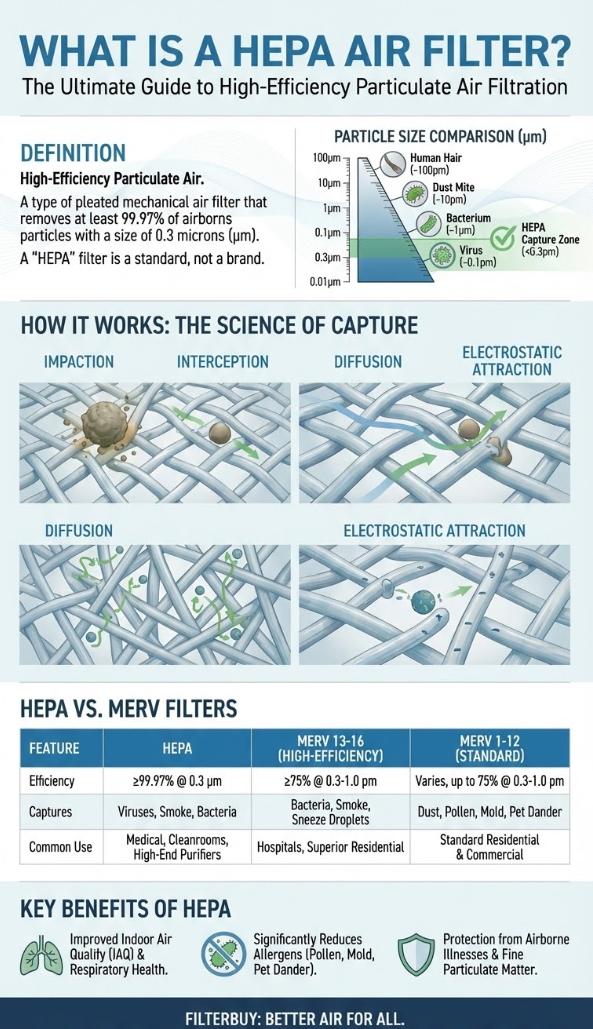
A HEPA filter is a pleated mechanical high efficiency particulate air filter that captures at least 99.97 percent of 0.3 micron particles. In healthcare and other controlled spaces, HEPA is used where very high particle removal is required.
TL;DR: Quick Answers
What is the definition of a HEPA filter?
A HEPA filter is a high-efficiency particulate air filter that captures at least 99.97% of airborne particles as small as 0.3 microns. This includes dust, pollen, mold spores, pet dander, and some bacteria.
Key facts:
HEPA stands for High Efficiency Particulate Air
Uses dense, pleated fiber media to trap particles through multiple capture methods
Commonly found in portable room air purifiers and specialized commercial applications
Does not remove odors, gases, or VOCs—activated carbon is needed for those
Important for homeowners: Most residential HVAC systems cannot accommodate true HEPA filters due to airflow restrictions. For whole-home filtration, use the highest MERV-rated filter your system supports, such as MERV 13, and add a portable HEPA purifier in rooms where you spend the most time.
Key takeaways
HEPA captures at least 99.97% of 0.3 micron particles.
HEPA removes particles while odors and gases need activated carbon.
Most home HVAC systems are not built for HEPA so use the highest MERV your system supports such as MERV 13.
Best practice is a room HEPA purifier plus whole home MERV filtration and Filterbuy provides MERV 8 11 13 and an Odor Eliminator carbon option.
What “HEPA” stands for and how does it capture particles
HEPA means High Efficiency Particulate Air.
Air moves through dense fiber media. Multiple capture modes work together—impingement, interception, diffusion, and electrostatic effects—to trap different particle sizes as air passes through the filter.
HEPA vs. MERV
HEPA is a very high-efficiency particle filter used in room air purifiers and specialized building applications. It targets particles.
MERV-rated HVAC filters are designed for whole-home systems and report performance across particle sizes. For homes, EPA recommends using at least MERV 13, or the highest your system can safely support, to reduce small particles of greatest health concern.
Bottom line: Most residential central HVAC systems are not designed for a HEPA filter. Use MERV 11–13 in the central system and, if you need extra room-level cleaning, add a room HEPA purifier.
HEPA for particles vs. odors and gases
HEPA is for particles. If you want to reduce odors or VOCs, look for a purifier that combines HEPA with activated carbon or use a central HVAC filter that includes activated carbon media for system-wide odor reduction. CADR ratings apply to particles, not gases.
Choosing a room HEPA purifier: CADR and room size
To size a purifier, match its Clean Air Delivery Rate (CADR) to your room. EPA provides a quick sizing table—for example, a 300 sq ft room calls for a particle CADR around ~195 cfm, assuming 8-foot ceilings. Higher ceilings or open floor plans need more. Running at higher fan speeds or for longer periods increases filtration.
Placement tips: Use the purifier in rooms you occupy most, keep airflow unobstructed, and consider noise ratings if you need quiet operation for sleep.
Operation and maintenance
Follow the manufacturer schedule for filter changes. A clogged filter reduces performance.
In professional guidance, HEPA efficiency and system performance depend on good seals, proper installation, and routine checks.
Safety note: avoid ozone-generating “air cleaners”
EPA advises avoiding devices that intentionally produce ozone. Ozone is a lung irritant. Some technologies can emit ozone as a byproduct. Check listings from California Air Resources Board (CARB) or Association of Home Appliance Manufacturers (AHAM) for models tested to emit little or no ozone.
HEPA and energy use
Room air purifiers run for long periods, so efficiency matters. The U.S. Department of Energy has adopted national energy conservation standards for air cleaners, expressed as CADR per watt, with Tier 1 effective December 31, 2023 and Tier 2 December 31, 2025. Look for efficient models so you can run them more without a power bill surprise.
Myths and quick answers
“HEPA solves mold problems.” No. Filtration can reduce mold particles, but moisture control and cleanup are required to solve mold.
“HVAC filters clean the whole house all the time.” HVAC filters only work while the system is running. For more filtration, the system would need longer run time, which has comfort and energy trade-offs.
Enhance whole-home protection with pleated MERV HVAC filters
Filterbuy’s whole-home filters are MERV-rated (MERV 8, 11, 13) for central HVAC systems, plus an Odor Eliminator option with activated carbon for gases and smells. If you already use a room True HEPA purifier, complement it with a MERV 11 or MERV 13 pleated HVAC filter to reduce fine particles throughout your home, and switch to Odor Eliminator (carbon) if odors or VOCs are a concern.
Ready to complement your HEPA purifier with whole-home filtration? Shop Filterbuy’s MERV 8, 11, and 13 pleated filters and Odor Eliminator (activated carbon) options—made in the USA and shipped fast for free!
FAQs
What does HEPA mean
HEPA means High Efficiency Particulate Air. It captures at least 99.97% of 0.3 micron particles.
Is HEPA the same as HEPA type
No. True HEPA meets 99.97% at 0.3 microns. HEPA type is a marketing term and may not meet that mark.
Does HEPA remove odors or gases
No. HEPA targets particles. Use activated carbon if you want to reduce odors and VOCs.
Can I use a HEPA filter in my home HVAC
Usually no. Most residential systems are built for MERV rated filters. Use the highest MERV your system safely supports such as MERV 13.
What is the best setup for a home
Use a room HEPA purifier in key spaces. Pair it with whole home MERV filtration. Filterbuy offers MERV 8, 11, and 13 plus an Odor Eliminator carbon option.
How do I size a room HEPA purifier
Match the purifier CADR to your room size. Larger rooms need higher CADR. Higher fan speeds and longer run time improve results.
Where should I place a HEPA purifier
Place it in the room you use most. Keep intake and outlet clear. Avoid corners and blocked airflow.
How often should I replace a HEPA filter
Follow the device instructions. Replacement timing varies by model, use, and air quality.
Does HEPA help with wildfire smoke or allergens
Yes. HEPA reduces fine smoke particles, pollen, pet dander, and dust. Use carbon as well if odors are a concern.
Are ozone generating air cleaners safe
Avoid devices that produce ozone on purpose. Ozone is a lung irritant. Choose models that are tested for low or no ozone.