June 29, 2026
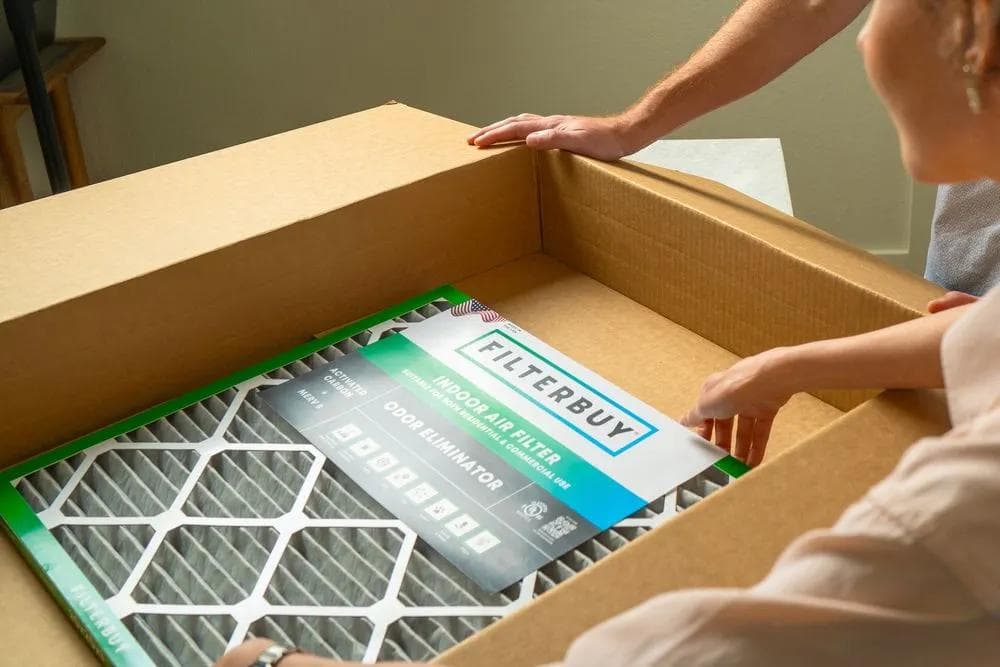
Your filter's doing its job—so why does your home still smell stale? After shipping millions of filters to American homes over the past decade, we hear this question constantly. And here's what we've learned: a clean filter handles particles, but odors need a different approach.
A furnace filter air freshener turns your existing HVAC system into a whole-house freshening solution—no plug-ins, no room-by-room guesswork. Just consistent, circulated freshness every time your system runs.
Based on thousands of customer conversations, we've found that most homeowners don't realize their ductwork is already the perfect delivery system for fresh scent. The air's already moving. The infrastructure's already there. You just need the right freshening method paired with the right filter.
In this guide, we'll share:
How vent fresheners actually interact with your HVAC airflow (and common mistakes we see)
Which scent options work best for pet odors, cooking smells, and general mustiness
How to pair freshening solutions with the correct MERV rating—because we've tested what happens when you don't
We're not just filter manufacturers—we're air quality problem-solvers. Whether you're battling stubborn odors or simply want your home to smell as clean as your new filter makes it feel, this guide gives you the straightforward answers we wish more homeowners had from the start.
A furnace air freshener is a scented product—typically a pad, clip, or gel bead—placed in your HVAC system to distribute fragrance throughout your entire home as air circulates.
How it works:
Warm air passes over the scented product
Fragrance travels through ductwork into every room
Provides whole-home scent without plug-ins or candles
Where to place it:
Downstream side of the filter (facing away from return air)
Never directly on the filter surface
What most people don't realize:
Most odor problems are actually filtration problems
Upgrading your filter often eliminates smells without added fragrance
A MERV 11, MERV 13, or activated carbon filter captures odor-causing particles at the source
Filterbuy's recommendation: Get your air clean first. Add scent only as a finishing touch—not a cover-up.
Short on time? Here's what matters most.
Most odor problems are filtration problems in disguise
A clogged or low-quality filter recirculates odor-causing particles
Upgrade to MERV 11, MERV 13, or Odor Eliminator first
Watch most smells disappear without adding fragrance
Get the air clean before you make it smell "nice."
Adding fragrance to dirty air = spraying cologne in a gym locker room
Fix filtration and odor sources first
Then add scent only if you still want it
Real fresh air smells like nothing
Truly clean air is neutral
The goal: walk in and notice nothing at all
Not a candle store—just clean
Sensitive households need extra caution
27+ million Americans have asthma
Heavy synthetic fragrances can trigger symptoms
Pair MERV 13 with unscented or natural options
Set it and forget it
The best filter doesn't work if you forget to change it
Auto-delivery = fresh filters at your door, right on schedule
No store runs, no guesswork
The Bottom Line: Start with the filter. Address the source. Add fragrance only if you want to.
The concept is simple: your HVAC system already circulates air through every room in your home. A furnace filter air freshener leverages that existing airflow to distribute pleasant scents throughout your entire living space.
When your heating or cooling system kicks on, air passes through your filter and ductwork. Freshening products—whether clip-on scent pads, gel-based vent attachments, or scented filter sprays—release fragrance into that moving air. The result? Whole-house freshness without multiple plug-ins or candles burning in every room.
From our experience helping homeowners troubleshoot air quality issues, this approach works best when your system runs regularly. If you only run your HVAC occasionally, scent distribution will be inconsistent.
Not all furnace filter fresheners are created equal. Here's what we see homeowners using most:
Clip-On Scent Pads: These attach directly to your existing filter and release fragrance as air passes through. They're affordable, easy to swap out, and work with any standard filter size.
Vent Register Freshener:s Gel-based or solid fresheners that sit inside floor or ceiling vents. They freshen the air as it exits into each room, giving you slightly more control over scent intensity by location.
Filter Spray Treatments: Lightly mist your filter with a scent-enhancing spray before installation. We recommend caution here—overapplication can restrict airflow and reduce filter efficiency.
Activated Carbon or Odor-Eliminating Filters. These don't add fragrance but actively neutralize odors at the source. Our Odor Eliminator filters with activated carbon are designed specifically for homes battling pet smells, smoke, or cooking odors.
We've talked with thousands of homeowners frustrated by the plug-in treadmill—constantly replacing units, dealing with uneven scent coverage, and spending more than they realized over time.
Whole-house freshening solves these common complaints:
Consistent coverage. Every room your HVAC reaches gets the same level of freshness. No more over-scented bathrooms and stale-smelling bedrooms.
Set-it-and-forget-it convenience. Replace your freshener when you replace your filter—typically every 60-90 days. That's it.
Cost efficiency. One freshening solution for your entire home costs less than outfitting each room with individual products.
Cleaner look. No visible plug-ins or candles cluttering your outlets and countertops.
Scent preference is personal, but we've gathered insights from customer feedback on what works in real homes:
For pet odors: Look for clean, neutral scents like fresh linen or ocean breeze. Avoid heavy florals—they tend to clash with pet smells rather than neutralize them.
For cooking odors: Citrus-based or light herbal scents cut through lingering food smells effectively.
For general mustiness: Crisp, airy fragrances work better than warm, heavy ones. Think cotton or spring rain over vanilla or cinnamon.
For allergy-sensitive households: Consider fragrance-free odor eliminators instead. Activated carbon filters neutralize smells without adding any scent compounds that might trigger sensitivities.
Here's something we've learned from years of testing and customer feedback: your freshening solution is only as effective as the filter it's paired with.
If you're using a low-efficiency fiberglass filter, airborne particles like dust, dander, and pollen pass right through—carrying odors with them. Higher MERV-rated filters capture more of what causes those smells in the first place.
Our recommendation:
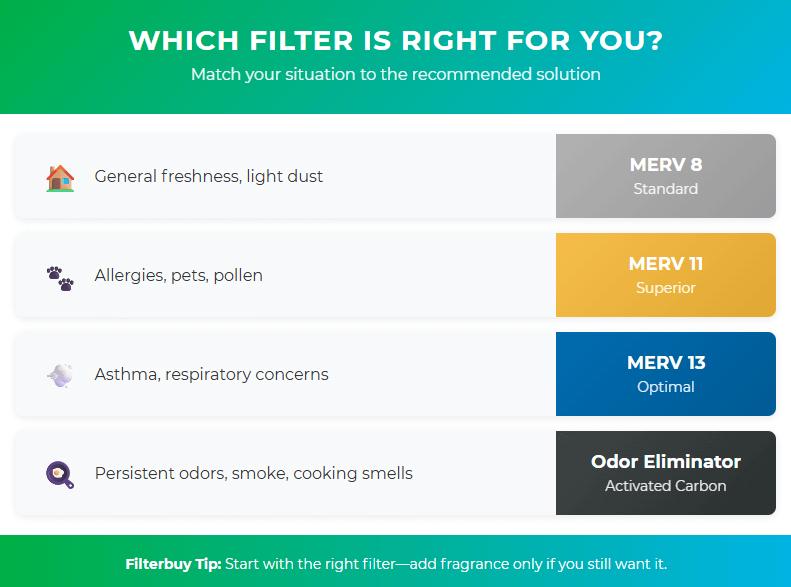
MERV 8: Good baseline protection. Captures dust and larger particles.
MERV 11: Better for homes with pets or mild allergies. Traps finer particles that hold odors.
MERV 13: Optimal for odor-prone homes. Catches bacteria, smoke particles, and microscopic allergens.
Odor Eliminator (Activated Carbon): Best for persistent smells. Actively absorbs odors rather than just filtering particles.
Pairing a quality filter with your freshening method gives you both cleaner air and better scent distribution. One without the other leaves you with incomplete results.
After a decade of helping homeowners improve their indoor air, here's what actually works:
Change your filter on schedule. A clogged filter restricts airflow, which means less scent circulation and harder work for your HVAC system.
Don't over-apply sprays or scents. More isn't better. Heavy fragrance can irritate the airways and reduce filter performance.
Run your fan periodically. If your system isn't actively heating or cooling, switch the fan to "on" for 15-20 minutes to circulate freshened air.
Address the source first. Air fresheners mask odors—they don't eliminate them. Deep clean carpets, upholstery, and pet areas for lasting results.
Consider auto-delivery. Forgetting filter changes is the number one reason homes develop persistent odor issues. Our subscription service keeps fresh filters arriving right when you need them.
Your HVAC system is already doing the heavy lifting—moving air through every corner of your home. With the right furnace filter, air freshener, and a quality filter matched to your needs, you can transform that airflow into whole-house freshness without the hassle of room-by-room solutions.
We've built our filters in the U.S. for over a decade, and we've heard every air quality challenge imaginable. Whether you need a standard MERV-rated filter, a custom size, or our activated carbon Odor Eliminator, we'll help you find exactly what works—shipped fast and free, direct to your door.
Ready to freshen your whole home the smarter way? Browse our filter options or set up auto-delivery so you never miss a change.
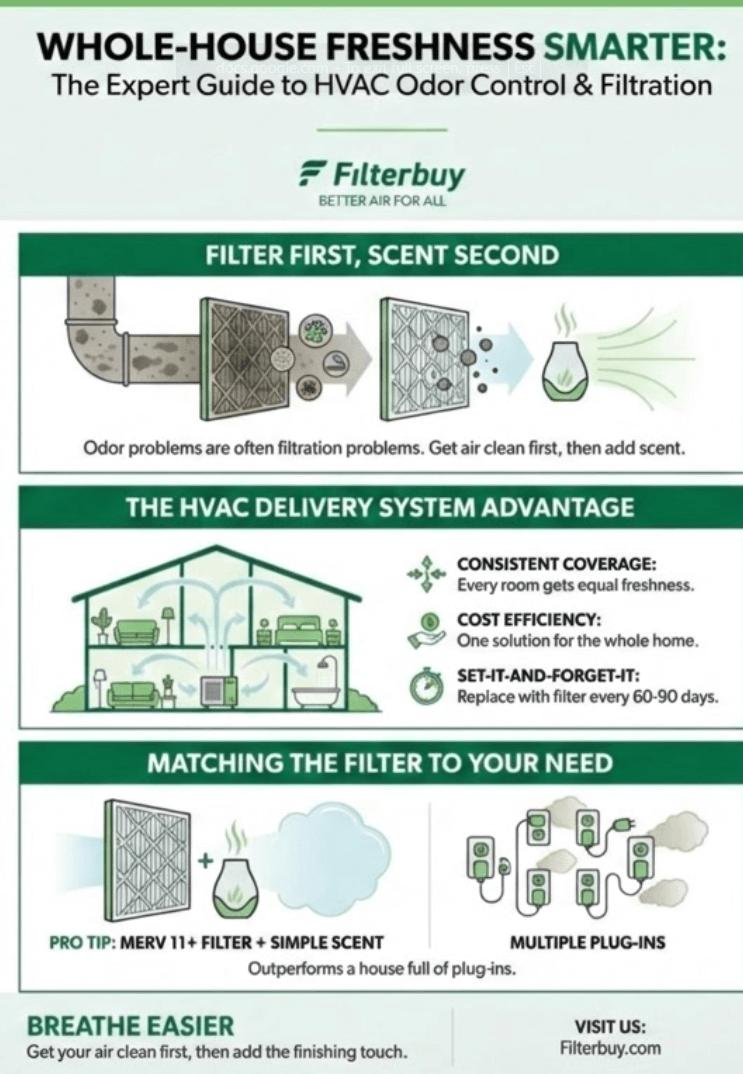
"We've tested countless freshening methods alongside our filters, and the data is clear: a MERV 11 or higher filter paired with a simple scent solution outperforms a house full of plug-ins every time—at a fraction of the cost and effort."
Look, we get it—you just want your home to smell good without turning it into a chemistry experiment. Whether you're curious about the essential oil hack your neighbor swears by or you're dealing with stubborn pet odors that won't quit, these seven resources will help you figure out what actually works.
We've been obsessing over indoor air quality for over a decade, so we've done the homework. Here's where to find the answers you need.
Before you start masking odors, it helps to know what's causing them. The EPA breaks down common indoor pollutants—dust mites, pet dander, mold spores, cooking particles—and explains how they affect your family's health and comfort.
Why we recommend it: Understanding the source of odors helps you decide whether you need to freshen your air or actually clean it. Sometimes it's both.
Resource: EPA Indoor Air Quality
MERV ratings don't have to be confusing. Our guide explains what each level captures in plain English, so you can match your filter to your household's actual needs—whether that's basic dust control or tackling allergens and odor-causing particles.
Why we built it: After helping millions of customers find the right filter, we know the questions you're asking. This guide answers them without the jargon.
Resource: Filterbuy MERV Ratings Guide
Some odors need more than masking—they need eliminating. Our Odor Eliminator filters pair MERV-rated particle filtration with activated carbon that actually adsorbs smoke, cooking smells, pet odors, and VOCs at the molecular level. No fragrance added, just cleaner air.
Why we made them: We heard from customers dealing with real challenges—smokers in the family, multiple pets, city living with exhaust fumes. These filters tackle the tough stuff.
Resource: Filterbuy Odor Eliminator Carbon Filters
Here's something worth knowing: some air freshening products release volatile organic compounds (VOCs) that can irritate airways, especially for family members with asthma, allergies, or sensitivities. The American Lung Association explains what to look for and what to avoid.
Why it matters: If you've got kids, pets, or anyone with respiratory concerns, this resource helps you weigh the trade-offs between fragrance and air quality.
Resource: American Lung Association Indoor Air Pollutants
Adding anything to your HVAC system—whether it's a scented pad or a higher-efficiency filter—affects airflow. The Department of Energy's maintenance guide explains how to keep your system running efficiently while you experiment with freshening solutions.
Why it's practical: Nobody wants a surprise repair bill because they went overboard with filter attachments. A few minutes of reading now can save headaches later.
Resource: Energy.gov Air Conditioner Maintenance
Changed your filter, tried the essential oils, even bought an air purifier—and your house still smells off? The issue might be hiding in your ductwork. The National Air Duct Cleaners Association explains when professional duct cleaning actually makes sense and how to find someone qualified.
Why we include it: We're filtering people, but we'll be straight with you—sometimes the problem goes deeper than what any filter can fix. This resource helps you figure out if that's your situation.
Resource: NADCA Air Duct Cleaning Guide
We've shipped millions of filters since 2013. These statistics reflect the real concerns we hear from customers every day.
The stat: Americans spend approximately 90% of their time indoors.
Source: U.S. Environmental Protection Agency
What we've learned from customers:
Most people don't think about indoor air until something goes wrong
Common triggers: musty smells after vacation, stubborn pet odors, allergy flare-ups at home
Addressing air quality and freshness together delivers better results than tackling them separately
Our takeaway: We're not just selling filters—we're responsible for the air people breathe nearly every hour of their lives.
The stat: Indoor air can be 2 to 5 times more polluted than outside—up to 100 times in some cases.
Source: American Lung Association
Why this matters:
Cooking smoke, cleaning chemicals, pet dander, and dust all accumulate indoors
Heavy synthetic fragrances can add VOCs (volatile organic compounds) to your air
Spraying air freshener directly onto filters pushes more chemicals through your entire home
What actually works (based on our experience):
Start with a higher MERV-rated filter to capture odor-causing particles
For persistent smells, try activated carbon filters—they absorb odors instead of masking them
Avoid heavy fragrances near your HVAC intake
Customer feedback: Our Odor Eliminator filters consistently outperform scent-based solutions because they remove odor molecules at the source.
The stat: More than 27 million people in the U.S. have asthma, including ~4.6 million children. Indoor triggers are a leading cause.
Source: Centers for Disease Control and Prevention
Common indoor asthma triggers:
Dust mites
Mold spores
Pet dander
Airborne irritants and fragrances
What we hear from these customers:
Many want their home to smell fresh, but find traditional air fresheners trigger symptoms
Parents managing children's asthma are especially cautious about scented products
"What works for one family may not work for another" is a phrase we repeat often
Our recommendation for sensitive households:
Use MERV 13 filters for superior particle capture
Choose unscented or naturally-derived freshening options
Always check with a healthcare provider before introducing new scent products
We're filter manufacturers, not researchers. But after 10+ years serving real homeowners, we've learned:
The statistics and customer stories match up
People underestimate how polluted their indoor air can be
Millions of Americans need air quality solutions that don't compromise respiratory health
That's why we approach the "how do I make my home smell better?" question differently:
Start with filtration
Use caution with heavy fragrances
Prioritize solutions that improve air quality—not just mask odors
Because a home that smells good should also be a home where everyone can breathe easily.
After 10+ years of manufacturing filters and talking to thousands of homeowners, we've developed strong opinions on this topic.
Most odor problems are filtration problems in disguise.
When customers call about persistent smells, our first question is always: "When did you last change your filter, and what MERV rating are you using?"
Nine times out of ten? They're running a basic fiberglass filter, capturing maybe 20% of particles. The rest—including odor-carrying molecules—recirculates right back into their home.
Adding fragrance to that system is like spraying cologne in a gym locker room. You haven't solved the problem. You've layered a new smell on top of the old one.
Based on real customer outcomes:
Upgrade your filter first
MERV 11 or MERV 13 captures significantly more particles
For serious odors, try our Odor Eliminator with activated carbon—it absorbs odor molecules, not just particles
Address the source
Pet accidents, mold, and cooking residue need cleaning, not covering
No air freshener fixes a dirty HVAC system or carpet that needs shampooing
Then consider a light fragrance (if you still want it)
Essential oil-based options over heavy synthetics
Place after the filter—never directly on it
Here's something nobody in the air freshener industry talks about:
The "freshness" most products promise is artificial.
Real fresh air doesn't smell like "ocean breeze" or "lavender fields." It smells like... nothing.
Clean air is neutral. When your home smells truly fresh, you walk in and notice nothing at all—no mustiness, no pet smell, no synthetic fragrance.
That's the goal: Not a house that smells like a candle store. A house where the air is so clean it doesn't announce itself.
We're a family-owned company manufacturing filters in the USA. We could easily sell scented products with big margins. Some competitors do exactly that.
But we talk to our customers. We hear from:
The mom whose kid's asthma got worse after using scented products near vents
The guy who thought his filter was fine—until he pulled it out and saw three months of gunk recirculating through his house
People who spent money on air fresheners when they really needed a $15 filter upgrade
Those conversations shape our advice. We'd rather give honest guidance that solves your actual problem than sell you something that masks it.
Furnace filter air fresheners have a place. For homes with good filtration and no underlying odor issues, a light HVAC-distributed scent can be a nice touch.
But if you're reaching for fragrance because something smells off, start with the filter.
Get the air actually clean first. Then decide if you still want to add a scent.
That's our take:
10+ years in business
Millions of filters shipped
Thousands of customer conversations
It might not be the most exciting advice. But it's the truth.
Because at Filterbuy, better air isn't about covering up problems. It's about solving them.
You've got the information. Now let's put it to work.
Before adding fragrance, answer these questions:
When did you last change it?
What MERV rating is it?
How dirty does it look?
If you can't remember when you changed it—it's time for a new one.
Not sure? Our team can help—see Step 5.
The best filter doesn't work if you forget to change it.
Why customers love it:
Filters arrive when you need them
No hardware store runs
Easy to pause, skip, or cancel
Delivery frequency:
1" filters → Every 1-3 months
2" filters → Every 3-6 months
4" filters → Every 6-12 months
Once filtration is handled, add scent if desired.
Do this:
Essential oil-based or natural options
Placethe scent after the filter (downstream)
Start light—add more if needed
Avoid this:
Spraying directly on the filter
Heavy synthetic fragrances near the intake
Oils or liquids that damage filter media
Remember: If you need fragrance to cover a smell, address the smell first.
We can help you:
Find your exact size (600+ options)
Recommend the right MERV rating
Set up auto-delivery
Create custom filters for non-standard sizes
Contact us:
Call: 1-800-222-3344
Visit: Filterbuy.com
No question is too basic.
Check current filter (age, MERV, condition)
Order the right replacement
Set up auto-delivery
Address underlying odor sources
Add light fragrance only after filtration is handled
Start with the filter. Address the source. Add fragrance only if you want to.
That's the Filterbuy approach. Better air for all.
Questions our team hears most—answered from 10+ years of experience.
A: Air flows past a scented product (pad, clip, or gel bead) and carries fragrance through your ductwork into every room.
Key points:
Placement matters more than the product itself
Scent goes on the downstream side—facing away from the return air
Fragrance travels into living spaces, not back into the filter
What we've learned from customers:
Many people place fresheners on the wrong side and see no results
HVAC scent is subtle and gradual—not like room sprays
Works best once filtration is dialed in first
A: Most are safe when used correctly, but caution is warranted—especially for sensitive households.
Safety concerns:
Heavy synthetic fragrances can release VOCs into your air
Some customers report worsened allergies or asthma symptoms
Never spray liquid air freshener directly onto filters
Our recommendation:
Respiratory sensitivities → essential oil-based or natural options
Or skip fragrance entirely and let a quality filter do the work
Real customer story: One mom told us her son's breathing issues cleared up within a week of removing a synthetic freshener. That story stuck with us.
A: Downstream of the filter—the side facing away from the return air duct.
Why downstream:
Air passes through the filter first (removes particles)
Clean air picks up scent on the way out
Fragrance travels into your living spaces
Quick test: Turn on your system. Hold a tissue near the filter. The side where tissue blows away = downstream. That's where your freshener goes.
Avoid:
Placing a freshener on the intake side
Putting anything directly on the filter surface
Gel products or sticky pads that leave residue
From our experience: This is the single most common mistake we see. We walk customers through this on every call.
A: Most products claim 30-60 days. Real-world results depend on system usage.
What affects lifespan:
Peak seasons (summer AC, winter heat) → faster fade
Moderate climates → closer to full 60 days
Essential oil clips → 2-4 weeks
Gel beads → longer but gradual potency loss
Customer feedback by climate:
Phoenix/Minnesota summers → 3 weeks max
Mild climates → full 30-60 days
Our tip: Sync freshener replacement with filter changes. One task, one reminder. Customers who do this stay on top of both.
A: Yes. Fresheners work independently of your filter type.
Compatible with:
MERV 8, MERV 11, MERV 13
Fiberglass and pleated filters
Activated carbon filters
The question you should really ask: Do you need added fragrance at all?
What we've learned from thousands of calls:
~70% of odor-related calls don't need freshener—they need better filtration
Basic fiberglass filters capture only ~20% of particles
Upgrading to MERV 11 or 13 often eliminates odors without added scent
For stubborn smells (smoke, cooking, pets):
Odor Eliminator filters with activated carbon absorb odor molecules directly
No fragrance masking required
Customers tell us these solve problems that years of air fresheners never touched
Bottom line: Get filtration right first. Add scent as a finishing touch—not a band-aid.
Start with the right filter—browse Filterbuy's full selection of MERV-rated and Odor Eliminator filters to find your perfect fit. Shop now at Filterbuy.com or call 1-800-222-3344 for expert help finding the fresh air solution your home deserves.
