
Which Way Does a Furnace Filter Go In?
December 16, 2025
The short answer
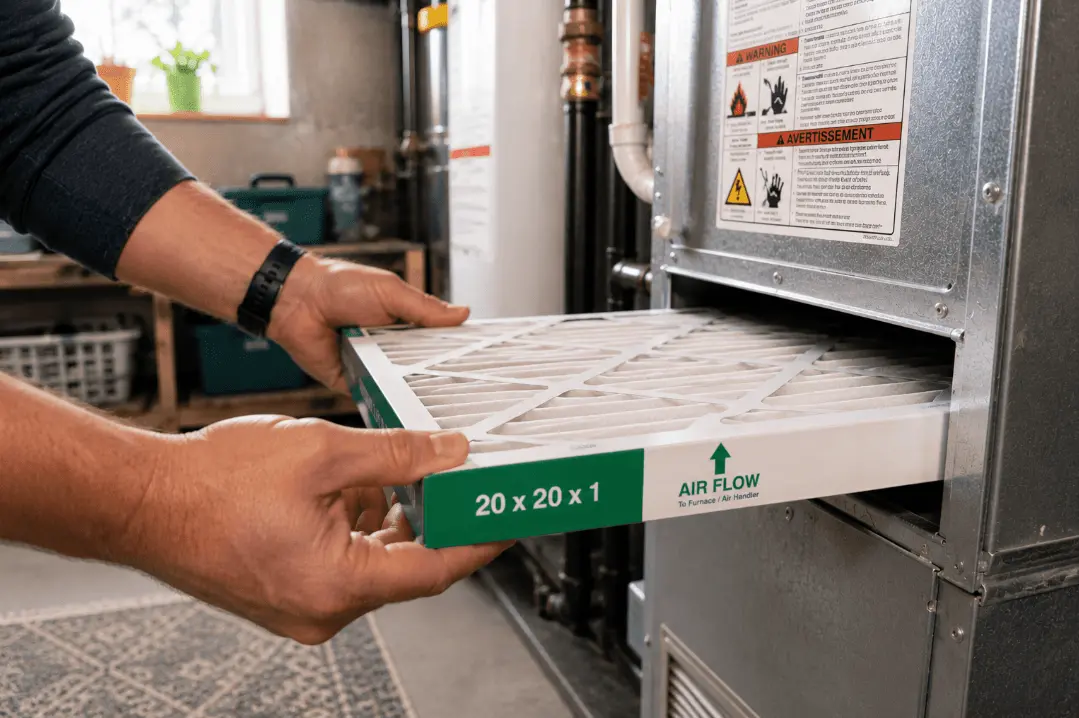
The arrow on the filter frame points toward the furnace, air handler, or blower — never back toward the return grille. Air travels from your rooms, into the return duct, through the filter, and into the blower. The arrow just follows the air.
Upflow, downflow, horizontal, ceiling, wall, or floor return — the rule does not change. The arrow flies toward the fan.

Before you slide it in
- No arrow on the frame? Face the open pleated side toward the return air. The denser side, or the side with wire backing, faces the blower.
- Pleat direction does not matter. Vertical or horizontal pleats make no difference. Only the arrow does.
- Installed backward, the filter still runs — it just restricts airflow, loads the blower, and lets more dust through. Nothing alarms. That is why it goes unnoticed for months.
- The bigger mistake is fit, not direction. A filter that does not seat snugly lets air travel around it instead of through it. Match the size printed on the frame exactly.
- Mark it once, remember it forever. Draw the arrow direction on the cabinet next to the filter slot with a permanent marker.
Need a fresh one while you are in there?
Match the size printed on your old frame first, then pick the rating that matches what you want to capture.
Need a size we don’t stock? · Compare MERV ratings · Set up auto-delivery
TL;DR
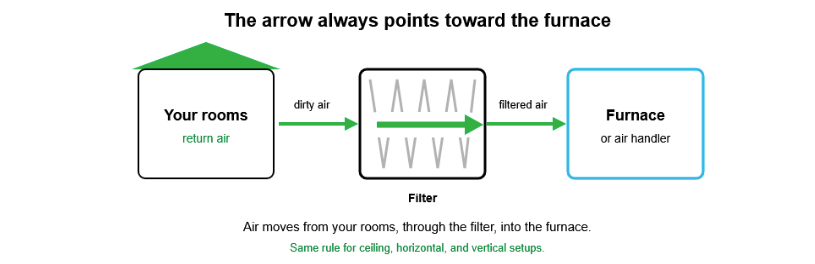
The arrow printed on your filter's frame must always point toward the furnace or air handler — the same direction the air flows. Your system pulls air from your rooms, through the filter, and into the furnace, so the arrow simply follows that path.
The rule is the same for ceiling, horizontal, and vertical setups: point the arrow toward the furnace every time. Not sure which filter fits your system? Take the quick match quiz below, or shop pleated filters at Filterbuy.
Answer 3 quick questions and we'll match you to your perfect filter.
Which Way Does a Furnace Filter Go In?
By Michelle Wan, Brand Manager and Air Quality Writer, Filterbuy | Reviewed for technical accuracy by David Clark, Licensed HVAC Technician and President of Filterbuy HVAC Solutions
Updated July 17, 2026
The arrow printed on your furnace filter’s frame points toward the furnace, air handler, or blower motor. That is the same direction the air is moving. Air travels from your rooms, into the return duct, through the filter, into the blower. The arrow follows it. Upflow, downflow, horizontal, ceiling, wall, or floor return: same rule. Arrow toward the fan.
Worth saying up front: we make the filter you are holding. Filterbuy has made air filters in the USA for over a decade, for more than two million households. That arrow is one we printed. This guide is written from the plant floor, not a contractor’s van.
“We print the arrow on every filter we make, and it is still one of the questions our team hears most. The arrow was never the confusing part. Knowing which way the air moves is. So this guide starts with the airflow path, not the filter.”
Michelle Wan, Brand Manager and Air Quality Writer, Filterbuy
Key Takeaways
The airflow arrow points toward the furnace or air handler, never back at the room.
The rule never changes with your setup. Only the direction the arrow ends up aimed does.
The wire-mesh side faces the furnace; the open pleated face takes the return air. Follow the arrow and this happens on its own.
A backward filter restricts airflow, loads the blower, and lets more dust through.
The bigger mistake than direction: a filter that does not fit. Air goes around it.
The Rule: The Arrow Points Toward the Furnace
Every disposable furnace filter has an arrow printed on the frame. Filterbuy prints ours on a two-piece die-cut beverage board frame before it leaves the plant, and after a decade of printing it, we can tell you it is the only thing you need to read.
The arrow shows the direction air should travel through the filter, and air travels toward the furnace.
The filter always sits between the return air and the blower. So the arrow always points at the blower.
That is not just convention. The U.S. Department of Energy describes filters as installed on the return side of the air handler, where they protect the motor. The arrow marks that path.
Easy way to remember it: the arrow flies toward the fan.
Which Way Does the Arrow Point in Your Setup?
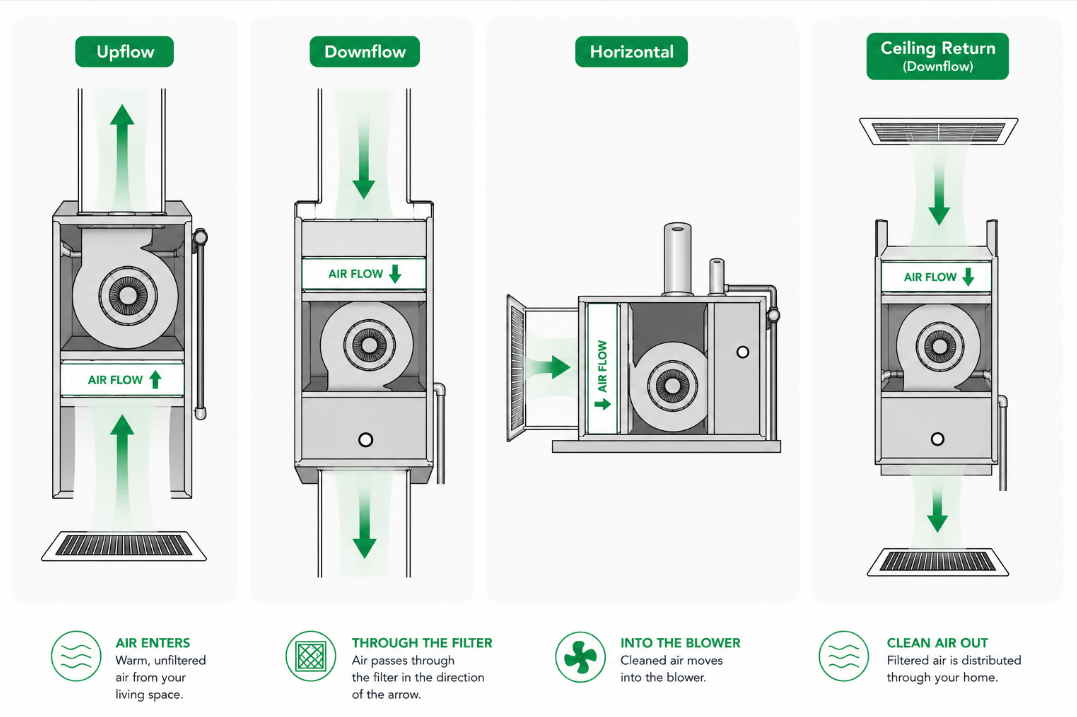
The rule is fixed. Where the arrow physically ends up pointing depends on your equipment.
The rule never changes: the arrow follows the air, and the air is heading into the furnace.
Return grilles are the ones that trip people up. At a ceiling, wall, or floor return, air is pulled out of the room into the duct, so the arrow points away from the room: up at a ceiling, down at a floor, into the wall at a hallway grille. If your arrow aims at your living room, it is backward. And one thing about ceiling returns nobody warns you about: gravity works against the seal up there. A filter that sat flush on install day can sag off an edge by month two, so check the fit when you check the filter.
Which Side of the Air Filter Faces the Furnace?
A pleated filter’s wire-mesh or reinforced backing faces the furnace. The open pleated face receives the dirty return air. Filterbuy builds ours with dual wire backing over the media for exactly that reason: metal reinforcement keeps the pleats evenly spaced and stops them sagging at high airflow. That tells you which way the filter is meant to load.
Install it with the arrow pointing at the furnace and the sides take care of themselves. The arrow is the instruction. The mesh is just the evidence.
What Happens If You Install a Furnace Filter Backwards?
Nothing dramatic on day one. That is the problem: it is a slow, quiet cost, not an alarm.
Airflow gets restricted. Air hits the dense side of the media first and meets resistance the filter was not designed to create.
The blower works harder and longer. The U.S. Department of Energy finds that routinely replacing or cleaning your air filters can lower an air conditioner’s energy consumption by 5–15 percent. Restricting airflow on purpose pushes in the opposite direction.
More dust gets through. You paid for MERV 11 performance and are not getting it.
The motor pays for it. Months of extra load turns a $20 item into a repair bill.
How Much Resistance Does a Filter Actually Add?
Most sites quote someone else’s resistance numbers. These are Filterbuy’s own. See our published figures for a 20x25x1 at 1000 CFM installed correctly, from our own lab across 2 million+ filters made. The reversed column is what we are measuring now.
Initial (clean-filter) pressure drop in inches of water gauge, from Filterbuy laboratory testing data across 2 million+ filters manufactured. Reversed-orientation figures pending measurement.
How Do You Know If Your Filter Is In Backwards?
Three checks, no tools:
Read the frame. If the arrow points at the room instead of the furnace, it is backward.
Read the dirt. The gray, loaded side should be the side the arrow points away from. If the gray side faced the furnace, it was backward.
Read the pleats. Badly reversed filters bow or collapse toward the blower.
Found one backward? Flip it. A few months reversed is not an emergency. If it ran that way a year or more and airflow is weak, have a technician check the blower and coil.
How to Find Airflow Direction When There Is No Arrow
Rare on a new filter, but it happens on washables and older stock:
Feel for the pull. Run the fan and hold a tissue near the slot. The side it pulls toward is the return side.
Follow the ducts. The big duct feeding the slot is the return. Point the arrow at the furnace on the other side.
Then make it permanent: draw an arrow on the cabinet beside the slot.
How to Install a Furnace Filter, Step by Step
Turn the system off at the thermostat.
Photograph the old filter before pulling it. Get the size and the arrow direction.
Match the size exactly (for example, 16x25x1).
Slide it in, arrow toward the furnace, snug with no gaps. Close the panel, restore power.
The long version, including the gap mistakes Filterbuy sees most, is in the safe filter replacement guide.
The Mistake That Beats Direction: The Wrong Size
A correctly oriented filter that does not fill its slot is worse than a backward one that does. Air takes the easiest path: a gap at the frame lets unfiltered air stream past the media onto your blower and coil. No MERV rating stops it. EPA says it plainly: make sure the filter fits snugly so air does not leak around it. ASHRAE is blunter: air that goes around the filter never gets cleaned, leaving you the performance of a lower-rated filter than the one you bought.
So: arrow toward the furnace, and no daylight around the frame. The Filterbuy five-minute filter fit check walks through the press, edge, and light tests. Fit is what the Filterbuy customer service team hears about daily, and it is why we cut 600+ sizes instead of saying close enough. If your slot is odd, measure the interior dimensions and order a custom size rather than forcing a close-enough filter and taping the gap.
What MERV Rating Should You Use?
MERV, or Minimum Efficiency Reporting Value, is the standard for how much a filter actually captures, defined under ASHRAE Standard 52.2. Higher number, finer particles.
The EPA recommends a filter rated at least MERV 13, or as high as your system’s fan and filter slot can accommodate, and notes that most furnaces and HVAC systems can take a MERV 13 without equipment problems, provided the filter is replaced frequently. ASHRAE recommends MERV 13 as a minimum as well.
The EPA recommends at least MERV 13, or as high a rating as your system's fan and filter slot can accommodate. Most homes land in the MERV 8–13 range.
The old worry that pleated filters choke a system comes from too high a MERV for the equipment, not from pleats. A quality MERV 8, 11, or 13 filter, sized and installed right, will not hurt a typical residential system.
A caveat we would rather give you than sell past: Filterbuy’s own compatibility guidance puts pre-1995 systems at MERV 6–8, 1-inch only, and 1995–2004 systems at MERV 11. If your equipment is that old, the EPA’s MERV 13 recommendation may be more filter than your blower can pull through.
Shop MERV 8, MERV 11, or MERV 13. Or compare them side by side in the Filterbuy MERV 8 vs. 11 vs. 13 guide.
If Airflow Is Your Worry, Go Thicker Before You Go Weaker
Here is the counterintuitive part, and it falls out of Filterbuy’s own lab table. At 1000 CFM, a 20x25x4 MERV 13 measures 0.11" w.g. of resistance. A 20x25x1 MERV 8, a far weaker filter, measures 0.10". Practically the same. Against a 1-inch MERV 11 (0.15"), the 4-inch MERV 13 is stronger and easier to breathe through. Depth buys pleat surface area, and surface area buys airflow. If your cabinet takes a 4-inch filter, MERV 13 costs you almost nothing in resistance. If it only takes a 1-inch, that trade is not on the table.
How Often Should You Replace It?
Every 90 days is the baseline; the EPA notes manufacturers typically recommend 60 to 90 days. Check monthly; change sooner with pets, allergies, renovation, or a stretch of poor outdoor air quality. Gray and matted means done. Other overdue signs: clogged filter symptoms.
Supporting Statistics
A filter in a loose slot leaks roughly 10% of your air past it. A large gap: about 25%. Lawrence Berkeley National Laboratory researchers modeling residential coil fouling used exactly those figures for a loose slot and for a filter with a large gap or fixed on one edge. Their finding: the added efficiency of a high-MERV filter can be largely compromised by bypass. (Siegel, Walker & Sherman, ACEEE, 2002.)
MERV 8 captures about 20% of particles in the 1–3 micron range. MERV 13 captures at least 85%. That gap, published by ASHRAE (which writes the MERV standard), is what you pay for when you upgrade, and what leaks away when air routes around the filter.
52% of the average U.S. household’s annual energy goes to space heating and air conditioning. More than every other end use combined (U.S. Energy Information Administration, RECS 2020). The blower you are making work harder runs the biggest energy line in your house.
Get It Right Once, Then Stop Thinking About It
The whole rule is four words: arrow toward the furnace. Get that right, keep it snug and clean, and your system does its job for three months.
Find your size. Filterbuy cuts 600+ standard sizes plus custom, made in the USA. Set it to auto-deliver and the right one shows up when it is time, arrow already printed on it.
Frequently Asked Questions
Which way does the arrow on a furnace filter point?
Toward the furnace, air handler, or blower motor, the direction air flows. Never back toward the room.
What happens if I install a furnace filter backwards?
Airflow is restricted, the blower works harder, more dust gets through, and sustained strain can shorten the system’s life. Flip it and move on.
How do I know if my air filter is in backwards?
Check the arrow. If it points at the room, it is backward. Second check: the gray, loaded side should be the side the arrow points away from.
Which way does an air filter go in a ceiling return vent?
Arrow up, into the ductwork, away from the room.
Which way does a filter go in a floor return?
Arrow down, into the ductwork. Same logic: air is leaving the room.
Does arrow direction change for a horizontal furnace?
No. The arrow still points at the blower; it just points sideways instead of up or down.
Which side of the air filter faces the furnace?
The wire-mesh or reinforced side. The open pleated face takes the incoming return air.
Do the pleats need to face a certain direction?
Not on their own. Follow the arrow and the pleats end up right.
Does a 4-inch media filter go in the same way?
Yes. Thicker filter, same rule: arrow toward the furnace.
Are pleated filters bad for my HVAC system?
No. A correctly sized MERV 8–13 pleated filter filters well without straining a typical residential system. Problems come from a MERV too high for the equipment, or a filter that does not fit.
Can a backward filter raise my energy bill?
Yes. Restricted airflow means longer run times and more energy per cycle.
How often should I replace my furnace filter?
Every 90 days as a baseline; every 30–60 with pets, allergies, or dusty conditions.
Sources
U.S. Department of Energy — Energy Saver 101: Home Cooling (PDF) — the 5–15 percent figure.
U.S. DOE Building Science Education — HVAC Proper Installation of Filters — filters sit on the return side of the air handler.
U.S. EPA — Guide to Air Cleaners in the Home — MERV 13 minimum, snug fit, 60–90 day replacement.
ASHRAE — Filtration and Disinfection FAQ — MERV 13 recommendation; filter bypass performs like a lower-MERV filter.
Filterbuy — MERV Ratings & Pressure Drop Chart — our own lab figures for initial pressure drop.
Siegel, J., Walker, I. & Sherman, M. (Lawrence Berkeley National Laboratory), "Dirty Air Conditioners: Energy Implications of Coil Fouling," ACEEE Summer Study on Energy Efficiency in Buildings, 2002 (PDF) — filter bypass values of 10% and 25%.
U.S. Energy Information Administration — Use of Energy in Homes — 52% figure, Residential Energy Consumption Survey 2020.