
5 Signs Your Air Purifier Filter Is Clogged
August 17, 2026

A clogged air purifier filter restricts airflow, forces the fan to work harder, and reduces the unit's ability to capture particles, even when it sounds like it's running normally. The five core signs are weaker outlet airflow, louder fan noise, faster dust accumulation, visible packed debris on the filter, and auto-mode units staying on longer than usual.
The catch is that none of those signs is loud enough to force the issue on its own. Most people only notice once the fan has been straining for months, and by then the motor has been paying for it.
Key Takeaways
Trust your instincts. If your unit sounds strained or the room feels dustier than it should, a clogged filter is the most likely cause.
Clogged filters hide their impact. Performance declines gradually, so you won't notice unless you check.
Confirmation takes two minutes. A quick airflow and inspection check tells you whether the filter is the problem.
Act once you've confirmed it. Replacing the filter restores airflow and stops the fan motor from wearing out early.
What Are The 5 Fast Signs Of A Clogged Air Purifier Filter?
Before you open the unit, run through this checklist. None of these signs alone is definitive, but two or more together is a strong indicator.
1. Weaker Airflow At The Same Fan Setting
Hold your palm about six inches from the outlet. If the airflow feels noticeably softer than it did when the filter was new, the filter is likely restricting it.
2. The Fan Running Louder Or Ramping Up On Auto Mode
A straining fan gets noisier. On auto-mode units, the sensors detect reduced air quality and push the fan harder to compensate, which is the opposite of what you want.
3. Dust Settling Faster On Nearby Surfaces
When particle capture drops, more particulates stay airborne and eventually land on furniture and shelves. If you're dusting more often than usual, the filter may not be pulling its weight.
4. Visible Packed Debris On The Intake Side Of The Pleats
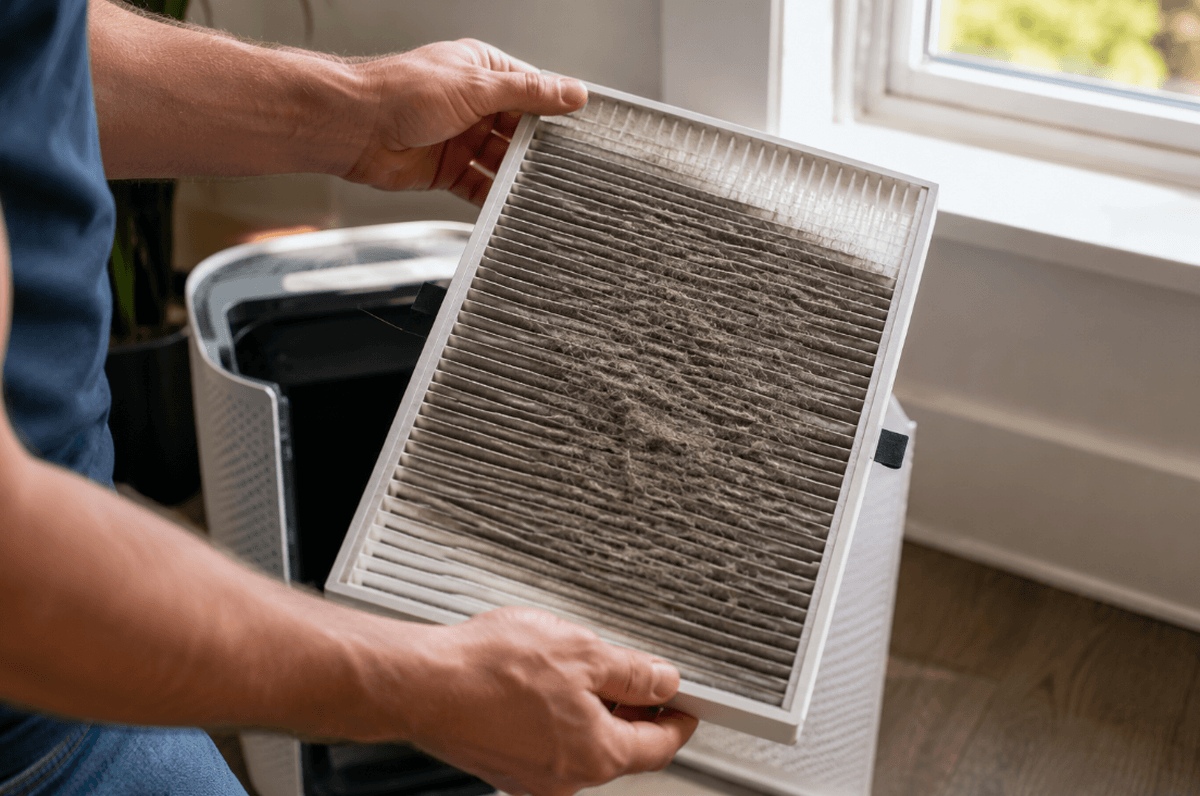
This is the clearest sign of all. A dense, matted layer of dust and debris on the filter's intake face means the filter is clogged.
5. Auto-Mode Units Staying On High Longer Than They Used To
A unit that used to settle to a low or medium setting now runs on high continuously. The air sensor is detecting particles that the compromised filter is no longer capturing.
What Does A Clogged Air Purifier Filter Actually Do Inside The Unit?
Understanding the mechanics helps explain why a clogged filter is more than a maintenance inconvenience.
As the filter media traps particles over time, those particles narrow the gaps between fibers. The air has less space to move through, so resistance rises. To maintain airflow, the fan motor spins faster and works harder, consuming more electricity in the process.
Here's the problem: even though the fan is working harder, less air is actually moving through the filter. Clean Air Delivery Rate (CADR), the standard measure of how much filtered air a unit produces as defined by AHAM, drops even as the fan sounds busier. The unit is expending more energy to deliver worse results.
Over time, that sustained strain shortens the life of the fan motor. A clogged filter doesn't just hurt air quality. It accelerates wear on the most expensive component in the unit.
How To Confirm A Clogged Air Purifier Filter In Two Minutes
Follow these steps in order. Each one gives you concrete, testable information.
Check airflow at the outlet. With the unit running on its usual setting, hold your palm six inches from the outlet for a few seconds. Note how strong the airflow feels. This is your baseline for comparison.
Power off and unplug the unit. Always do this before opening the housing.
Open the housing and remove the filter. Consult your unit's manual if you're unsure how. Most residential units use a panel or drawer on the back or side.
Inspect the intake side under good light. Look at the face of the filter that faces inward toward the fan. Packed, fuzzy, or matted debris means the filter is clogged. Light gray discoloration alone does not. That's normal loading and doesn't indicate blockage.
Check the installation date. If you wrote the date on the filter frame when you installed it, now's the time to check it. If you didn't, start doing this every time you replace a filter. It takes five seconds and removes all the guesswork.
Compare airflow with and without the filter, only if your manual permits. Some units can run briefly without a filter installed. If yours allows it, run the unit for a few seconds without the filter and note the airflow at the outlet. Significantly stronger airflow confirms the filter was the restriction. Do not do this if your manual advises against it.
“A lot of customers assume that if the unit is running, it's working,” says our Customer Service Manager at Filterbuy. “The most reliable thing to check is airflow at the outlet, not the indicator light and not the fan noise. If you put your hand in front and barely feel anything, that filter needs attention.”
4 Problems That Look Like A Clogged Air Purifier Filter But Aren't
Not every performance issue traces back to the filter. Rule these out before replacing anything.
1. Blocked Intake Or Outlet
Furniture, curtains, or walls placed too close to the unit restrict airflow without any filter involvement. Check that there's at least 18 to 24 inches of clearance around the intake and outlet sides.
2. A Badly Seated Filter Or Loose Panel
If the filter isn't fully seated or the housing panel isn't secured, air bypasses the filter entirely. You'll get airflow loss and sometimes rattling. Remove and reseat the filter, then confirm the panel clicks or latches fully.
3. A Saturated Carbon Layer
If odors have returned but airflow still feels normal, the activated carbon layer may be exhausted. Carbon can't trap odors once it's saturated, but a spent carbon layer doesn't necessarily restrict airflow the way a loaded HEPA layer does.
4. Wrong Placement Or An Undersized Unit
A unit running in a room that's too large for its CADR rating will struggle to keep up regardless of filter condition. If you've confirmed the filter is clean, check whether your unit is rated for your room size.
Should You Clean The Filter Or Replace It?
This depends entirely on the filter type. Using the wrong approach can cause permanent damage.
Pre-filters: Many are washable or can be vacuumed. Check your manual. If it says washable, rinse gently and let it dry completely before reinstalling.
HEPA media: Not washable, ever. Rinsing or vacuuming HEPA fibers damages the media structure and creates gaps that particles pass through freely. A rinsed HEPA filter is not a clean HEPA filter. It's a broken one.
Activated carbon: Cannot be cleaned or revived by any home method. Once saturated, replace it.
Filter indicator lights: Most are runtime timers, not particle-load sensors. They count hours, not debris. Resetting the light without replacing the filter doesn't fix anything. It just delays the reminder.
Why Do Some Air Purifier Filters Clog Faster Than Others?
Filter lifespan varies significantly based on what's in the air. These factors accelerate loading:
Pets: Dander and hair load filters quickly, especially in homes with multiple animals
Carpeting: Releases fine fibers and trapped dust continuously
24/7 runtime: Constant operation means constant particle accumulation
Wildfire smoke season: Fine particulate matter during smoke events can clog a filter in days, not months
Candles and fireplaces: Both produce fine combustion particles that pack filter media tightly
Renovation dust: Drywall and sanding dust are particularly dense and can clog a filter in a single day of work
High outdoor pollution: Units in urban environments or near high-traffic areas see faster loading
If any of these apply to your home, check your filter more frequently than the manufacturer's standard interval suggests.
Remember To Change Your Filter To Prevent A Clogged Air Purifier
If your two-minute check confirmed a clog, the fix is straightforward: replace the filter. Find the right replacement for your unit at Filterbuy, where filters are organized by unit type and size.
Once the new filter is in, write the installation date on the frame with a marker. That one habit eliminates the guesswork next time. You'll know exactly how long the filter has been running and whether it's due for a check. No app required.
Frequently Asked Questions
Can I Run My Air Purifier With A Clogged Air Purifier Filter?
You can, but you shouldn't. A clogged filter significantly reduces CADR, meaning the unit captures fewer particles even while running. It also forces the fan motor to work harder than it was designed to, which shortens the motor's lifespan. Running the unit with a clogged filter is effectively paying for electricity to move less clean air.
How Do I Clean A Clogged Air Purifier Filter?
It depends on the filter type. Pre-filters can often be washed or vacuumed per the manufacturer's instructions. HEPA media cannot be washed or vacuumed, since doing so damages the fiber structure and reduces filtration efficiency. Activated carbon filters cannot be cleaned at all. When in doubt, consult your unit's manual before attempting any cleaning.
Why Does My Air Purifier Filter Get Dirty So Fast?
Pets, carpeting, continuous runtime, candles, fireplaces, renovation dust, and high outdoor pollution all accelerate filter loading. If your filter is consistently wearing out faster than the manufacturer's estimate, one or more of these factors is likely at play.
Does A Clogged Air Purifier Filter Use More Electricity?
Yes. When filter resistance rises, the fan motor draws more power to maintain airflow. According to EPA guidance on appliance efficiency, increased motor load directly increases energy consumption. A clogged filter costs you more on your electricity bill while delivering worse air quality, a losing trade on both ends.
Will A Clogged Air Purifier Filter Damage The Unit?
Over time, yes. Sustained high-resistance operation puts thermal and mechanical stress on the fan motor. While a single clogged filter cycle won't destroy a unit, consistently running with overloaded filters shortens the motor's service life. Replacing filters on schedule is one of the lowest-cost ways to protect the unit long-term.