
What Size Air Purifier Do You Need for Your Room?
July 23, 2026
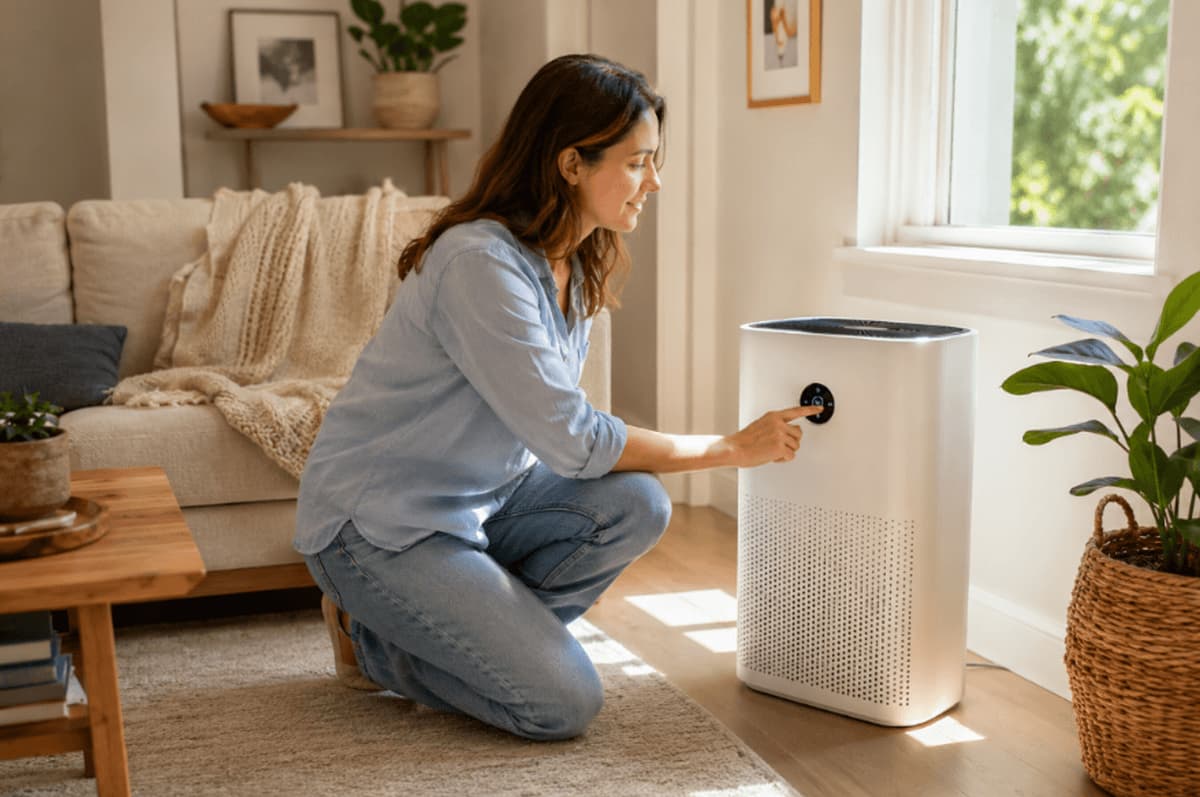
Match your air purifier's CADR to at least two-thirds of your room's square footage — and size up if your ceiling is taller than 8 feet. A 150-square-foot bedroom needs a smoke CADR of roughly 100 CFM; bigger or taller rooms need more.
When in doubt, size up: a larger unit running quietly on a low setting still clears the air fast. See how your room's dimensions translate into the CADR you need below.
Want whole-home comfort control, too? Answer a few quick questions below to see if a ductless mini split is right for your space.
Prefer to shop filters directly? Browse Filterbuy's full filter lineup →
Have you ever stared at an air purifier box, wondering if it will actually clean the air in your living room? You are not alone. When deciding what size air purifier you need, most people just look at the square footage listed on the packaging. Unfortunately, that number rarely tells the whole story.
Buying the wrong size means you either waste money on too much power or, worse, you end up with an undersized unit that leaves allergens floating in your home. You need to know how to calculate your room's true volume. Let's break down exactly how to find the perfect fit for your space.
Key Takeaways
Use smoke CADR as your sizing benchmark: aim for a CADR of at least two-thirds your room's square footage as a starting point.
Calculate room volume, not just floor space: high or vaulted ceilings hold significantly more air, so you'll need a higher CADR than the packaging suggests.
Target 4.8 to 5 ACH for standard rooms: bump this up to 6 to 12 ACH if you have allergies, asthma, pets, or wildfire smoke to contend with.
When in doubt, size up: a larger unit running on a lower fan speed cleans just as effectively while staying much quieter.
What Is the Quick Rule for Matching CADR to Room Size?
To size an air purifier correctly, start with CADR. CADR stands for Clean Air Delivery Rate, and it measures how much clean air a unit delivers each minute. It's expressed in cubic feet per minute (CFM) and verified by a standardized industry test that runs each unit through the same controlled chamber, ensuring comparable ratings from one brand to the next.
The easiest way to find your baseline is the two-thirds rule: your purifier's CADR should be at least two-thirds of your room's square footage.
Here's a simple example. For a 120-sq-ft bedroom, multiply 120 by 0.66. That works out to about 80, so you'd want a unit with a CADR of at least 80 CFM.
You'll often see three CADR numbers listed: smoke, dust, and pollen. Always size your unit by the smoke number. Smoke particles are the smallest and hardest to capture, so a purifier that can handle smoke will clear larger dust and pollen particles without trouble. Curious how these filters trap particles in the first place? Check out our guide on what a HEPA filter is.
Why Square Footage Alone Is Not Enough
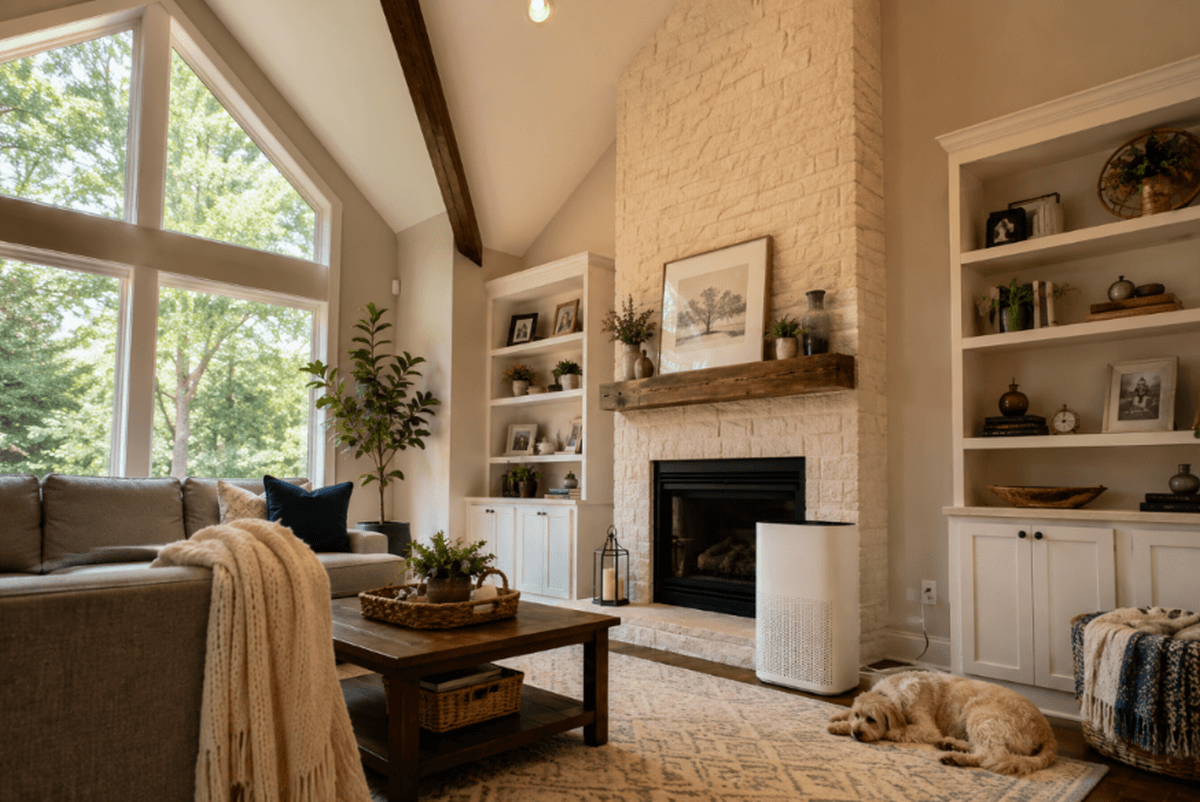
Air purifiers clean a 3-D volume of air, not a 2-D floor. When a manufacturer claims a unit "covers up to 300 sq ft," they silently assume your room has standard 8-foot ceilings.
Why Ceiling Height Changes Everything
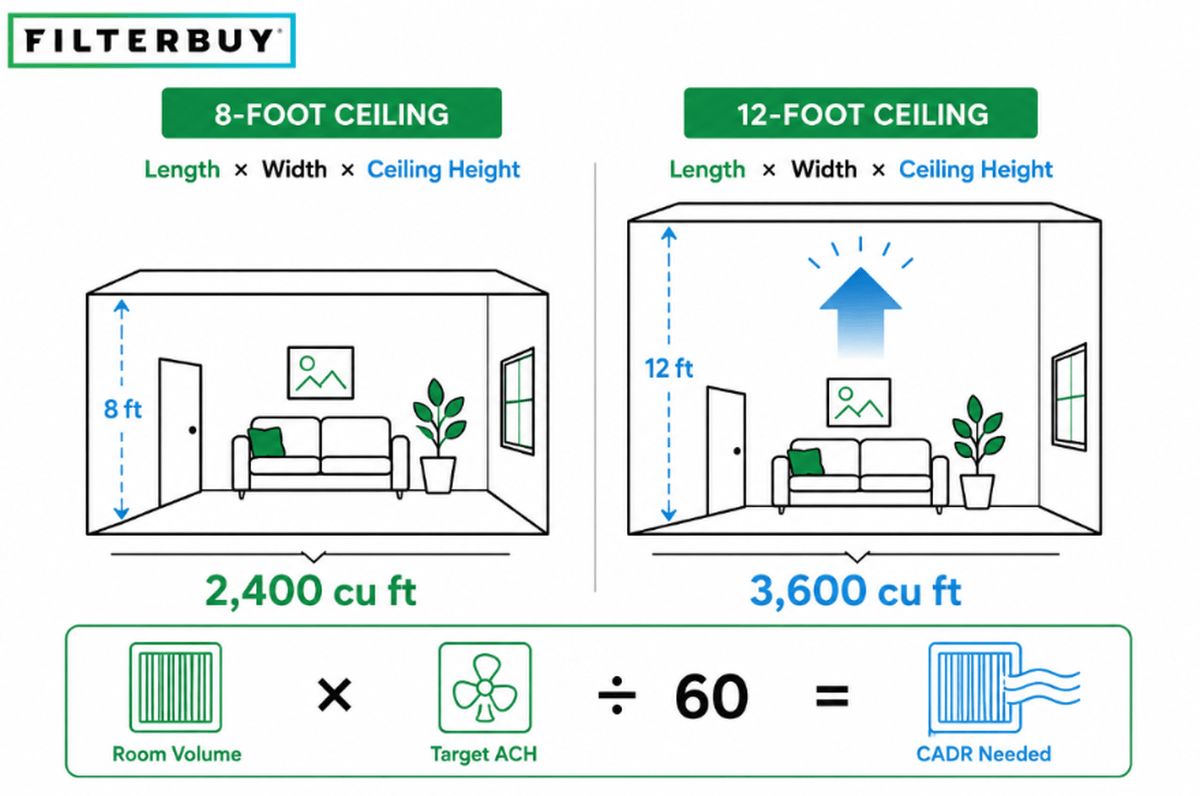
If you have high ceilings, that square footage claim falls apart quickly. A 300-sq-ft room with an 8-foot ceiling contains 2,400 cubic feet of air. But if you have 10-foot ceilings, that same floor plan holds 3,000 cubic feet of air. At 12 feet, it jumps to 3,600 cubic feet.
The same unit that works perfectly in an 8-foot room will underperform badly in a room with a vaulted ceiling. For example, a 200 CFM unit will drop from filtering the room 5 times an hour to just 3.3 times an hour if you move it to a room with 12-foot ceilings.
How Do You Size an Air Purifier by True Room Volume?
To get accurate air purifier sizing for high ceilings or vaulted rooms, you should calculate by true volume.
Here is the exact formula: Room volume (Length × Width × Ceiling Height) × desired air changes per hour ÷ 60 = the CADR you need.
Let's look at a clean example. Say your room is 15 feet long, 10 feet wide, and has 10-foot ceilings. That is 1,500 cubic feet. If you want the air cleaned 5 times per hour, multiply 1,500 by 5. That equals 7,500. Divide that by 60, and you need a CADR of 125 CFM.
How Many Air Changes Per Hour Do You Need?
Air changes per hour (ACH) indicate how many times the unit filters the room's air in 60 minutes. An ACH of 4.8 means the whole room's air is cleaned roughly every 12 to 13 minutes.
Most industry standards recommend a baseline of 4.8-5 ACH for standard residential rooms. However, sensitive situations require higher ACH targets. Allergy, asthma, pets, and wildfire seasons are exactly when undersizing hurts you the most.
Here is a quick look at air-change-per-hour targets based on your specific needs.
| Room Type / Situation | Recommended ACH Target | Rationale |
|---|---|---|
| Standard Bedroom | 4 to 5 ACH | Good baseline for normal sleeping conditions. |
| Living Room / Office | 4 to 6 ACH | Handles moderate foot traffic and everyday dust. |
| Nursery | 5 to 6+ ACH | Extra protection for sensitive infant lungs. |
| Allergy / Asthma | 5 to 6+ ACH | Faster removal of sudden allergen spikes. |
| Kitchen | 8 to 12 ACH | Clears out cooking odors and smoke rapidly. |
| Wildfire Smoke | 8 to 12 ACH | Heavy-duty filtration for hazardous outdoor air leaks. |
What Size Air Purifier Do You Need for Each Room?
To make things easy, we built an air purifier room size calculator chart. This assumes a standard 8-foot ceiling.
For non-standard ceilings, use the volume formula we covered in the previous section.
| Room Type & Size | Approx. Volume (8 ft ceiling) | Min CADR for ~4.8 ACH | CADR for High-Need (8 ACH) |
|---|---|---|---|
| Standard Bedroom (150 sq ft) | 1,200 cu ft | 96 CFM | 160 CFM |
| Master Bedroom (250 sq ft) | 2,000 cu ft | 160 CFM | 266 CFM |
| Living Room (350 sq ft) | 2,800 cu ft | 224 CFM | 373 CFM |
| Open Great Room (500 sq ft) | 4,000 cu ft | 320 CFM | 533 CFM |
| Vaulted Room (300 sq ft, 12 ft ceiling) | 3,600 cu ft | 288 CFM | 480 CFM |
Why Should You Buy a Slightly Bigger Air Purifier?
Air purifiers are noisy at their maximum settings. Units only hit their top tested CADR when the fan is running at full speed. For most purifiers, high speed sounds like a running dishwasher.
Because of the noise, most people run their air purifiers on low or sleep mode. Unfortunately, running a unit on low speed can roughly halve its real-world CADR.
The practical takeaway here is strategic oversizing. Buy an air purifier rated for a larger room than yours. This allows the unit to clean the air effectively while running quietly on a medium or low setting. For instance, a purifier rated for a 600 sq ft space will quietly and easily handle a 200 sq ft bedroom. Bigger is generally fine and often better. The real risk is buying a unit that is too small.
How Do You Improve Air Quality Beyond a Single Room?
A room air purifier handles one specific space. But what about the rest of your house? Your HVAC system filters the whole house every time it runs.
The smartest setup pairs a whole-home filter with targeted room purifiers. We recommend installing a high-MERV pleated filter in your central system for whole-home coverage. Then place a properly sized HEPA purifier in the rooms where you spend the most time, such as your bedroom.
Most residential HVAC systems cannot handle the dense airflow restriction of a true HEPA filter. Therefore, using a MERV 13 filter in your furnace alongside a room HEPA purifier is the right-sized, real-world combo. To see which filter works best for your furnace, review our MERV rating chart or learn more about whole-home HEPA and MERV setups.
How Do You Keep Your Air Purifier Working at Its Best?
A correctly sized air purifier will still underperform if you misuse it. Even the best unit needs the right environment to thrive.
Follow this quick checklist to maximize your air purifier coverage area:
Run it continuously. Pollutants rebuild within minutes of shutting the unit off.
Close windows and doors. Do not force your purifier to fight a constant stream of outdoor air.
Give it breathing room. Keep the unit 18 to 24 inches away from walls and heavy furniture.
Change filters on schedule. A clogged HEPA filter loses CADR, which shrinks your effective room coverage.
Need help keeping your unit fresh? Read our guide on how to clean HEPA filters and find replacements.
Find the Right Filtration for Your Home at Filterbuy
Sizing your air purifier doesn't have to be a guessing game. Just remember this simple formula to find the right CADR for your space: (Room Volume x Target ACH) / 60.
Ready to breathe easier? Use our filter finder to get the right replacement filter for your purifier. And don't forget your central air system, then pair your room purifier with a Filterbuy MERV 13 filter for whole-home protection.
Frequently Asked Questions
What size air purifier do I need for my bedroom?
For a standard 150 sq ft bedroom with an 8-foot ceiling, you need an air purifier with a CADR of at least 100 CFM. This will clean the air about 5 times per hour. If you want to run it quietly at a lower setting, size up to a 150- or 200-CFM unit.
Is it bad to buy an air purifier that's too big for the room?
No, it is not bad to get an air purifier that is too big for a room. An oversized unit is actually better. It cleans the air faster and lets you run the fan at a lower, quieter speed while still achieving your desired air changes per hour.
What is CADR, and which CADR number should I use?
CADR stands for Clean Air Delivery Rate. It measures how much clean air the unit outputs per minute in cubic feet (CFM). Always size your air purifier using the smoke CADR number, as smoke particles are the smallest and most difficult for the filter to capture.
How many air changes per hour do I need?
For standard residential rooms, aim for 4.8 to 5 air changes per hour (ACH). This cleans the room's air every 12 minutes. If you have allergies, asthma, or are dealing with wildfire smoke, you should aim for 6 to 8 ACH.
Do I need a bigger air purifier for high or vaulted ceilings?
Yes. Air purifiers clean a volume of air, not just floor space. A 300 sq ft room with a 12-foot ceiling holds 50% more air than the same room with an 8-foot ceiling. You must calculate the total cubic volume to size the purifier correctly.
Does a bigger room need a stronger HVAC filter, too?
Your HVAC filter handles the whole home, not just one room. Instead of worrying about room size for your central air, focus on efficiency. A MERV 11 or MERV 13 pleated filter provides excellent whole-home coverage when paired with a standalone HEPA unit in your main living areas.