
All About Activated Carbon Air Filters
September 4, 2025
What Does Activated Carbon Do in an Air Filter?
Activated carbon traps odor molecules, gases, and volatile organic compounds (VOCs) inside millions of microscopic pores — a process called adsorption — that standard HVAC filters simply cannot do.
Think of it as a specialized tool. While your standard air filter is designed to trap physical particles like dust and pollen, a carbon filter's job is to capture gases, smoke, VOCs, and chemical fumes. So if your house smells like pets, lingering cooking odors, or fresh paint, a carbon filter is exactly what you need.
That said, a carbon filter doesn't replace a standard particle filter. For the best indoor air quality results, you need both:
Carbon filters for smells and gases
MERV-rated filters for physical particles
Key Takeaways
- Activated carbon filters remove odors, gases, and volatile organic compounds (VOCs)
- They work through adsorption — trapping pollutants securely inside microscopic pores
- Carbon filters help eliminate pet smells, cooking odors, smoke, and chemical fumes
- They work best when paired with MERV-rated pleated filters
- Filterbuy Odor Eliminator Filters combine activated carbon with pleated media for stronger filtration and a longer lifespan
What Is an Activated Carbon Air Filter?
An activated carbon air filter is a specialized HVAC filter containing a layer of carbon. Manufacturers design this layer specifically to remove odors, smoke fumes, and VOCs. You might also hear them called activated charcoal filters, carbon odor filters, or VOC air filters — they all refer to the same thing.
Activated carbon is created by heat-treating carbon-rich materials, such as coconut shells or coal. This intense heating process forms millions of microscopic pores, producing an enormous internal surface area uniquely suited for trapping pollutants. Because of this highly porous structure, activated carbon is incredibly versatile — widely used in water filtration, industrial air purification, respirators, and residential HVAC systems.
Filter Capabilities Comparison
| Filter Type | Removes Dust | Removes Odors | Removes VOCs |
|---|---|---|---|
| Fiberglass | Minimal | No | No |
| Pleated MERV 8 | Yes | No | No |
| Activated Carbon | Some | Yes | Yes |
| MERV 13 + Carbon | Yes (fine particles) | Yes | Yes |
How Do Activated Carbon Filters Remove Odors?
Activated carbon filters remove odors through a specific chemical process called adsorption — which is entirely different from absorption.
Adsorption vs. Absorption
Absorption occurs when a substance dissolves completely into another material, like a sponge soaking up water.
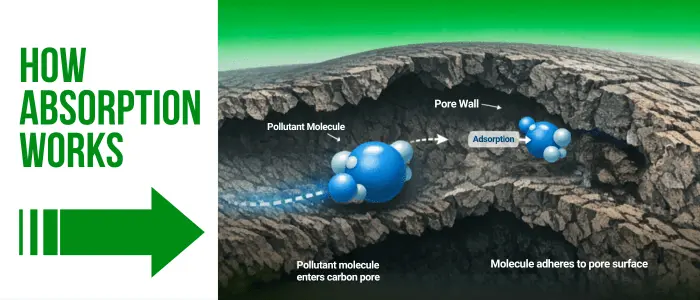
Adsorption works differently. In activated carbon filters, pollutant molecules physically stick to the surface of the carbon pores. They remain trapped along the walls of the carbon material rather than soaking in.
Because activated carbon contains millions of these microscopic pores, it provides a massive surface area where gases can easily attach. Laboratory tests show a single gram of activated carbon can expose between one and two thousand square meters of internal pore walls — that's why carbon is used in everything from water pitchers to industrial scrubbers.
In HVAC filters, the carbon is bonded to a pleated backing so air can still move easily while spending long enough inside the pores for adsorption to happen. Gas capture depends on three factors: carbon weight, dwell time, and pollutant load. A thicker bed means more pores and a longer service life. Slower airflow gives gases more time on the surface. A home with pets, heavy cooking, or a recent renovation will saturate the pores sooner than a lightly used guest room.
What Odors and Gases Can Carbon Filters Remove?
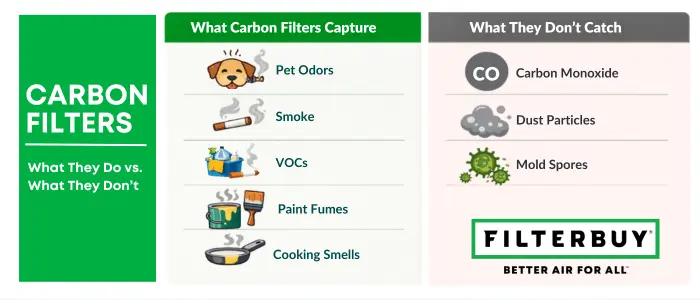
Activated carbon filters are commonly used to reduce a wide variety of household smells and chemical pollutants, including:
Cooking smells
Pet odors
Cigarette smoke odors
Wildfire smoke odors
Paint fumes
Cleaning chemical smells
New furniture off-gassing
VOCs from everyday household products
These gaseous pollutants simply pass right through normal HVAC filters, which are designed mainly for solid particles.
What Activated Carbon Filters Cannot Remove
To get the best results, it's important to understand their limitations. Carbon filters do not remove:
Carbon monoxide (homes that burn fuel still need a dedicated CO alarm)
Radon
Large particle loads
Mold spores
To remove mold spores and dust, you need particle filtration — which is exactly why a carbon filter works best when paired with high-quality MERV-rated filters.
Do Activated Carbon Filters Remove Smoke?
Smoke removal is a major concern for many homeowners, and it's important to understand that smoke comes in two forms.
Cigarette Smoke
Activated carbon filters excel at removing smoke odors and many gaseous smoke compounds. However, cigarette smoke also contains ultra-fine particles. To capture those tiny solid particles alongside the gases, you need a higher MERV filter or HEPA filtration working in tandem with the carbon.
Wildfire Smoke
Wildfire smoke contains two distinct components: smoke odors (gases) and fine particulate matter (PM2.5). Activated carbon filters handle the burning smell, while MERV 11 to MERV 13 filters capture the harmful smoke particles. Using both technologies together creates a far more effective indoor air solution.
Activated Carbon vs. HEPA Filters
Many homeowners mistakenly assume HEPA filters remove odors. They do not. Carbon and HEPA filters serve completely different purposes — and the best indoor air quality setups use both.
| Feature | Activated Carbon | HEPA |
|---|---|---|
| Removes Odors | Yes | No |
| Removes VOCs | Yes | No |
| Removes Fine Particles | Limited | Yes |
| Best For | Odor & gas control | Allergy & dust control |
For the most complete indoor air cleaning, use both carbon filtration and high-efficiency particle filtration. This combination removes gases, smells, allergens, and solid particles simultaneously.
What MERV Rating Should You Pair With Activated Carbon?
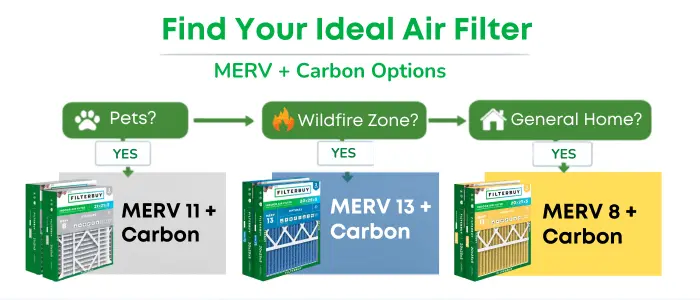
Carbon handles the gases. MERV handles the particles. Together, they provide complete indoor air protection. Here's how to pick the right combination for your situation:
| Household Situation | Recommended Combination | Why It Works |
|---|---|---|
| General home, basic odors | MERV 8 + Carbon | Removes basic dust and odors while maintaining strong HVAC airflow |
| Pets or moderate allergies | MERV 11 + Carbon | Better for trapping pet dander and stronger allergy protection |
| Wildfire smoke or asthma | MERV 13 + Carbon | Captures fine particles (PM2.5) and removes smoke gases simultaneously |
Are Activated Carbon Air Filters Worth It?
Activated carbon filters are absolutely worth the investment if you regularly experience:
Persistent pet odors
Frequent cooking smells
Indoor smoking
Wildfire smoke exposure
Chemical sensitivities
Recent renovations or new furniture off-gassing
They may not be necessary if your main concern is simply household dust, your home has no noticeable odor problems, or you already use a dedicated carbon air purifier in your main living space.
For most homes, adding a carbon layer to your existing HVAC filtration is one of the easiest and most effective indoor air quality upgrades available.
How Long Do Activated Carbon Filters Last?
Filter lifespan depends heavily on your indoor environment. Activated carbon works until its pores fill with odor molecules and VOCs. Once saturated, it stops adsorbing and can even release captured gases back into the airstream.
| Usage Level | Typical Lifespan | Household Type |
|---|---|---|
| Heavy use | 1–3 months | Multiple pets, indoor smokers, frequent cooking, recent renovation |
| Average use | 3–6 months | Standard home with occasional odors |
| Light use | Up to 12 months | Low-pollutant environments, infrequently occupied spaces |
Signs It's Time to Replace Your Filter
Odors begin returning to the home
Smoke smells linger longer than usual
You recently painted or remodeled a room
Pet smells noticeably worsen
DIY Activated Carbon Filters: Do They Really Work?
Some DIY air purifier builds use buckets, box fans, and loose activated carbon. While these makeshift setups can reduce odors in very small spaces, they have several major limitations. Carbon weight matters greatly for effective adsorption. Airflow must be carefully controlled, and dwell time is required for gases to actually stick to the carbon. DIY setups are often bulky, noisy, and highly inefficient for whole-home air systems.
If you're considering a DIY option because sizing is an issue, you're much better off using a manufacturer like Filterbuy that can create the exact custom air filter size you need — giving you a precise fit with far less hassle and far better results.
Why Choose Filterbuy Carbon & MERV Filters?
Filterbuy's Odor Eliminator Filters combine activated carbon with electrostatically charged pleated media for strong, balanced filtration:
Real Carbon Bonded Media — a true activated carbon layer designed specifically for odor and gas adsorption
Electrostatic Pleated Filtration — captures dust, pollen, pet dander, mold spores, and household debris
Longer Lifespan — pleated filters last up to three times longer than cheap fiberglass filters
Balanced Airflow — engineered to protect HVAC airflow while drastically improving filtration
Custom Sizes Available — exact sizing ensures a better filter seal, improved performance, and no DIY cutting
Made in the USA — dependable manufacturing processes and consistent quality
Fast Free Shipping — makes it easy to maintain a regular, healthy filter replacement schedule
The Bottom Line: Use Carbon Filters for Odors, MERV Filters for Particles
Activated carbon filters remove odors, chemical fumes, and gases that traditional HVAC filters simply miss. MERV-rated pleated filters reliably capture dust, allergens, and solid smoke particles. When properly combined, they provide complete, highly effective indoor air protection.
If your home smells less than fresh, upgrading to a carbon and MERV filter combination could be one of the simplest improvements you make this year. Filterbuy makes it easy to find the exact size and filtration level your home needs — delivered fast and ready to install.
Frequently Asked Questions
Do activated carbon air filters remove odors?
Yes. Activated carbon filters remove odors by trapping gas molecules in microscopic carbon pores through a chemical process called adsorption.
Do carbon air filters remove cigarette smoke?
They effectively remove smoke odors and many gaseous compounds. However, fine physical smoke particles require a higher MERV or HEPA filter to be fully captured.
Do activated carbon filters remove VOCs?
Yes. Carbon filters are specifically designed to capture many volatile organic compounds released by household paints, chemical cleaners, new furniture, and standard household products.
Are carbon air filters better than HEPA filters?
They serve completely different purposes. Carbon filters remove invisible gases and odors, while HEPA filters capture extremely small physical particles. For the best results, use both.
Do carbon filters remove mold?
No. Activated carbon does not remove mold spores, which are physical particles. To capture mold spores, you need a MERV-rated or HEPA filter. Carbon filters do help remove the musty odors associated with mold.
Can activated carbon filters make you sick?
No — when used correctly and replaced on schedule, activated carbon filters improve air quality. However, an overdue filter that has reached saturation can release captured gases back into your air, so staying on top of replacements is important.
How often should you replace an activated carbon air filter?
Most standard homes should replace them every 3 to 6 months. Heavy odor environments — such as homes with multiple pets or indoor smokers — may require replacement every 1 to 3 months.