
Do Air Purifiers Help With Smoke? Wildfire and Indoor Smoke | Filterbuy
November 18, 2026
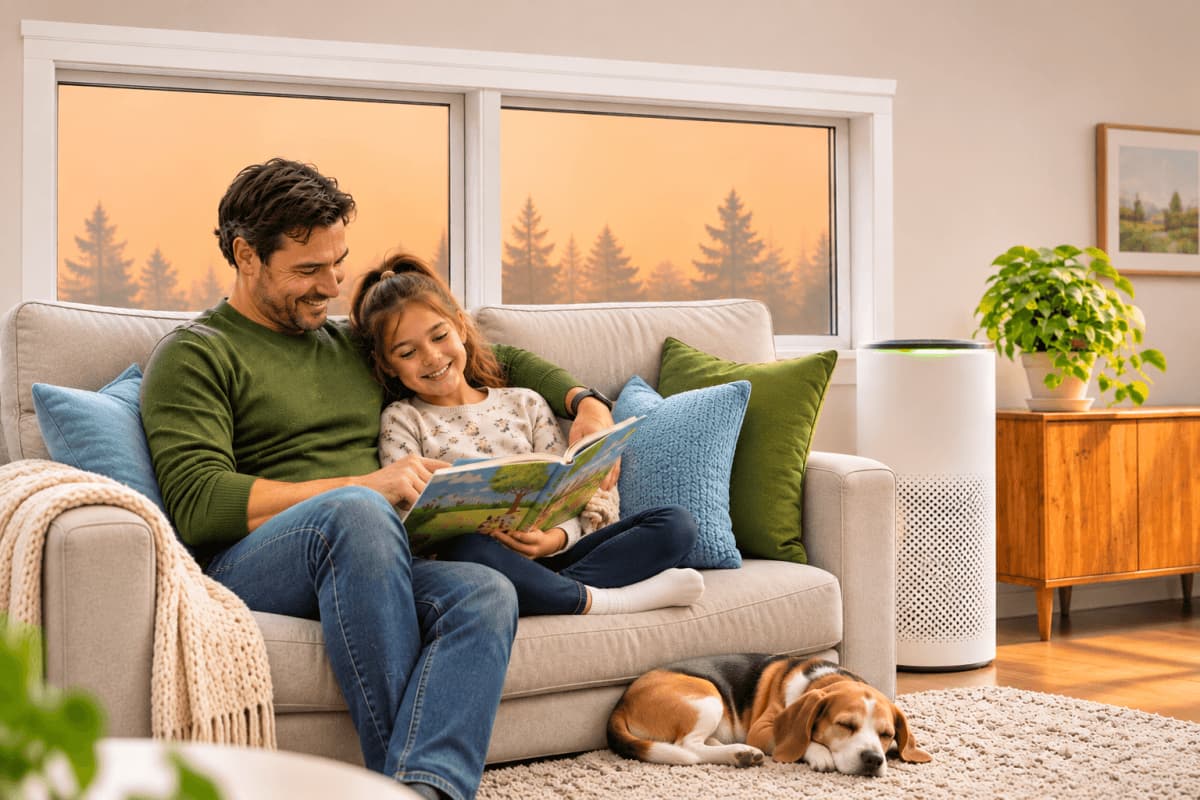
Yes, air purifiers help with smoke, as long as they have the right filters and enough airflow for the room.
I've spent years writing about indoor air for Filterbuy alongside our U.S. manufacturing team, and because we build and ship filters ourselves, we see what heavy smoke does to them. Our advice is simple: match the filter to the part of the smoke you're fighting.
TL;DR
Air purifiers with True HEPA filters remove most of the fine particles in wildfire and indoor smoke, and activated carbon helps with the odors and gases. Any purifier needs to fit the room and stay on, and it should never produce ozone. When your local AQI tops 100, Filterbuy recommends switching to an EPA-recommended MERV 13 filter if you have an HVAC system and running a HEPA air purifier in each room you use.
Key Takeaways
HEPA handles smoke particles, and carbon handles smoke gases and odors. Filterbuy recommends a purifier with both.
Size by smoke clean air delivery rate (CADR): two-thirds of the room's square footage, or all of it in wildfire smoke, at the speed you'll actually run.
COVID-19 and sleep benefits are modest. Filtration alone won't stop COVID-19, and one small trial found about 12 extra minutes of sleep a night.
Above AQI 100, use both layers: an EPA-recommended MERV 13 filter if you have an HVAC system, plus a HEPA purifier in each room.
Avoid ozone generators. The EPA says ozone at safe levels is generally ineffective at cleaning indoor air.
Do Air Purifiers Help With Smoke?
Air purifiers help with smoke by pulling room air through filters that catch smoke particles and, with carbon, some gases. A True HEPA filter, rated 99.97% efficient at 0.3 microns, traps the fine particles (PM2.5), while carbon adsorbs the gases behind the smell.
According to the EPA's Guide to Air Cleaners in the Home, most filters target either particles or gases, so many purifiers pair the two.
What Each Filter Does Against Smoke
Filterbuy summary based on EPA air cleaner guidance.
Filterbuy's carbon vs. HEPA guide and HEPA ratings explained go deeper.
Do Air Purifiers Help With Wildfire Smoke?
Air purifiers are one of the most effective ways to cut wildfire smoke indoors, because smoke gets inside even with windows shut. "We have seen how fast indoor air changes once smoke moves into a region," says Filterbuy founder and CEO David Heacock. Field studies agree: staying indoors alone wasn't enough, but HEPA purifiers closed much of the gap:
Seattle, 2020 wildfire smoke: 48%–78% lower indoor PM2.5 with HEPA purifiers (Xiang et al., Science of the Total Environment, 2021)
Victoria, Australia, prescribed-burn smoke: 30%–74% lower indoor PM2.5 across nine homes (Wheeler et al., Public Health Research & Practice, 2024)
Results vary because homes leak differently, and wildfire smoke can stay in the air for days. The EPA's wildfire guidance suggests at least one closed "cleaner air room" with an ozone-free purifier sized for the space. Filterbuy's guides to running an air purifier during wildfire season and how to clean indoor air after wildfire smoke cover setup and cleanup.
No Purifier? A Box-Fan Air Cleaner Works in a Pinch
A 20-inch box fan with a MERV 13 filter attached to the back is an EPA-tested stopgap. In EPA lab tests, designs with a cardboard shroud and more filters removed more smoke particles than some pricier commercial units.
CADR from EPA laboratory tests. Room sizes are Filterbuy calculations using AHAM's wildfire rule, with 8-ft ceilings.
As a filter maker, Filterbuy would start with the free shroud and then step up to a 20x20x4 MERV 13, a standard size we build. Either way, follow EPA's safety basics:
Use a box fan made in 2012 or later with a UL or ETL mark.
Skip extension cords and damaged fans.
Check the filter daily, since EPA found DIY units almost useless once filters got dirty.
Do Air Purifiers Help With Indoor Smoke?
Air purifiers cut indoor smoke from cooking and fireplaces, but they can't make tobacco smoke safe. HEPA clears particles from a burnt pan or smoky fireplace start, and carbon eases the smell. For cooking smoke, Filterbuy suggests the range hood plus an hour of the purifier on high.
Cigarette smoke is a different story. The CDC says there is no risk-free level of secondhand smoke and that cleaning the air can't eliminate exposure, so only a smoke-free home fully protects.
How Big an Air Purifier Do You Need for Smoke?
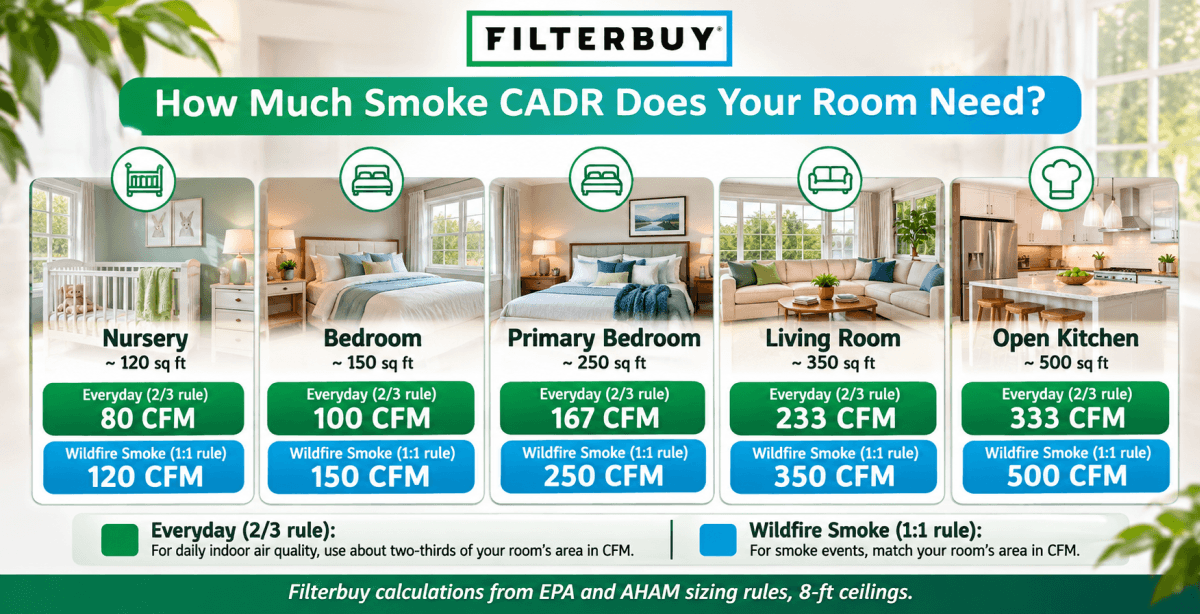
Choose a purifier whose smoke CADR is at least two-thirds of the room's square footage, and equal to it for wildfire smoke. CADR is filtered air delivered in cubic feet per minute (CFM); the smoke rating tests the smallest particles.
The Association of Home Appliance Manufacturers' two-thirds rule matches the EPA's sizing chart, and for smoke events AHAM recommends matching smoke CADR to square footage. Filterbuy turned both rules into a quick lookup:
Filterbuy calculations from EPA and AHAM sizing rules. Choose a higher CADR for vaulted ceilings.
Look for the AHAM Verifide mark (independent CADR testing).
Size for the Speed You'll Actually Use
CADR is measured at the highest fan speed, but many people turn their purifier down to keep it quiet. A 2026 Pacific Northwest National Laboratory study found that, for most products, room coverage dropped 40%–60% on medium and 70%–85% on the lowest setting. Filterbuy's rule of thumb: if you'll run it on medium, buy about double the CADR in the table above.
Do Air Purifiers Help With Odors?
Air purifiers help with odors only when they contain activated carbon or another gas-adsorbing filter. The EPA says carbon works best in large amounts, and there's no common rating for gas filters. A purifier also can't pull smell out of carpets and upholstery; only cleaning does that.
For whole-home odor control, Filterbuy's Odor Eliminator air filters combine activated carbon with MERV 10-level pleated media in your HVAC system, and our activated carbon air filters guide explains how carbon works.
Skip ozone generators. The EPA says ozone at safe levels is generally ineffective, and it can harm your lungs.
Do Air Purifiers Help With COVID?
HEPA purifiers can reduce virus-carrying particles in a room, but they can't protect you from COVID-19 on their own. The EPA calls filtration one part of a plan and suggests a room-sized HEPA unit where people gather plus a MERV 13 HVAC filter. Filterbuy's guide on whether HEPA filters remove viruses goes deeper.
Do Air Purifiers Help You Sleep?
Air purifiers may help you sleep a little longer, but the evidence is early and the effect is small. In a 2023 randomized, double-blind crossover study of 30 healthy adults, a purifier with a working HEPA filter added about 12 minutes of sleep per night. But the two-week pilot was funded by Dyson, which makes purifiers, and time awake at night actually rose (Lamport et al., Journal of Sleep Research, 2023).
In Filterbuy's view, any benefit likely comes from fewer allergy triggers and less smoke, so keep the purifier near the bed and size up for sleep mode.
What Filterbuy Recommends When the AQI Tops 100
When your local AQI climbs above 100, the EPA's "Unhealthy for Sensitive Groups" level, Filterbuy recommends two layers of protection plus two habits:
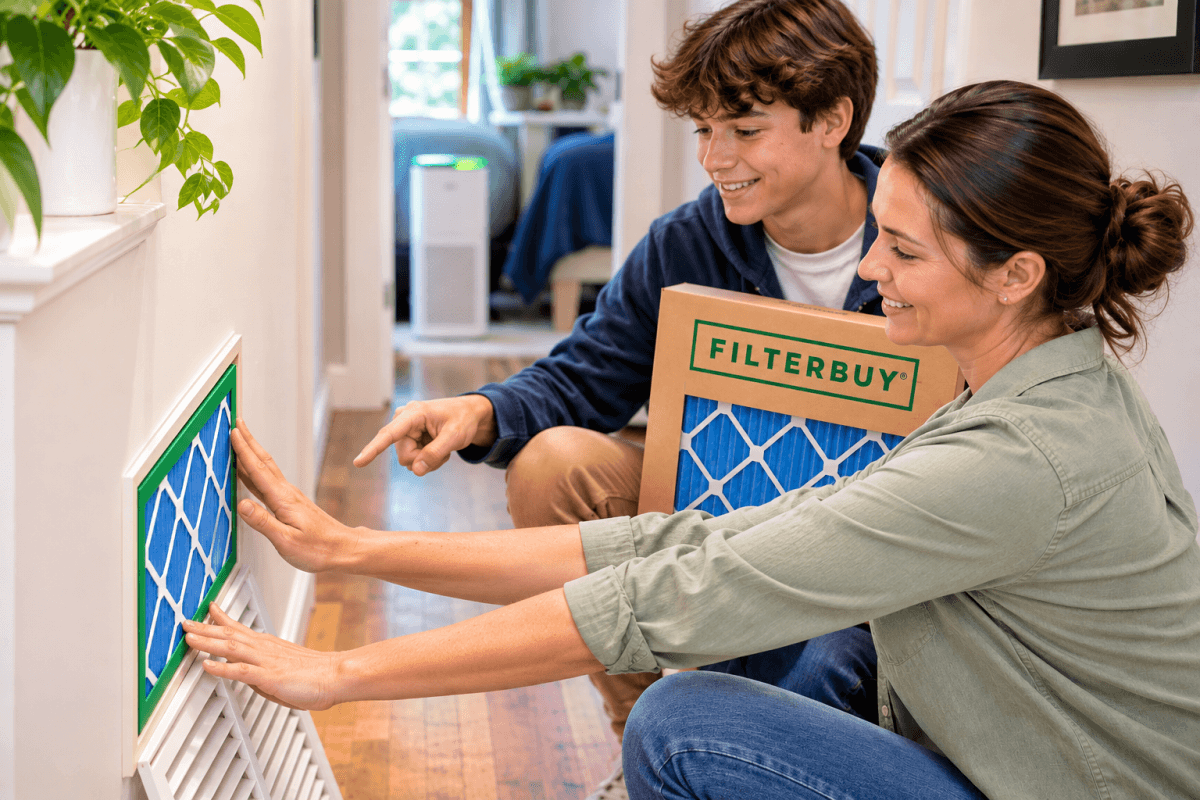
Upgrade the whole house if you have an HVAC system. Switch to an EPA-recommended MERV 13 air filter and set the fan to recirculate. Ours is rated to capture 98% of airborne particles.
Protect each room, too. Run a HEPA air purifier in each room you use, even with a MERV 13 in place. No HVAC system? This becomes your main defense. Filterbuy's portable air purifier vs. HVAC filter guide compares the cost of each.
Keep smoke out. Shut off any whole house fan during wildfire smoke.
Check filters weekly. Filterbuy has seen filters turn visibly gray in under two weeks of smoke.
Our live AQI and wildfire smoke map tells you when to act, though it only shows outdoor air. My own habit is to check the monitor closest to wherever I'll actually be that day, rather than trusting a single statewide number.
What Filterbuy Has Learned Shipping Filters Into Fire Country
Filterbuy has made filters in the U.S. since 2013, and one lesson repeats every season:
Our reviewer puts it the same way: "The best filter is the highest rating your system can move air through, changed on schedule." (David Clark, Licensed HVAC Technician) For a side-by-side, see MERV 13 vs. HEPA filters for wildfire smoke.
Supporting Statistics: Why Smoke Protection Matters
Smoke days send more people to the ER.
Asthma ER visits ran 17% above expected.
It happened over 19 days of wildfire smoke in 2023, at AQI 101+.
Unhealthy particle spikes are common.
61.5 million Americans live in counties graded F for particle spikes.
Indoor smoke reaches 1 in 4 nonsmokers.
58 million U.S. nonsmokers were exposed to secondhand smoke (2013–2014).
Over 7 in 10 were exposed when someone smoked indoors.
Source: CDC, 2018
Frequently Asked Questions
How Long Does It Take an Air Purifier to Clear Smoke?
A purifier whose smoke CADR equals the room's square footage filters the air about 7.5 times an hour (8-ft ceilings). By Filterbuy's math, that clears most airborne smoke from a closed room in under an hour.
Should I Run My Air Purifier All the Time During Wildfire Season?
Yes. The EPA says higher speeds and longer run times filter more air.
How Often Should I Change My Air Purifier Filter After Smoke?
Check it weekly during smoke events and replace it when gray. Shop Filterbuy's air purifier replacement filters.
Glossary
- PM2.5
- Particles 2.5 microns or smaller.
- True HEPA
- Captures at least 99.97% of 0.3-micron particles.
- CADR (Clean Air Delivery Rate)
- Filtered air delivered, in cubic feet per minute, under ANSI/AHAM AC-1.
- AQI (Air Quality Index)
- The EPA's 0–500 outdoor air scale.
- MERV (Minimum Efficiency Reporting Value)
- The 1–16 HVAC filter rating scale.
Sources
U.S. EPA, Guide to Air Cleaners in the Home
U.S. EPA, Wildfires and Indoor Air Quality
U.S. EPA, Air Cleaners, HVAC Filters, and Respiratory Viruses
CDC, Ventilation Does Not Effectively Protect People Who Don't Smoke From Secondhand Smoke
CDC, Asthma-Associated Emergency Department Visits During the Canadian Wildfire Smoke Episodes, United States, April–August 2023, MMWR, 2023
CDC, Decline Stalls: 58 Million Americans Still Exposed to Secondhand Smoke, 2018
American Lung Association, "State of the Air" 2026: Key Findings
U.S. EPA, Research on DIY Air Cleaners to Reduce Wildfire Smoke Indoors
Pacific Northwest National Laboratory, Laboratory Testing of Portable Air Cleaner Products for Energy Efficiency and Clean Air Performance at Various Fan Settings (PNNL-38694), 2026
AHAM, Air Filtration Standards
Xiang J, et al., Field Measurements of PM2.5 Infiltration Factor and Portable Air Cleaner Effectiveness During Wildfire Episodes in US Residences, Science of the Total Environment, 2021 (DOI: 10.1016/j.scitotenv.2021.145642)
Wheeler AJ, et al., Evaluating Portable Air Cleaner Effectiveness in Residential Settings to Reduce Exposures to Biomass Smoke From Prescribed Burns, Public Health Research & Practice, 2024 (DOI: 10.17061/phrp33232307)
Lamport DJ, et al., Can Air Purification Improve Sleep Quality? A 2-Week Randomised-Controlled Crossover Pilot Study in Healthy Adults, Journal of Sleep Research, 2023 (DOI: 10.1111/jsr.13782)