September 21, 2026
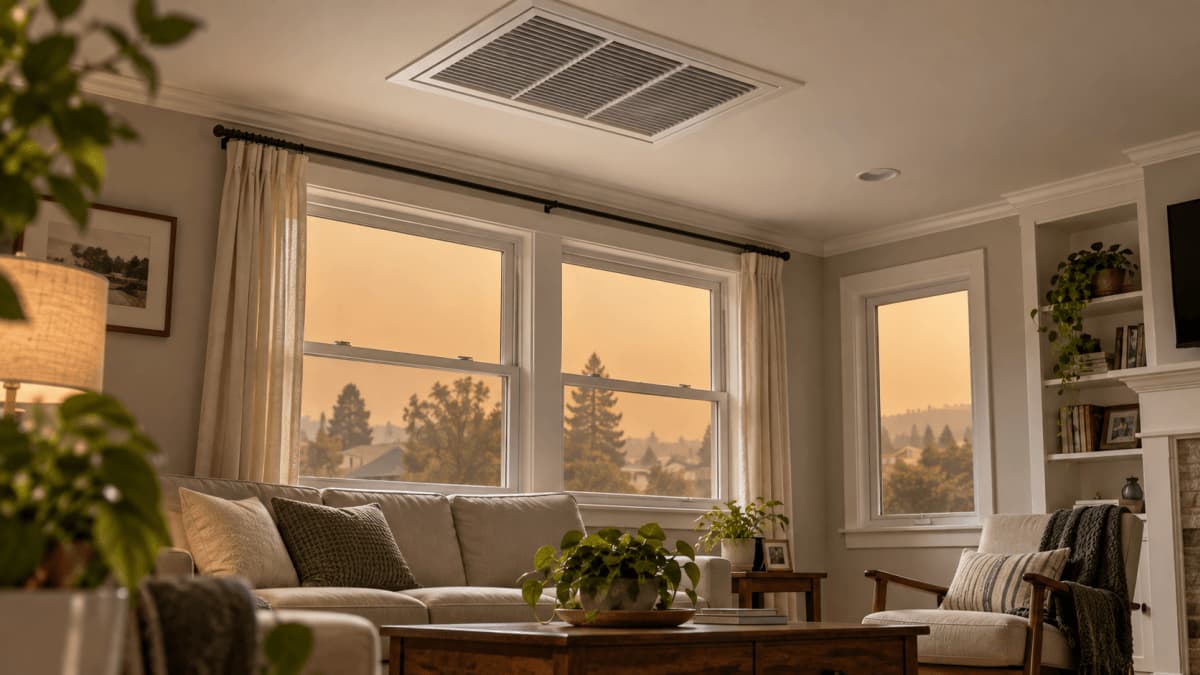
No. Turn your whole house fan off and keep it off while there is smoke outside. A whole house fan has no filter, so it pulls outdoor air, smoke and all, through every room in minutes. The EPA advises against running whole-house fans when outdoor air pollution is high.
When the outdoor AQI is over 100, Filterbuy recommends these steps:
Turn off the whole house fan and keep windows and doors shut.
With an HVAC system, switch to a MERV 13 filter if your HVAC manual allows that rating.
Set the thermostat fan to "on" instead of "auto."
Run a HEPA air purifier in each room you use, with or without an HVAC system.
MERV 13 is the rating the EPA recommends during smoke events.
Your filter size is printed on the frame of the filter you have now.
Sign up for filter replacement reminders and HVAC tips before the next smoke event.
By Michelle Wan, Brand Manager and Air Quality Writer · Technically reviewed by David Clark, Licensed HVAC Technician and CEO of Filterbuy HVAC Solutions · Published September 21, 2026 · Updated September 21, 2026
Turn your whole house fan off when there’s wildfire smoke in the air, because it pulls unfiltered outdoor air through every room, and EPA advises avoiding whole-house fans when outdoor air pollution is high. Once the outdoor AQI is over 100, switch to a MERV 13 filter and set the system fan to on if your home has an HVAC system. MERV 13 is the rating EPA recommends during smoke events. Run a HEPA air purifier in each room you use as well, and keep the house closed up.
A whole house fan has no filter, so every cubic foot it moves comes straight from outdoors, smoke included.
EPA advises avoiding whole-house fans when outdoor air pollution is high, and the California Air Resources Board gives the same advice during smoke events.
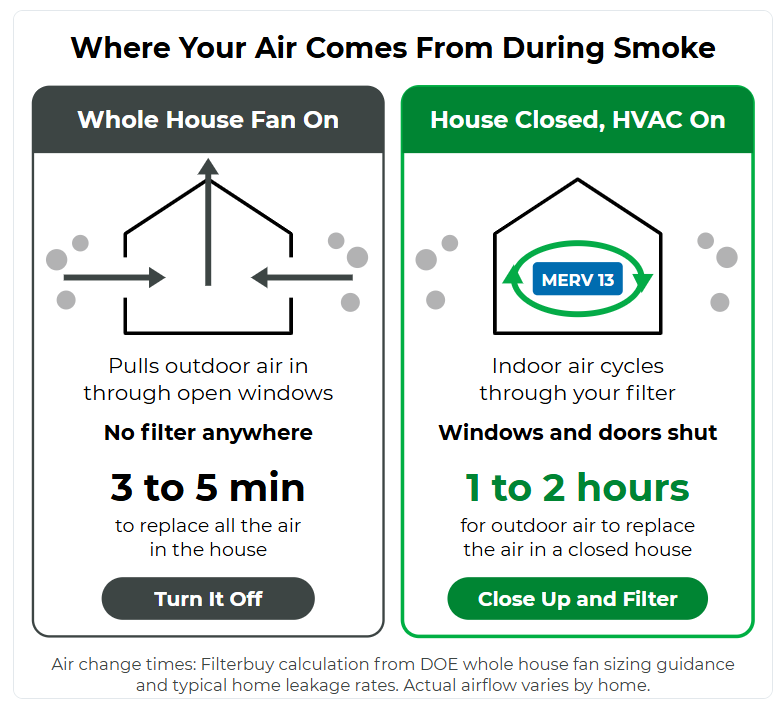
A whole house fan sized to Department of Energy guidance replaces all the air in a home every 3 to 5 minutes.
An attic fan is a different device but still a bad idea in smoke, since it depressurizes the attic and can draw smoky air down through ceiling leaks.
Evaporative coolers also pull in outdoor air, though EPA suggests covering their intakes with 4-inch MERV 13 filters.
When the outdoor AQI is over 100, Filterbuy recommends switching to a MERV 13 filter with the thermostat fan on if you have an HVAC system, running a HEPA air purifier in each room you use, and keeping the house closed up. MERV 13 is the rating EPA recommends during smoke events.
No. Turn it off and leave it off for as long as there’s smoke outside. A whole house fan has no filter. It’s built to swap indoor air for outdoor air as fast as possible, which is exactly what you don’t want when that air is full of smoke. Filterbuy makes air filters, and even so, the most important step on this page is turning the fan off.
The agencies agree. The U.S. Environmental Protection Agency (EPA) says to avoid using whole-house fans if air pollution outside is high. California’s Air Resources Board lists whole house fans with swamp coolers as devices to shut down in its Smoke Ready California guidance. A whole house fan guide from the U.S. Department of Energy (DOE) names smoke among the things these fans bring indoors.
It’s an easy mistake. On a clear night, a whole house fan does freshen your air, but during a smoke event, that fresh air is the hazard. Wildfire smoke is mostly PM2.5, fine particles that reach deep into the lungs, and the fan can spread them through every room in minutes. Filterbuy’s guide to wildfire smoke and the Air Quality Index explains what each AQI level means indoors.
It’s tempting to split the difference by running the fan with the windows shut or just one cracked, but that makes things worse. A whole house fan moves 1,000 to 10,000 CFM, and that air has to come from somewhere. With no open windows to supply it, DOE’s Building America guide warns the fan can quickly depressurize the house and pull air from the garage or crawlspace. The same guide flags depressurization as a problem for gas appliances that draw room air. If you run the fan at all, open the windows and do it only when the outdoor air is clean.
When the outdoor AQI is over 100, Filterbuy recommends turning the whole house fan off and switching to a MERV 13 filter, with the thermostat fan on, if your home has an HVAC system. Either way, run a HEPA air purifier in each room you use. The table shows how that shifts with the AQI and your home.
Filterbuy's action line is an outdoor AQI over 100. On EPA's scale, 101 is where the Unhealthy for Sensitive Groups category begins. If anyone at home has a heart or lung condition, follow their doctor's advice and local guidance.
A whole house fan sits in the ceiling between your living space and the attic. Switch it on with the windows cracked and it draws outdoor air through your rooms, then pushes it up through the ceiling grille and out the attic vents. All the cooling comes from that air exchange, with no coil or filter. The same airflow that cools so well is what makes it risky in smoke.
How much air? The Department of Energy’s Building America Solution Center puts typical whole house fan sizing at 12 to 23 air changes per hour. That replaces all the air in your home every 3 to 5 minutes. A closed-up house trades air with the outdoors through ordinary leakage at roughly 0.5 air changes per hour if it’s newer and closer to 0.9 if it’s older. Running the fan during a smoke event therefore brings outdoor air in somewhere between 13 and 46 times faster than keeping the house shut.
Filterbuy calculation from DOE Building America whole-house-fan sizing guidance (updated September 2022) and typical residential infiltration rates. Actual airflow varies by fan rating and attic venting, and drops if too few windows are open.
That number is where Filterbuy’s view as a filter manufacturer comes in. Your HVAC filter only sees the air your blower pulls through the return. A whole house fan moves air from the windows to the attic without it ever reaching that filter, so a higher MERV rating does nothing for it.
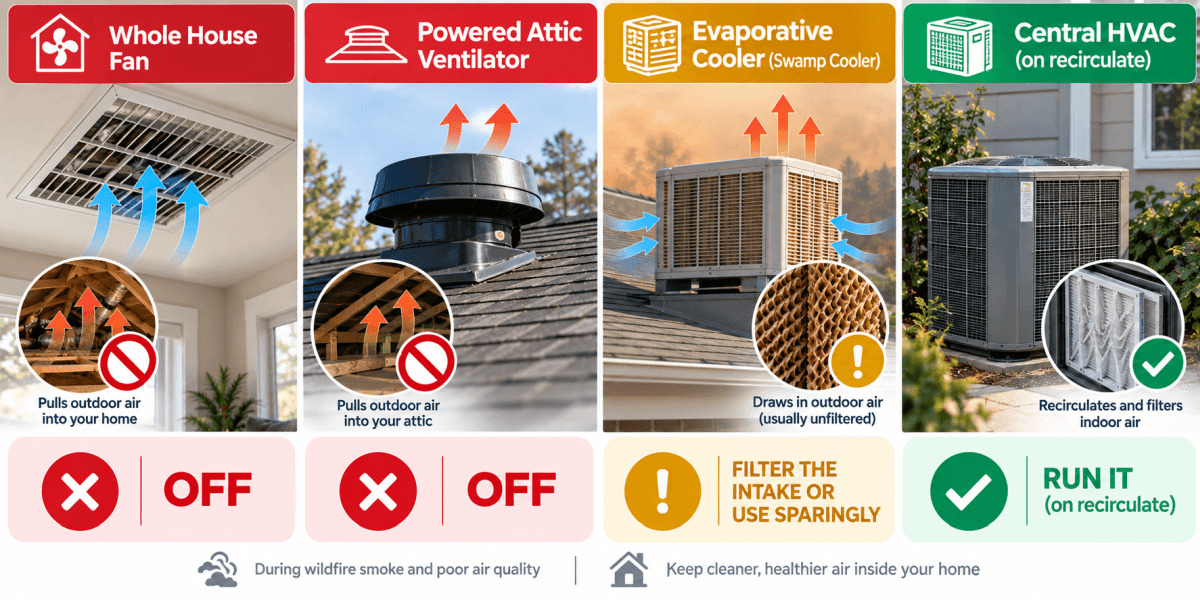
People use these names interchangeably, but they behave very differently in smoke. Whole house fans and attic fans should both be turned off, while a swamp cooler is the one device with a workaround EPA describes: filtered intakes.
| Device | Air Source | Filtered? | During a Smoke Event |
|---|---|---|---|
| Whole house fan | Outdoor air, through open windows | No | Shut it off |
| Powered attic ventilator | Attic air, plus air pulled through ceiling leaks | No | Shut it off |
|
Evaporative cooler (swamp cooler) |
Outdoor air, through the intake | Not unless you add one |
Shut it off or filter the intake |
| Central HVAC on recirculate | Indoor air, recycled | Yes, at the filter | Run it, fan set to on |
The attic fan is the one that catches people off guard. A powered attic ventilator sits in the roof or a gable end and exhausts hot attic air. Since it doesn’t need open windows, it’s easy to assume it’s harmless in smoke. But it lowers the pressure in the attic and pulls replacement air from wherever it can, including your living space through gaps like recessed lights and the attic hatch.
Attic fans carry a second risk that has nothing to do with smoke. By depressurizing the house, a powered attic ventilator can backdraft a natural-draft water heater or furnace and pull carbon monoxide indoors. A study of eight occupied homes in North Carolina flagged this hazard, and Florida Solar Energy Center’s attic ventilation literature review lists backdrafting among the documented risks. If you have atmospherically vented gas appliances, that’s reason enough to leave the attic fan off and have a licensed technician check the system.
Evaporative coolers, or swamp coolers, draw outdoor air across wet pads, so they bring smoke in much as a whole house fan does. They’re the one device here with a workaround, though. If you can reach the unit safely, EPA suggests covering its outside air intakes with 4-inch MERV 13 furnace filters. It makes no such exception for whole house fans. Otherwise, use the cooler sparingly, and check those filters often, since wind and rain take a toll.
Start with official guidance. Check the AirNow Fire and Smoke Map and follow your local air agency, including any advice to stay somewhere else. Then the goal shifts from bringing in fresh air to filtering the air already inside.
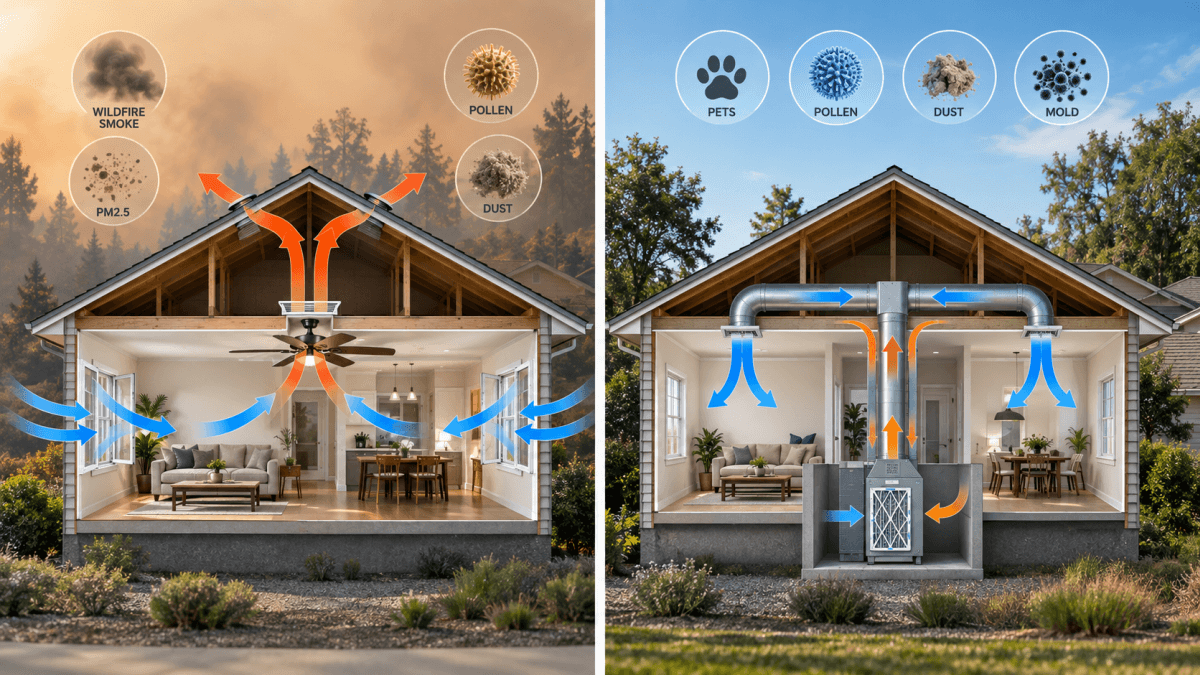
Turn off the whole house fan and seal the grille. Shut the windows, too. A fan that’s switched off can still leak. Newer models have motorized, insulated dampers. Older ones use gravity louvers, thin metal slats that flap open when the fan starts, and DOE notes those leak even when closed. A vented attic breathes outdoor air, so it gets smoky too. If your fan has louvers, cover the grille from below with rigid foam board held by Velcro, the fix DOE’s guide describes.
If you have an HVAC system, switch to a MERV 13 filter. MERV 13 is the rating EPA recommends: a filter rated MERV 13 or higher during smoke events. It also notes that most furnaces and HVAC systems can take a MERV 13 without equipment problems, as long as you replace it often. Filterbuy’s action line is an outdoor AQI over 100, and that’s when we tell customers to make the switch. Order it in the size printed on your current filter, the same check as any filter order. Our guide to the best MERV filter for wildfire smoke covers the details, and if your slot is an odd size, we also build custom-size filters.
Set the thermostat fan to “on” instead of “auto.” EPA advises running the fan continuously during a smoke event. On “auto,” it only filters while heating or cooling.
Run a HEPA air purifier in each room you use, bedrooms first. Do this whether or not you have an HVAC system. That’s Filterbuy’s recommendation. EPA, which calls these devices portable air cleaners, advises setting up at least one cleaner air room. In a home with HVAC, the two layers do different jobs: the MERV 13 filters the whole house, and each purifier filters its room harder than the central system can. EPA’s sizing rule is a smoke CADR of at least two-thirds of the room’s square footage. A 300-square-foot bedroom needs a smoke CADR of about 200, and more if the ceiling is over 8 feet. Skip ionizers and ozone generators, because the EPA advises against air cleaners that produce ozone. Our comparison of MERV 13 vs. HEPA for wildfire smoke explains the difference.
Keep the house closed up. Windows and doors stay shut, and so does any fresh-air intake. Central systems already recirculate indoor air, so there’s usually no button to press; what matters is closing any outdoor-air damper. Don’t add smoke of your own: no candles, frying, gas stoves, aerosols, smoking, or vacuuming without a sealed HEPA vacuum.
In an apartment, a home with window units, or an older house without ductwork, HEPA air purifiers are your main filtration, so run one in each room you use.
During a smoke event, check the HVAC filter often. Replace it when it looks dirty, dark brown or black, which can be well before its normal interval. Keep two spares on hand, since shipping slows once a regional smoke event starts, orders from Filterbuy included.
We’ve made air filters in the U.S. since 2013, and our smoke-season advice is the least glamorous thing we could tell you: close up first, filter second. A running whole house fan refills a house with outdoor air far faster than any home HVAC filter can keep up with. So if the air outside is bad, expect your home to smell the same inside that fast.
Without air conditioning, ventilate briefly at the coolest, least smoky hour, then close up and filter, and leave for a cleaner, cooler space if you can’t stay cool. Fire season often overlaps with heat waves, and EPA notes that smoke and extreme heat together may be considerably worse for your health than either one alone.
EPA’s guidance for this situation is practical. If you have no air conditioning and must open windows to cool your home, do it. Then close them once the house cools and run your HEPA air purifiers to filter what came in. The decision table near the top shows where your home falls.
If you can’t tolerate the smoke and can’t keep cool, EPA recommends going somewhere else. That could be a cleaner air and cooling center, or a friend’s home with air conditioning and good filtration. Meanwhile, interior fans are fine for comfort, since moving indoor air around brings no smoke inside. Just don’t point a fan directly at yourself once the room is hotter than 90 degrees.
Turn the fan back on once the outdoor PM2.5 AQI is back to 100 or lower and it’s cooler outside than in. If anyone at home has a heart or lung condition, follow their doctor’s advice and local guidance on timing. Go by the AQI rather than the sky, because smoke can look thin while PM2.5 stays high, and the AQI can stay high after the haze clears.
Look up your AQI by ZIP code on EPA’s AirNow Fire and Smoke Map or on Filterbuy’s live wildfire and smoke map.
Wait for the right number. The table below lists the thresholds by household.
Use the fan to flush the house, then close up. Once the outdoor air is clean and cooler than inside, the fan clears leftover smoke odor fastest. Run it, then close up again and keep the system fan on.
Change the filter afterward. A filter that worked through a smoke event is loaded. Replace it with the same size printed on the frame, or use Filterbuy’s guide to measuring your air filter if the label is unreadable. A pleated filter captures particles, and odor is a gas, so for lingering smell, Filterbuy’s Odor Eliminator line is the odor option. For the rest of the cleanup, see how to clean the air in your house after wildfire smoke.
An AQI of 100 or lower is Filterbuy's line for reopening. Check your ZIP code on the AirNow Fire and Smoke Map first, because smoke can look thin while PM2.5 stays high.
Every recommendation here rests on agency data. These three numbers are the ones Filterbuy’s advice relies on most.
With windows closed, indoor PM2.5 typically runs about 55–60% of outdoor levels.
With windows open, indoor and outdoor levels are about the same.
A whole house fan only works with the windows open, which puts your home in the second group.
Source: U.S. EPA, Strategies to Reduce Exposure Indoors, updated October 2025
Researchers analyzed more than 28 million California hospitalizations from 2011 to 2020.
About 8% of respiratory hospitalizations were linked to smoke and heat acting together.
Without air conditioning, ventilate briefly when the air is cleanest, then close up and filter.
Source: NIH PubMed Central, Joint Effects of Wildfire Smoke and Extreme Heat on Hospitalizations in California, 2011–2020, published June 2025
Each year in the U.S., unintentional carbon monoxide poisoning not linked to fires causes:
More than 400 deaths
More than 100,000 emergency room visits
More than 14,000 hospitalizations
Why it matters here:
An attic fan can backdraft a gas furnace or water heater.
CDC recommends a CO detector near every sleeping area.
Source: CDC, Carbon Monoxide Poisoning Basics, updated January 2026
No. A whole house fan is ventilation equipment with no filter anywhere in its airflow path, and unlike an evaporative cooler, it has no single intake you could cover with one.
Not to a standard one, because air comes in through windows all over the house. The alternative is ducted night-ventilation cooling, which pulls outdoor air through a dampered intake and the central air handler’s filter without any open windows. If smoke season is routine where you live, ask an HVAC contractor about it. It’s still an outdoor-air intake, though, so EPA’s advice to close intakes on smoky days applies to it too.
Only if the air quality is good at that hour, smoke often settles into valleys overnight, so the AQI at night can be worse than during the day, and it’s worth checking the reading before you open up.
Both are fine, since neither brings in outside air. Attach a MERV 13 filter to a box fan, and it becomes a DIY air cleaner, a design EPA’s research found effective. EPA recommends a certified fan made in 2012 or later, with a UL or ETL safety mark. Don’t leave the unit running unattended, and treat it as a stopgap for when a commercial HEPA air purifier isn’t available.
Smoke season starts before the smoke does. Filterbuy makes MERV 13 filters in the U.S., in standard and custom sizes. Find yours and put one in the slot now.
Shop MERV 13 Air FiltersWhole house fan. A ceiling-mounted ventilation fan that cools a home by drawing outdoor air in through open windows and exhausting it through the attic. It has no filter.
Gravity louvers. The thin metal slats on older whole house fan grilles that open under airflow and don’t seal when closed.
Powered attic ventilator (attic fan). A roof- or gable-mounted fan that exhausts hot attic air only. It doesn’t cool the living space and can depressurize the house.
Evaporative cooler (swamp cooler). A unit that cools by drawing outdoor air across water-soaked pads. It works best in dry climates and ventilates with outdoor air by design.
PM2.5. Fine particulate matter 2.5 microns or smaller, and the main health hazard in wildfire smoke.
MERV. Minimum Efficiency Reporting Value, the 1 to 16 scale for how well a filter captures particles. EPA recommends MERV 13 or higher for smoke.
AQI. The Air Quality Index, EPA’s 0 to 500 scale for outdoor air pollution. Readings above 100 are unhealthy for sensitive groups.
Air changes per hour (ACH). How many times a space’s full volume of air is replaced in an hour.
CFM. Cubic feet per minute, the measure of a fan’s airflow.
Backdrafting. When negative pressure inside a home pulls combustion gases from a furnace or water heater indoors instead of up the flue.
Cleaner air room. EPA’s term for one room set up with closed windows and a portable air purifier to keep smoke levels there as low as possible.
EPA. The U.S. Environmental Protection Agency, the federal agency behind AirNow and most U.S. wildfire smoke guidance.
DOE. The U.S. Department of Energy, whose Building America Solution Center publishes guidance on installing and operating whole house fans.
HVAC. Heating, ventilation, and air conditioning, the central system whose blower pulls indoor air through your furnace filter.
HEPA. High-efficiency particulate air, the filter standard used in portable air purifiers, which EPA calls portable air cleaners. It isn’t made for home HVAC filter slots.
Smoke CADR. Clean Air Delivery Rate for smoke, a rating of how much filtered air a portable air purifier delivers. EPA’s sizing rule is at least two-thirds of the room’s square footage.
