
Running an Air Purifier During Wildfire Season
July 7, 2026
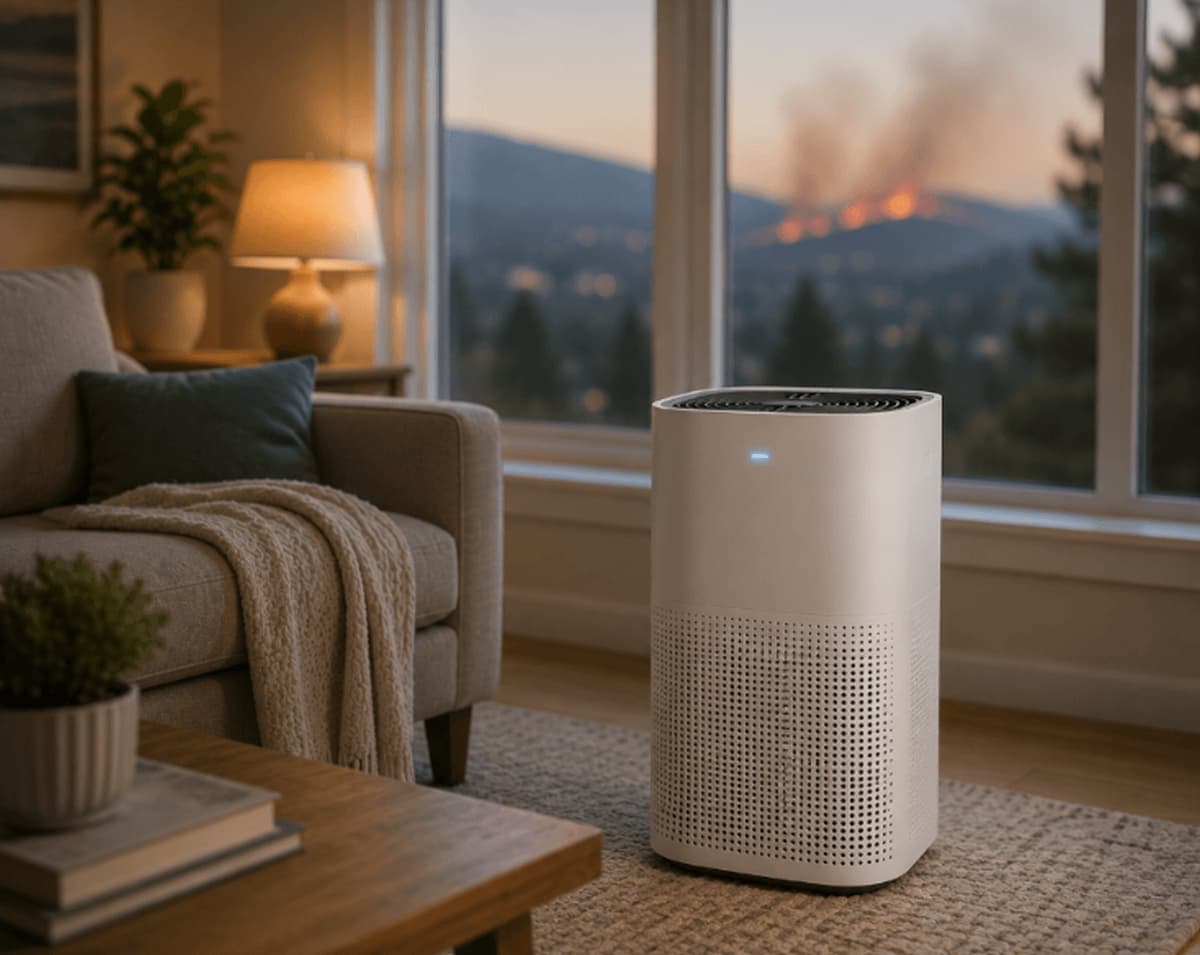
If you can smell smoke or see haze outside, your indoor air is already affected. The good news? There are simple, practical steps you can take right now to reduce your exposure.
Running an air purifier during wildfire season is one of the most effective things you can do. But it works best as part of a layered approach: a portable purifier in the room you use most, plus a high-quality HVAC filter that supports whole-home airflow. This guide walks you through exactly how to do both.
Before you do anything else, check the current AQI for your area to see live smoke conditions near your ZIP code. Then come back here and follow the steps below.
Key Takeaways
Running an air purifier is a highly effective way to reduce indoor exposure to wildfire smoke, especially when combined with a quality HVAC filter.
Using a portable air purifier in the most frequently used room effectively improves air quality.
Checking the Air Quality Index (AQI) for your area is important for understanding current smoke conditions and guiding your response.
A layered approach that tackles both room-specific and whole-home airflow provides the best protection during wildfire season.
Why Wildfire Smoke Is Different from Regular Dust
Not all airborne particles are created equal. Understanding what makes wildfire smoke uniquely harmful helps explain why standard dust control isn't enough, and why the right filtration setup matters so much during smoke events.
Wildfire smoke is mostly a fine-particle problem
Regular household dust is relatively large. Your nose and throat can trap most of it before it reaches your lungs.
Wildfire smoke is different. It's loaded with fine smoke particles (what scientists call PM2.5). These particles are 2.5 micrometers or smaller, roughly 30 times smaller than a human hair. The EPA identifies fine particles as the primary health concern from wildfire smoke because they can travel deep into the lungs and irritate the eyes, nose, throat, and respiratory system.
A helpful way to think about it: PM2.5 behaves less like dust and more like an invisible cloud of particles drifting through your home.
Smoke can get inside even when the windows are closed
You might assume closing your windows seals you off from outdoor smoke. It helps, but it doesn't fully work.
Smoke particles can still get in through the following entry points:
| Entry Point | Why It Matters |
|---|---|
| Door and window gaps | Even small gaps allow fine particles to seep inside |
| Cracks in the building envelope | Hard to seal completely in older homes |
| HVAC fresh-air intakes | Pulls outdoor air and smoke directly into circulation |
| Exhaust fans | Create negative pressure that draws outside air in |
| Fireplace dampers | Often poorly sealed when not in use |
That's why indoor air can feel smoky even in a well-sealed home, and why filtration matters so much.
When Should You Run an Air Purifier During Wildfire Season?
Knowing when to act is just as important as knowing what to do. This section covers how to use real-time AQI data to time your response and the steps to take at each air quality level.
Run it before the smoke gets bad
Don't wait until your house smells like a campfire. By then, smoke particles have already built up indoors.
If AQI is trending upward in your area, or if you can see haze on the horizon, start your purifier early. Close windows and doors at the same time. Getting ahead of the smoke is much easier than trying to clear it after the fact.
Use AQI as your trigger
AQI (Air Quality Index) is the simplest way to know when to act. It measures PM2.5 and other pollutants in real time, and it's specifically designed to help you prepare for and manage smoke exposure. Check your local AQI in the morning, afternoon, and before bed during wildfire season. See current AQI conditions for your area.
Here's a practical guide for what to do at each AQI level:
| AQI Level | What It Means | What to Do |
|---|---|---|
| 0–50 Good | Air quality is fine | Normal use; check your HVAC filter replacement schedule. |
| 51–100 Moderate | Some pollutants present | Sensitive groups should run air purifiers in bedrooms. |
| 101–150 Unhealthy for Sensitive Groups | Higher risk for some people | Run an air purifier in the main room or bedroom; inspect your HVAC filter. |
| 151–200 Unhealthy | Risk for everyone | Run the air purifier continuously, keep windows closed, and reduce indoor pollution. |
| 201+ Very Unhealthy / Hazardous | Serious health risk | Create a cleaner-air room and follow local health guidance. |
AQI categories range from Good through Hazardous, with 301+ classified as Hazardous.
How to Run an Air Purifier for Wildfire Smoke
Running an air purifier during wildfire season isn't complicated, but a few key decisions (placement, speed, and sizing) make a real difference in how well it works. Here's what to focus on.
Keep it on continuously during smoky conditions
This is the most important tip. The longer your purifier runs, and the higher the fan speed, the more air it filters. According to the EPA, air cleaners filter less air on lower speeds and more air on higher speeds.
When smoke is present, run it on the highest speed you can tolerate. If the noise is an issue overnight, most modern purifiers have a sleep mode that still moves meaningful airflow.
Put it where people spend the most time
The EPA recommends placing portable air cleaners in the room where you spend the most time and keeping airflow unobstructed. That usually means a bedroom, home office, or living room. For families, a nursery or a child's bedroom is worth prioritizing.
Don't tuck it in a corner behind furniture. Give it space to pull and push air freely.
Match the purifier to the room size
CADR stands for Clean Air Delivery Rate. It tells you how quickly a purifier removes particles from the air. The higher the CADR, the faster it cleans the room.
For wildfire smoke, focus specifically on the CADR rating. Tobacco smoke CADR is used as the benchmark for small particles like PM2.5. The EPA recommends choosing a portable air cleaner with a high CADR for tobacco smoke when targeting fine particles.
AHAM (the Association of Home Appliance Manufacturers) recommends choosing a model with a smoke CADR equal to the room's square footage during wildfire smoke events, which is stricter than the usual two-thirds rule. So, for a 200 sq ft bedroom, look for a smoke CADR of 200 or higher.
Avoid ozone-generating air cleaners
Important: Avoid air purifiers that intentionally produce ozone. These devices can irritate the lungs and worsen indoor air quality, even if they're marketed as air cleaners. Stick to HEPA or activated carbon units. The CDC recommends using portable air cleaners in a closed-off cleaner-air room and avoiding added indoor pollution sources during smoke events.
Don't Forget Your HVAC Filter
A portable purifier handles one room well. But your HVAC system affects the air throughout your entire home, and the filter inside it plays a big role in how clean that circulated air is. This section covers how to get the most out of your HVAC setup during wildfire season.
Air purifiers clean rooms; HVAC filters support whole-home airflow
A portable air purifier does a great job in one room. But your HVAC system moves air throughout your entire home, and its filter determines how clean that air is.
Here's the key thing to understand: your HVAC filter only works when air is actively moving through the system. If the system is off, the filter isn't filtering anything.
Use MERV 13 if your system can handle it
MERV 13 filters are designed to capture fine smoke particles and other small airborne particles. The EPA advises choosing a MERV 13 filter, or as high as your system fan and filter slot can safely accommodate, when increasing HVAC filtration for wildfire smoke. The CDC also recommends MERV 13 or higher for central AC systems when compatible.
Filterbuy note: MERV 13 is the right target for most homes, but always start with the highest-rated filter your system can handle without straining airflow. If you're not sure, check out our guide to upgrading your HVAC system with a MERV 13 filter. And before ordering, check the size printed on your current filter frame.
Shop Filterbuy MERV 13 Air Filters - stock up before smoke reaches your area.
Can't find your exact size? Filterbuy offers custom air filters with fast shipping and U.S. manufacturing.
Change filters more often during wildfire season
Wildfire smoke loads up filters much faster than regular household dust. A filter that would normally last 60–90 days might need replacing in a few weeks during a heavy smoke event.
According to EPA guidance on DIY air cleaners, filters should be changed when they look dirty, dark, or grey/brown, or start to smell like smoke. During smoke events, inspect your filter more often than your normal replacement schedule: every week or two if AQI is consistently elevated.
Should You Run Your HVAC Fan During Wildfire Smoke?
Yes, with the right setup. If your system has a clean, compatible MERV 13 filter installed, running the fan on recirculate can help filter the air throughout your home.
The CDC recommends setting central AC systems to recirculate mode or closing the outdoor intake damper during smoke events. This keeps the system from pulling smoky outdoor air inside.
| Action | Is It Recommended | Why |
|---|---|---|
| Run the fan on recirculate with the MERV 13 filter | Yes | Filters circulating air without pulling smoke indoors |
| Close the outdoor air intake or damper | Yes | Prevents drawing smoky air into the system |
| Run exhaust fans unnecessarily | No | Creates negative pressure that draws outdoor air in |
| Upgrade to MERV 13 on an older system without checking | Use caution | Some older systems can't handle higher-resistance filters |
If your HVAC system starts struggling, makes unusual noises, or experiences noticeably reduced airflow after upgrading to MERV 13, consult an HVAC professional.
How to Create a Cleaner-Air Room During Wildfire Season
When AQI reaches unhealthy levels, your whole home may be compromised. The solution is a cleaner-air room: one dedicated space where you concentrate your filtration efforts. Here's how to set one up.
Pick the right room
Choose a bedroom or interior room with fewer windows and doors. Fewer openings means less smoke infiltration.
Seal it as much as possible
Close all windows, doors, and fireplace dampers. If your HVAC has an outdoor air intake, close it. Then eliminate as many indoor pollution sources as possible.
The CDC specifically advises avoiding the following activities during smoky conditions, as they add particles to the air you're trying to clean:
| Activity to Avoid | Reason |
|---|---|
| Burning candles or incense | Releases fine particles indoors |
| Smoking indoors | Directly worsens indoor air quality |
| Using a gas stove | Produces combustion byproducts |
| Vacuuming | Stirs up settled particles and re-suspends them |
Use both the purifier and the HVAC filter support
Think of it as a layered defense:
A portable purifier running continuously in the room
Clean MERV 13 HVAC filter supporting whole-home air circulation
Closed windows and doors reduce infiltration
Real-time AQI monitoring: check current conditions here so you know when to act
Creating a cleaner-air room? Pair a properly sized portable purifier with a fresh Filterbuy MERV 13 HVAC filter.
What About DIY Air Purifiers?
If you don't have a certified portable purifier on hand, a DIY box-fan build (sometimes called a Corsi-Rosenthal box) can help in a pinch.
The EPA has found that DIY air cleaners with MERV 13 filters can reduce smoke concentrations in lab testing, and that designs with cardboard shrouds and multiple filters show improved performance. The EPA also recommends using newer certified box fans and not leaving DIY units unattended.
They're not a permanent replacement for a certified air cleaner, but they're a reasonable emergency option. If you build one, use MERV 13 filters, and keep extra replacement filters on hand.
Quick Checklist: Running an Air Purifier During Wildfire Season
Use this as your go-to reference when smoke is in the forecast. Before doing anything else, check the current AQI for your ZIP code so you know how urgently to act.
| Action | Notes |
|---|---|
| Check real-time AQI for your area | View current conditions, then act before smoke builds up indoors |
| Close all windows and doors | Do this early, before smoke peaks |
| Run the air purifier continuously | Prioritize the room you use most |
| Use the highest fan speed you can tolerate | Higher speed = more air filtered |
| Set HVAC to recirculate mode | Prevents drawing smoky outdoor air inside |
| Upgrade to MERV 13 if compatible | Check your system's tolerance first |
| Avoid candles, incense, smoking, frying, and vacuuming | All add particles to the indoor air |
| Inspect filters every one to two weeks | Replace when dirty, dark, or smoky-smelling |
| Create a cleaner-air room if AQI hits 151+ | One sealed, well-filtered room is better than none |
Get Your Home Ready Before Smoke Season Peaks With Filterbuy
Wildfire season doesn't announce itself with much notice. The homes that handle it best are the ones that are prepared ahead of time: clean filters already installed, a purifier in the right room, and a habit of checking AQI before opening windows in the morning.
Your air purifier is doing a lot of the heavy lifting. Give it the best chance to work by keeping your HVAC filter fresh and your home as sealed as the situation allows.
Prepare before AQI spikes: shop Filterbuy MERV 13 filters or order a custom-size filter made to fit your HVAC system exactly.
Frequently Asked Questions
Can an air purifier remove wildfire smoke?
Yes. A properly sized air purifier with a high-efficiency particle filter, such as a HEPA filter, can meaningfully reduce smoke particles in a room. According to the EPA, CADR ratings apply only to particles. For smoke odors and gases, look for activated carbon, but note that it works best when a substantial amount of the material is present. Filters reduce exposure to smoke particles; they don't make a home entirely smoke-proof.
Is HEPA or MERV 13 better for wildfire smoke?
They serve different purposes. HEPA filters are standard in portable room air purifiers. MERV 13 is the recommended rating for residential HVAC systems when filtering wildfire smoke, per EPA and CDC guidance, if your system can handle it. Most homes benefit from using both: a HEPA purifier for room-level filtration and a MERV 13 HVAC filter for whole-home airflow. See our guide on the best MERV filter for wildfire smoke for more details.
Should I leave my air purifier on all night during wildfire season?
Yes, especially in bedrooms when AQI is elevated or smoke is present. Overnight is when you're stationary and breathing the same air for hours. Choose a purifier that's sized correctly for the room so it can clean effectively at a noise level you can sleep through.
Do I need a carbon filter for the smell of wildfire smoke?
Carbon filters can help with smoke odors and some gases. But MERV 13 and HEPA filters target fine particles, which are the bigger health concern. A standard HVAC filter won't remove volatile organic compounds (VOCs) unless it's specifically designed for gas and odor control. For more on the difference, see our guide on carbon vs. traditional air filters.
How often should I change my HVAC filter during wildfire season?
More often than usual. Wildfire smoke can clog a filter in weeks rather than months. Check your filter every one to two weeks when AQI is consistently elevated. If it looks dark grey or brown, airflow has dropped noticeably, or your home still smells smoky with filtration running, replace it immediately. Don't wait for your normal schedule.
Should my AC be on recirculate during wildfire smoke?
Yes. The CDC recommends setting central AC systems to recirculate mode or closing the outdoor intake damper during smoke events. This prevents your system from drawing in smoky outdoor air. Avoid running exhaust fans unnecessarily for the same reason, as they pull outdoor air in to replace what they push out.